


Filed under: Unborn Jesus
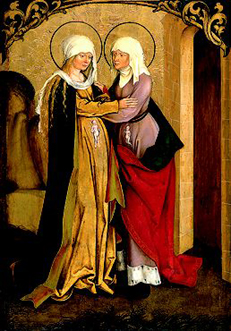
STRUEB, Hans and/or Jakob
The Visitation
c. 1505
The Visitation
by
Joyce Kilmer
(For Louise Imogen Guiney)
There is a wall of flesh before the eyes
Of John, who yet perceives and hails his King.
It is Our Lady’s painful bliss to bring
Before mankind the Glory of the skies.
Her cousin feels her womb’s sweet burden rise
And leap with joy, and she comes forth to sing,
With trembling mouth, her words of welcoming.
She knows her hidden God, and prophesies.
Saint John, pray for us, weary souls that tarry
Where life is withered by sin’s deadly breath.
Pray for us, whom the dogs of Satan harry,
Saint John, Saint Anne, and Saint Elizabeth.
And, Mother Mary, give us Christ to carry
Within our hearts, that we may conquer death.
Filed under: Evangelium Vitae
John Paul II Says in the encyclical Evangelium Vitae:
“The Gospel of life is something concrete and personal, for it consists in the proclamation of the very person of Jesus…Through the words, the actions and the very person of Jesus man is given the possibility of ‘knowing’ the complete truth concerning the value of human life…In Christ, the Gospel of life is definitively proclaimed and fully given” (#29).
In addition to the numerous marvels in the adult life of Jesus – the profundity of teaching, the healing touches, supernatural acts completing and anointing natural ones, His Passion journey through sorrowing redeeming death unto Resurrection – we must add those actions (yes, and even words – see Heb 10:5-7) of the Unborn Christ Child, through which we are “given the possibility of ‘knowing’ the complete truth concerning the value of human life”. Even the Unborn months of Christ’s life are a revelation to all Christians.
Specifically, we “discover” Christ in His unborn state and through these discoveries we learn about the spiritual personhood of all unborn babies. For He was like all unborn babies in countless respects. Perhaps the most profound lessons are discovered in the solidarity which the Unborn Christ has with all unborn children. Not a “natural” solidarity only, not a solidarity that is merely “symbolic”, but a supernatural solidarity. For Christianity is not a man-made religion. Christianity goes through the symbol to the mystical. The symbol is static, the mystical is living and active like the Word of God.
There are a number of key events in the life of the unborn Christ Child where we witness His solidarity with the unborn. One example was posted on this site on May 31st, the Feast of the Visitation. In the future we will be devoting lots of attention to these events.
GAP
Filed under: Quotes from Great Christians
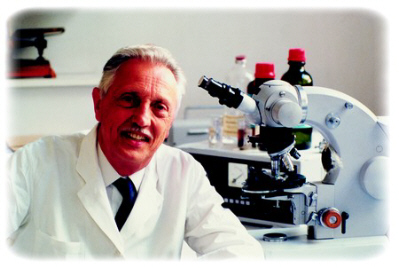
“At the true age of one month, a human being is four and a half millimeters long. Its tiny heart has already been beating for a week, its arms, legs, head, brain are already recognizable. At two months old, from head to the tip of its bottom, the human embryo is about three centimeters long. It could fit curled up inside a walnut shell. Inside a clenched fist, it would be invisible, and the clenched fist would crush it accidentally without even noticing. But open your hand, the embryo is almost complete, hands, feet, head, organs, brain, everything is in its place and from now on will merely grow. Look more closely , you can already read the life lines in its palms and predict its good fortunes. Look closer still, with an ordinary microscope, and you can see its fingerprints. Everything is already there and it would be possible to issue its identity card.”
“The incredible Tom Thumb, the man no bigger than my thumb, actually exists ; not the one in the fairy tale, but the one which every one of us once was.” Dr. Jerome LeJeune (the great pro-life scientist who discovered the cause of Downs Syndrome)
Filed under: Evangelium Vitae
In the Gospel of Life, John Paul II presents a powerful and prophetic teaching in defense of human life. Nowhere is this more evident than in Section 57 of the encyclical. Could the following be anything but an infallible and definitive teaching?
“Therefore, by the authority which Christ conferred upon Peter and his Successors, and in communion with the Bishops of the Catholic Church, I confirm that the direct and voluntary killing of an innocent human being is always gravely immoral. This doctrine, based upon that unwritten law which man, in the light of reason, finds in his own heart (cf. Rom 2:14-15), is reaffirmed by Sacred Scripture, transmitted by the Tradition of the Church and taught by the ordinary and universal Magisterium. ” (Footnote 51: LG 25) Evangelium Vitae, 57
The footnote references the Vatican II document, Lumen Gentium, point 25. Point 25 talks about Papal Infallibility.
See also Section 58 of The Gospel of Life below which elaborates on this strong teaching in Section 57.
“The deliberate decision to deprive an innocent human being of his life is always morally evil and can never be licit either as an end in itself or as a means to a good end. It is in fact a grave act of disobedience to the moral law, and indeed to God himself, the author and guarantor of that law; it contradicts the fundamental virtues of justice and charity. “Nothing and no one can in any way permit the killing of an innocent human being, whether a fetus or an embryo, an infant or an adult, an old person, or one suffering from an incurable disease, or a person who is dying. Furthermore, no one is permitted to ask for this act of killing, either for himself or herself or for another person entrusted to his or her care, nor can he or she consent to it, either explicitly or implicitly. Nor can any authority legitimately recommend or permit such an action“. Evangelium Vitae, 58
Filed under: The Incarnation
The Gospel reading at Mass today, Monday, 6-4-07, is: Mark 12:1-12. In this reading Jesus is speaking to the chief priests, scribes and elders. Things got a little heated, when Jesus finally said to them,
“Have you not read this scripture passage: ‘The stone that the builders rejected has become the cornerstone; by the Lord has this been done, and it is wonderful in our eyes’?”
As we know, Jesus is the wonderful “cornerstone” of a New Covenant and a New Creation, and He was pointing to this mystery and showing its fulfillment in Himself.
But Jesus also spoke of His Body as a temple (Jn 2:19-21). And St. Paul spoke of our bodies as temples (I Cor 3:16-17, II Cor 6:16-18). So let us go back now to the moment of the Incarnation, that one-cell stage of His life. At conception, that one cell was the “cornerstone” of His Body, just as the one cell stage of human development is the “cornerstone” of every human life. Not only is this “cornerstone cell” special, but it is engraved we might say by “the creative action of God”.
As Pope John XXIII said in his encyclical Mater et Magistra:
“Human life is sacred. From its very beginnings it calls for the creative action of God. By the violation of His laws, the Divine Majesty is offended…(#194).”
Those “builders of society” today, who reject new human lives in their earliest beginnings, that is, at the zygote or embryonic stage of life, who would experiment upon them and dispose of them as some waste product, are gravely offending God. They reject that very special “cornerstone cell” of a new person’s life, and then they destroy it. But this is an area where they lack expertise and jurisdiction. Only God has this sacred expertise and ultimate jurisdiction! The first living cell, the “cornerstone cell” of every person’s body and life must be respected not rejected!
Filed under: The Incarnation
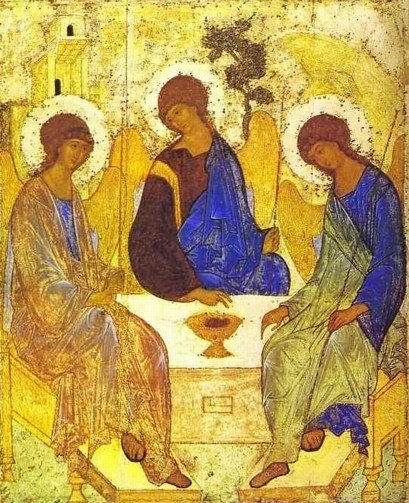
June 3rd, Solemnity of the Most Holy Trinity
St. Bonaventure (1221-1274) says of the Incarnation:
“For you must know that the sublime work of the Incarnation was the work of the whole Trinity, although it was only the Person of the Son of God who became incarnate. It was as if one who put on a tunic were helped by two standing on either side of him who held the tunic in their hands…For although the Holy Trinity is everywhere, nevertheless you must think of It in your meditation as being here in a very special manner, by reason of the great and unique work which is being done.” Meditations On The Life Of Christ
And St. Bernard in a prayer to Mary about the Incarnation says:
“Nor is God the Son alone with you, whom you clothe with your flesh; but also God the Holy Spirit, of whom you conceive; and God the Father, who has begotten that which you conceive.”
John Paul II says:
“In the salvific design of the Most Holy Trinity, the mystery of the Incarnation constitutes the superabundant fulfilment of the promise made by God to man after original sin…” Mother of the Redeemer, 11
Filed under: Sacred Heart
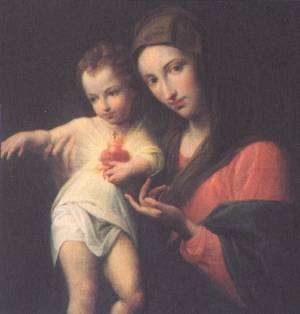
June is the month of the Sacred Heart of Jesus. Much can be said about His heart and His love for innocent babies and children. But there is also another perspective too and that is how much He cares for people who are pro – life and trying to build up a Culture of Life and protect the unborn. In other words, God reaches out to you this month in a special way, to encourage you in your pro-life work!
“Come to me, all (you who are pro-life) who labor and are heavy laden, and I will give you rest. Take my yoke upon you, and learn from me; for I am gentle and lowly in heart, and you will find rest for your souls. For my yoke is easy, and my burden is light.” Mt 11:28-30
If you are sometimes discouraged in your pro-life work there is a place you can always go for courage and encouragement – to the Heart of Jesus Christ!
Filed under: Fathers of the Church
FEAST DAY Of ST. JUSTIN MARTYR, June 1
St. Justin Martyr (Died c. 155 A.D.) taught that it was Jesus who appeared to Moses in the burning bush.
“These words (of the Prophets), then, have become the proof that Jesus Christ is the Son and Apostle of God, being of old the Word, appearing at one time in the guise of fire, and at another time as an incorporeal image…formerly He appeared to Moses and to the other prophets in the form of fire and as an incorporeal image…” First Apology, 127
St. Fulgence of Ruspe (467-527 A.D.) seems to see the burning bush as prefiguring the Incarnation when he observes:
“From the very beginning of the virginal conception a unity of Person so remained in Christ, and the unconfused reality of both natures so perdured, that neither could the Man be torn asunder from God, nor could God be separated from the Man assumed. Nevertheless, the divinity did not consume the humanity, nor did the humanity change the divinity into something else…” The Trinity, 2248
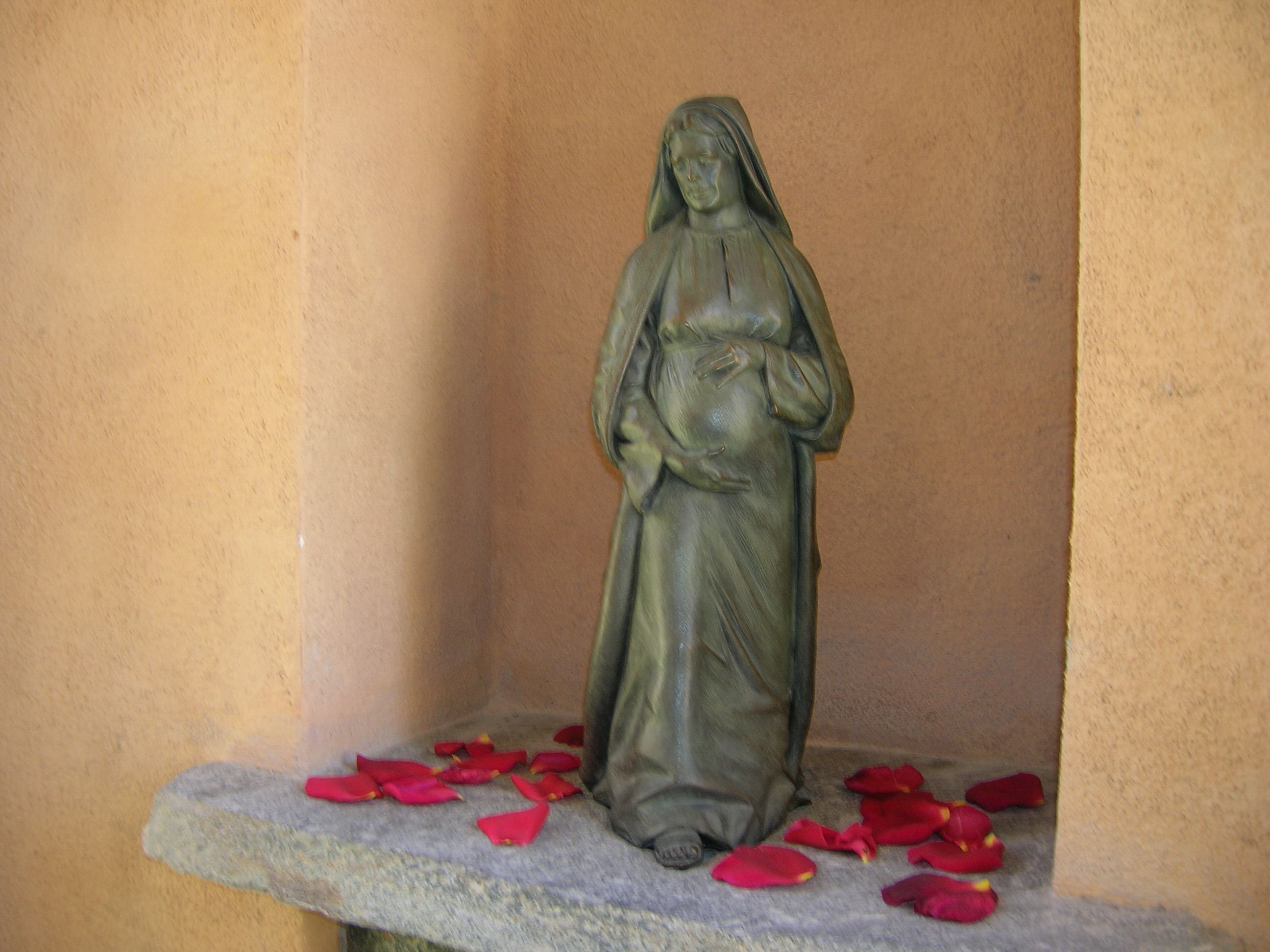
Fr. Richard F. Clark, S. J. in a pamphlet published by the Catholic Truth Society in 1964 sees the expectant Madonna (see above statue) in terms of the burning bush.
“The flame of fire in the burning bush was a figure of Jesus in Mary’s sacred womb…. So He still speaks as if concealed in Mary’s womb…”. The Coming of Christ, p. 38
“Perhaps the difference between the bush ablaze and the mother expectant is that the former is a spectacular miracle, whereas the latter is mystifyingly tender and meek. Moses was frightened by the spectacle (Ex 3:6), but who could be frightened of this young and thoughtful handmaid, Mary? She did not obscure the presence of the Son of God within her by arrogance, vanity, or any peculiar personal characteristics. Her naturally simple human ways were ideally matched with these supernatural divine ways of God’s providence. ” Unborn Jesus Our Hope
Filed under: Unborn Jesus
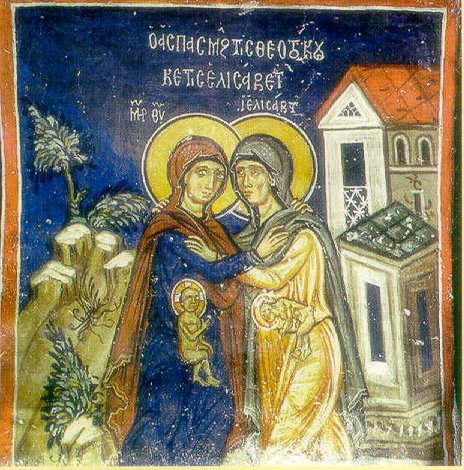
When we speak of the Visitation we usually refer to Mary’s journey to the hill country to visit her cousin Elizabeth. In fact, that is how Luke’s Gospel recounts the event (Lk 1:39). But we can also view it as God journeying to the hill country to visit His people, or more specifically, to visit an unborn baby. St. Peter Julian Eymard sums up the visit this way:
“The Word was in Mary’s womb. He inspired His mother to visit Elizabeth; Mary carried to John his Master and King. John could not come, for his mother was too old to undertake that journey; Jesus Christ went to him. He did the same for us: we could not go to God; God came to us.”
The Catechism of the Catholic Church carefully explains what happens next:
“John was ‘filled with the Holy Spirit even from his mother’s womb’ by Christ Himself, whom the Virgin Mary had just conceived by the Holy Spirit. Mary’s visitation to Elizabeth thus became a visit from God to his people.” (717)
Maybe many of us have had a tendency to picture this whole scene in a different way, thinking of this just-conceived Christ as passively hidden within the womb of Mary while the dynamic Holy Spirit descends upon John and Elizabeth both, causing the unborn John to leap and the pregnant Elizabeth to exclaim in wonder. But the just-conceived Christ is not passive! First He inspires Mary to journey to Elizabeth (and unborn John). Then, as the Catechism says, He causes the Holy Spirit to fill John.
Just think, the Annunciation/Incarnation occurs, Jesus Christ is now officially an unborn baby, and He travels “with haste” (Lk 1:39) – where?, to whom? – to another unborn baby! Then, as if to leave no doubt as to His Holy intentions, He dramatically pours forth His Spirit upon the unsuspecting unborn baby John. Suddenly, definitively, Grace rushes upon one chosen person – John the Baptist. We see the redemption of humanity and the New Creation in Christ prefigured here, encapsulated as it were, in the womb of Elizabeth. Here is a concrete living example of the words from the Prologue of John’s Gospel: “And the Word became flesh and dwelt among us, full of grace and truth…And from his fullness have we all received, grace upon grace “(Jn 1:14,16).
This is a marvelous prophetic event for the Church and for the world. When Blessed Teresa of Calcutta gave her Nobel Peace Prize Lecture in December 1979, she reminded the world of this Gospel event, focusing on these two unborn babies. And John Paul II refers to this same event several times in his prophetic encyclical letter The Gospel of Life (issued in 1995).
Filed under: Unborn Jesus
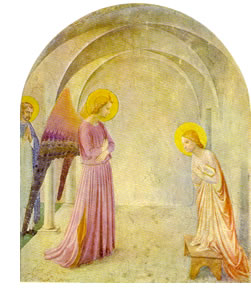
“When we cast the mysteries of His Life into great groups and masses, we make His Life threefold, Joyful, Suffering and Glorious. The most complete form is that which distinguishes eight lives in Him, His Unborn Life, Infant Life, Hidden Life, Public Life, Suffering Life, Risen Life, Ascended Life, and Sacramental Life. Into these moulds the Incarnation pours itself, and comes out in forms and shapes of the most surpassing beauty.” Father Faber (Bethlehem, p.242)
You might wonder why we would have a blog that focuses on the Unborn Christ Child. We want to show the beauty of His Unborn Life and what this teaches the Church about the Incarnation. We live in a time that completely devalues unborn children, but the Unborn Christ Child reveals the Father’s great love for these unborn children. The Unborn Christ Child, is for us, a champion of the Culture of Life.
“The pregnancy of Mary – no longer “too holy” to talk about, is now too relevant to ignore.” Unborn Jesus Our Hope
“I see how just as the errors of radical feminism challenged us to develop a true Christian sense of womanhood, so can the scourge of abortion bring forth new wonder about the unborn person in the light of the life of the unborn Jesus.” Ronda Chervin, Foreword, Unborn Jesus Our Hope
REMINDER: MAY 31 IS THE FEAST OF THE VISITATION
Filed under: Evangelium Vitae
“…In this great endeavour to create a new culture of life we are inspired and sustained by the confidence that comes from knowing that the Gospel of life, like the Kingdom of God itself, is growing and producing abundant fruit (cf. Mk 4:26-29). There is certainly an enormous disparity between the powerful resources available to the forces promoting the “culture of death” and the means at the disposal of those working for a “culture of life and love”. But we know that we can rely on the help of God, for whom nothing is impossible (cf. Mt 19:26)”
“…a great prayer for life is urgently needed, a prayer which will rise up throughout the world. Through special initiatives and in daily prayer, may an impassioned plea rise to God, the Creator and lover of life, from every Christian community, from every group and association, from every family and from the heart of every believer.” Evangelium Vitae, 100
Please note our page entitled Please Pray. This page is for prayer intentions.
Here are some websites with pro-life prayers:
Litany of the Unborn Christ Child
Filed under: Evangelium Vitae
Today is the Feast day of St. Senator, Archbishop of Milan, Italy, and papal legate, St. Senator was sent as a papal representative to the Council of Chalcedon (451). The Council of Chalcedon in 451 A.D. was one of a number of Councils that took a stand against a world that wanted to minimize the Incarnation.
Recall how in the early centuries of Christianity the issue of Jesus having a human physical body was challenged again and again. The Fathers of the Church were constantly pushing back against confused heretical theories claiming that Jesus was some kind of phantom. For example, St. Cyril of Jerusalem once echoed the sentiments of St. Paul regarding the reality of the resurrection (see I Cor 15:17) when he countered these falsehoods about the Incarnation by stating: “For if the incarnation was a phantasm, so too is salvation a phantasm.”
Today factions within society challenge and question the personhood and identity of unborn children, just as in the early centuries of Christianity the Personhood and Identity of Jesus Christ was repeatedly called into question. The Church is now taking a leading role in proclaiming and clarifying the unique personhood of each unborn child.
“Endowed with a spiritual soul, with intellect and with free will, the human person is from his very conception ordered to God and destined for eternal beatitude. He pursues his perfection in “seeking and loving what is true and good” (GS 15 § 2). The Catechism of the Catholic Church, 1711.
“Some people try to justify abortion by claiming that the result of conception, at least up to a certain number of days, cannot yet be considered a personal human life. But in fact, “from the time that the ovum is fertilized, a life is begun which is neither that of the father nor the mother; it is rather the life of a new human being with his own growth. It would never be made human if it were not human already. This has always been clear, and … modern genetic science offers clear confirmation. It has demonstrated that from the first instant there is established the programme of what this living being will be: a person, this individual person with his characteristic aspects already well determined. Right from fertilization the adventure of a human life begins, and each of its capacities requires time-a rather lengthy time-to find its place and to be in a position to act”. Even if the presence of a spiritual soul cannot be ascertained by empirical data, the results themselves of scientific research on the human embryo provide “a valuable indication for discerning by the use of reason a personal presence at the moment of the first appearance of a human life: how could a human individual not be a human person?”. Evangelium Vitae, 60
“… which expresses our appreciation for life and that human individuality, human personality is present from the first moment (of life). “LifeNews.com Pope Benedict XVI, May 9, 2007
To see photos of unborn babies
Filed under: John Paul II
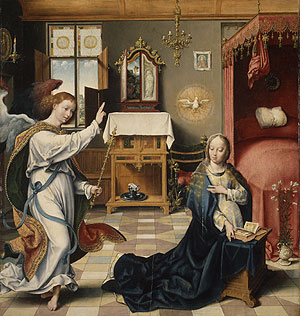
PENTECOST SUNDAY
“The conception and birth of Jesus Christ are in fact the greatest work accomplished by the Holy Spirit in the history of creation and salvation…”
Pope John Paul II
The Holy Spirit in the Life of the Church and the World (#50)
“Creation is thus completed by the Incarnation and since that moment is permeated by the powers of the Redemption, powers which fill humanity and all creation.”
Pope John Paul II
The Holy Spirit in the Life of the Church and the World (#52)
“The Holy Spirit filled Mary with new life at the Annunciation, and Mary gave birth to Jesus. The Holy Spirit filled the Apostles with new life at Pentecost, and they immediately gave birth to a new era through their preaching and example.Turn the world toward Christ!” June 11, 2000, from a reflection given at the John Paul II Center.
Archbishop Charles Chaput, O.F.M. Cap
Come Holy Spirit, help us to comprehend with wonder that first moment of the Incarnation, help us to perceive and be part of that new era begun at Pentecost.
Filed under: Evangelium Vitae
Welcome to UNBORN WORD of the day. Each day you will find an inspirational pro-life quote of the day, with special emphasis on the Unborn Christ Child and the great hope we have in Him. Feel free to participate with comments, suggestions, and ideas!
This blog will begin posting on May 27, 2007 Pentecost Sunday. For more information, or to acquire books and prayer cards on the Unborn Christ Child, visit our sponsor’s website: UnbornWordAlliance.com.
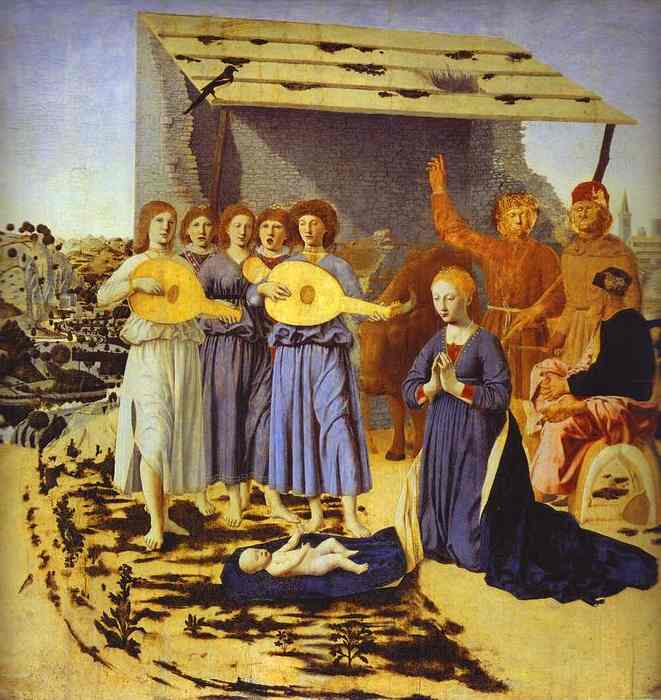
The Gospel of life is at the heart of Jesus’ message…
At the dawn of salvation, it is the Birth of a Child which is proclaimed as joyful news: “I bring you good news of a great joy which will come to all the people; for to you is born this day in the city of David a Saviour, who is Christ the Lord” (Lk 2:10-11). The source of this “great joy” is the Birth of the Saviour; but Christmas also reveals the full meaning of every human birth, and the joy which accompanies the Birth of the Messiah is thus seen to be the foundation and fulfilment of joy at every child born into the world (cf. Jn 16:21). Evangelium Vitae Point 1
For truly it is one of life’s great secrets: every newborn child is a witness to the Prince of Peace, and every birth day a little Christmas. George Peate Unborn Jesus Our Hope.
 UNBORN WORD of the day