


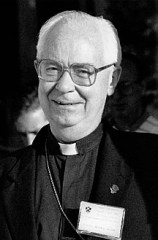
Today June 25, 2007 is the memorial of the death of a truly inspirational man, Bishop Austin Vaughan. My husband and I were inspired by Bishop Vaughan’s witness as a Bishop and as a pro-life leader.
John Burger in his tribute to Bishop Vaughan writes: “In December 1987 Bishop Vaughan received an invitation to join Operation Rescue, which had just begun its nonviolent protests aimed at shutting down abortion clinics.
He did not respond immediately, but, after a virtual blackout of the abortion debate during the 1988 presidential primary campaign in New York, he decided that he had to do something to make abortion an issue for voters and candidates. Along with New York Giants star Mark Bavaro and 500 others, he was arrested at an upper East Side Manhattan abortion clinic in May 1988. He went on to be arrested at least eight other times in Dobbs Ferry, Albany, Amherst, N.Y., Pennsylvania and Texas, as well as the Netherlands and Belgium. He served prison sentences of up to 10 days for the actions.”
Father Frank Pavone writes about Bishop Vaughan’s decision to be involved in these rescues:
“I have never broken the law. I have never been arrested. Yet I often think of Bishop Austin Vaughan, auxiliary bishop of New York, who in the last years of his life of faithful service to the Church, was arrested and imprisoned many times for rescuing unborn babies. He saw what Christians were doing across the country as they peacefully blocked the doors of abortion mills to put their bodies between the babies and the instruments of death. Then one day he looked at his episcopal ring, and realized that the three figures on it — St. Peter, St. Paul, and the Lord Jesus — had all been arrested and imprisoned! He no longer hesitated to do so too, if it was the price to pay for saving lives.”
Bishop Vaughan was also known for his tireless defense of the faith. For instance, after Pope Paul VI issued his encyclical letter Humanae Vitae, many voices both outside and sadly inside the Church spoke out against him and this teaching. Bishop Vaughan was one of a small group of Theologians who frequently defended Pope Paul and this teaching. There were numerous other instances of his strong defense of the faith.
Here are three links to help us remember this kind man whose favorite saying was “Whatever God Sends” and who lived by this motto: “To Jesus through Mary”.
The Catholic duty to be Prolife by Bishop Vaughan
An Assessment of Present Day Catechesis by Bishop Vaughan
We received the following note from Kathy Reilly: Fr. Thomas Morrette has begun the cause for his canonization, but you know how slow things like this can go. It is our hope to obtain letters of testimony from people who knew him, worked with him and were imprisoned with him. He truly was a saintly man of the clothe, a saint who humbly walked among us.
She gave us an address that you can write to for prayer cards – I’m sure you could send any testimonies that you might have to this address too:
Bishop Vaughan Prayer Cards
11 J Street
Schenectady, NY 12305-1133
Filed under: Quotes from Great Christians
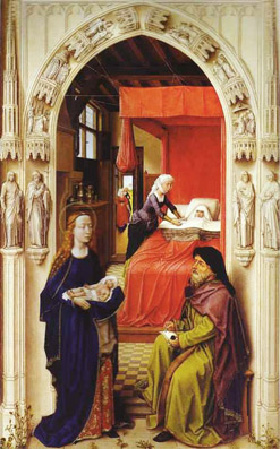
Today, Sunday, June 24th is the Solemnity of the Nativity of John the Baptist.
Q1. Were Mary and her unborn baby, Jesus, present at the birth of John the Baptist?
Q2. Why does the Church celebrate John’s birth on June 24th rather than June 25th (the latter date would be exactly 6 months before the Lord’s birth on Dec. 25th)?
Q3. John’s father Zechariah was unable to speak, but could he hear?
A1. Since this is the most important question of the three we will devote the most time to this first one. (And some source info. will be listed at the end of this post.) When one consults both Catholic and Protestant Bible Commentaries there is not universal agreement on the answer, however a strong majority in my survey either state clearly that Mary stayed for the birth or remain silent about it as opposed to actually taking the negative position. The possible confusion relates to the positioning of verses 56 and 57 in Luke 1. Here’s what two Catholic commentaries say: a.) “Luke stylistically closes the scene; Mary must have remained longer, in order to be of service at the birth of John the Baptist”, b.) “Lk rounds off one theme before passing on to another. Consequently, it does not follow that Mary had departed before the birth of John”. *
Here’s how one Catholic mother and author answered: “No one is sure, they say, if she stayed for the birth of St. John. I am amazed. So is every mother I know. Let the scholars haggle over it if they will; of course she stayed…” (Mary Reed Newland)*
In his book The World’s First Love, Archbishop Fulton Sheen talks about Mary being present at three births – listing first the birth of John the Baptist. (Chp. 3) In their book The Gospel Story, Ronald Knox and Ronald Cox make the following observation about the scene eight days after the birth of John when he is being named: “This scene is most vivid if we recall that the Messias himself was present there, in his mother’s womb”. (Chp. 1)
Finally, it has long been believed that it was Mary who told Luke about all the events occurring in the first two chapters of Luke (directly or indirectly as the source).
A2. In the fifth century A.D. the Feast of Christmas was established on December 25th, (exactly nine months, to the day, after the March 25th feast of the Annunciation). Gabriel told Mary that Elizabeth was in her sixth month of pregnancy. So 3 months after March 25th brings us to June 25th. But according to Francis Weiser, S.J., we celebrate on the 24th because of “…the Roman way of counting, which proceeded backward from the calends (first day) of the succeeding month. Christmas was ‘the eighth day before the Kalends of January’ (Octavo Kalendas Januarii). Consequently, Saint John’s nativity was put on the ‘eighth day before the Kalends of July.’ However, since June has only thirty days, in our way of counting the feast falls on June 24”.
A3. The only reason this is a question is because of Lk 1:62: “And they made signs to his father (Zechariah), inquiring what he would have him called.” There are two schools of thought. But nowhere does it state that Zechariah could not hear. Rev. L.C. Fillion, S.S. points out that the Angel Gabriel had only threatened Zechariah with loss of speech and when he is “cured” the Gospel only states that “his mouth was opened and his tongue loosed”, further he suggests that when someone is signing to you (because he can’t speak) you may be inclined to respond in kind (even if he can hear).*
* Q1. a.) Jerome Biblical Commentary b.) A New Catholic Commentary on Holy Scripture. Also, the IVP Bible Background Commentary, New Testament and Halley’s Bible Handbook, New Revised Ed. Zondervan, 1965.
Newland: The Year and Our Children, P.J. Kenedy & Sons, NY, 1956.
Q2. Fr. Weiser, S.J., Handbook of Christian Feasts and Customs, Harcourt, Brace & Co., NY, 1958.
Q3. Fillion: The Life of Christ, Herder Book Co., St. Louis, 1940.
Filed under: Quotes from Great Christians

“Yes, it certainly seemed that God wanted to give the world the impression that it is ordinary for Him to be born of a human creature. Well, that is a fact. God did mean it to be the ordinary thing, for it is His will that Christ shall be born in every human being’s life and not, as a rule, through extraordinary things, but through the ordinary daily life and the human love that people give to one another.”
The Reed of God by Caryll Houselander

Filed under: Quotes from Great Christians
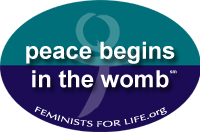
I really liked this slogan – if you click on it you can go to Feminists For Life where you can buy bumper stickers etc. with this slogan on them.
The slogan reminded me of what Mother Teresa said in her Nobel Lecture when she won the Nobel Peace Prize in 1979.
“… I feel the greatest destroyer of peace today is abortion, because it is a direct war, a direct killing – direct murder by the mother herself. And we read in the Scripture, for God says very clearly: Even if a mother could forget her child – I will not forget you – I have carved you in the palm of my hand. We are carved in the palm of His hand, so close to Him that unborn child has been carved in the hand of God. And that is what strikes me most, the beginning of that sentence, that even if a mother could forget something impossible – but even if she could forget – I will not forget you. And today the greatest means – the greatest destroyer of peace is abortion.”
Filed under: The Incarnation
The Gospel reading today, Thursday 6-21-07, is Mt 6:7-15 which recounts the famous scene when Jesus teaches His disciples the Lord’s Prayer. Let us focus on seven words from this prayer: “thy Kingdom come, thy will be done”. How might these majestic words relate to the Unborn Christ at the one-cell stage of his earthly life?
First, the Angel Gabriel explains to Mary that her Son will receive the “throne of his father David”, will reign over “the house of Jacob for ever” and that “of his kingdom there will be no end” (Lk 1:32-33). So, just prior to her “fiat” and her conceiving, she realizes her Son will be king. In fact, at the moment of His conception He is Lord and King!
Secondly, immediately at His conception He speaks a prayer of consecration to God the Father and says: “Lo, I have come to do thy will, O God”. (The whole prayer is found in Hebrews 10:5-7.) St. Ignatius of Loyola tells us that these words were uttered “from the first moment of His conception”, at the one-cell stage. (These verses from Hebrews are featured during the Mass on March 25th for the feast of the Annunciation.) To see extended commentaries on Hebrew 10:5-7 click here)
So, just before His conception the Angel makes three references to His Divine Kingship and at the moment of His conception He Himself says that He has “come to do thy will, O God”. The seven words which He teaches His disciples to address to God are linked to His coming into the world! In fact, His immediate prayer to the Father upon entering the world is like a Mission Statement for His Life.
But wait, this is the mission statement for every life: “Lo, I have come to do thy will, O God”. This is the intuitive spiritual orientation of every human being, at least initially- that there is an All Holy God and that we should seek and do His will in our lives. Therefore, at the one-cell stage of His earthly life the Unborn Christ, who was King, submits – figuratively He bows down in submission to the Father – and He teaches us how to live our lives.
Filed under: Quotes from Great Christians

Here is a quote about the patience of Christ from Mother St. Paul’s book Ortus Christi (published in 1921) .
“Patience is a twofold grace, that of waiting and that of suffering, both are a great aid to zeal. The Eternal Word’s zeal for the salvation of men had existed in all its perfection and all its fullness from all eternity, yet think how long He waited! When the conditions were changed and He had at length become incarnate, He still waited patiently for nine months, and after that He waited for thirty years! This was zeal, zeal in its perfection. Is my zeal tempered with patience?”
Yesterday Caryll Houselander was quoted reflecting on “the habit of Advent”. Part of this “habit” is living the virtue of patience. Through the decades the pro-life movement has had to be patient while trying to promote a Culture of Life. Many disappointments, trials and setbacks have been experienced. Those who are pro-life must persevere and patiently trust in God.
Filed under: Quotes from Great Christians
Caryll Houselander (1901-1954) wrote the following reflections in the early/mid 1940’s.
“We live in an age of impatience, an age which in everything, from learning the ABC to industry, tries to cut out and do away with the natural season of growth. That is why so much in our life is abortive. We ought to let everything grow in us, as Christ grew in Mary….. No man should ever make anything except in the spirit in which a woman bears a child, in the spirit in which Christ was formed in Mary’s womb, in the love with which God created the world.”
“In this contemplation there is great virtue in practicing patience in small things until the habit of Advent returns to us.”
Caryll Houselander
The Reed Of God
Filed under: Evangelium Vitae
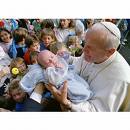
In Evangelum Vitae (The Gospel of Life) John Paul II is not afraid to use the term pro-life – in fact he calls us to be unconditionally, actively and unreservedly pro-life:
“This situation, with its lights and shadows, ought to make us all fully aware that we are facing an enormous and dramatic clash between good and evil, death and life, the “culture of death” and the “culture of life”. We find ourselves not only “faced with” but necessarily “in the midst of” this conflict: we are all involved and we all share in it, with the inescapable responsibility of choosing to be unconditionally pro-life.” (#29)
“The Gospel of life is for the whole of human society. To be actively pro-life is to contribute to the renewal of society through the promotion of the common good. It is impossible to further the common good without acknowledging and defending the right to life, upon which all the other inalienable rights of individuals are founded and from which they develop. A society lacks solid foundations when, on the one hand, it asserts values such as the dignity of the person, justice and peace, but then, on the other hand, radically acts to the contrary by allowing or tolerating a variety of ways in which human life is devalued and violated, especially where it is weak or marginalized. Only respect for life can be the foundation and guarantee of the most precious and essential goods of society, such as democracy and peace.” (#101)
“Nor can it be denied that the mass media are often implicated in this conspiracy, by lending credit to that culture which presents recourse to contraception, sterilization, abortion and even euthanasia as a mark of progress and a victory of freedom, while depicting as enemies of freedom and progress those positions which are unreservedly pro-life.” (#17)
Since the 1970’s many have conscientiously tried to depict people who are pro-life as radical right-wing zealots who are insensitive and out of touch with mainstream society. The media has catered to this and promoted this concept. It is a false and degrading caricature. As a consequence, many people with pro-life beliefs are reluctant to call themselves “pro-life”. But in his landmark encyclical, The Gospel of Life, John Paul II was not afraid to use the term pro-life, rather he embraced it and identified the term pro-life with the saving Gospel of Jesus Christ.
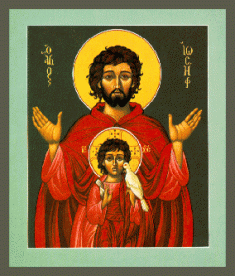
St. Joseph Shadow of the Father
Painting by Fr. William McNichols
Happy Father’s Day – June 17
St. Joseph is a model for all fathers but in a special way for those fathers who adopt. Here are three quotes from Father Faber to describe St. Joseph:
“He stood to Jesus visibly in the place of the Eternal Father”
“Shadow of the heavenly Father.”
“Meek and gentle, blameless and loving, as St. Joseph was, it is not possible to think of him without extreme awe, because of that shadow of identity with the Eternal Father which belongs to him, and hides him from our sight even while it presents him to our faith.”
St. Joesph adopted Jesus when He was still an unborn baby! All adoptive parents – and especially adoptive fathers – have a special connection with St. Joseph. St. Joseph gave Jesus a place in society, he took care of him and in a special way was ‘the shadow of the Heavenly Father” for Him. God has asked you fathers who adopt to be His sheltering shadow, to stand in His place for those children who need fathers. Happy Father’s Day to all you loving fathers who see in St. Joseph a model for fatherhood.
Filed under: Unborn Jesus

The Feast of the Immaculate Heart of Mary – June 16
The following excerpt from the book Unborn Jesus Our Hope discusses the relationship between Unborn Jesus and His mother.
Even the physical movements of her Son within her womb, which she could feel, and later even partly observe from without, were as signs of the more profound spiritual and intellectual movements of the soul of Jesus. For His part, Jesus too was experiencing the sense of touch as He would touch the inner wall of Mary’s uterus via the thin veil of the amniotic sac. This divine touch within from within – one can almost envision a Sistine Chapel-like ceiling painting of God, not the Father but the little unborn Son, straining forward and reaching out His tiny finger towards the inner heart of Mary His mother – can almost give shape to God’s way of touching each human heart from deep within. There was a continuous exchange between mother and Child, not only on the physical level but at every level…
In this particular mother Child exchange it was the Child Jesus who was the dominant participant, and His mother was the frequent recipient to the extent that Mary’s life was a reflection, a magnification of the hidden, unborn Divine Life within her.
Filed under: Sacred Heart
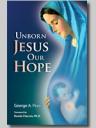
The Feast of the Sacred Heart – June 15
“This love inflamed His Heart from the first moment of His conception until His last breath and, since His resurrection, has not ceased nor will ever cease doing so.”
St. Peter Julian Eymard, S.S.S. The Real Presence
The first distinctive parts of His Body to be formed would have been the heart and head. At three weeks they were primitively functional, but by six weeks their form is clearly distinctive. Pope Pius XII has stated that from the moment of Our Lord’s conception. “The adorable Heart of Jesus Christ began to beat with a love at once human and divine after the Virgin Mary generously pronounced Her “Fiat”.” Pope Pius XII, “On Devotion To The Sacred Heart Of Jesus” (Haurietis Aquas), 63. The Love of God Incarnate did not wait for a physical human organ to join its urgent surging beat for love of us! But certainly once the physical human organ was in place it too, in perfect unison, took up this pulse of eternal love.
And so we picture the unborn baby Jesus within His mother’s womb, skin almost transparent in these early weeks of human life, and His Heart, not yet hidden by a thicker, more developed skin, but visible, actually throbbing, pulsing with divine love for us! This is the miniature reservoir of that one commodity that could purchase the salvation of the entire human race, the blood of God Himself! This Precious Blood is separate and different from His mother’s. A small delicate vial of heavenly medicine. It is a tiny Heart, but proportionately compared to the rest of its body, during the first and second months it measures up to nine times the size of the adult heart. Appropriately, the Heart of Unborn Jesus (and His head) dominated His Body: for the Incarnation is about God’s Love for us.
Not only was the Heart of Unborn Jesus proportionally large in physical size, but like that of all unborn infants it beat at a much faster rate than the adult heart (roughly twice as fast) as if to leave no doubt as to its quickening desires and designs towards the human family.
Surely Unborn Jesus had – and has – a special place in His most tiny hidden heart for today’s vulnerable unborn children.
Excerpts from Unborn Jesus Our Hope
Filed under: Unborn Jesus

Yesterday we talked about the Church’s longstanding devotion to the Christ Child. A natural extension of that devotion is devotion to the Unborn Christ Child.
We can demonstrate that Unborn Jesus, during His nine months in the womb, identified with unborn children in many ways. (See our post on the Visitation for part of this demonstration). Once we make this simple but profound connection between Unborn Jesus and all unborn children today –especially those at risk – the devotion takes shape quite logically.
It is, like most devotions, a devotion of discovery. That is, we discover Christ in a new and powerful way. And in discovering Unborn Jesus we re-discover the beauty and meaning of each unborn child. He is like a prism through which we see the human integrity and beauty of all unborn children, no matter their age, size, color, shape or other characteristics.
This discovery of the Unborn God leads our thoughts to a unifying principle of supernatural awareness, such that the Christian devotional heart harmonizes with the Christian social conscience! A powerful unity of purpose which brings together Christian spirituality on the one hand with this basic human rights issue – the right to life of unborn children – on the other hand. Both hands in prayer.
We are presented with an altogether unique devotional opportunity. The devotional heart and the social conscience each inform and heighten the awareness of the other. The right to life of unborn children is linked to the life of the Unborn Savior. Devotion leads to action. (And for a different side of the coin, see our post on The Sacred Heart.)
Filed under: Unborn Jesus
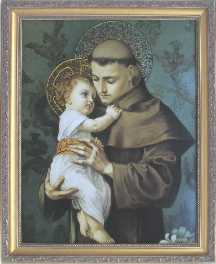
The life of Jesus Christ has enamored Christians from the earliest days. While we don’t know a lot about His hidden years growing up in Nazareth, and then working as a carpenter, yet every aspect of His life and all the events of His life fascinate us and draw us deeper into the mystery of His Person and mission.
No doubt it was such a loving fascination with Christ that caused
St Francis of Assisi (1182 -1226) one Christmas to construct a manger and re-enact the Christmas story. The focal point of his devotional creation was the little newborn baby Jesus – an act of tender devotion by a loving disciple.
A contemporary of Francis’ – and another Franciscan – St. Anthony of Padua (1195-1231), whose feast day is today, is almost always portrayed in paintings and sculptures holding the small Christ Child and looking intently at His face. This portrayal is based on an actual event that was witnessed by a friend of Anthony’s one evening.
What drew the mystic Francis (who had received the stigmata) and this Doctor of the Church, Anthony, to the baby Jesus?
The great St. Teresa of Avila (another reformer of the Church, like Francis) had a devotion to the Christ Child also and in each of the many convents which she founded she placed a statue of the Christ Child. What drew this sixteenth century saint to this young Child?
Do we not find Christ in His utter simplicity and lowliness when we see Him as a Child? But also, He is God approachable – as in the crib – who can fear God as newborn baby? Who would not be able to draw near to God in His “helplessness”, His weakness, His poverty, His innocent childlike revelation of Himself?
Jesus as a baby and infant calls the world to Himself – we can whisper something to Him and even be playful with Him. Certainly, this is part of the message of St. Therese of Lisieux (1873-1897) also known as Theresa of the Child Jesus. From her own childhood she was attracted to the Child Jesus. She wrote to Him, drew pictures for Him and learned spiritual lessons from Him. Even in her early adult years (she died at the age of 24) she often thought of Christ (and her own life) in the simplest childlike terms. She called her path to God and Heaven “her little way”. And in the last century the Church weighed in on this “little way” – naming her Doctor of the Church (like her namesake Teresa of Avila).
As you can see the Church has had a rich tradition through the centuries of devotion to the Christ Child. Devotion to the Unborn Christ Child is simply an extension of devotion to the (born) Christ Child. Given the reality of abortion-on-demand, we think it is important for the Church to discover the solidarity established between Unborn Jesus and every unborn child, especially those unborn infants at risk.
Filed under: John Paul II
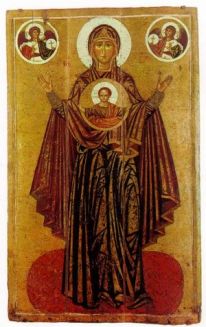
This Saturday June 16 is the Feast of the Immaculate Heart of Mary – in preparation for this great feast day I thought it would be nice to quote John Paul the Great.
“Not only is the dignity of this Motherhood unique and unrepeatable in the history of the human race, but Mary’s participation, due to this Maternity, in God’s plan for man’s salvation through the mystery of the Redemption is also unique in profundity and range of action.
We can say that the mystery of the Redemption took shape beneath the heart of the Virgin of Nazareth when she pronounced her ‘fiat’. From then on, under the special influence of the Holy Spirit, this heart, the heart of both a virgin and a mother, has always followed the work of her Son and has gone out to all those whom Christ has embraced and continues to embrace with inexhaustible love.”
Filed under: The Incarnation
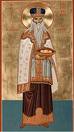
The first reading in yesterday’s Sunday Mass for the Solemnity of Corpus Christi, spoke about the ancient priest Melchizedek making a sacrifice of bread and wine (Gen 14:18-20). This sacrifice prefigured the offering of Jesus during the Last Supper. In this short reading of three verses, a term appears three times which is a very instructive term: “God Most High”. But Melchizedek’s sacrifice, while prophetic, was incomplete and awaited the Body of God’s Son.
Now fast forward to the Annunciation/Incarnation. Gabriel explains to Mary that her son “will be called the Son of the Most High” (Lk 1:32) and that “The Holy Spirit will come upon you, and the power of the Most High will overshadow you (Lk 1:35). In a way, the credibility and authenticity of the message delivered to Mary is intensified by this majestic reference to God as “the Most High”. And the hint of “priesthood”, in the line of Melchizedek, has now been established. She then conceives miraculously the “Son of the Most High”.
A short time afterwards –maybe a week or so later – when she enters Elizabeth’s home and greets her, she utters her famous Magnificat (Lk 1:46-55). Twice during this prayer song she speaks of her lowliness and the lowliness of those who find favor with God: “…for He has regarded the low estate of his handmaiden” and “exalted those of low degree…”
So here we have it then, the matter-of-fact contrast, in terms of spiritual stature (‘height’ or ‘distance’): God Most High and Mary of low estate. Yet it is this humility in Mary which God “regards” with favor (Lk 1:30) and He exalts her above others and instructs us to exalt her as well: “For behold, henceforth all generations will call me blessed…” But why do we call her blessed? “…for he who is mighty has done great things for me, and holy is his name.”
The “great things” God had done for Mary at that point in her life, were primarily the same “great things” which He had also done for us, that is, the Incarnation – Christ Unborn within her, within His mother. These were incomparable things, things which cause awe and wonder in the Christian heart. And by virtue of these “great things”, we too have a share in Mary’s blessedness.
Filed under: The Eucharist
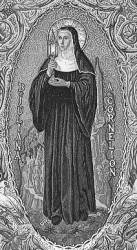
You may have never heard of Blessed Juliana of Cornillon (Juliana of Liege), 1192 -1258. She was an Augustinian nun who was the first promoter of a feast day in honor of the Blessed Sacrament. She has been recognized as the person primarily responsible for the introduction of the Corpus Christi feast day during the middle ages. According to Acta Sanctorum, she had a unique and extraordinary devotion. She said the Magnificat (Lk 1:46-55) nine times a day; once for each month that Our Lord spent in the womb of His mother. (The Magnificat was proclaimed by Mary while she was pregnant.) One can not help but see the beautiful connection here in Juliana’s spiritual life between her devotion to the Body of Christ in the womb and the Body of Christ upon the altar.
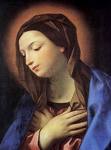
Which leads us to the second woman: Mary the Mother of Jesus. In his encyclical letter ECCLESIA DE EUCHARISTIA, On the Eucharist in Its Relationship to the Church, John Paul II discusses Mary and the Eucharist:
“In a certain sense Mary lived her Eucharistic faith even before the institution of the Eucharist, by the very fact that she offered her virginal womb for the Incarnation of God’s Word. The Eucharist, while commemorating the passion and resurrection, is also in continuity with the incarnation. At the Annunciation Mary conceived the Son of God in the physical reality of his body and blood, thus anticipating within herself what to some degree happens sacramentally in every believer who receives, under the signs of bread and wine, the Lord’s body and blood.”
“As a result, there is a profound analogy between the Fiat which Mary said in reply to the angel, and the Amen which every believer says when receiving the body of the Lord. Mary was asked to believe that the One whom she conceived “through the Holy Spirit” was “the Son of God” (Lk 1:30-35). In continuity with the Virgin’s faith, in the Eucharistic mystery we are asked to believe that the same Jesus Christ, Son of God and Son of Mary, becomes present in his full humanity and divinity under the signs of bread and wine.”
“Blessed is she who believed” (Lk 1:45). Mary also anticipated, in the mystery of the incarnation, the Church’s Eucharistic faith. When, at the Visitation, she bore in her womb the Word made flesh, she became in some way a “tabernacle” – the first “tabernacle” in history – in which the Son of God, still invisible to our human gaze, allowed himself to be adored by Elizabeth, radiating his light as it were through the eyes and the voice of Mary. And is not the enraptured gaze of Mary as she contemplated the face of the newborn Christ and cradled him in her arms that unparalleled model of love which should inspire us every time we receive Eucharistic communion?”(#55)
“The Eucharist has been given to us so that our life, like that of Mary, may become completely a Magnificat!” (#58)
Filed under: Unborn Jesus
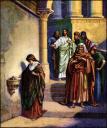
The Gospel reading at Mass today recounts the scene when Jesus sat down across from the Temple Treasury and watched the people putting money into it. He spied a poor widow who “put in two small coins worth a few cents” – the famous “widow’s mite”. Jesus explained that she “put in more than all the other contributors”. This wonderful hopeful story touches on a theme that recurs in various ways in the New Testament. Remember when Jesus spoke about having faith “the size of a mustard seed”?
Here are some other examples:
“God chose what is weak in the world to shame the strong” I Cor 1:27
“…for when I am weak, then I am strong.” II Cor 12:10
St. Paul says that God spoke these words to him:
“My grace is sufficient for you, for my power is made perfect in weakness.” II Cor 12:9
Christ too came in “weakness”, first as a tiny unborn baby, then an infant, toddler and so on. He took on our weaknesses as part of His Incarnation. He even singled out the “least” to identify with them in a most special manner: “Truly, I say to you, as you did it to one of the least of these my brethren, you did it to me.” (Mt 25:40) And we know that the unborn are among the “least of the least”. Where Christ is, there is hope…
Now this relates to the world’s current struggle between the Culture of Life and the Culture of Death. And it is again the amazing St. Paul who reveals this mystery of Providence to us: “…where sin increased, grace abounded all the more…” (Rom 5:20) St. Paul is pointing not to a half empty glass of sin but to a glass already half full of Grace and rising, continuing to fill even more. We live in a culture that is rampant with sins, and among these abortion is near the top of the list – quite possibly at the top – yet God is pouring out His Grace on our world to bring about a pro – life surge of awareness and awakening! Rejoice!
 UNBORN WORD of the day