Filed under: Quotes from Great Christians

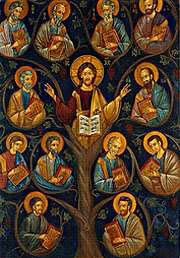
The intriguing quote above is from Tertullian (155/160 A.D. – 240/250 A.D.), De Carnis Resurrectione. St. Francis de Sales (1567-1622) elaborates:
“…if someone intends to build a house or a palace he must first consider whether it is to be a lodging for a vine dresser or a peasant or if it is for a lord, since obviously he would use entirely different plans depending on the rank of the person who is to live there. Now the Eternal Father did just that when he built this world. He intended to create it for the Incarnation of His Son, the Eternal Word. The end or goal of His work was thus its beginning, for Divine Wisdom had foreseen from all eternity that His Word would assume our nature in coming to earth.” The Sermons of St. Francis de Sales for Advent and Christmas
Filed under: Unborn Jesus
Today June 11 is the feast day of St. Benedict. Benedict (born c. 480 -d. 547) was known as the patriarch of western monasticism. Here are some quotes from the Rule of St. Benedict (Chp. 6, Of Silence):
“Let us do what the Prophet saith: ” I said, I will take heed of my ways, that I sin not with my tongue: I have set a guard to my mouth, I was dumb, and was humbled, and kept silence even from good things” (Psalm 38(39): 2-3).”
“For it belongeth to the master to speak and to teach; it becometh the disciple to be silent and to listen.”
The reflection below is from Father Faber. Faber shows us how Christ taught us the power of silence and worship even from His mother’s womb:
“So that, in the first moment of the Incarnation, not only were the amazing decrees of everlasting wisdom fulfilled, and creation with incredible magnificence completed, but the creation thus completely turned round as it were to the Face of the Creator, and worshiped Him with a worship equal to Himself….”
“Such was the existence which began that night in Mary’s (womb). If we look at it in the general, so as to get a view of the characteristics, it seems to us, first of all, a life of oblation. Worship was the predominant idea. Adoration was the mold in which it was cast. It continually reflected God….”
“Worship alone is power, intellectual power and moral power, the power of world-wide change and of all beneficent revolution. We not only learn this lesson from the life of confinement, which the Incarnate Word led in Mary’s (womb), but it is that life which gives our life power to become universal like itself.”
“It was a life of silence also. The Great Teacher, the utterer of the marvelous parables, the preacher of the world stirring sermons, the oracle whose single words have become vocations, institutions and histories, finds silence no bar to the fertility of His action. Silence has ever been as it were the luxury of great holiness, which implies that is contains something divine within itself. So it is the first life which He, the eternally silent-spoken Word of the Father chooses for Himself.” Above quotes from Father F. W. Faber, Bethlehem.
Filed under: Evangelium Vitae
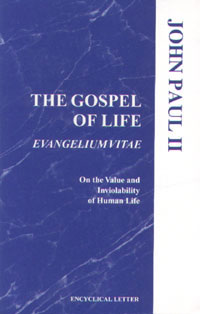
Father Frank Pavone says that the Gospel of Life has been called “the Magna Carta of the pro-life movement”.
On the Fifth Anniversary of the issuance of the document Pope John Paul II made the following reflections on his encyclical letter The Gospel of Life.
“I greet all of you, participating in this reflection on a document that I consider central to the whole of the Magisterium of my pontificate and in perfect continuity with the Encyclical “Humanae Vitae” of Pope Paul VI of venerable memory.” #1
” Every person of good will must feel called to mobilize for this great cause, and must be sustained by the conviction that every step taken in defense of the right to life and in the concrete promotion of it is a step toward peace and civility.” #6
“In a particular way I turn to youth, who are sensitive to the need to respect the values of the human body and, above all, the value of conceived life itself: may they be the first architects and beneficiaries of the work that will be carried out in the context of the pastoral of life.” #6
Filed under: The Incarnation
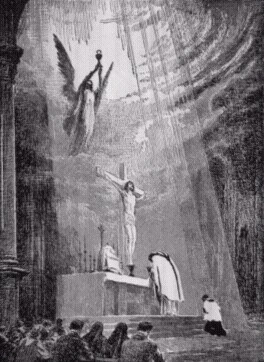
It’s hard not to notice that most of the blogs are talking about the Holy Father’s Motu Proprio on the Latin Mass, using the 1962 Missal. I thought that for today I would pick up on that theme. So I found the Collect for the Annunciation, said at Mass every day during Advent from the Latin Mass. It may not be quite the same since the book I am taking it from was published in 1921.
Deus, qui de beatae Mariae Virginis utero, Verbum Tuum, Angelo nuntiante, carnem suscipere voluisti; praesta supplicibus Tuis ut qui vere eam Genitricem Dei credimus ejus apud Te intercessionibus adjuvemur.
O God Who didst please that Thy Word should take flesh, at the message of an Angel, in the womb of the Blessed Virgin Mary; grant to Thy suppliants that we who believe her to be truly the Mother of God, may be helped by her intercession.
From Ortus Christi : meditations for Advent by Mother St. Paul, published in 1921.
Filed under: John Paul II
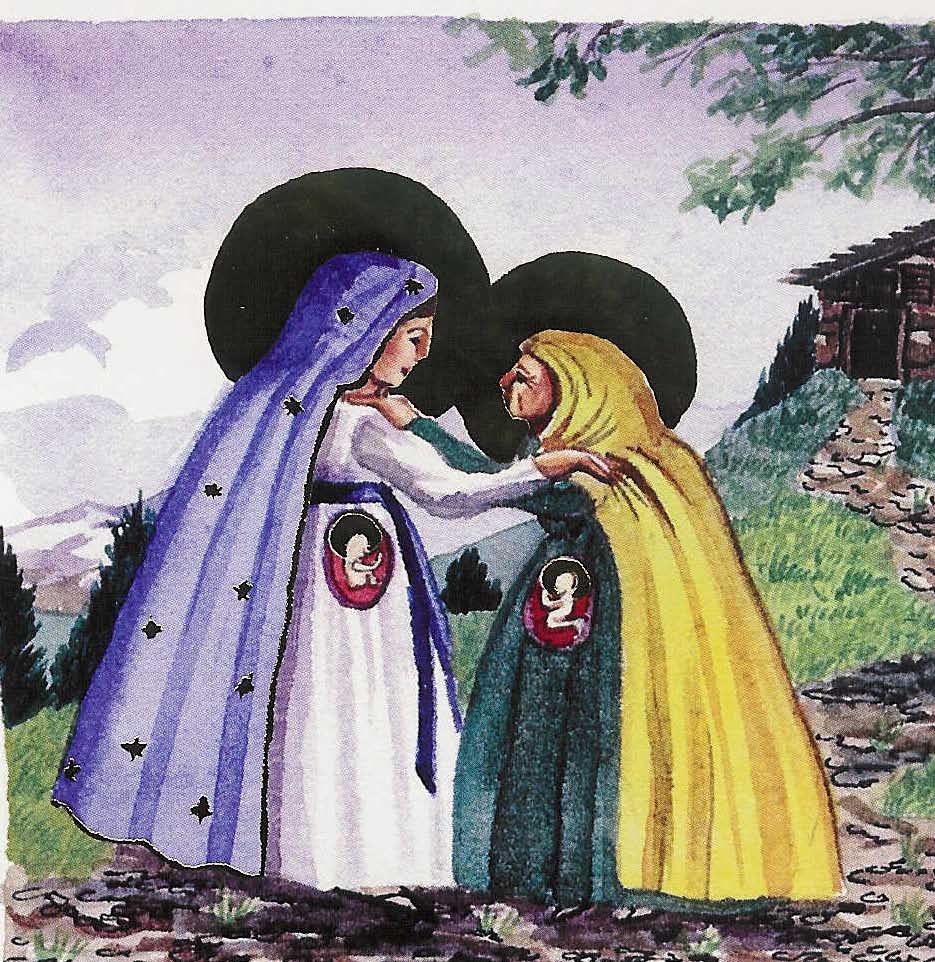
In today’s Gospel, Sunday, July 8, 2007, St. Luke recounts the Lord’s appointing of 72 others sent off, two by two, as evangelists. These 72 prefigured the great missionary journeys, years later, of the Apostles, St. Paul and others proclaiming the Gospel of Jesus Christ. But in the first chapter of St. Luke’s Gospel, Mary (pregnant with Unborn Jesus) is presented as the “first evangelist”! Pope John Paul II explains:
“In the Visitation episode, St Luke shows how the grace of the Incarnation, after filling Mary, brings salvation and joy to Elizabeth’s house. The Saviour of men, carried in his Mother’s womb, pours out the Holy Spirit, revealing himself from the very start of his coming into the world…. St Luke also seems to invite us to see Mary as the first “evangelist”, who spreads the “good news”, initiating the missionary journeys of her divine Son.” General Audience, Pope John Paul II, October 2, 1996
Filed under: The Incarnation
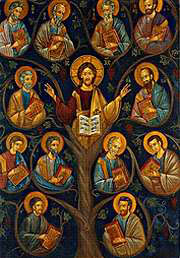
The Gospel reading today, Saturday, July 7, 2007, is from Mt 9:14-17. Jesus explains to His disciples that “People do not put new wine into old wineskins. Otherwise the skins burst…”
He could have very well been speaking, of course, about His own Sacred Humanity which was all Holy and Wholly New at His conception. The above quote in our heading is from Ronald Knox’s book The Hidden Stream, and he is discussing the marvelous impact of the Incarnation upon humanity. God did not put the new wine of His redemption into an old wineskin, He instead became Incarnate. Cardinal Christoph Schonborn explains it well:
“Can we imagine a human existence that is free, from its inception, from implication in guilt? Can we imagine a life that is holy, sinless, right down to its roots? This is precisely what Jesus’ conception by the Spirit affirms…here is one man whose existence is entirely new, right from its root. In the midst of a world where anything new simply replaces something old, only to become old in its turn, there is now a new humanity, a human life which does not, at its conception, have the germ of death in it, but comes forth entirely out of God’s newness.” (from The Mystery of the Incarnation)
Vatican II comments: “Human nature, by the very fact that it was assumed, not absorbed, in him, has been raised in us also to a dignity beyond compare. For, by his incarnation, he, the son of God, has in a certain way united himself with each man.” (The Church in the Modern World, #22) This is accomplished at the one-cell stage of His earthly life, for He is then, true God and true man.
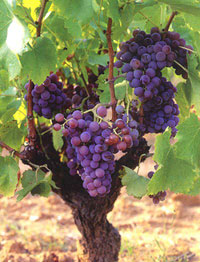
So, at His conception, the Incarnate Word establishes in Himself a New Humanity that is fresh and free of sin, having the unique capacity to refresh, redeem and renew humanity. St. Paul sums it up perfectly: “…if any one is in Christ, he is a new creation; the old has passed away, behold, the new has come” (II Cor 2:17) And Jesus sums it up, well, even more perfectly: “I am the vine, you are the branches. He who abides in me, and I in him, he it is that bears much fruit…” (Jn 15:5) The new wineskin is then, a new Vine, and we are invited to abide in Him.
Filed under: Unborn Jesus
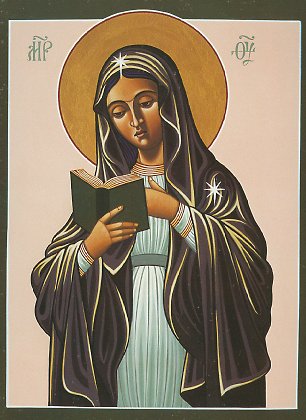
Mother of the Incarnate Word
by Fr. William McNichols
O JESUS, living in Mary,
Come and live in Thy servants,
In the spirit of Thy sanctity,
In the fulness of Thy strength,
In the reality of Thy virtues,
In the perfection of Thy ways,
In the communion of Thy
mysteries.
Dominate over every opposing
power
In Thine own Spirit, to the
glory of the Father.
Amen.
Prayer of Venerable Father Olier
“He, in her, carried on the blessed converse with His Father; there was never any separation between Mary and the Blessed Fruit of her womb, Jesus. She would come back to Him with all the more joy, and tell Him what she had been doing and saying…When we think of Jesus praying for nine months to His Father, when we think of Mary’s nine months’ colloquy with Jesus, we begin to think that there is something wrong about our methods of prayer, that they need re modeling. Let us try to understand something of what His prayer was.“
Mother St. Paul, Ortus Christ
Filed under: John Paul II
“The Lord called me from the womb, from the body of my mother he named my name” (Is 49:1).
“From my mother’s womb you called me” (Responsorial Psalm)
“Today we can make our own these words of the Psalmist. God knew and loved us even before our eyes could contemplate the marvels of creation. At birth all men and women receive a human name. But even before that, each one has a divine name: the name by which God the Father knows and loves them from eternity and for eternity. This is true for everyone, with the exception of none. No one is nameless in God’s sight! All have equal value in his eyes: all are different, yet all are equal, and all are called to be sons and daughters in the Son.”
From a Homily given by Pope John Paul II, Chayka Airport, Kiev – Sunday, June 24, 2001
Filed under: Evangelium Vitae
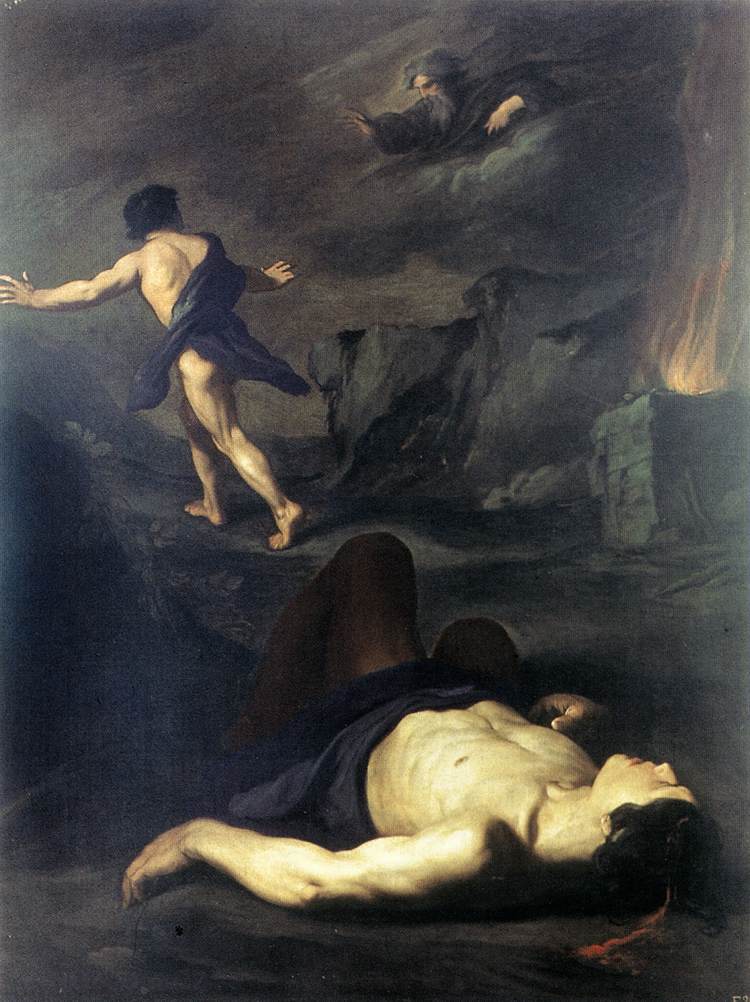
Cain and Abel by Pietro Novelli
At another level, the roots of the contradiction between the solemn affirmation of human rights and their tragic denial in practice lies in a notion of freedom which exalts the isolated individual in an absolute way, and gives no place to solidarity, to openness to others and service of them. While it is true that the taking of life not yet born or in its final stages is sometimes marked by a mistaken sense of altruism and human compassion, it cannot be denied that such a culture of death, taken as a whole, betrays a completely individualistic concept of freedom, which ends up by becoming the freedom of “the strong” against the weak who have no choice but to submit.
It is precisely in this sense that Cain’s answer to the Lord’s question: “Where is Abel your brother?” can be interpreted: “I do not know; am I my brother’s keeper?” (Gen 4:9).
Yes, every man is his “brother’s keeper”, because God entrusts us to one another. And it is also in view of this entrusting that God gives everyone freedom, a freedom which possesses an inherently relational dimension. This is a great gift of the Creator, placed as it is at the service of the person and of his fulfillment through the gift of self and openness to others; but when freedom is made absolute in an individualistic way, it is emptied of its original content, and its very meaning and dignity are contradicted. John Paul II, The Gospel of Life #19
On this 4th of July let us all pray that our country returns to the path of true freedom.
“The worlds of philosophy and humor often intersect so that philosophers can sometimes be mistaken for comedians and vice versa. To the age old question “If a tree falls in the forest and no one is around to hear it, does it make a sound?” one might not be certain whether to respond with a frown or a smile. A contemporary variant of the question leaves no doubt about the appropriate response: “If a husband says something and his wife is not there to correct him, is he still wrong?”
“But there is decidedly nothing humorous about the question, “Does a human fetus feel pain during an abortion if no one is there to verify the pain scientifically?” We like to think that we citizens of the 21st century are compassionate people. …It is rather curious, then, that the subject of fetal pain, rather than activating the springs of compassion that exist in all of us, is often politicized, depersonalized, trivialized, and relativized. If a person is truly compassionate, it would seem that his sensitivity to another’s pain would not be subject to ideological compromise. It appears disingenuous to say, “I will feel your pain as long as it is politically correct to do so.”
From Fetal Pain: Real or Relative? by Dr. Donald DeMarco Adjunct Professor, Holy Apostles College and Seminary
“I put myself on the side of childhood – on the side of the assassinated child, Abel as well as on the side of the victorious child David; of the child Joseph who reigned in Egypt and of the Hebrew children who sang their joy in a furnace and were subjected to lions and flames. I am above all on the side of the Infant God who promised happiness to the meek.” From The Son of Man by François Mauriac who won the Nobel Prize in Literature, 1952
“When He came into the world as a tiny unborn baby, Jesus placed Himself squarely “on the side of childhood”. He demonstrated His solidarity with all unborn children, and later with children at every stage of life. Would that all were pledged to be “on the side of childhood” ‑ with the Infant God ‑ throughout all of its many stages, from conception and early life in the mother’s womb to late adolescence when the child prepares to go out on his own. If the world were truly on the side of childhood, we would live in a much more innocent and receptive world.” From Unborn Jesus Our Hope
Filed under: Evangelium Vitae
“We have been sent. For us, being at the service of life is not a boast but rather a duty…We have been sent as a people. Everyone has an obligation to be at the service of life. This is a properly “ecclesial” responsibility, which requires concerted and generous action by all the members and by all sectors of the Christian community….Together we all sense our duty to preach the Gospel of life…” Pope John Paul II, The Gospel of Life, #79.
Filed under: Quotes from Great Christians
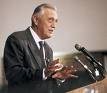
Earlier this month we had a quote from Dr. Jerome LeJeune entitled The Story of Tom Thumb. Here are two more quotes from Dr. LeJeune that were in an article published by the Knights of Columbus.
“Life has a very long history, but each individual has a very neat beginning — the moment of conception.”
“I see no difference between the early person that you were at conception and the late person you are now. You were, and are, a human being. It is hard to believe, although beyond any possible doubt, that the whole genetic information necessary and sufficient to build our body and even our brain, the most powerful problem-solving device, even able to analyze the laws of the universe, could be epitomized so that its material substratum could fit neatly on the point of a needle!” – World renowned geneticist, the late Dr. Jerome LeJeune
Filed under: Papal Quotes
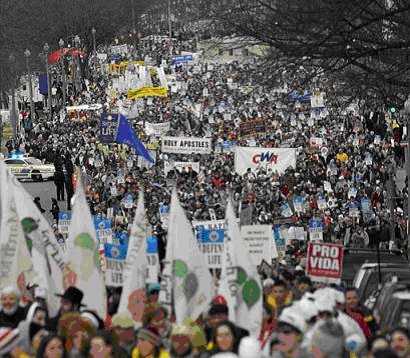
Look at the love of Jesus Christ – according to Pope Pius XII, He was loving us even at the first moment of His conception:
“But the knowledge and love of our Divine Redeemer, of which we were the object from the first moment of His Incarnation, exceed all that the human intellect can hope to grasp. For hardly was He conceived in the womb of the Mother of God, when He began to enjoy the beatific vision, and in that vision all the members of His Mystical Body were continually and unceasingly present to Him, and He embraced them with His redeeming love.”
Pope Pius XII
Mystici Corporis, The Mystical Body Of Christ And Our Union In It With Christ #75 June 29, 1943
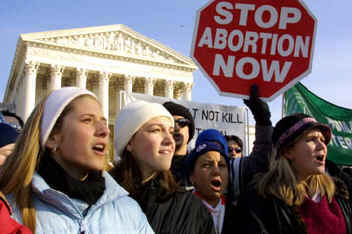
When one sees this large crowd from the March for Life, one can almost picture Christ embracing them with His redeeming Love. Contrast the love that filled Christ’s heart when He was first conceived to the indifference of the world that wants to destroy newly conceived human beings soon after their conception for convenience and “research”. He embraced us with His redeeming Love, let us embrace these little ones with our love and commitment.

Father Frederick W. Faber was born in England, June 28, 1814. A famous convert to the Catholic faith – he wrote 150 hymns, the most famous being “Faith of Our Fathers”and “There’s A Wideness in God’s Mercy”. We are honoring him on his birthday because he has written extensively about Unborn Jesus and has tried to help us all appreciate those early months of the Incarnation. He wrote the following in his book entitled The Blessed Sacrament.
“The Incarnation is as much the world in which we live as the globe on which we tread, with its earth, air, fire and water, its sun, moon and stars, its animal, vegetable and mineral kingdoms. If we look at our souls, their present wants and eternal expectations, their life, strength, health and maladies, the Incarnation is as indispensable to them, and as indispensable every hour of the day, as the heat and cold, the air and light, are to our natural subsistence. We live and move in the Incarnation. We are what we are, through it. It covers us, underlies us, and is all around us. It is incessantly affecting us in almost numberless ways, both within and without. We cannot get beyond the reach of its blessed influence, even by disbelieving it or dishonoring it.”
Look at what John Paul II said:
” Creation is thus completed by the Incarnation and since that moment is permeated by the powers of the Redemption, powers which fill humanity and all creation.”
Pope John Paul II
Dominum Et Vivificantem, The Holy Spirit in the Life of the Church and the World (#52)
Take heart all you who are trying to build a Culture of Life!
Filed under: Fathers of the Church
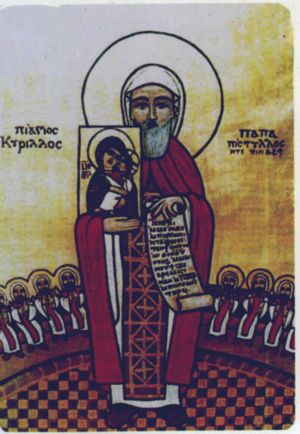
Today June 27 is the Feast day of St. Cyril of Alexandria
St. Cyril of Alexandria was an eloquent and outspoken defender of Mary as the Mother of God at the Council of Ephesus in 431. At one time He wrote “That anyone could doubt the right of the Holy Virgin to be called Mother of God fills me with astonishment. Surely she must be the Mother of God if our Lord Jesus Christ is God and she gave birth to him.”
Below are some excerpts from a famous homily (Homily 4) delivered by St. Cyril when he was presiding over the Council of Ephesus in 431 A.D.:
“Hail Mary, seat of Him who in no place can be contained. In your womb you contained the Only Begotten Word of God…”
“Hail Mary, Mother of God, for whom John, yet still in his natural womb, jumped for joy and adored the luminary of eternal light.”
“Hail to You, who in your holy and virginal womb have enclosed the Immense and the Incomprehensible.”
*We took our heading for today’s post from the following quote from Cyril:
“Christ, as I have said, was also God in his humanity, permitting human nature to use its laws while nonetheless conserving also the purity of divinity. For in this way and in no other is God to be understood both what was born by nature, and those things which the virgin mother produced not only of flesh and blood in the same way that other mothers do, but (the flesh and blood) of the Lord and of God imbued with our likeness.” Paschal Homilies, No. 17:2 MG 77, 776
Filed under: Quotes from Great Christians
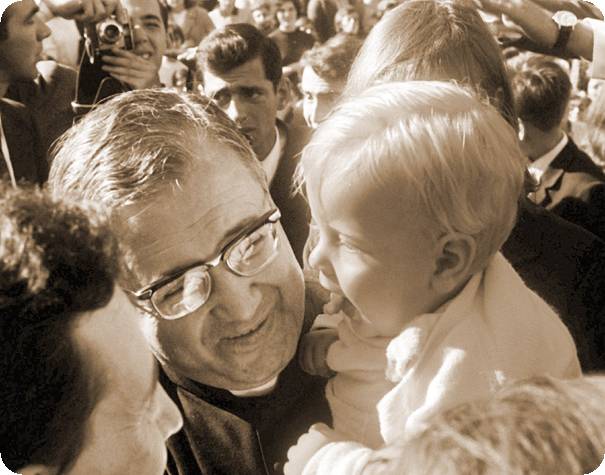
Today June 26 is the Feast Day of St. Josemaria Escriva.
St Josemaria Escriva was asked a question by a social worker during one of the many talks he gave around the world. She wanted to know how to talk to the poor women who came to her as a social worker and as a Catholic when they were distressed after becoming pregnant – she wanted advice about what to say to them.
His responded in part: “Tell them they should be proud of the confidence God has in them, giving a baby to the world who is a child of God even while still in the womb. So, they should not be dismayed. No, they should give thanks to God for making them instruments of such a marvelous thing, an extraordinary miracle, this participation in the creative power of God. “
He went on to tell them the true story about a wise Chinese doctor whom he knew. This man worked in a very poor area. A woman came to him (a non-Christian) who was distressed because she was pregnant with her ninth child. She told him she wanted an abortion because there was not enough food to feed this child. He told her he could not kill her child but then he had an idea and asked her about her oldest child. She told him about her oldest child – a son. He pointed out quite logically that if having enough food was the problem it was this son who ate the most – a Solomon-like leading comment- No, she said he’s my child I could never harm one of my children. He then, gently pointed out that the one in her womb was also one of her children.
 UNBORN WORD of the day