Filed under: Evangelium Vitae
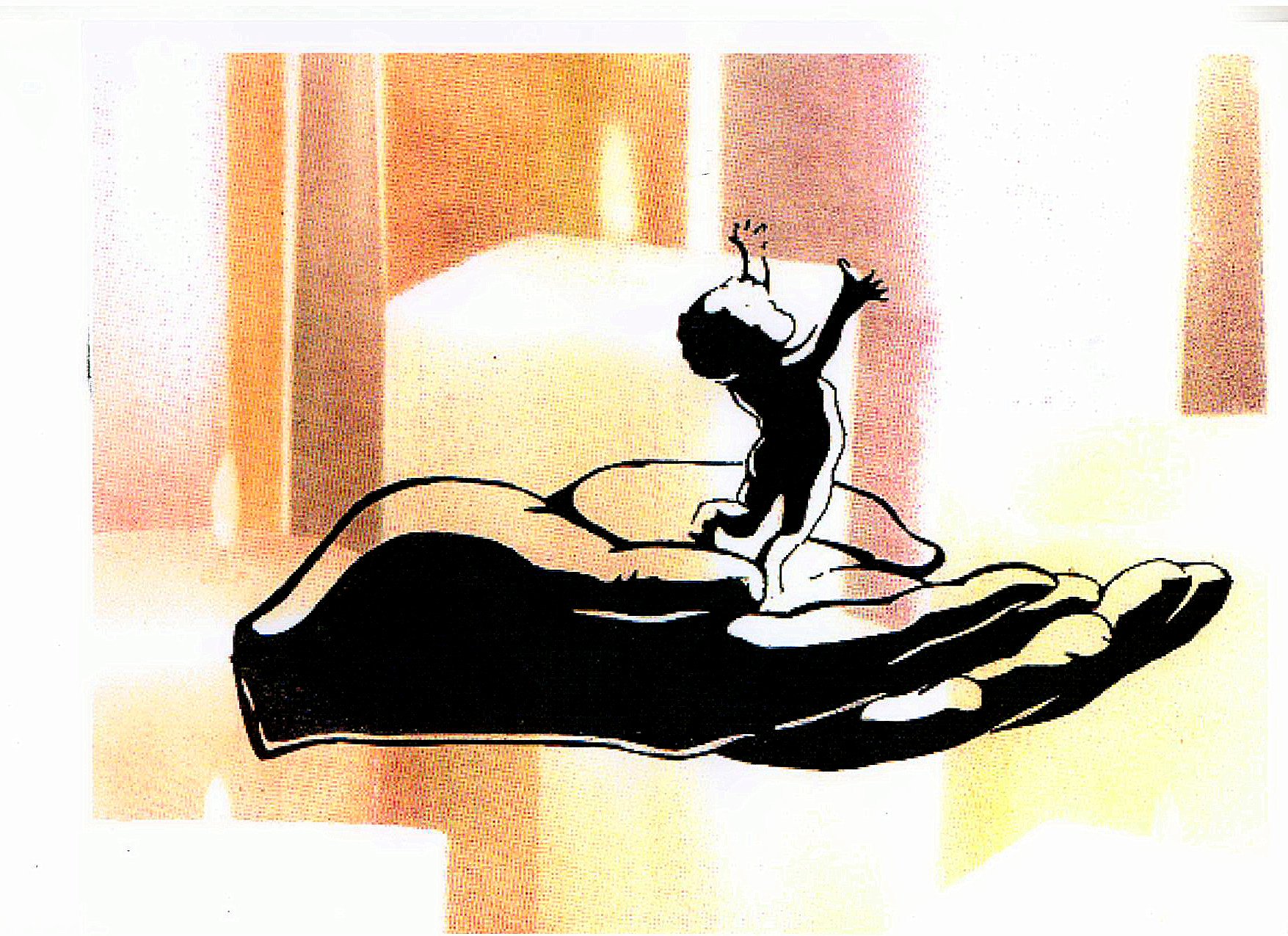
You formed my inmost being; you knit me in my mother’s womb.
I praise you, so wonderfully you made me; wonderful are your works! (Psalm 139)
Yesterday, November 12, the Psalm read at Mass was Psalm 139. John Paul II meditates on this Psalm in his encyclical The Gospel of Life.
- Like the Psalmist, we too, in our daily prayer as individuals and as a community, praise and bless God our Father, who knitted us together in our mother’s womb, and saw and loved us while we were still without form (cf. Ps 139:13, 15-16). We exclaim with overwhelming joy: “I give you thanks that I am fearfully, wonderfully made; wonderful are your works. You know me through and through” (Ps 139:14). Indeed, “despite its hardships, its hidden mysteries, its suffering and its inevitable frailty, this mortal life is a most beautiful thing, a marvel ever new and moving, an event worthy of being exalted in joy and glory”. #84
- Human life is sacred and inviolable at every moment of existence, including the initial phase which precedes birth. All human beings, from their mothers’ womb, belong to God who searches them and knows them, who forms them and knits them together with his own hands, who gazes on them when they are tiny shapeless embryos and already sees in them the adults of tomorrow whose days are numbered and whose vocation is even now written in the “book of life” (cf. Ps 139: 1, 13-16). There too, when they are still in their mothers’ womb – as many passages of the Bible bear witness – they are the personal objects of God’s loving and fatherly providence. #61
- Because we have been sent into the world as a “people for life”, our proclamation must also become a genuine celebration of the Gospel of life. This celebration, with the evocative power of its gestures, symbols and rites, should become a precious and significant setting in which the beauty and grandeur of this Gospel is handed on. For this to happen, we need first of all to foster, in ourselves and in others, a contemplative outlook. Such an outlook arises from faith in the God of life, who has created every individual as a “wonder” (cf. Ps 139:14). #83
Filed under: Fathers of the Church
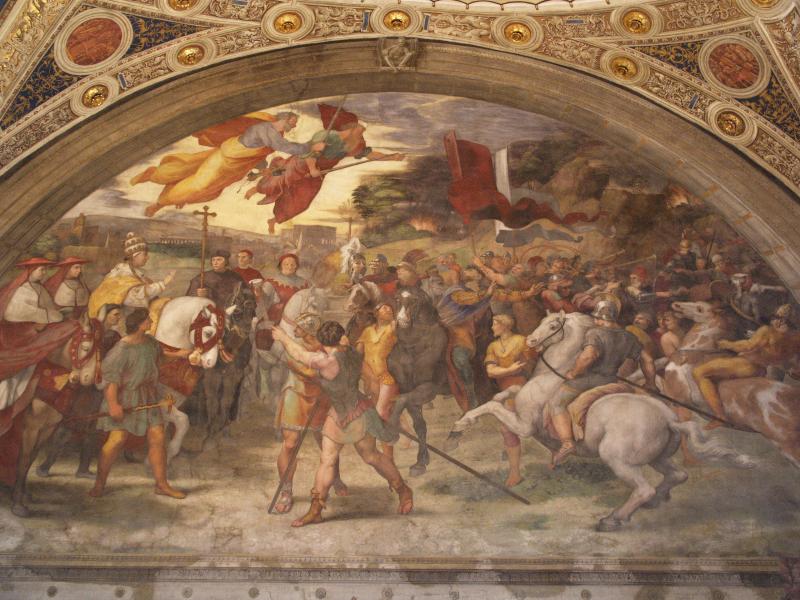
Vatican City: Vatican Museum: St Leo the Great’s Meeting with Attila in 452 (1511-1514, Raphael and assistants)
Today, November 10th is the feast day of St. Leo the Great (A.D. 400?-461). He is regarded as one of the most important of the Western Fathers of the Church and was declared a “Doctor of the Church” by Pope Benedict XIV. He is one of only three Popes in two thousand years to be called “the Great.”. Not only was Leo a great teacher, he is credited with saving Rome.
The Picture above depicts St. Leo persuading Attila, called the Scourge of God, to spare the city. Attila said that while Leo was talking to him, he saw a person in priestly robes who stood nearby with bared sword, threatening his life should he disobey Leo’s commands.
Here are a few quotes from St. Leo about the life of the Unborn Christ Child:
“Nothing could contain his greatness, yet he allowed himself to be enclosed in his mother’s womb.” The Binding of the Strong Man.
“…the power of the Most High overshadowed her, so that within her spotless womb Wisdom might build itself a house and the Word become flesh.” Creator of Time is Born in Time
“…when at her greeting, John (in the womb of Elizabeth and not yet born) was stirred with prophetic exaltation-as if even in his mother’s womb he were already crying out, ‘Behold the Lamb of God, behold the one who takes away the sins of the world’.” Sermon 35

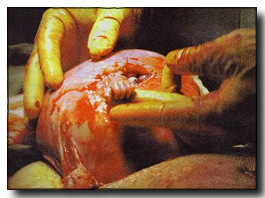
These two pictures show a hand reaching to touch another. The first is God’s hand reaching towards Adam’s. Dr. DeMarco in his article The Hand of Hope points out that in the first picture:
” Michelangelo depicts God the Creator vigorously thrusting the index finger of his right hand toward a reclining Adam, whose own hand withdraws just enough that a gap appears separating the author of life from his somewhat indecisive recipient. This gap symbolizes the drama of God and man, the divine and the human, the source of life and our hesitation in welcoming it.”
In commenting on the second picture Dr. DeMarco says:
“But such hesitation or reluctance does not apply to Samuel Alexander Armas. In a photograph which some observers say should be the “picture of the decade,” we see the tiny hand of Samuel when he was a 21-week-old fetus reaching up through an incision in his mother’s uterus and grabbing and squeezing the finger of the surgeon who had just performed a life-saving, though not life-forming, procedure.”
When Michael Clancy the photographer talked to the attending nurse about what had happened, she replied, rather matter-of-factly, “Oh, they do that all the time.”
Could little Samuel’s hand, and the hands of other unborn babies reaching out to touch us, be another way God’s hand is reaching out to a hesitant humanity? Or as Doctor DeMarco suggests in his article: “He represents life uncompromised. He is our pro-life role model.” A ‘little child shall lead us'(Is. 11:6). Samuel’s hand, grabbing hold of his physician’s hand, is a symbol of how our hands should reach out to grab The Divine Physician’s hand in love for life.
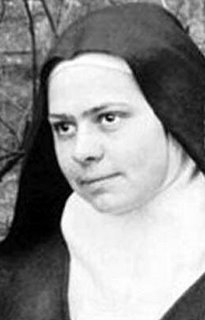
Today, November 8 is the feast day of Blessed Elizabeth of the Trinity (1880-1906). She has been called the Saint of the Divine Indwelling. In 1901 she entered the Carmelite order, receiving the name “Sister Elizabeth of the Trinity.” In his book Redeemer in the Womb, John Saward, points to her as one of three woman in the 20th century who emphasize the importance of Jesus’ life in the womb. (The other two are Caryll Houselander and Adrienne von Speyr.) Another lesser known woman who wrote extensively on this topic was Mother St. Paul.
Here is a quote from Blessed Elizabeth:
“It seems to me that the attitude of the Virgin during the months between the Annunciation and the Nativity is the model for interior souls, for those whom God has chosen to live inwardly, in the depths of the unfathomable abyss.” From Le Ciel dans la foi.
She elaborates in a letter to her sister, Guite (Oeuvres completes):
“Think what must have been going on in the Virgin’s soul after the Incarnation, when she possessed within her the Word incarnate, the Gift of God…In what silence, what recollection, what adoration she must have buried herself in the depths of her soul to embrace this God whose Mother she was. My little Guite, he is in us. O let us stay close to him in this silence, with this love, of the Virgin. This is the way to spend Advent, isn’t it?”
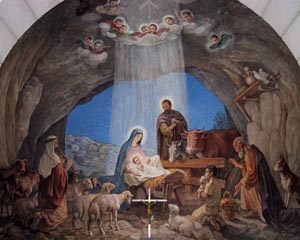
Christ is the light and center point of the Culture of Life. He embodies in Himself the good news of this Culture of Life; He is the Gospel of Life!
To the culture of death, which surrounds us, He is the counterpoint:
“The people who walked in darkness have seen a great light;
those who dwelt in a land of deep darkness, on them has light shined…
For to us a child is born, to us a son is given; and the government will be upon his shoulder, and his name will be called ‘Wonderful Counselor, Mighty God, Everlasting Father, Prince of Peace.'”
The people of the culture of death are afraid of children and afraid of this Light.
The people of the Culture of Life are emboldened by this Light.
When Gabriel appeared to Zechariah to announce the conception and birth of John, he said: “Do not be afraid Zechariah…” Lk 1:13
When Gabriel appeared to Mary to announce the conception and birth of Jesus, he said:“Do not be afraid Mary…” Lk 1:30
When the angel of the Lord appeared to Joseph to announce the conception and birth of Jesus, he said: “…do not fear…” Mt 1:20
When the angel of the Lord appeared to the shepherds in Bethlehem to announce the birth of Jesus, he said: “Be not afraid…” Lk 2:10
As Christ was coming into the world as a baby, a star appeared in the East to lead gentiles to Christ, ‘the Light of the World’ (Mt 2:1-12, Jn 8:12). Christ is our Light and Life today as well. In Christ we find a resounding call to courage, hope and confidence, which strengthens us to proclaim His Gospel of Life and to welcome children into our world.
“The light shines in the darkness, and the darkness has not overcome it.” Jn 1:5
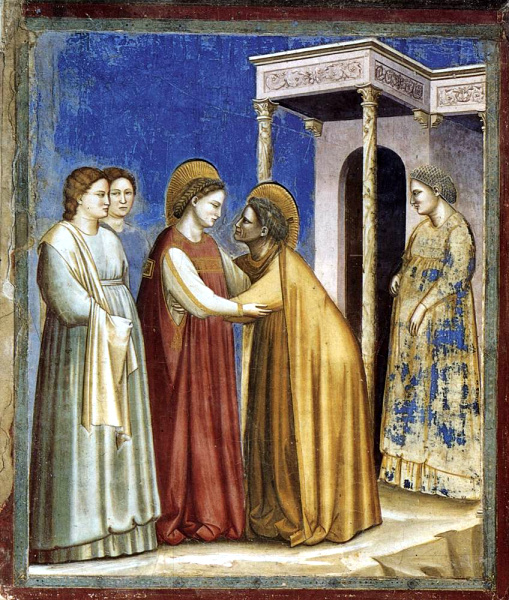
Yesterday, November 5 was the feast day of St. Elizabeth and Zachery, the parents of St. John the Baptist. Yesterday, the focus of our blog was on Zechariah, (today we will concentrate on Elizabeth). The account of Mary’s Visitation to Elizabeth (and her unborn baby John) and Zechariah, is found in Luke 1:38-57.
- Humble Elizabeth has an important role in this encounter; Fulton Sheen spoke of it in this way: “One of the most beautiful moments in history was that when pregnancy met pregnancy ‑ when child bearers became the first heralds of the King of Kings.” (The Worlds First Love)
- Elizabeth seems to have been awestruck by the immediate revelation she received at this moment. Some people would be similarly overwhelmed should a famous celebrity or world leader walk in their front door, but for Elizabeth there could have been nothing more momentous than the pregnant mother of the Messiah – carrying Him within her – entering her home. The Holy Spirit imparts to Elizabeth the gifts of knowledge and understanding, and she, who is full of good will and faith, is enlightened as to the meaning of what is occurring (Lk 1:42).
- Archbishop Goodier notes that “… throughout His life the one desire of Jesus was that He should be discovered; that He should be discovered, and recognized, owned. For every step made in that discovery He was grateful; no man made it but met with reward overflowing. The one thread of interest running through the whole drama of His life is the growth of this discovery.”( The Public Life of Our Lord Jesus Christ, Vol. One) Unborn John and his mother Elizabeth share in this first discovery together, as if to remind us all that the first place Jesus should be discovered is in the family.
- Consider the astounding words of Elizabeth which introduce, for the first time, two titles: the title “Lord” to describe unborn baby Jesus, and the title “Mother of (the) Lord” to describe Mary.
- For Elizabeth this was a bittersweet time. Her husband was still distressed at having doubted Gabriel: as his wife, she was yoked to his troubled thoughts and sad countenance. With whom could she share her joy? To whom could she vent her anxieties about her son’s childhood, and from whom could she receive encouraging words in return? Who could understand her situation and nurture hope in her new mother’s heart? And who could lift the spirits of her husband? Enter Mary: her young faithful heart near exploding with the Holy Spirit and the exuberant joy of miraculous motherhood and intimate knowledge of the Messianic mission. Mary’s companionship and support were a great blessing for Elizabeth.
- But more important than Mary, the unborn Lord arrives with His divine companionship. Now Elizabeth could pour out her heart…..and then listen with a renewed heart as the Word spoke to her. Conversations had been banished from her house and silence had been a constant companion, but now the very Word of God Himself came in through the front door and dwelt in the center of her home. Condensed from Unborn Jesus Our Hope.
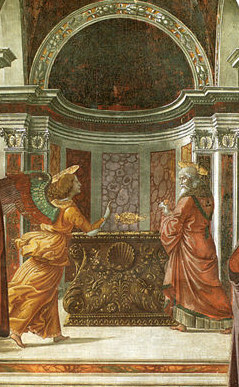
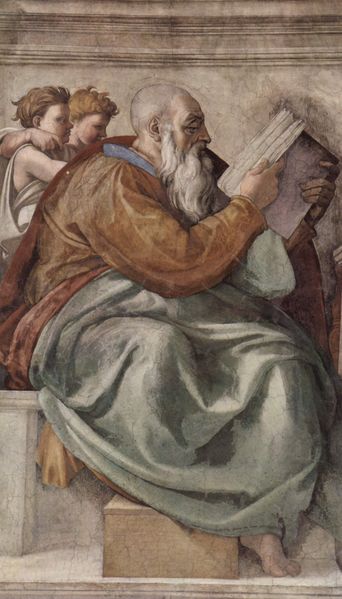
Today, November 5 is the feast day of Saints Zachary and Elizabeth, the parents of St. John the Baptist. Today the focus will be on Zechariah, (tomorrow we will concentrate on Elizabeth). The account of the Archangel Gabriel appearing to Zechariah is found in Luke 1:5-25.
- The priest Zechariah had been the first person told of the Messiah’s impending mission to the House of Israel. That God willed this is understandable as he was a faithful and holy priest. Zechariah represents the remnant of faithful souls within Israel awaiting the Messiah.
- Gabriel’s initial greeting to Zechariah had been full of tenderness as he recounted God’s attentiveness to the prayers of both Zechariah and Elizabeth. He then proclaimed the conception and future mission of Zechariah’s son John.
- But Zechariah confronts the Archangel with a doubting question: “How shall I know this? For I am an old man, and my wife is advanced in years.” Suddenly, this joyous breathtaking event sours.
- Zechariah of Ain‑Karim, would have had a keen interest in the prophecies and teaching concerning the long awaited Messiah, but now by his own doubt and lack of faith he had rebuffed the exalted Archangel Gabriel, the same angel who had appeared to the great prophet Daniel.
- The Archangel has no choice but to put aside the rest of the message as it was intended to be delivered. He delivers instead a brief angelic rebuke: “I am Gabriel, who stand in the presence of God and I was sent to speak to you, and to bring you this good news.”
- The divine message has, in effect, been cut short and there is nothing left to say. Indeed, the Angel will see to it that Zechariah has nothing else to say for a very long time: “…..you will be silent and unable to speak until the day that these things come to pass….” And when would “these things come to pass”?
- And so for the next six months, prior to the arrival of Mary (and unborn Jesus), Zechariah was a man ashamed, begging God to forgive him for his stubborn and hardened heart. He was acutely aware of his sinfulness and weakness and would have prayed often, readily identifying with many of the Psalms. “O Lord, rebuke me not in thy anger, nor chasten me in thy wrath…! I am utterly bowed down and prostrate; all the day I go about mourning” (Ps 38:1,6).
- Finally, with Mary and unborn Jesus came hope. Literally, physically, supernaturally, prophetically. A great ray of light broke through the clouds of Zechariah’s thoughts and musings. As he could witness God fulfilling His promises to Israel ‑ in spite of his own obstinacy ‑ hope began to grow in him and even the courage to believe more fiercely that yes, God could forgive him, God would forgive him and even rely on him again. For Zechariah this visit was a wonderful gift from God, an indescribable consolation. And in three short months his lips would again sing aloud the praises of God his Savior. (Luke1:67-79) Condensed from Unborn Jesus Our Hope.
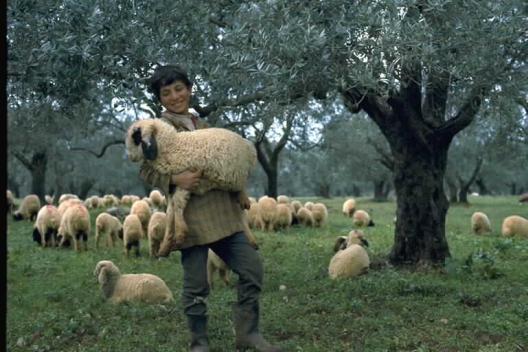
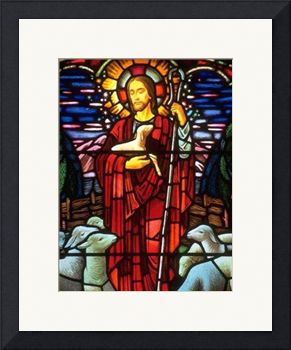
Today, Friday, November 2nd is All Souls Day, and the Psalm for today’s Mass is the one and only Psalm 23. My childhood was not very religious, but my grade two class did memorize Psalm 23 (King James Version, KJV). It left a formative and lasting impression upon my little eight year old mind. I would suggest to parents and teachers alike that this is one of the best religious passages for a child to memorize.
While only six verses in length, it is chock full of positive and healthy images for the childlike. Let’s look at a few (KJV) verses:
“The Lord is my shepherd” – this suggests a one-on-one relationship of simple dependency. But the shepherd is the one who CARES ‘for’ the sheep and ‘about’ the sheep.
He leads me “beside the still waters” and “makes me to lie down in green pastures”. For the childlike mind these are calm and peaceful images of a little innocent sheep being cared for.
“He restoreth my soul” – now we drift into the spiritual ever so gently. The child might wonder what is “my soul” and he is left with a beautiful image to guide his questioning.
“He leadeth me in the paths of righteousness for His name’s sake”. Perhaps this is now stretching the child’s moral framework, but that is a good thing. God, my shepherd is leading me somewhere “for His name’s sake”. There is a purpose behind His leading, it is not aimless, it is for my good (whatever that might be).
Even in a dark valley (“the valley of the shadow of death”) He is with me so I need not be afraid. He even comforts me.
He prepares a meal for me and pours mysterious oil upon my head. These are profound images that the child can ponder without fully understanding them. That is a good thing. The child doesn’t need to understand all of this like some dumbed-down cartoon. The child can be left wondering about such mysterious images.
“Goodness and mercy shall follow me” all through my life “and I will dwell in the house of the Lord forever” – that is, His door is open and He invites me into His house. The Shepherd’s house is a place of safety, refuge and hope for me.
We do not think about God in simple childlike ways often enough. There are passages and stories in the Bible that are especially poignant for children (and the childlike). Let’s cherish them and pass them on.
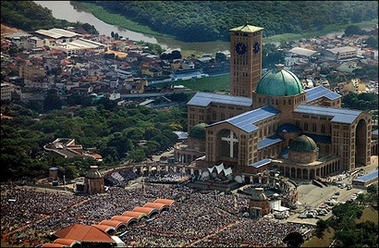
General view of the open-air mass conducted by Pope Benedict XVI in the vast explanade of the National Sanctuary of Aparecida, in Aparecida do Norte, Brazil.
Popes have been using the Apostleship of Prayer as a dedicated prayer group for about 120 years. . Each month this group encourages us to pray for the monthly intentions of the Holy Father
Pope Benedict’s intention for November, 2007 is Respect for Life. That medical researchers and legislators may have a deep respect for human life from its beginning to its natural conclusion.
Each month the Apostleship of Prayer offers a monthly reflection on the the Holy Fathers intentions:
Something that many parents will appreciate is that they offer a reflection for children each month too.
The Apostleship of Prayer also encourages the morning offering. Their motto is a simple profound way of life. Father Raoul Plus, S. J. in his book Christ in Our Time explains:
“As all activity is offered to God in the morning, with occasional renewals during the day, all work is undertaken solely for the Glory of the Master, and rises to Heaven like a prayer…To pray always-that is what it means. That is not to say that the soul should always be in the act of prayer, but rather that it should live in a state of elevation. It is to live always with the implicit desire strongly formed in the soul to render to God, in every passing moment the glory which is His due.”

When most people start taking down their Halloween decorations, stores around Los Angeles put up garland and wreaths.
One of my pet peeves is the fact that commercially the Christmas season now starts right after Halloween. When I was young businesses did not promote Christmas until after Thanksgiving. But we are living more and more in a consumer society – you guessed it Christmas = money.
Why don’t we try to beat them at their own game? Let’s make this a real Christmas season and start preparing spiritually now. Today Dan and Mike Engler sent us a link to a really great video on You-tube. It combines Christmas with the pro-life message. Click here:
O Holy Night-A Pro-life Christmas

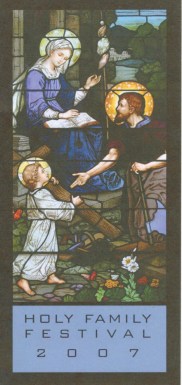
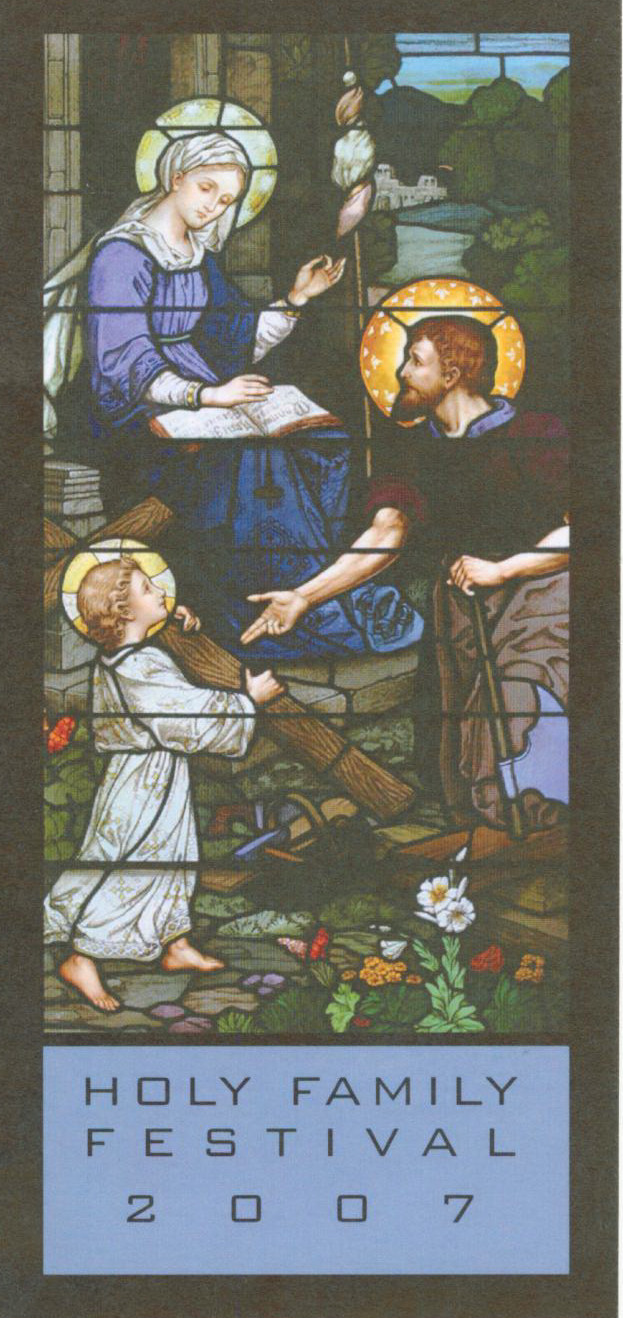
This weekend we attended the Holy Family Festival in Ojai. They had a wonderful speaker from Catholic Answers, Tim Staples, who gave two talks on “The Immaculate Conception and the Dignity of Man”. Tim Staples is a fabulous speaker and I would recommend him highly for both adults and teenagers.
At the end of the day, we were fortunate enough to get to speak with Tim and his lovely wife, Valerie. Tim brought up an interesting scripture about Mary and referenced St. Jerome’s interpretation of it. We were surprised because we weren’t aware of this passage about Mary’s pregnancy and the Unborn Christ Child.
“The LORD has created a new thing upon the earth: the woman must encompass the man with devotion.” Jeremiah 31:22
St. Jerome in his commentary on this verse understood it of Mary’s virginal conception of Christ. “The LORD has created a new thing on earth; without seed of man, without carnal union and conception, ‘a woman will encompass a man’ within her womb – One who, though He will later appear to advance in wisdom and age through the stages of infancy and childhood, yet, while confined for the usual number of months in his mother’s womb, will already be perfect man.” USCCB New American Bible Footnote 3 Point C
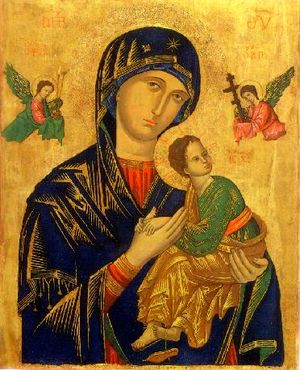
Our Lady of Perpetual Help *
Caryll Houselander was born on October 29, 1901. Caryll was one of the most popular spiritual writers of her day. She is certainly still one of my favorites. Many of her books are still in print. Maisie Ward (Frank Sheed’s wife) wrote a wonderful biography about her “Caryll Houselander – The Divine Eccentric” which was published in 1962.

While in college (many eons ago) a friend of mine and I were reading this biography at the same time – I still remember a funny comment that she made to me at the time – ‘Hey, this is actually, the first person I’ve read about who might be a saint who drank a Martini.’ I think Maisie Ward had a story in the book about inviting Caryll over for dinner and giving her a before dinner drink. I don’t have the book so I can’t check on why my friend made this comment but it made me laugh at the time and has always stuck with me.
On the occasion of her death, Ronald Knox said of Caryll Houselander that she could have established a school of spirituality. In a letter to The Tablet on 23 October 1954, he wrote:
“…she seemed to see everybody for the first time, and the driest of doctrinal considerations shone out like a restored picture when she had finished with it. And her writing was always natural; she seemed to find no difficulty in getting the right word; no, not merely the right word, the telling word, that left you gasping.”
Of course I’m going to end this with a quote from Caryll Houselander about the Unborn Christ Child from her book, The Passion of the Infant Christ.
“There is in fact, a huge force, a tremendous power for love being neglected, not being used, at the time when it is needed as never before and when every sign seems to be pointing to it and challenging it as the only answer-the power of the Infancy of Christ.
The Infant Christ is the whole Christ. Christ was not more God, more Christ, more man, on the Cross than He was in His Mother’s womb. His first tear, His first smile, His first pulsation in the womb of His Mother, could have redeemed the world.”
*An icon venerated by Christians of the East and West for centuries. The Archangels Gabriel and Michael hold the instruments of the Lord’s Passion, while the Divine Child looks on and clings to His Mother’s hand. Also known as “Our Mother of Sorrows.”
As God, He knew that the angelic apparition was prophetic of His future passion. Yet in His human nature as a small child, He is frightened and runs to His Mother for protection. Our Lady hastily picks Him up and clasps Him to her bosom. This action is indicated by the fact that the Lord’s right foot is nervously curled about the left ankle and in such haste that His right sandal has become loosened and hangs by a single strap. Further action is indicated by the way the Child Jesus clasps His Mother’s right hand with both of His, holding tightly to Our Lady’s thumb.
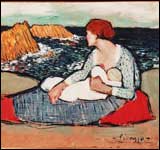
Caryll Houselander’s (1901-1954) birthday is October 29. Here is a beautiful quote from her book The Passion of the Infant Christ.
“Rest is not idleness; indeed, restlessness is the torment of idle people….
Rest, far from being relaxation, is a culmination, a fullness of gathered peace, like the fullness and stillness of waters gathered to a flood tide.
Think of a child asleep in his mother’s arms; the abandon with which he gives himself to sleep can only be because he has complete trust in the arms that hold him. He is not lying asleep on that heart because he is worn out with anxiety. He is asleep there because it is a delight to him to be asleep there. The mother rests too. She rests in his rest. Her mind and her body rest in him. … Rest is a communion of love between them. It is a culmination of content.
…Not content to be a human being, Christ wishes to be each human being, and in fact is born in the soul of everyone who will receive Him; and in each one in whom He lives, whose life He lives, He is loved infinitely by the Father, loved for what He is, the only Son.
…If this were realized there could be no one who could not fulfill the first condition of rest, which is trust.”
Filed under: Evangelium Vitae

Here is a beautiful quote from John Paul II’s encyclical, The Gospel of Life:
“In every child which is born and in every person who lives or dies we see the image of God’s glory. We celebrate this glory in every human being, a sign of the living God, an icon of Jesus Christ.” #84
One of my favorite quotes from St. Francis de Sales
(1567-1622) elaborates:
“…if someone intends to build a house or a palace he must first consider whether it is to be a lodging for a vine dresser or a peasant or if it is for a lord, since obviously he would use entirely different plans depending on the rank of the person who is to live there. Now the Eternal Father did just that when he built this world. He intended to create it for the Incarnation of His Son, the Eternal Word. The end or goal of His work was thus its beginning, for Divine Wisdom had foreseen from all eternity that His Word would assume our nature in coming to earth.” The Sermons of St. Francis de Sales for Advent and Christmas

There is a wonderful tradition in Christendom of beginning each day by offering oneself and one’s day to God. It has been called by some ‘morning devotions’ or more frequently in Catholicism a ‘morning offering’. One of the traditional morning offering prayers is that promoted by the Apostleship of Prayer.
The morning offering is a great way to start each day. I know when I make this offering as I begin my day I am often mindful of the offering Christ made to His Father, from Mary’s womb, as He entered the world:
“Consequently, when Christ came into the world, he said:
“Sacrifices and offerings you have not desired;
but a body have you prepared for me;
in burnt offerings and sin offerings
you have taken no pleasure.
Then I said, Lo, I have come to do your will, O God.”
(Hebrews 10:5-7)
Pope Paul VI called this “…the fundamental offering that the Incarnate Word made to the Father when He entered the world (cf. Heb. 10:5-7).” Marialis Cultus, #20
St. Alphonsus De Ligouri, a Doctor of the Church, made the following comment about this quote from Heb. 10:5-7:
“The divine Word, from the first instant that he was made man and an infant in Mary’s womb, offered himself of his own accord…” (The Incarnation, Birth and Infancy of Jesus Christ)
John Paul II, reflecting on these words in Hebrews states: “He places himself as a gift within the womb of Mary.” (The Word Made Flesh). Later, in the same book he says: “All Christians are in fact called to share in Christ’s priesthood and mirror his total gift of self to the Father and be a spiritual sacrifice…”
One way we can mirror this total gift of self that Christ made as He first came into the world is to offer ourselves to the Lord as we start each day.
Filed under: Pro-life
Yesterday we had a post about the Launching of the Benenson Society – For more information here is a link to Catholic News.com about the Benenson Society: Schools set up Amnesty pro-life alternative
The good news is that Catholic schools around the world are opting out of Amnesty because of their new pro-abortion policy. Here are a few stories:

Click here for Lifesite News Story
From Scotland:
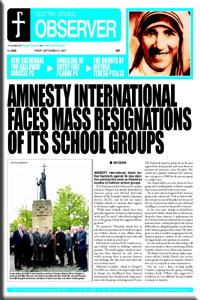
Click Here for Link to Scottish Catholic Observer News Page
Here is another story from Lifesite News
Irish Diocese Advises Catholic School to Suspend Amnesty Chapter
The BBC Reports:
Schools ‘cut links with Amnesty’ (from Ireland)
I find all of this very encouraging although I have not been able to find any information on schools in the U.S. or England. And it seems that the Canadian Bishops are delaying their decision about Amnesty until November. I know because of a pro-life administration my daughter’s school in California has cut ties with Amnesty. It is my hope that many other schools are quietly severing their ties with Amnesty.

White Rose*
On September 3, we had a post School Severs Ties with Amnesty and Starts a New Group Called Benenson Society.
Last week one of our readers in a comment asked:
Todays word of the day put me in mind of why I no longer support Amnesty International. Has anyone heard anything further on the Benenson Society?
Well I am happy to say that Fr Chris Middleton, S.J. has sent an email out announcing the official launching of the Benenson Society.
Benenson Society Information Page (St. Aloysius’ College)
On this page you will find:
- Charter of the Benenson Society
- Withdrawal from Amnesty and Establishment of the Benenson Society
- Register as an individual or Chapter
- Comments and Feedback
Father Chris explains in his email:
“We are now inviting groups and individuals to affiliate, especially existing Amnesty groups in schools or universities. The aim would be to allow groups to continue to do much as they are already doing and keep their autonomy while allowing the sharing of resources through an email group list and arrangements with human rights organizations…
As of Friday schools or individuals were able to go on the St Aloysius website and register membership. Initially Aloysius and Loreto here in Sydney will sponsor the Society, but hopefully once it is up and running it might be rotated around schools. Already schools in Brisbane and Perth and individuals in England have registered.”
*The Benenson Society has as its symbol a stylized white rose. This symbol draws inspiration from the White Rose Society, a group of Catholic and Protestant students and teachers at Munich University, who opposed Nazism with letters and pamphlets, with nine paying the ultimate price of being guillotined for their stand for human rights.
 UNBORN WORD of the day