Filed under: Evangelium Vitae
AROUND THE WORLD AND THROUGH THE CENTURIES WITH THE UNBORN CHRIST CHILD
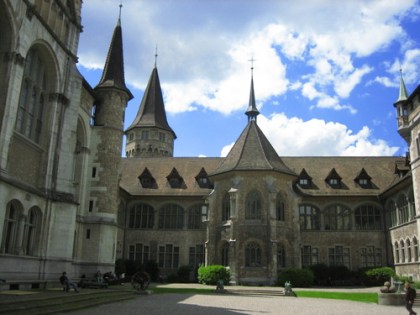
Swiss National Museum – Zurich,Switzerland
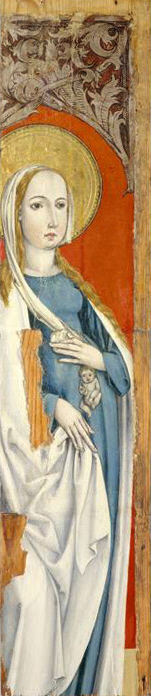
Schwangere Maria – Pregnant Mary (Fragment of Altar wing)
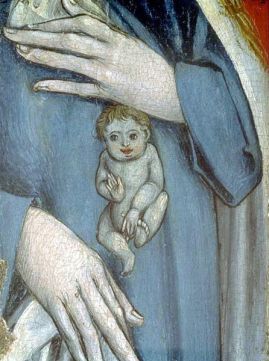
Unborn Jesus (detail)
Fragment of an altar wing. Pregnant Mary in a blue dress with a white cape in front of a red background. In the body of Mary the unborn child Jesus is visible. Anonymous painter. Tempera on wood frame: pine wood. 1505. Origin: Cham (ZG), Field Chapel. Dimensions: height 81 cm, width 17.7 cm.
“This divine touch within from within – one can almost envision a Sistine Chapel-like ceiling painting of God, not the Father but the little unborn Son, straining forward and reaching out His tiny finger towards the inner heart of Mary – His mother can almost give shape to God’s way of touching each human heart from deep within.” Unborn Jesus Our Hope
AROUND THE WORLD AND THROUGH THE CENTURIES WITH THE UNBORN CHRIST CHILD
The Christian Museum
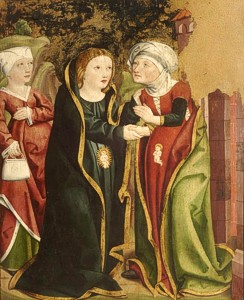
Visitation 15th Century
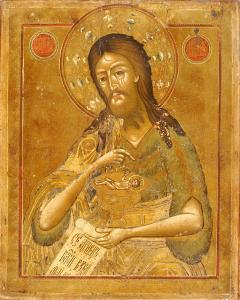
St. John the Baptist (parts of a Deesis) 17th Century
This panel showing the meeting of Mary and Elizabeth was once in the village of Csegöld in Szatmár County in East Hungary. It was probably painted in the last years of the 15th century, tempera and gold on wood, and its style is close to the works created in Upper Hungary. In the company of a servant, the expectant Virgin visits her relative, Elizabeth, who is also with child. This is a frequently represented scene of the Virgin’s life, following the Annunciation. It is unusual, however, that the unborn babies are painted on the exterior of their mothers’ wombs. The Christ child turns with a blessing gesture towards the little Saint John the Baptist who is kneeling in adoration.
St. John the Baptist (parts of a Deesis) Moscow, late 17th c. tempera and silver on wood . The above painting is an example of one tradition of St. John the Baptist icons. In these icons the adult John the Baptist is portrayed pointing to Christ Unborn. In his left hand he holds a chalice or charger and a scroll that reads, “Behold the Lamb of God which taketh away the sins of the world”. With his right hand he points to the Christ Child (unborn).
“St. John the Baptist is the Lord’s immediate precursor or forerunner, sent to prepare his way. “Prophet of the Most High”, John surpasses all the prophets, of whom he is the last. He inaugurates the Gospel, already from his mother’s womb welcomes the coming of Christ, and rejoices in being “the friend of the bridegroom”, whom he points out as ‘the Lamb of God, who takes away the sin of the world’.” Catechism of the Catholic Church, Article 3, 523.
“…when at her greeting, John (in the womb of Elizabeth and not yet born) was stirred with prophetic exaltation-as if even in his mother’s womb he were already crying out, ‘Behold the Lamb of God, behold the one who takes away the sins of the world’.” St. Leo the Great (A.D. 400?-461) Sermon 35
AROUND THE WORLD AND THROUGH THE CENTURIES WITH THE UNBORN CHRIST CHILD
Gemäldegalerie Berlin Germany
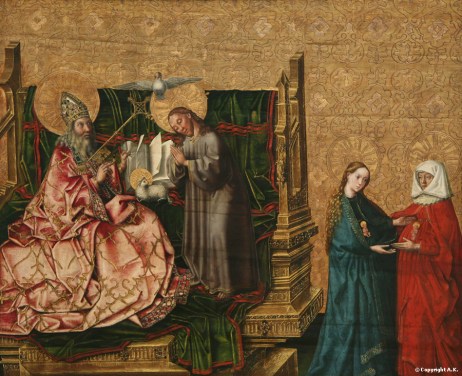
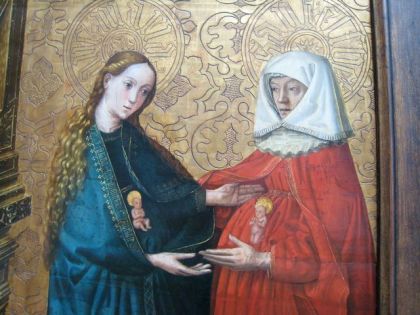
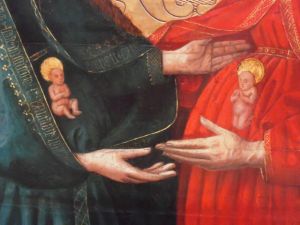
The Decree of Redemption by Konrad Witz (Click here to see enlarged copy of painting)
Richly ornamented with a gold background this painting shows us the Divine sphere. The invisible Mystery of the Trinity is made visible. God the Father sits on a throne. The book is opened. The Holy Spirit is hovering as a dove. Our redemption is being pondered. The Lamb looks to Christ who is worshiping the Father. The Son is being sent. The key locks the circle. The key starts at the heart of the Father and points to the halo of the Son where it ends with a cross. The Divine decree is the Incarnation of God – the Son is being sent for the Redemption of the world. The Innocent (the Lamb) is to be sacrificed in order to bring the Divine love to humanity.
The Incarnation has already taken place in the womb. The right section of the painting shows Mary and Elizabeth as pregnant women, with John and Jesus in their wombs. Here sits the unborn Baby Jesus in the womb of Mary as on a throne and the unborn John kneels, folds his hands and adores the Redeemer. The Divine is in the world. The thoughtful look of both Women indicates the understanding each has of the Unborn Redeemer. Mary is the Virgin with flowing hair and an open ear, she has just heard the word of the Angel affirmed by Elizabeth. Her blue dress of heavenly fidelity speaks the Magnificat. The letters of this song of praise adorn the Mantle of her cloak embroidered in gold Letters. Elizabeth is the old and wise woman in the red dress. She looks with love into the transcendent distance at the Counsel of Redemption. The views of both women draw the viewer, to involve them in the wonder of this Event.
“O King of nations, as I look back through the ages and see the Child and His Mother so clearly set forth in promise and prophecy, in type and example, when I think of Thy plans for the Redemption of the world, made from all eternity and gradually unfolding as the fullness of time approached, when I think of the nations all desiring Thy coming, when I think of the intense desire of Thy loving Heart, there is one thing that seems to jar and to be out of harmony with the rest, and that is the lamentable want of desire in my own heart ! The time is very short now, the Child with His Mother are already on the way to Bethlehem. Oh! Let me multiply my Acts of Desire that my little King when He comes may be indeed my ‘desired One’ too.” Mother St. Paul, Ortus Christi, pp. 124.125.
AROUND THE WORLD AND THROUGH THE CENTURIES WITH THE UNBORN CHRIST CHILD
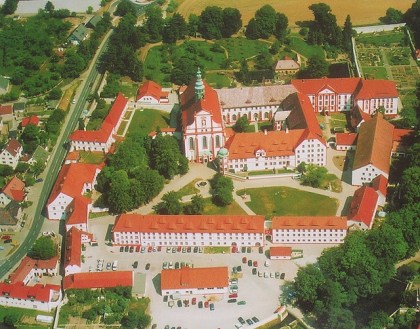
Cistercian convent, St.Marienstern
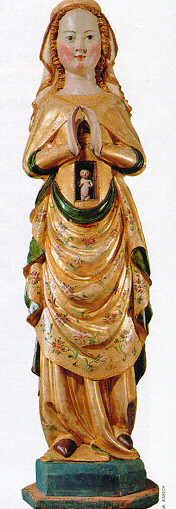
Pregnant Virgin
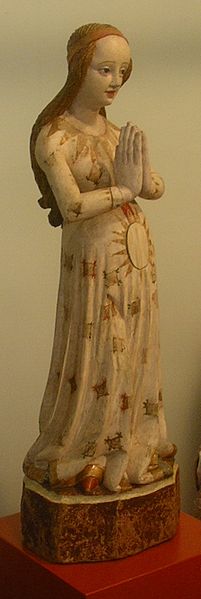
Maria in der Hoffnung
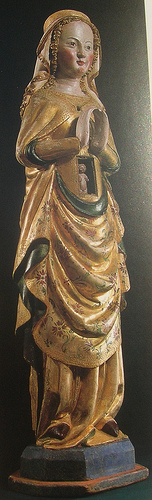
Pregnant Virgin
In 1996, Medievalist, Markus Bauer visited the Cistercian convent, St. Marienstern, in Panschwitz-Kuckau — a small village with a population of 2400 and located in the Sachsen part of the Lausitz area in search of material for an historical exhibit. The historian found three sculptures of the Blessed Virgin Mary, each with an opening in the stomach, where the viewer could see a miniature carving of the unborn Christ Child.
Such sculptures were highly valued devotional objects in the 14th and 15th centuries. In the 19th century, this type of devotional image no longer spoke to the souls of the sisters in the same way, so they hung a cloth over the stomach opening, or they nailed the opening closed. Since the covering for one of these Marian figures was missing, it was put away in a remote cell, where it stayed to the present time.
“It would simply weary the reader to repeat almost word for word this description of our dearest Lord’s life in the Womb, changing the phrases to apply it to the Blessed Sacrament. The parallel is so complete, that it must already have suggested itself; and I have dwelt upon it at greater length, because, as the devotion to the life in the womb is especially a devotion of interior souls, so the corresponding thoughts with regard to the Blessed Sacrament are those which are most familiar to interior souls in their prayers before the tabernacle; and again as all the mysteries of the Sacred Infancy take their color and character from the life in the womb, to establish the analogy between it and the Blessed Sacrament is in truth to establish the analogy between the Blessed Sacrament and the Sacred Infancy altogether.” The Blessed Sacrament, Fr. F. W. Faber
AROUND THE WORLD AND THROUGH THE CENTURIES WITH THE UNBORN CHRIST CHILD
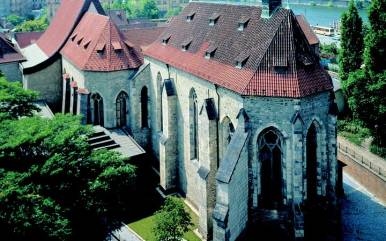
National Gallery of Prague (Convent of St. Agnes of Bohemia)
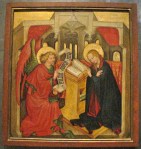
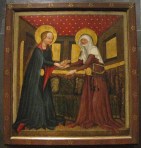
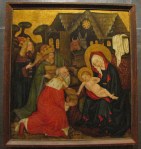
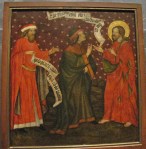
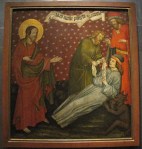
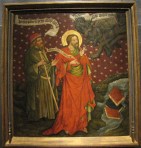
St. James Altarpiece ( a few panels)
St. James Altarpiece Scenes from the life of the Virgin Mary and St. James the Great
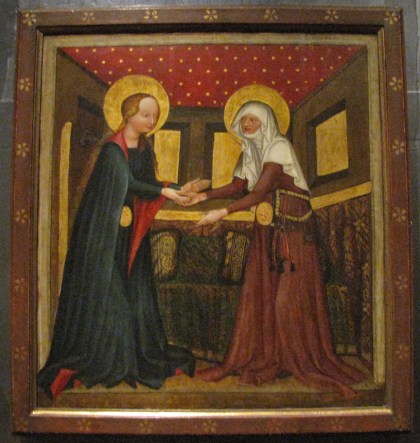
Visitation panel St. James Altarpiece
An altarpiece is a picture or relief representing a religious subject and suspended in a frame behind the altar of a church. The altarpiece is often made up of two or more separate panels created using a technique known as panel painting. It is then called a diptych, triptych or polyptych for two, three, and multiple panels respectively.
“We can feel the rush of warmth and kindness, the sudden urgency of love that sent that girl hurrying over the hills. ‘Those days’ in which she rose on that impulse were the days in which Christ was being formed in her, the impulse was His impulse.” Caryll Houselander The Reed of God
AROUND THE WORLD AND THROUGH THE CENTURIES WITH THE UNBORN CHRIST CHILD
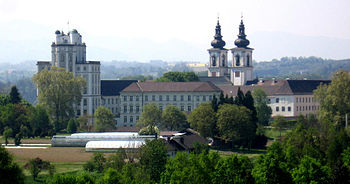
Kremsmünster Abbey
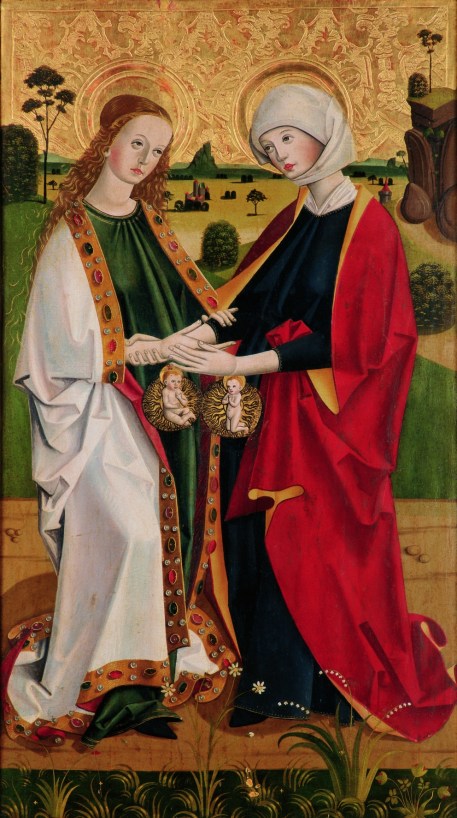
Heimsuchung von Maria und Elisabeth (Mary and Elisabeth Meeting)
In Christian art Mary’s pregnancy was broached not only in scenes with Jesus as an unborn child but also in pictures of the virgin mother by herself or in association with the Eucharist. Depending on how realistic or symbolic the picture was meant to be, her pregnancy was made evident as a rounded belly, by showing the figure of a child, or by having “IHS” marked on Mary’s stomach.
The original portrayal of this theme was the veneration with which, during her pregnancy, Elisabeth greeted Mary: “Blessed are you among women, and blessed is the fruit of your womb!” (Luke 1,42) This Bible text became widespread due to the “Ave Maria” (Hail Mary) which became part of the Advent liturgy in the 7th and 8th centuries and as of the 13th century had become one of the most important Christian prayers. In medieval times portrayals of Mary and Elisabeth meeting (the “Visitation”) became very common. From around the year 1300 the children were shown in front of their mothers’ bellies as can be seen in this painting from Kremsmünster (around 1460).
“John was ‘filled with the Holy Spirit even from his mother’s womb’ by Christ himself, whom the Virgin Mary had just conceived by the Holy Spirit. Mary’s visitation to Elizabeth thus became a visit from God to his people.” Catechism of the Catholic Church, Article 8, 717.
AROUND THE WORLD AND THROUGH THE CENTURIES WITH THE UNBORN CHRIST CHILD
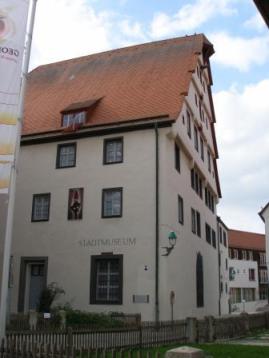
Stadtmuseum – Nördlingen,Germany
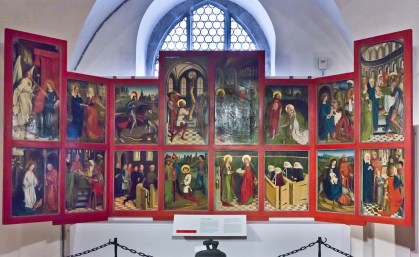
Flügel des Hochaltars aus St. Georg (Wing of the high altar of St. George) Full Altar wing
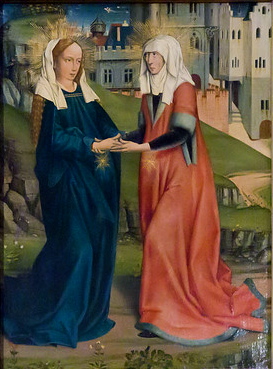
Verkündigung Die Ungeborenen Jesus (detail of Altar wing)
The wings of the high altar of St. George’s Church (1462) 1462 were a complex altarpiece created by Friedrich Herlin for the Church of St. George, where he acted not only as painter of the panels, but also as an entrepreneur who co-ordinated the other artisans and carpenters. This Visitation detail show another common way unborn Jesus and John were recognized in Visitation paintings of this period. Light is emanating from the wombs of the two mothers.
When the Angel appeared to Zachariah – he made a number of predictions about John the Baptist before his conception. One was “He shall be filled with the Holy Ghost even from his mother s womb” (Luke 1: 15) Here is what one writer says about the fulfillment of this Angelic pronouncement.
“Six months later, Elizabeth who had been waiting in solitude and silence for God to fulfil His designs, received a visit from the Mother of God, and the Precursor and the Messias Who was to come were brought into close contact. We cannot doubt that it was at that moment when, as Elizabeth said “the infant in my womb leaped for joy”, that John was “filled with the Holy Ghost”. Thus God cleansed His Precursor before his birth from the stain of original sin, again showing us that those who are to prepare for the Coming of His Son must be distinguished by their purity.” Mother St. Paul, Ortus Christi, p. 35.
AROUND THE WORLD AND THROUGH THE CENTURIES WITH THE UNBORN CHRIST CHILD

Museum of Applied Arts-Frankfort, Germany
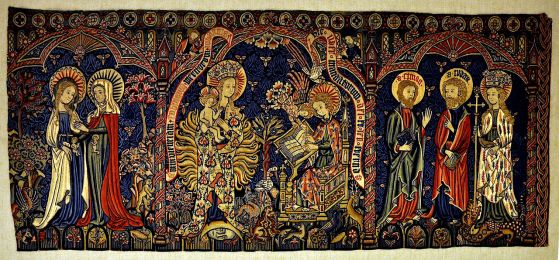
Antependium, or altar cloth hanging of tapestry woven in colored wools (Full Tapestry)
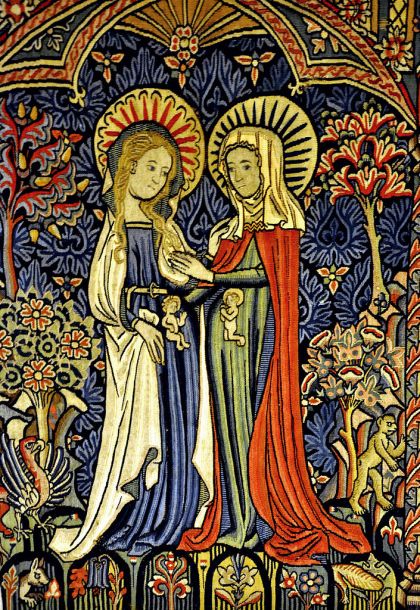
Visitation – Detail from Frontal – German – wool, linen and silk
An antependium (Latin: “to hang before”), more commonly known as a hanging cloth, or, when speaking specifically of the hanging for the altar, an altar frontal (Latin: pallium altaris), is a decorative piece of material that can adorn a Christian altar, lectern, pulpit, or table. Specifically, an antependium hangs down in front of whatever it covers, and is to be distinguished from the altar linens which are used in the service of the Eucharist, and an altar cloth which covers the top of the altar.
“One of the most beautiful moments in history was that when pregnancy met pregnancy when child bearers became the first heralds of the King of Kings.” Archbishop Fulton Sheen, The World’s First Love.
“Now Elizabeth didn’t recognize what was in Mary’s womb as a “fetus.” No One less than God the Holy Spirit gave Elizabeth the gift to recognize that what was alive in her cousin’s womb, was already a person. And that person was her Lord (God).” Charles Hoffman, The Holy Rosary Rich in Jewish Tradition
AROUND THE WORLD AND THROUGH THE CENTURIES WITH THE UNBORN CHRIST CHILD
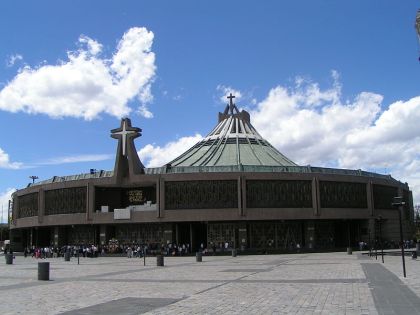
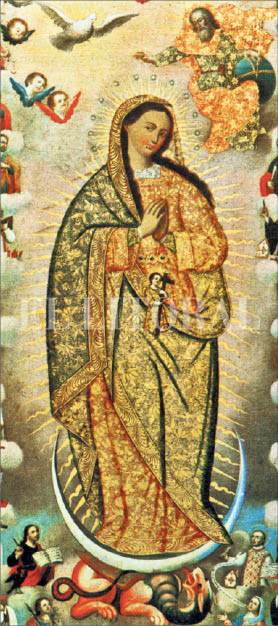
One of the best known representations of Mary’s pregnancy is the image of Our Lady of Guadalupe. This image is in the Basilica of Guadalupe in Mexico City.
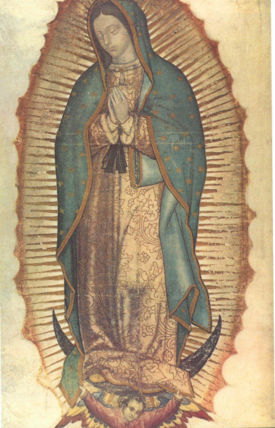
It is commonly thought that Our Lady is pregnant in this miraculous image given to Juan Diego in December, 1531.
Miguel Sanchez, the author of the 1648 tract Imagen de la Virgen María, described her (Our Lady of Guadalupe) as the Woman of the Apocalypse from the New Testament’s Revelation 12:1-2 “clothed with the sun, and the moon under her feet, and upon her head a crown of twelve stars. She was with child…
We also know she was with child in this image because she wears a black belt which was the Aztec Maternity Belt.
Father Frank Pavone points out that “In the image, Our Lady is pregnant, carrying the Son of God in her womb. Her head is bowed in homage, indicating that she is not the Goddess, but rather the one who bears and at the same time worships the one true God.” Our Lady of Guadalupe and the Pro-life Movement
Another indication that it has been widely held that the Guadalupe image was of Mary pregnant is the Anonymous Cuzqueño 18th century painting, Mary Immaculate with the Child Jesus in the womb. Private Collection, Lima, Peru. This work is included in “Colonial Art Book Iconography” by Hector Schenone. The image has the unborn Christ child included in an image that is reminiscent of the image of Our Lady of Guadalupe.
AROUND THE WORLD AND THROUGH THE CENTURIES WITH THE UNBORN CHRIST CHILD
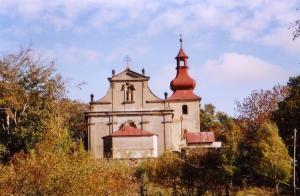
Trutzhain-Quinauer pilgrimage Shrine
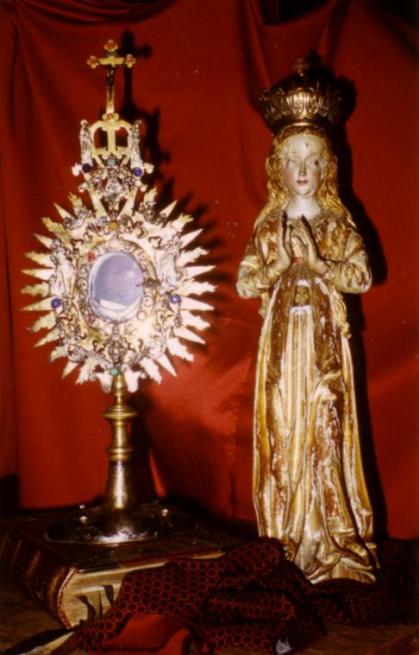
Virgin of Quinau with Unborn Christ
![trutzhain_wallfahrtskirche[1]](https://unbornwordoftheday.net/wp-content/uploads/2012/12/trutzhain_wallfahrtskirche1.jpg?w=420)
St. Mariahilf (St. Mary Our Help Parish), Trutzhain,Germany
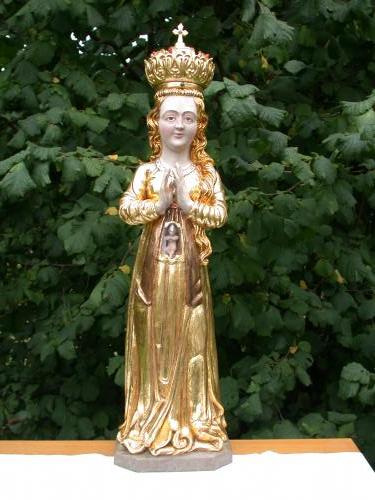
The Trutzhain Madonna – ‘Mater gravida’. She is the ‘pregnant Madonna’ with the infant Jesus under her heart
This was a new version Of theQuinauer Madonna. 1987 artist: Uhrissen Anton
July 2, the Feast of the Visitation is the feast day of the sanctuary in the lower Quinau. It is a time for the pilgrims to honor the miraculous Virgin of Quinau. During the pilgrimage season pilgrims come daily in fancy dress from many places in the region to honor the Mother of God.
History of Quinau: The legend of the origin of the statue is as follows: A boy named Joseph kept sheep for his master on the spot where the church now stands. Once, the normally pious boy cursed while taking care of the cattle. Then came a voice: “Joseph, cease your anger and cursing, you insult my son, Jesus”. Startled, Joseph turned his face in the direction from which the voice came and he saw the statue of Mary in a rocky niche . The boy fell to his knees and begged for forgiveness. Then he built a little chapel with stones and shrubs around the statue and performed his devotions there every day.
He concealed his experience for a long time. Then the boy became ill. During his illness, he betrayed his experience while delirious. When he awoke they questioned him and discovered little by little the whole story. The boy expressed the desire to be carried up the mountain to image of the Virgin. This took place on September 4, 1342 . The farmer who employed the boy took the image of Mary to his home. But the next day the statue was gone. Everyone in his household, denied taking the statue. After a long search they found the statue again at the previous location. The farmer took it back home and the event repeated itself. A few villagers had now heard of these events. They wanted to build a chapel in the village. But one day the building material disappeared. It had miraculously been taken to the top of the hill. People saw it as a sign from God and so with the permission of the landowner, Count von Lobkowitz Gallus Babelus, the chapel was built on the mountain top at the apparition site. St. Mariahilf a newer Chruch in Trutzhain has a modern version of the statue.
“How could he have shown his mercy more clearly than by taking on himself our condition? For our sake the Word of God became as grass….The incarnation teaches us how much God cares for us and what he thinks and feels about us…The smaller he became through his human nature the greater was his goodness; the more he lowered himself for me, the dearer he is to me.” St. Bernard, O. Cist., Sermo 1, in Ephiphania Domini, 1 2: PL 133.
AROUND THE WORLD AND THROUGH THE CENTURIES WITH THE UNBORN CHRIST CHILD
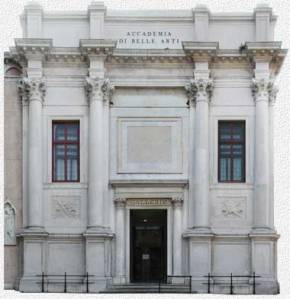
Gallerie dell’Accademia, Venice, Italy
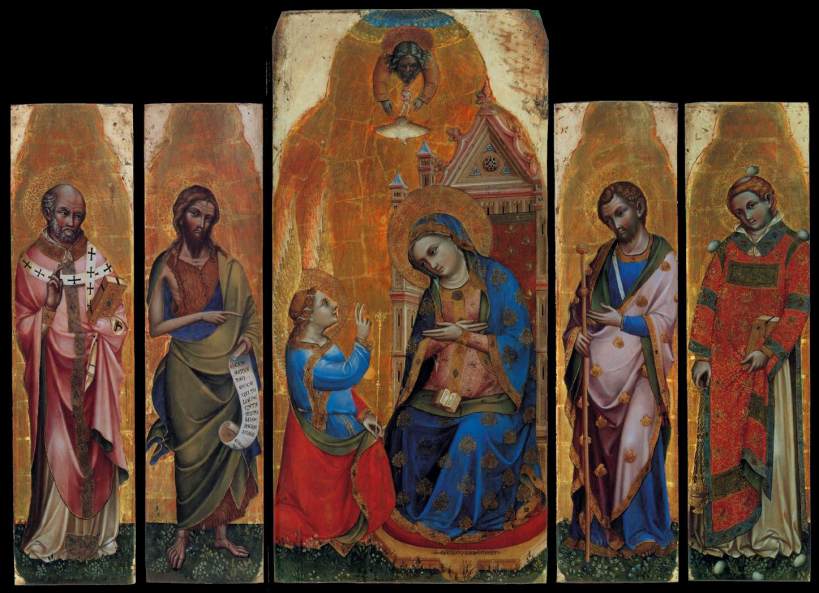
Annunciation with Saints by Lorezo Venzian
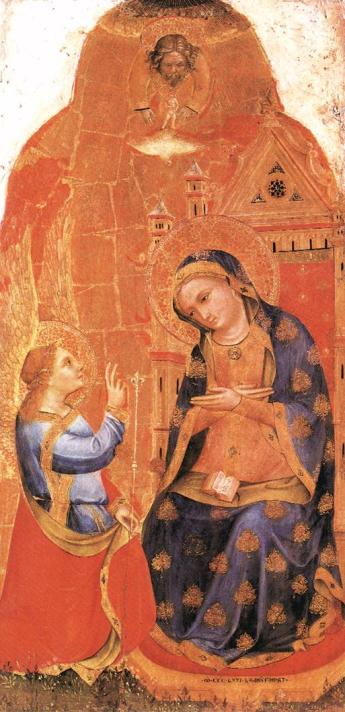
Annunciation by Lorezo Venzian (detail)
The Accademia fine Art Gallery of Venice, is one of the most important Italian museums. This painting, signed and dated in 1371, is the central panel of a polyptych. Here we can see clearly how Lorenzo Veneziano, in his mature work moved increasingly towards the musical expressiveness of colour shot through with Gothic accents.
The figure of the Virgin is sitting with her hands crossed prayerfully listening to the message of the angel. The angel is kneeling before her, his right hand raised and his wings pointing toward the sky where the Eternal Father appears, as a crowning figure releasing the dove with the unborn Christ Child.
But the knowledge and love of our Divine Redeemer, of which we were the object from the first moment of His Incarnation, exceed all that the human intellect can hope to grasp. For hardly was He conceived in the womb of the Mother of God, when He began to enjoy the Beatific Vision, and in that vision all the members of His Mystical Body were continually and unceasingly present to Him, and He embraced them with His redeeming love. Pope Pius XII, Mystici Corporis (On the Mystical Body of Christ) #75.
Filed under: Advent, Incarnation, Mother of the Lord, Unborn Jesus | Tags: byzantine painting, religion, wall paintings
AROUND THE WORLD AND THROUGH THE CENTURIES WITH THE UNBORN CHRIST CHILD
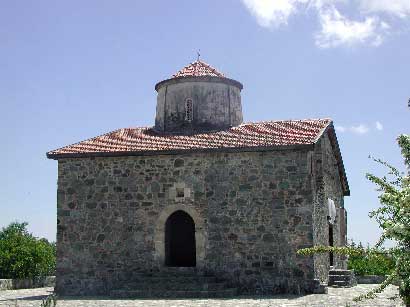
Timios Stavros Church
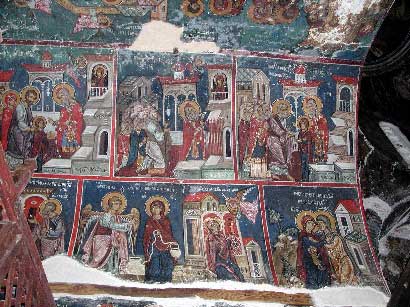
Timios Stavros Church Wall Painting (Full)
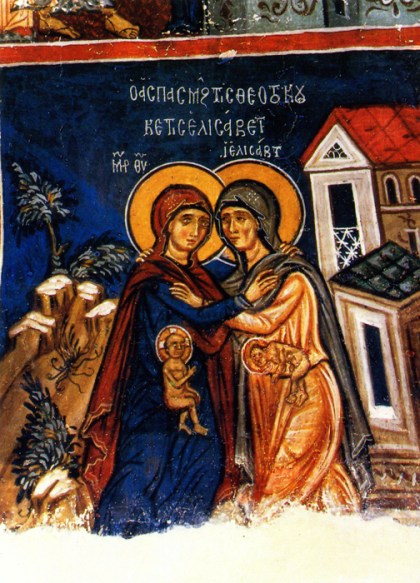
Unborn John the Baptist Bows Before Unborn Jesus Church Wall Painting (detail)
In the central part of Cyprus, in the mountains of the Troodos range, some of the most important monuments of the history of Byzantine painting have survived. These are painted churches which have preserved to this day brilliant examples of various trends of Byzantine and post-Byzantine monumental art, from the 11th to the 19th century. The church of Timios Stavros is situated in a central area of the Troodos mountain range, at the south end of the village of Pelendri.
The original church was destroyed under unknown circumstances. Only the apse survived, which was incorporated in a new church of the same type, built at the end of the 13th or the beginning of the 14th century. The main part of the church of Timios Stavros was decorated during the second half of the 14th century. At least two artists belonging to the same workshop were involved, together with their students. Many donors contributed towards this decoration complex. From these wall-paintings we can distinguish a group which follows the Palaiologan style developed in Constantinople during the 14th century.
“God has become a child, and so he wants first to be known and adored by a child…Thus the Infant-God is recognized and manifested, not by and angel, but by a child. So his first prophet is a child, just as shortly his first martyrs will be children.” Cardinal Bérulle (1575 -1629)
“I thank thee, Father, Lord of heaven and earth, that thou hast hidden these things from the wise and understanding and revealed them to babes; yea, Father, for such was thy gracious will.” Lk.10.21
AROUND THE WORLD AND THROUGH THE CENTURIES WITH THE UNBORN CHRIST CHILD
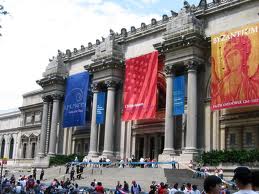
Metropolitan Museum of Art, New York City
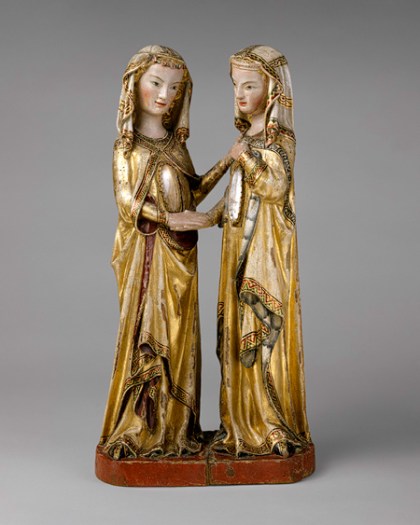
The Visitation This artwork is currently on display in Gallery 304
Soon after the Virgin Mary learned of her miraculous conception of Jesus, she visited her kinswoman Elizabeth, who was also expecting a child, John the Baptist. This representation of their joyous meeting comes from the Dominican convent of Katharinenthal, in the Lake Constance region of present-day Switzerland.
Carved of walnut, with the original paint and gilding almost completely preserved, the figures of Mary and Elizabeth are each inset with crystal-covered cavities through which images of their infants may originally have been seen. The representation of the Visitation incorporating images of the unborn Christ and John the Baptist, found with some frequency in contemporary works from German-speaking lands, emphasizes the moment when, according to “The Golden Legend,” Saint John, being unable “to manifest his joy with his tongue,” leapt “with joy in his mother’s womb.” The Virgin tenderly places her hand on Elizabeth’s shoulder, while her cousin raises her arm to her breast in reference to her declaration, “Who am I, that the mother of the Lord should visit me?” (Luke 1:43).
Bishop Austin Vaughn (1927-2000), formerly Auxiliary Bishop of New York, who himself was arrested a number of times for prayerfully protesting in front of abortion facilities once wrote in an article entitled The Catholic Duty to Be Pro – Life: “It is not an accident, I think, that in the scriptures the first person, after Mary, who adored Jesus when He came into the world was St. John the Baptist….The second person who ever worshipped Jesus, after Mary, was an unborn baby, and I think God made it that way to tell us in our day and age the worth and importance of every individual right from the very beginning of life”.
AROUND THE WORLD AND THROUGH THE CENTURIES WITH THE UNBORN CHRIST CHILD
Gallerie dell’Accademia, Venice, Italy
Annunciation with Saints by Lorezo Venzian
Annunciation by Lorezo Venzian (detail)
The Accademia fine Art Gallery of Venice, is one of the most important Italian museums. This painting, signed and dated in 1371, is the central panel of a polyptych. Here we can see clearly how Lorenzo Veneziano, in his mature work moved increasingly towards the musical expressiveness of colour shot through with Gothic accents.
The figure of the Virgin is sitting with her hands crossed prayerfully listening to the message of the angel. The angel is kneeling before her, his right hand raised and his wings pointing toward the sky where the Eternal Father appears, as a crowning figure releasing the dove with the unborn Christ Child.
But the knowledge and love of our Divine Redeemer, of which we were the object from the first moment of His Incarnation, exceed all that the human intellect can hope to grasp. For hardly was He conceived in the womb of the Mother of God, when He began to enjoy the Beatific Vision, and in that vision all the members of His Mystical Body were continually and unceasingly present to Him, and He embraced them with His redeeming love. Pope Pius XII, Mystici Corporis (On the Mystical Body of Christ) #75.
Filed under: Advent, Mother of the Lord, Quotes from Great Christians, The Incarnation, Unborn Jesus
AROUND THE WORLD AND THROUGH THE CENTURIES WITH THE UNBORN CHRIST CHILD
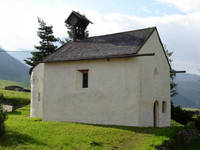
Chapel of St. Leonard Nauders Austria
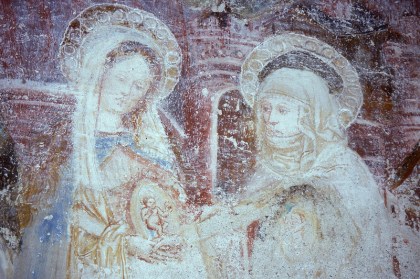
Maria Heimsuchung – One of Three Frescoes found in the Chapel of St. Leonard
The wall paintings in the Chapel of St. Leonard are among the most important Romanesque frescoes discoveries that have been made in North Tyrol ever. Their rediscovery goes back to 1914. Although the paintings are not completely preserved, they are among the earliest frescoes of North Tyrol and thus are important in Austria’s art history. The latest research link these frescos to benchmark examples in South Tyrol and Graubünden and assume that the frescoes were created by 1210.
“Truly He is in haste to be about His Father’s business. Truly He is an impatient conqueror, to be thus early beginning His conquests, and laying the foundations of His world wide empire. He can not bear to be in the world for even so short a while, but sin shall feel the weight of His unborn arm…..His first mission and ministry was in the womb, and the babe unborn the first conquest of His divine apostolate…..and the Unborn Child destroys the sin and abolishes the curse of the unborn child.” Frederick W. Faber, D.D., The Blessed Sacrament (Baltimore, MD: John Murphy Company, circa 1855), 162 163.
Filed under: Advent, Christmas, How are we to honor Unborn Jesus, Incarnation, Pro-life

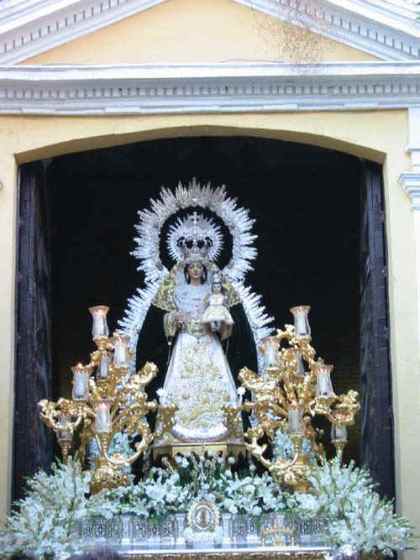
Our Lady of Hope, is renowned for her beauty. The image is from the second half of the 16th century but later restorations (one by Castillo Lastrucci), added to it‘s beauty and unmistakable Sevillian style. The Virgin wears a green coat with sterling silver lining, highlighting her magnificent crown. All year – except Advent – Mary holds the infant Jesus with her left hand and arm.
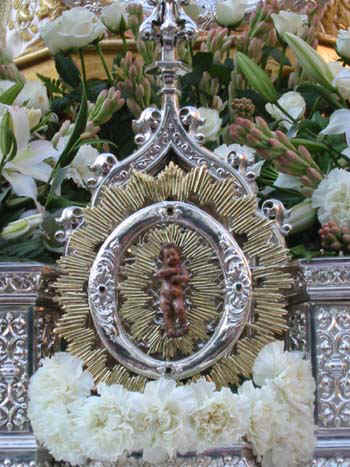
Below the statue (see above photos), in front of the basket appears an oval “O” iconographic detail of the Unborn Christ Child (reminiscent of the Advent “O” antiphons).
During Advent, the oval with the Unborn Christ is placed upon the Virgin, in front of her womb. (The infant Jesus is taken down from Mary’s left hand during Advent and placed in an ornate casing.) See photos below.
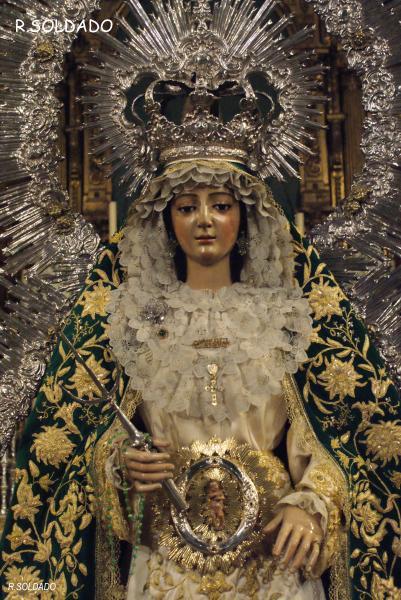
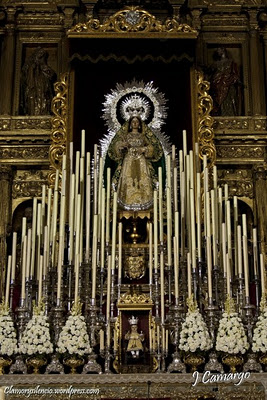
Then, on Christmas day the unborn Christ oval is returned to its place below the statue and the infant Jesus returned to Mary’s hand. These rituals give a unique charm to this statue and the Incarnation event.
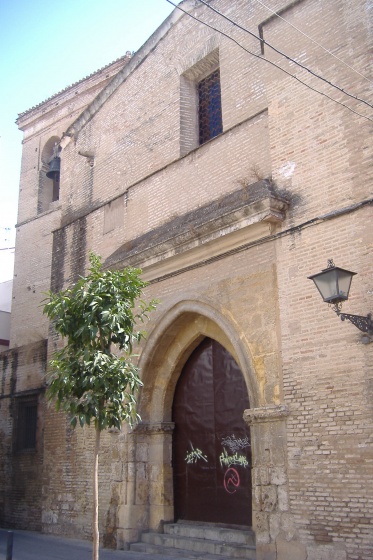
Iglesia de San Martín de Tours de Sevilla
Filed under: Advent, Christmas, How are we to honor Unborn Jesus, Incarnation, Unborn Jesus
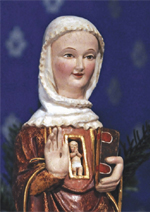
Over the last number of years, we have found over 100 images of Christ in Mary’s womb from around the world. Recently, we discovered that 2 of these images are part of an Advent Tradition that surprised us. The St. Phillip Neri Institute in Berlin has a wonderful statue that a friend of theirs carved for them. It is a copy of a miraculous statue of “Maria Gravida” that is in the Church of Maria Hilf Assumptio in Malta, Austria. This miraculous statue dates from around the 1400’s.
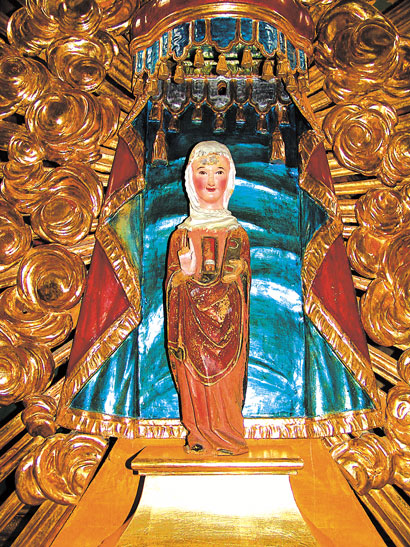
Maria Gravida (1400) Malta, Austria
Below are a few views of the statue of Maria Gravida at St. Phillip Neri Institute in Germany
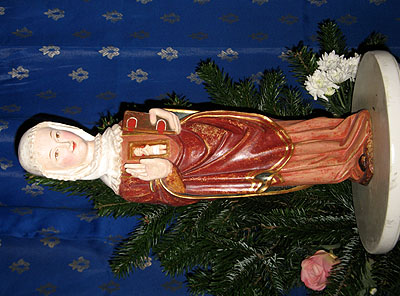
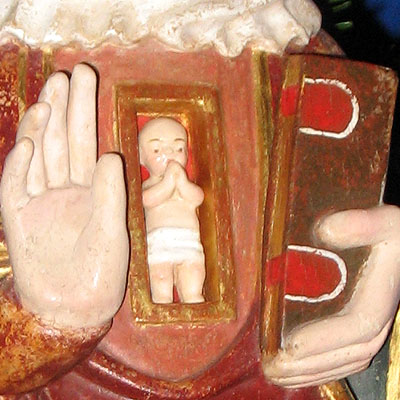
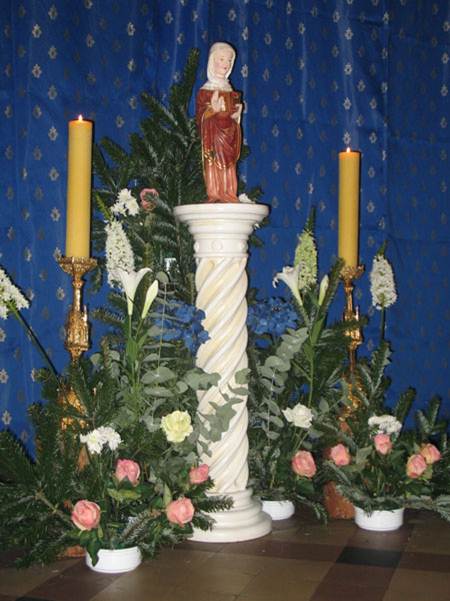
During Advent this Maria Gravida statue is placed on a pedestal in front of a blue curtain – behind the curtain is a Nativity scene. At Midnight on Christmas eve, the statue of Mary Pregnant is taken off the pedestal and the Nativity scene is unveiled.
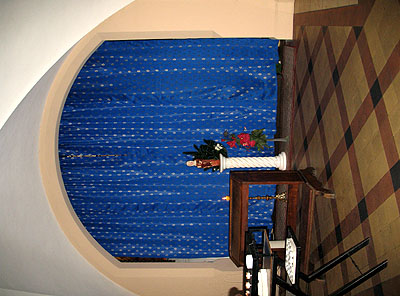
Maria Gravida, December 24, Christmas Eve day
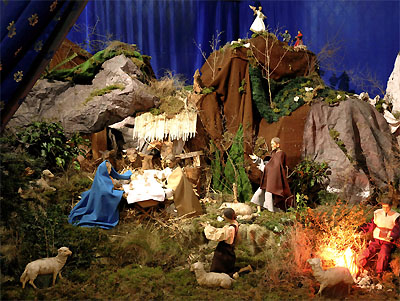
Nativity Scene, Christmas Eve Midnight
We have also discovered a similar tradition for the statue of Our Lady of Divine Hope in the Iglesia de San Martín Sevilla in Spain which we will highlight in a future post.
 UNBORN WORD of the day