


Filed under: Unborn Jesus
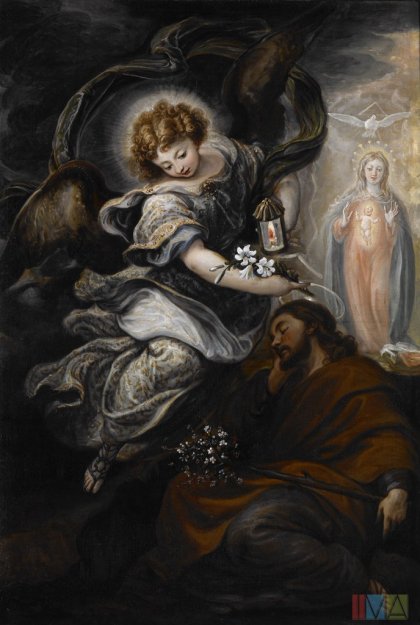
The Dream of St. Joseph (with unborn Christ Child) by Francisco Rizi (1608-1685)
In a subject that became popular in Spain during the 17th century, an angel appears to St. Joseph in a dream and explains that Mary has miraculously conceived a child. The luminous angel points to a vision of Mary with the infant Christ in her womb and the dove of the Holy Spirit above her. The veneration of the expectant Virgin as protectress of women in childbirth was prevalent at the Spanish court and was promoted by the royal confessor.
The angel comes to Joseph in a dream, pointing to the luminous vision of Mary crowned with stars (Apocalypse 12:1), with the Divine Spirit (dove and triangle) hovering over her and Jesus Incarnate in her womb. The angel also seems to carry a book and a light, perhaps indicating the fulfillment of the prophecies quoted in Matthew’s text. The white flowers may indicate the fruitful virginity that Joseph is to share with Mary and Jesus. Joseph’s halo shows him to be the “righteous man” of faith (Matthew 1:19). The angel communicates to Joseph his vocation as husband of the Mother of God.
Francisco Rizi was the Spanish-born son of a Bolognese painter who went to work for Philip II at the Escorial in 1583. Rizi, became the royal painter to Philip IV in 1658.
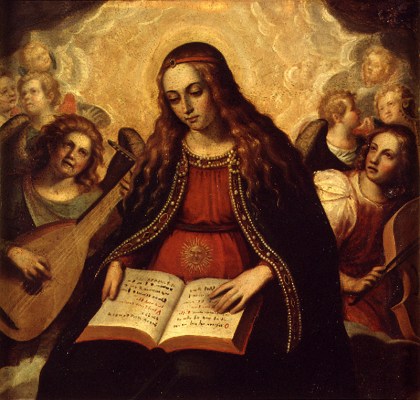
Virgen de la Esperanza-Our Lady of Expectation
Tuesday, April 28 is the feast day of St. Louis de Montfort. Here are a few quotes from him about Christ’s time in the womb.
God the Son came into her virginal womb as a new Adam into his earthly paradise, to take his delight there and produce hidden wonders of grace.
God-made-man found freedom in imprisoning himself in her womb. He displayed power in allowing himself to be borne by this young maiden. He found his glory and that of his Father in hiding his splendors from all creatures here below and revealing them only to Mary. He glorified his independence and his majesty in depending upon this lovable virgin in his conception, his birth, his presentation in the temple, and in the thirty years of his hidden life.
The Incarnation is the first mystery of Jesus Christ; it is the most hidden; and it is the most exalted and the least known. It was in this mystery that Jesus, in the womb of Mary and with her co- operation, chose all the elect. For this reason the saints called her womb, the throne-room of God’s mysteries
Our good Master stooped to enclose himself in the womb of the Blessed Virgin, a captive but loving slave, and to make himself subject to her for thirty years. As I said earlier, the human mind is bewildered when it reflects seriously upon this conduct of Incarnate Wisdom. He did not choose to give himself in a direct manner to the human race though he could easily have done so. He chose to come through the Virgin Mary. Thus he did not come into the world independently of others in the flower of his manhood, but he came as a frail little child dependent on the care and attention of his Mother.
From: Treatise on True Devotion To The Blessed Virgin
by St. Louis de Montfort
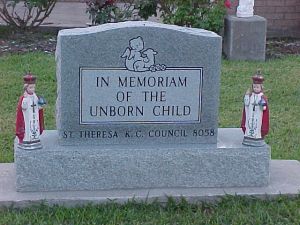
“We proclaim a God who became Incarnate. Jesus Christ, the Second Person of the Blessed Trinity. This Jesus walked the way of every human person. That included taking that extraordinary journey into the first home of the whole human race, his Mothers womb. This new chemical concoction ensures there will be no room in the womb for millions for whom He came.”
From:‘Plan B’ for 17 year old girls: Equipping Children to Kill Children? By Deacon Keith Fournier
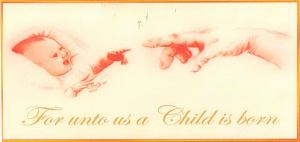
God’s Language of Harmony
by Sister M. Linus Coyle
I looked into the mind of God,
His Will residing in the Son.
I looked into the heart of Christ,
and saw His Will fulfilled.
I looked into the Will of God
and saw its breath of Love.
I looked into the depth of Love
so Spirit shadowed from above.
This led me to each human child
Where God’s glory-hopes of love are fed.
And then I knew God’s fatherhood
as cherished image of His Son;
for life within a mother’s womb
would share Life’s weaving loom
freedom to begin again
in YES to life from Him.
The breath of Love might cherish yet
A life Christ entering would become
Sister M. Linus Coyle belongs to the order of the Sisters of the Presentation. She receives our e-newsletter and sent us this beautiful poem/reflection on the dignity of each unborn child conceived in the image and likeness of God.

Father Richard Neuhaus, a great friend to the unborn died earlier this year. In 2008 he gave a memorable speech at the National Right to Life Convention. Here are a couple of excerpts from his speech.
At one point, he talks about the moment he knew that he was ‘recruited’ for the cause of the culture of life. My husband and I have often spoken about the fact that we both know the exact moment when we realized that this issue was more important than any other social issue of our time. We have even likened what happened to us as a type of conversion. Father Neuhaus speaks very eloquently about this moment.
“In that moment, I knew that I had been recruited to the cause of the culture of life. To be recruited to the cause of the culture of life is to be recruited for the duration; and there is no end in sight, except to the eyes of faith. Perhaps you, too, can specify such a moment when you knew you were recruited. At that moment you could have said, “Yes, it’s terrible that in this country alone 4,000 innocent children are killed every day, but then so many terrible things are happening in the world. Am I my infant brother’s keeper? Am I my infant sister’s keeper?” You could have said that, but you didn’t. You could have said, “Yes, the nation that I love is betraying its founding principles—that every human being is endowed by God with inalienable rights, including, and most foundationally, the right to life. But,” you could have said, “the Supreme Court has spoken and its word is the law of the land. What can I do about it?” You could have said that, but you didn’t. That horror, that betrayal, would not let you go. You knew, you knew there and then, that you were recruited to contend for the culture of life, and that you were recruited for the duration.”
Here is another excerpt from this speech that gave me great hope. I believe it describes the attitude of many pro-lifers and this is one of the reasons that I think that someday the rights of the unborn will be restored:
“We shall not weary, we shall not rest, until every unborn child is protected in law and welcomed in life. We shall not weary, we shall not rest, until all the elderly who have run life’s course are protected against despair and abandonment, protected by the rule of law and the bonds of love. We shall not weary, we shall not rest, until every young woman is given the help she needs to recognize the problem of pregnancy as the gift of life. We shall not weary, we shall not rest, as we stand guard at the entrance gates and the exit gates of life, and at every step along the way of life, bearing witness in word and deed to the dignity of the human person—of every human person.”
We Shall Not Weary, We Shall Not Rest By Richard John Neuhaus

In the temporal order we say that the shortest distance between two points is a straight line.
In the spiritual order we can say that the truest path between two events in the Plan of Salvation is simply the will of God.
This can be demonstrated in the life of Jesus Christ. Let’s consider the Incarnation and the Resurrection. When Christ came into the world – according to the Letter to the Hebrews – He said:
“Sacrifices and offerings thou hast not desired,
but a body hast thou prepared for me;
in burnt offerings and sin offerings thou has taken no pleasure.
Then I said, ‘Lo, I have come to do thy will, O God,
as it is written of me in the roll of the book.’” Heb 10:5-7
St. Alphonsus de Ligouri, a Doctor of the Church, says Christ spoke these words at the first moment of His conception. The Church has traditionally believed this also and links this scripture passage to the Feast Day of the Annunciation/Incarnation on March 25 (nine months before Christmas Day).
Christ spoke often – directly and indirectly – about doing the Father’s will. For example, it is incorporated for all time into the Lord’s Prayer: “Thy will be done”.
But in Gethsemane He re-dedicated Himself to it – three times: “My Father, if it be possible, let this cup pass from me; nevertheless, not as I will, but as thou wilt.” (Mt 26:39,42,44). The prayer in Gethsemane was a holy point of reckoning, for humanity in general, and for the humanity of Our Lord in particular. Jesus Christ – fully God and fully man – not only adhered to the will of God, in fact, He bowed down to it and fastened His human will to it by the bloody sweat of His brow (Lk 22:44).
For one of the soldiers presiding at the crucifixion, the shortest distance between him and the Savior’s Heart was a spear – which he didn’t hesitate to thrust. For us that distance can be traveled in prayer – which we shouldn’t hesitate to offer.
The Catechism of the Catholic Church tells us that the Resurrection of Christ is the “fulfillment in accordance with God’s eternal plan” of His Incarnation (CCC#653). The true distance from the Incarnation to the Resurrection is the Will of God; a Merciful Will of Love poured out lavishly upon the human situation; cause for great joy!
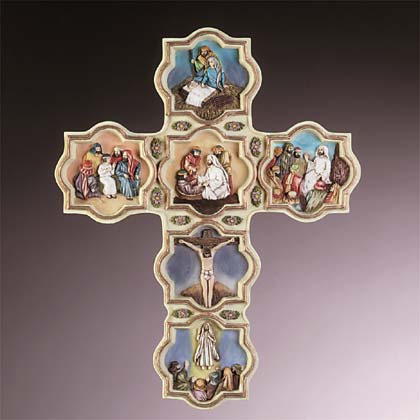
“Taking up St. John’s expression, “The Word became flesh”, the Church calls “Incarnation” the fact that the Son of God assumed a human nature in order to accomplish our salvation in it.” Catechism of the Catholic Church 461
“Christ’s Resurrection is closely linked to the Incarnation of God’s Son, and is its fulfillment in accordance with God’s eternal plan.” Catechism of the Catholic Church 653
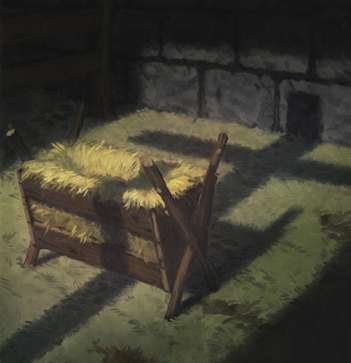
Today, during the Stations of the Cross , Pope Benedict prayed this prayer at the Seventh Station.
“We have faith, Lord, but not enough. Help us to have more. May we never question or mock serious things in life like a cynic. Allow us not to drift into the desert of godlessness. Enable us to perceive you in the gentle breeze, see you in street corners, love you in the unborn child.
God, enable us to understand that on Tabor or Calvary, your Son is the Lord. Robed or stripped of his garments, he is the Saviour of the world. Make us attentive to his quiet presences: in his “word”, in tabernacles, shrines, humble places, simple persons, the life of the poor, laughter of children, whispering pines, rolling hills, the tiniest living cell, the smallest atom, and the distant galaxies.
May we watch with wonder as he walks on the waters of the Rhine and the Nile and the Tanganyika.”
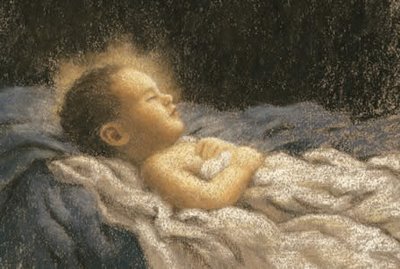
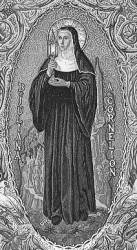
You may have never heard of Blessed Juliana of Cornillon (Juliana of Liege), 1192 -1258. She was an Augustinian nun who was the first promoter of a feast day in honor of the Blessed Sacrament. She has been recognized as the person primarily responsible for the introduction of the Corpus Christi feast day during the middle ages. According to Acta Sanctorum, she had a unique and extraordinary devotion. She said the Magnificat (Lk 1:46-55) nine times a day; once for each month that Our Lord spent in the womb of His mother. (The Magnificat was proclaimed by Mary while she was pregnant.) One can not help but see the beautiful connection here in Juliana’s spiritual life between her devotion to the Body of Christ in the womb and the Body of Christ upon the altar.
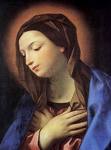
Which leads us to the second woman: Mary the Mother of Jesus. In his encyclical letter ECCLESIA DE EUCHARISTIA, On the Eucharist in Its Relationship to the Church, John Paul II discusses Mary and the Eucharist:
“In a certain sense Mary lived her Eucharistic faith even before the institution of the Eucharist, by the very fact that she offered her virginal womb for the Incarnation of God’s Word. The Eucharist, while commemorating the passion and resurrection, is also in continuity with the incarnation. At the Annunciation Mary conceived the Son of God in the physical reality of his body and blood, thus anticipating within herself what to some degree happens sacramentally in every believer who receives, under the signs of bread and wine, the Lord’s body and blood.”
“As a result, there is a profound analogy between the Fiat which Mary said in reply to the angel, and the Amen which every believer says when receiving the body of the Lord. Mary was asked to believe that the One whom she conceived “through the Holy Spirit” was “the Son of God” (Lk 1:30-35). In continuity with the Virgin’s faith, in the Eucharistic mystery we are asked to believe that the same Jesus Christ, Son of God and Son of Mary, becomes present in his full humanity and divinity under the signs of bread and wine.”
“Blessed is she who believed” (Lk 1:45). Mary also anticipated, in the mystery of the incarnation, the Church’s Eucharistic faith. When, at the Visitation, she bore in her womb the Word made flesh, she became in some way a “tabernacle” – the first “tabernacle” in history – in which the Son of God, still invisible to our human gaze, allowed himself to be adored by Elizabeth, radiating his light as it were through the eyes and the voice of Mary. And is not the enraptured gaze of Mary as she contemplated the face of the newborn Christ and cradled him in her arms that unparalleled model of love which should inspire us every time we receive Eucharistic communion?”(#55)
“The Eucharist has been given to us so that our life, like that of Mary, may become completely a Magnificat!” (#58)
Our last post gave reflections by John Paul II on his “Gospel of Life” Encyclical, 5 years after its issuance. Here are more of those reflections, taken from the second half of his discourse. John Paul II called for an APOSTOLATE OF LIFE:
“An authentic apostolate of life cannot be simply delegated to specific movements, however praiseworthy, that work in the sociopolitical field. It must be an integral part of the Church’s pastoral ministry, whose task is to proclaim the ‘Gospel of Life’. For this to be effective, it is important to set up educational programs, as well as services and special structures for guidance and support.”
“…it should be given practical expression by offering services that will enable anyone in trouble to find the necessary help.”
“…efforts should be made so that these services become a ‘sign’ and a message.”
“Just as the community needs places of worship, it should sense the need to organize, especially at the diocesan level, educational and operational services to support human life, services that will be the fruit of charity and a sign of vitality.”
“…accompanied by the changing of mentalities and morals on a vast scale, in an extensive and visible way. In this area the Church will spare no effort nor can she accept negligence or guilty silence.”
“I turn in particular to those young people…may they be the first agents and beneficiaries of the work that will be done in the context of the apostolate of life.”
“May every person of good will feel called to play an active part in this great cause. May he be sustained by the conviction that every step taken in defending the right to life and its concrete advancement is a step towards peace and civilization.”
UNBORNWORDoftheday Comments on John Paul II’s reflections: John Paul called for “an authentic apostolate of life” that he said “must be an integral part of the Church’s pastoral ministry”. He describes this apostolate of life in terms of education, services and structures that will present a sign and deliver a message borne of charity, all “in defending the right to life and its concrete advancement”. It seems to us that the Pope was envisioning a New form of comprehensive Pastoral Outreach for the 21st century. A New pastoral ministry combining education and services “especially at the diocesan level” which would “support human life”. This seems to be a radical challenge from John Paul the Great to “every person of good will”. Are we up to it? Are we willing? Remember his sobering warning: “…the Church will spare no effort nor can she accept negligence or guilty silence”.
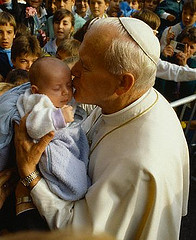
At a Vatican symposium in early 2000 commemorating the 5th anniversary of his prophetic “Gospel of Life” Encyclical Letter , John Paul made some interesting comments about the document (Latin title is: Evangelium Vitae). Here are two of those comments.
“I started from a vision of hope for humanity’s future.”
“…a document which I consider central to the whole Magisterium of my Pontificate and in thematic continuity with the Encyclical Humanae Vitae of Pope Paul VI of venerable memory.”
John Paul also gives the following two facts about the Gospel of Life:
- “The persistent difficulty which this message encounters in a world marked by serious signs of violence and decadence.”
- “The unchanging validity of this message and also the possibility of it being accepted in a society where the community of believers, with the concerned involvement of people of good will, courageously and unitedly express its commitment.”
John Paul then called the Encyclical’s message: “a reference point for civil salvation”.
In our next post we will present Part II of this reflection & John Paul’s expectation for ACTION by all of us!
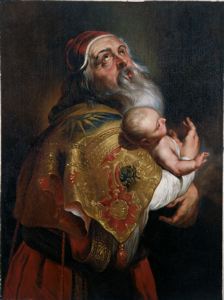
Simeon Holding the Christ Child
When the baby Jesus was still a newborn Mary and Joseph presented Him to the Lord according to Jewish custom. As they left the Temple they met a holy man named Simeon (Lk 2:25-35). He prayed to God and made a prophecy about the baby Jesus. In part, he said: “…this child is set for the fall and rising of many in Israel, and for a sign that is spoken against…” Other translations say “as a sign of contradiction” or a sign that will be “opposed”.
Yes Christ is “A Sign”. First He is a Person! A Divine Person! But He is also “A Sign of Contradiction”. Likewise – thanks be to God – The Unborn Christ Child is a Sign of Contradiction!
We learn from a Prophetic Sign! And if we study the life of Unborn Jesus we have lots of uplifting, beautiful, edifying and hopeful lessons to learn there!
But there is also this: Unborn Jesus is a sign of contradiction to the culture of death that is encroaching day-by-day into our culture and society. Thanks be to God, Unborn Jesus is at the spiritual heart of the Culture of Life that the Church is committed to.
Here are two examples: “…as you did it to one of the least of these my brethren, you did it to me” (Mt 25:40). “Whoever receives one such child in my name receives me.” (Mt 18:5). Mother Teresa of Calcutta, John Paul II and Benedict XVI have all commented on these words of Jesus in relation to unborn children. When your local abortion facility aborts a baby, it is aborting Christ. And when your local Pregnancy Counseling Center helps a pregnant woman carry her child to term, they are also helping Christ be born in Bethlehem!
There is an intersection between time and eternity, earth and heaven, the worldly powers and the Kingdom of God, the physical life and the spiritual realm, evil and Good, death and Life – and the newly conceived Christ Child at the one cell stage is at that very point of intersection! So is Christ Crucified & the Resurrected Christ! When Life meets death Christ is there! When adults kill babies Christ is there (with the babies)!
Thanks be to God, the Unborn Christ is Victor when He collides with this pathetic culture of death. We as Christians must be united with Him, in solidarity with all unborn children. To quote George Weigel, we must be busy about building “a culture-forming counterculture”. Two of its distinguishing marks will be: it is Christ-centered and Life-affirming!
To quote John Paul II: “…we are facing an enormous and dramatic clash between good and evil, death and life, the ‘culture of death’ and the ‘culture of life’. We find ourselves not only ‘faced with’ but necessarily ‘in the midst of’ this conflict: we are all involved and we all share in it, with the inescapable responsibility of choosing to be unconditionally pro – life.” (Evangelium Vitae #28).
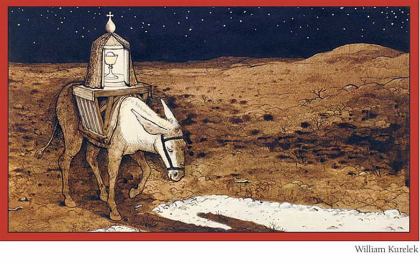
The Donkey Carrying God by William Kurelek
“The donkey that carried Our Lady to Bethlehem took another form in my thoughts. For he carried the Word—a dumb animal, carrying a Virgin who carried God—and so he was the carrier of God too. His bells were the first church bells, for Mary was the first Church, the first tabernacle of Christ.” Catherine Doherty foundress of Madonna House.
In another vein, St. Josemaria Escriva often compared himself to a donkey:
“One day at the beginning of the 1930s, the Founder of Opus Dei greeted Our Lord in the Tabernacle of the church of the St Elizabeth Foundation with these words: “Here is your mangy little donkey!” and heard in reply the gentle response, “A little donkey was my throne in Jerusalem.”
The donkey, docile, humble and hard-working, was an animal for which St Josemaria had always felt a special affection. He saw himself as a donkey – in the words of Psalm 73[72], ‘ut iumentum’. From The ‘theology of the donkey’.
‘I am like a beast (donkey) in your presence, but I am continually with you. You hold my right hand.’ (Psalm 72:23-24)

Nuestra Señora de la Esperanza
Today is the Feast of the Annunciation. Here are two beautiful quotes from Pope Pius XII which show us that right from the moment of His conception in Mary’s womb Christ our Savior embraced us with His redeeming love.
“But the knowledge and love of our Divine Redeemer, of which we were the object from the first moment of His Incarnation, exceed all that the human intellect can hope to grasp. For hardly was He conceived in the womb of the Mother of God, when He began to enjoy the beatific vision, and in that vision all the members of His Mystical Body were continually and unceasingly present to Him, and He embraced them with His redeeming love.” Pius XII Mystici Corporis , 75
“The Virgin Mary utters that generous word, “be it done”…Immediately the Heart of Jesus, ever to be adored, has begun to pulsate with love, divine and human” Pius XII, On Devotion to the Sacred Heart of Jesus, 63.
Filed under: Papal Quotes, Quotes from Great Christians, Thriving Not Just Surviving!
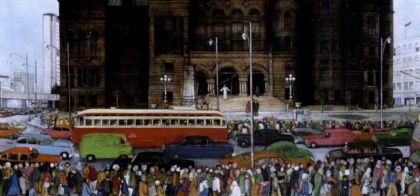
Toronto, Toronto by William Kurelek
“The Christian of the future will be a mystic or he will not exist at all.“
Karl Rahner, Theological Investigations XX, Concern for the Church, “The Spirituality of the Church of the Future”, translated Edward Quinn (New York: Crossroad, 1981), p. 149.————————————————————————————————————————————————–
“I have often had occasion to remember a saying of Pope Pius XI that was a favorite of Dorothy Day, co-founder of the Catholic Worker movement. “Let us thank God that he makes us live among the present problems; it is no longer permitted to anyone to be mediocre.” Catholicism’s Bright Future Seven Signs in America That the End Is Nowhere Near By George Weigel
After some research I was able to find this quote in the context of part of the larger statement Pius XI made:
Pius XI was even more insistent that the layman fulfill his function in the Church. He wrote: “It is absolutely necessary that in this our age all should be apostles: it is absolutely necessary that the laity should not sit idly by. . . . The crisis we are experiencing is unique in history. It is a new world that must burst out of a crucible in which so many different energies are boiling. Let us thank God that He makes us live among the present problems. It is no longer permitted to anyone to be mediocre. Everyone has the imperative duty to remember that he has a mission to fulfill, that of doing the impossible, each within the limits of his activity, to bring the world back to Christ.” Program of Action (Grailville, Loveland, Ohio, 1946)
Filed under: Medical/Bioethical Issues
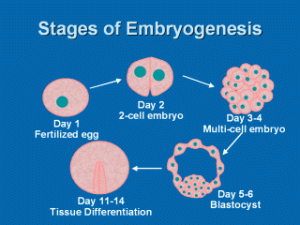
This post from one of my favorite bloggers, Kelly Clark, is just so startling that I am putting it up for you to read. The video link at the end of her post is really short and worth watching.
_______________________________________________________________________________________
Former President Bill Clinton on embryos and I am not making this up!
I tried to embed the Larry King Live interview after being alerted by alert watcher Deborah but couldn’t. She writes:
Clinton spoke about embryos not being fertilized and said that if embryos were ever on their way to be fertilized, they shouldn’t be used for experimentation. He said this one way or another about 3 or 4 times and then ended by saying it unequivocally.
I couldn’t believe my ears! Surely, I thought, Dr. Gupta – a medical doctor, isn’t he? – is going to nicely point out that an embryo is an embryo because it has been fertilized, that it is a genetically complete fully fertilized egg. Gupta said nothing.
Can it be that Bill Clinton and Dr. Gupta don’t really know what an embryo is?
I hope someone in the pro-life movement will use the clip of Clinton saying fertilized embryos should not be used for experimentation!
Anyway, you’ve GOT to watch this: Dr. Sanjay Gupta interviews Bill Clinton on embryonic stem cell research
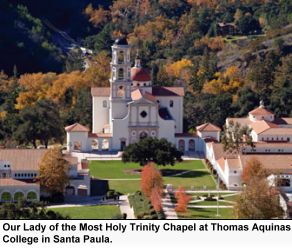
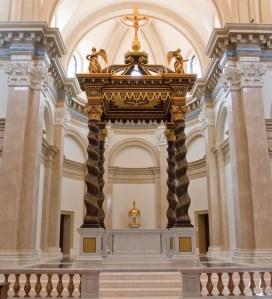
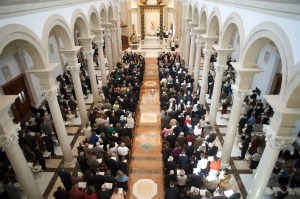
A Chapel Dedication
On the occasion of the Chapel Dedication at Thomas Aquinas College, March 7, 2009.
Today the Mystical Body of Christ is enriched
And this Archdiocese made more fruitful
The Holy Spirit unleashed God’s bounteous gifts
To bolden Christ’s witnesses ever truthful.
A Church, exquisite in splendor, yet humble
Frail in human stature, enflamed by Heaven
Not burning as others might suppose, rather
A light on a hill, in a valley, for a Mission.
Incense smoke ascending, wafting throneward
By the breezes of prayer, and Dedication.
A quake felt thro’ and beyond the Church wall
A Grace quake tumbling out the doors to Creation.
Forty odd miles away it overswept me
This soothing tsunami of light and compassion
The Woman in her pangs of birth is enlivened
Her young scholar soldiers of Peace to fashion.
Good neighbors and great almsgivers did gather
With Aquinas and a saintly host on this day.
The founders had ardently desired fruition,
Of pleasing Him, to Whom true homage we pay.
George A. Peate
 UNBORN WORD of the day