The strong manly apostle, St. Paul, had a tender side to him and revealed it, from time to time, to his “children in the faith”. For example, in letters to the churches of Corinth and Philippi, he speaks about writing to them with tears (II Cor 2:4. Phil 3:18). But one of his better known quotes advises: “Rejoice with those who rejoice, weep with those who weep” (Rom 12:15).
Christ Himself is the model for this. St. John the Evangelist describes a very emotional scene following the death of Lazarus, when Mary the sister of Lazarus falls on the ground weeping before Jesus, and her friends and neighbors are around her weeping as well. John tells us that Jesus “was deeply moved in spirit and troubled”. Then He asks where the body is laid, and when the people say “Lord, come and see” – Jesus breaks down and weeps. We are told that this is the shortest verse in the entire Bible: “Jesus wept” (Jn11:35).
Over the past few decades, billions of tears have been shed for unborn children. We can speculate that mothers have been the primary source of these rivers of tears simply because they are so close to unborn children, their lives more sensitized to tinier lives hidden within their bodies, their hearts listening for soft heartbeats signaling life close by.
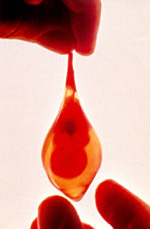
Back in the early 1970’s, as the Pro – Life movement was quickening, there was a powerful photograph of a tiny unborn child removed as a result of an ectopic pregnancy – my recollection is that the people referred to it as “the teardrop baby”. The doctor who took the photo spoke about the remarkable effect this tiny unfortunate “unborn” child had on those present. But the image of an “unborn” baby naturally formed into a teardrop stopped people in their tracks.
Doctors tell us that unborn children feel pain (Watch Me Grow, by Professor Stuart Campbell, M.D., 2004). This is, of course, to state the obvious. 3D ultrasounds show unborn babies grimacing. Do they cry also?
Christ died for us, and no doubt He also shed tears during His Passion for us. In his Letter to the Galatians St. Paul speaks of “the Son of God, who loved me and gave himself for me” (Gal 2:20). In effect, St. Paul is saying that Christ ‘died for me’. We can all say this with confidence. Likewise, each of us can say ‘Christ shed a tear for me’. Which also brings us back to the unborn children – Christ shed a tear for each unborn child and loves each one personally.
Divine tears and human tears are a part of our lives now. The tear Christ shed for me is His tear of Hope for me. Because a great sign of the New Jerusalem is that God Himself will be with us and “He will wipe away every tear from (our) eyes” (Rev 21:3-4).
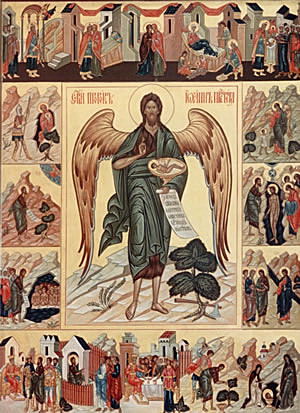
The Life of St. John the Baptist is depicted in this Icon
You know Luke’s marvelous account of the Visitation, when Mary greets Elizabeth and Elizabeth’s baby leaps for joy within her womb. Let’s look at this from a different angle:
Previously the Angel Gabriel had told Elizabeth’s husband that her son John “will be filled with the Holy Spirit, even from his mother’s womb” (Lk1:15).
Mary is pregnant with Unborn Jesus when she arrives at the home of Elizabeth, greets her and then unborn John leaps for joy. The leap signifies that John has just been “filled with the Holy Spirit”.
Let’s look at how the Catechism of the Catholic Church comments on the scene: “John was ‘filled with the Holy Spirit even from his mother’s womb’ by Christ himself, whom the Virgin Mary had just conceived by the Holy Spirit. Mary’s visitation to Elizabeth thus became a visit from God to his people” (#717). Note carefully that John is filled with the Holy Spirit by Christ himself. It is Christ Unborn – perhaps but a week old within His mother’s womb – who acts, who initiates.
But the Catechism goes on to say that the visit is truly a visit “from God” – that is, Unborn Jesus – “to his people” – that is, primarily to unborn John. So unborn John represents the people of God – that is, the Church.
What happens when “God” visits “his people”? He pours His Spirit into them. One of the greatest documents from Vatican II is Lumen Gentium (“Christ is the light of humanity…” it begins). It refers to the Church as “the people of God” and tells us that Christ “sent the Holy Spirit to all to move them interiorly to love God…” (LG 40). Of course, this is what He did for unborn John the Baptist!
In a section specifically about the laity, Lumen Gentium specifically teaches: “The laity become powerful heralds of the faith in things to be hoped for (cf. Heb 11:1) if they join unhesitating profession of faith to the life of faith” (LG 35). This is what unborn John did! After Mary, he was the first ‘herald of the faith’ through his ‘unhesitating profession of faith’! (For if he experienced joy he must have been given the gift – even if only temporarily – of reason, and thus also the gift of faith in his Redeemer. So the Church Fathers believed.) By leaping, he is heralding the faith. The first layman was an unborn layman!
Lumen Gentium also states: “Every lay person, through those gifts given to him, is at once the witness and the living instrument of the mission of the Church itself ‘according to the measure of Christ’s bestowal’ (Eph 4:7)” (LG 33). After Mary, Unborn John is the Church’s first “witness” and “living instrument of the mission of the Church”.
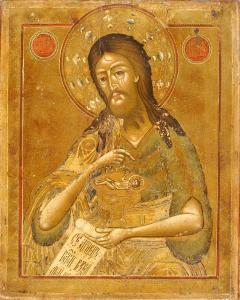
There is one tradition of St. John the Baptist icons that portray him pointing to the Christ Child (unborn). In his left hand he holds a chalice or charger and a scroll that reads, “Behold the Lamb of God which taketh away the sins of the world”. With his right hand he points to the Christ Child (unborn).
St. Leo the Great (A.D. 400?-461) has a wonderful quote that expresses in words what these icons express in art:
“…when at her greeting, John (in the womb of Elizabeth and not yet born) was stirred with prophetic exaltation-as if even in his mother’s womb he were already crying out, ‘Behold the Lamb of God, behold the one who takes away the sins of the world’.” ) Sermon 35
Here are a few more icons in this tradition:
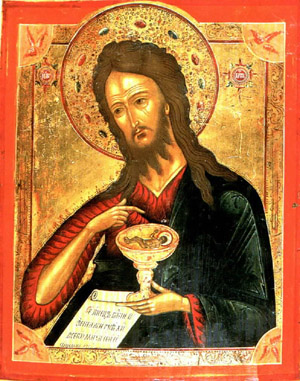
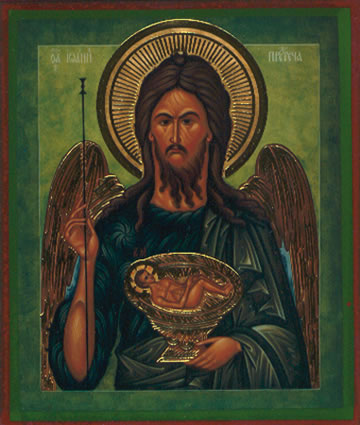
St. John the Forerunner and Baptist of our Lord
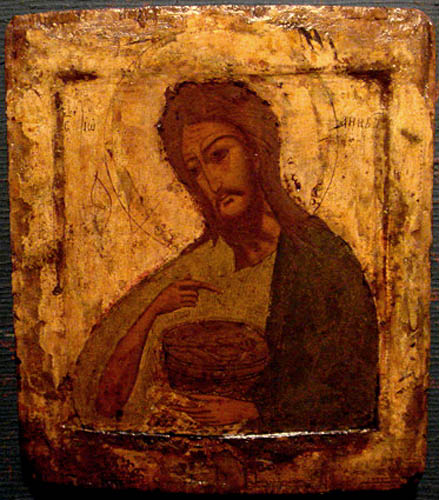

Maria der erste Tabernakel von J. Hane
The reading for Mass today included these wonderful words:
“For God so loved the world that he gave his only son, that whoever believes in him should not perish but have eternal life.”
From the first cell stage of His conception and new human life, Christ loved His Father in heaven and all of us on earth. Pope Pius XII assures us that from the first moment of His conception, “the Heart of Jesus, ever to be adored, began to pulsate with love, divine and human” (On Devotion to the Sacred Heart of Jesus).
We know that from the first moment of His conception the Unborn Christ (as Zygote, the one cell stage) joined His will to the will of His Father (Heb 10:5-7). ) Pius XII tells us “But the knowledge and love of our Divine Redeemer, of which we were the object from the first moment of His Incarnation, exceed all that the human intellect can hope to grasp. For hardly was He conceived in the womb of the Mother of God, when He began to enjoy the beatific vision, and in that vision all the members of His Mystical Body were continually and unceasingly present to Him, and He embraced them with His redeeming love.” The Mystical Body Of Christ, #75
We believe too that Christ loved His mother from the first moment of His conception (and that she joined her will to His; “Behold, I am the handmaid of the Lord; let it be to me according to your word.” Lk 1:38
And a week later in her Magnificat, when Mary says “My soul magnifies the Lord…” first and foremost, she magnified the Love of Christ hidden within her. His love was bursting forth from the womb which contained Him. His love, in a sense could not be contained along with His tiny body, within the womb of His mother.
When Mary arrived at the home of Elizabeth (six months pregnant with John the Baptist), the Catechism of the Catholic Church tells us that it was “Christ Himself” who filled unborn baby John with His Spirit of Love (CCC #717). Christ demonstrates His love here for unborn baby John and all unborn babies!
Out of Love, Unborn Christ inspires His mother to stay for the entire pregnancy of Elizabeth, accompanying unborn John lovingly to birth.
When they return to Nazareth, Unborn Christ loves Joseph too. In Bethlehem He loves the shepherds, the wise men, even those who rejected Him and His pregnant mother at the door of the Inn. At His glorious birth in the manger, His powerful Love broke forth like a wave of Love across the earth, hidden for a time, but affecting Mary and Joseph and countless others who would discover in time the message of Redeeming Love!
Filed under: Pope Benedict XVI

We are changing the focus of our blog for today in an effort to provide a collection of well-written articles on the topic of child sexual abuse media coverage and attempts to smear and discredit the Pope. All sexual abuse of children was and is horrific! But a lot of the ‘reporting’ in today’s mainstream media has degenerated into agenda-driven journalism rather than fact-based journalism. One key agenda item is to destroy the Church and especially its moral teaching capabilities.
With this in mind, we are providing articles (links) that show just how bad and misleading this reporting has been:
1. This article is written by the canonical judge in the Wisconsin case that the New York Times first broke. I found this article interesting because of how credible it is – This priest wrote it to outline how “sloppy and inaccurate” the “reporting on the Father Murphy case by the New York Times and other media outlets” was. I heard about it and had to search it out.
Update: Milwaukee church judge clarifies case of abusive priest Father Murphy
2. Here is another interesting article on the same Wisconsin abuse case by Father DeSousa – which details the facts.
A Response to the New York Times [Fr. Raymond J. de Souza]
3. On the blog (What Does Prayer Really Say) Father Z documents how the New York Times relied on a faulty translation of letters between the Vatican and the Diocese of Milwaukee in the article they wrote on the abuse case.
NYT used bad translator, made gross errors
4. Here is another interesting article by John Allen. It is called Will Ratzinger’s Past Trump Benedict’s Present. As he gets into the article he actually shows how Pope Benedict has done more than almost any other churchman to deal forthrightly with the child abuse scandals.
Will Ratzinger’s Past Trump Benedict’s Present
5. This is an article by a Jewish Rabbi who thinks that Cardinal Ratzinger is getting unfair treatment.
Rabbi calls media coverage of Church abuse scandal one-dimensional
6. The following article does a good job of putting a context to the child abuse scandals, Sandro Magister, a veteran Vatican reporter also points out that Cardinal Ratzinger was not the person in charge of investigating these scandals until 2001.
7. George Weigel also weighs in with a Newsweek article entitled What Went Wrong. The subtitle to his article is: Don’t blame celibacy. To fight the plague of sexual abuse, the church needs to become more Catholic, not less.
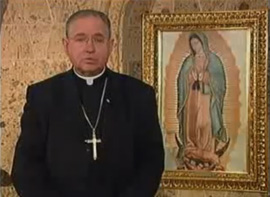
“May Mary, Patroness of the United States, help us to heal from our differences and build a nation where the rights of life, liberty, and the pursuit of happiness are a reality for all men and women, especially the unborn.” Archbishop Jose Gomez, Nov. 2008.
Archbishop Jose Gomez has been named as the new Archbishop of Los Angeles. There are many reasons to rejoice in his appointment – pro-lifer’s can rejoice that our new shepherd has a heart for the unborn and the life issues of our time.
Here are links to some of his respect life columns, sermons and writings.
Homily Respect Life Mass January 20, 2007
Some Reflections on End of Life Issues October 8, 2008
In Response to House Speaker Pelosi’s Remarks Concerning Abortion August 24, 2008
Truth, Freedom and Abortion October 10, 2008
Voters must know stances on ‘life’ issues October 29, 2008
Archbishop Gomez: Life Issues Not simply ‘Religious’ October 30, 2008
The Dignity of a Person: hopes and challenges January 16, 2009
Official Statement: Health Care Reform, in order to be just, must respect all life July 22, 2009
Bioethics, Health Care, and Catholic Teaching September 25, 2009
Catholic Church supports morally sound scientific research
A will to live: Clear Answers on End of Life Issues (68 page booklet)
Most Reverend Jose Gomez
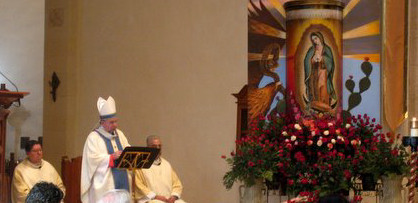
Welcome to the Archdiocese of Los Angeles Archbishop Jose Gomez!
Archbishop Jose Gomez is known to be a wonderful defender of the faith and of the unborn. We are thrilled that he is coming to Los Angeles to be our new shepherd. In the next day or so we will detail and link to a number of the pro-life articles etc. that this wonderful man has written. But for today we have a quote of his that relates to the topic of this blog. It is from an Oct. 10, 2008 column he wrote entitled Truth, Freedom and Abortion.
“I repeat: Abortion is not only a Catholic issue or a ‘matter of faith’. It concerns the most fundamental questions in any human civilization: Who gets to live and who doesn’t — and who gets to decide this question? Can one’s rights or freedoms include the right and freedom to extinguish the life of one who is weaker?
The Catholic Church’s position on these questions is clear. Our Savior chose to come among us as each one of us came into this world, by spending nine months in a mother’s womb. Blessed Mother Teresa (0f Calcutta) used to talk about this a lot. She reminded us that our religion begins with the story of two pregnant women and their unborn children. And it was an unborn child, John the Baptist, who was the first to proclaim Christ’s presence — when he leapt in his mother’s womb at the Visitation. (Luke 1:39-45)”
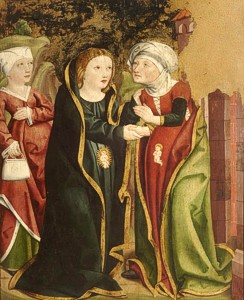
Visitation, Hungarian (?) painter (end of 15th c.)
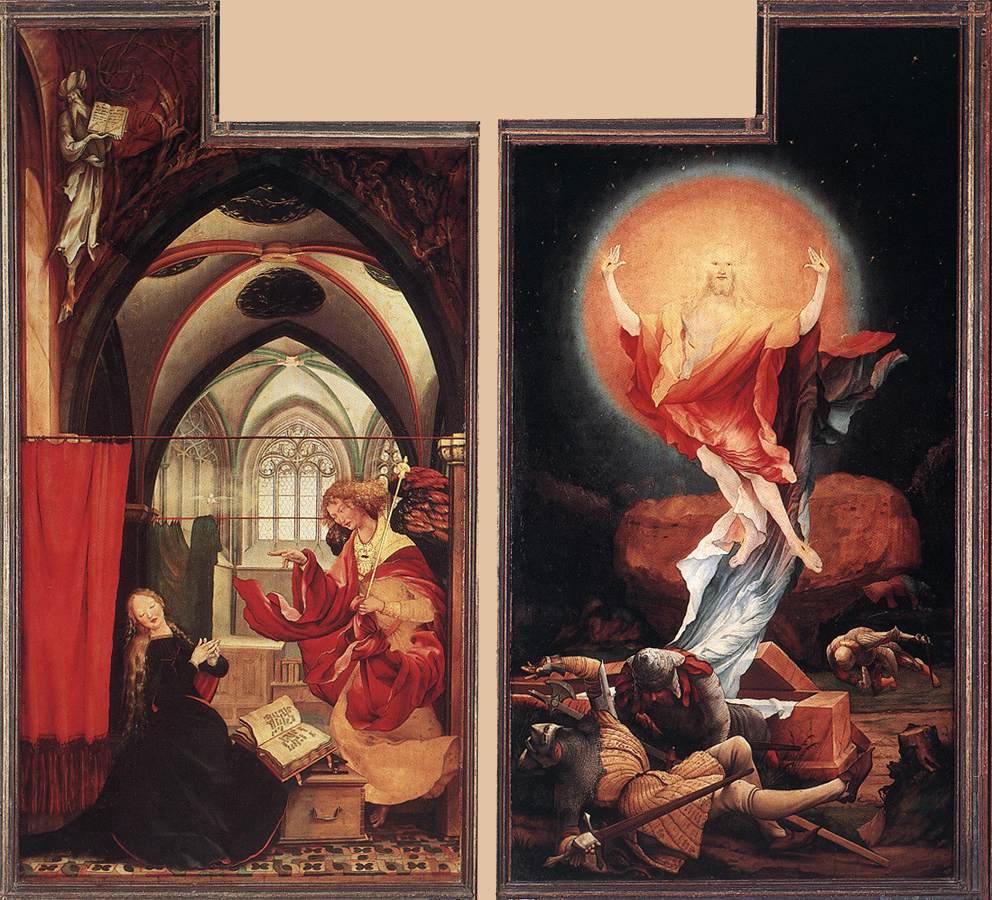
Matthias Grunewald, Annunciation and Resurrection
“Christ is the Lord of time; he is its beginning and end; every year, every day, every moment are embraced by his Incarnation and Resurrection, and thus become part of “the fullness of time’ ”
. “For me it is the virgin birth, the Incarnation, the resurrection which are the true laws of the flesh and the physical. Death, decay, destruction are the suspension of these laws. I am always astonished at the emphasis the Church puts on the body. It is not the soul she says will rise but the body, glorified…”
Flannery O’Connor, The Habit of Being, pg. 100
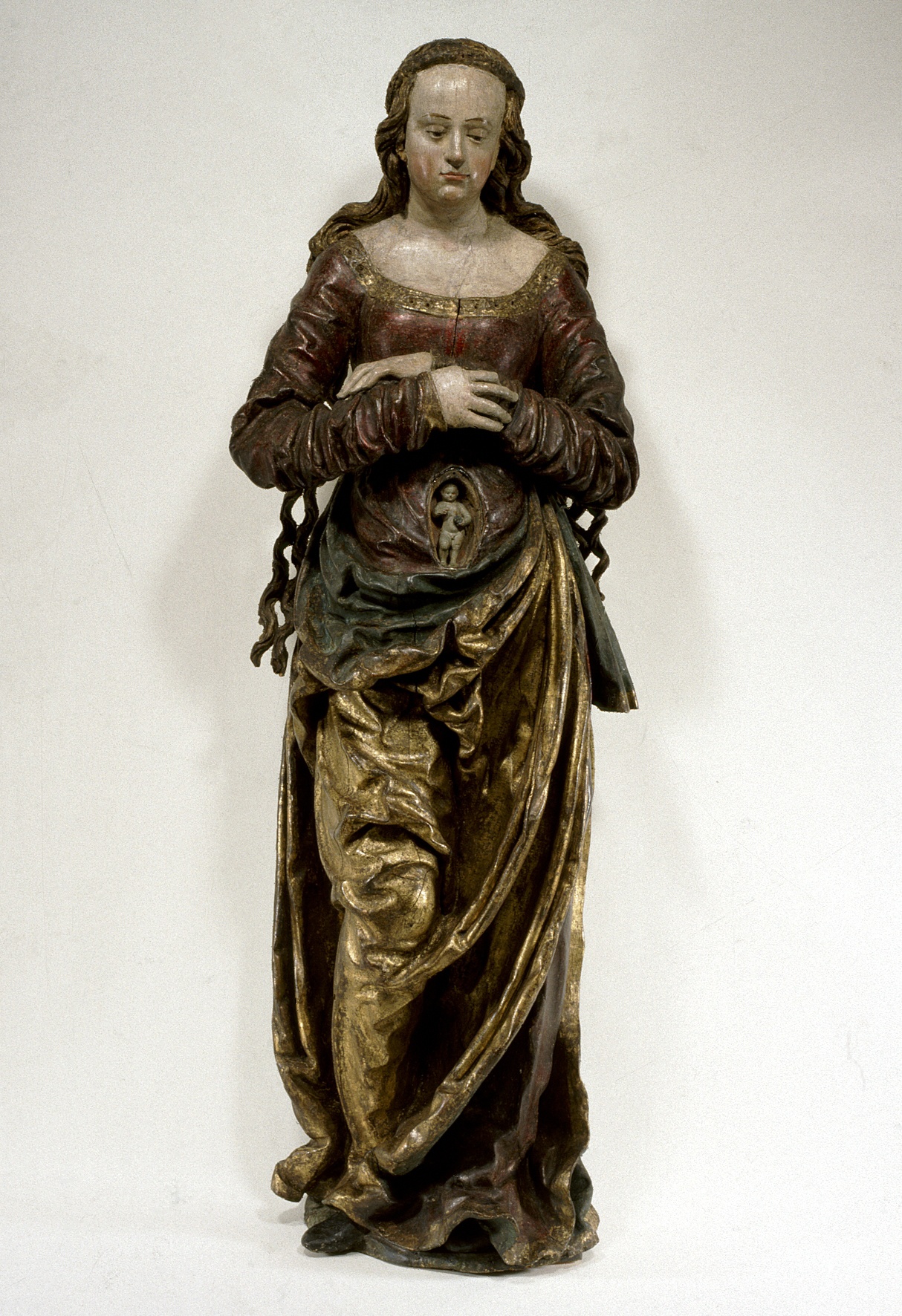
Replica of the miraculous image of Mary Bogenberg
“Though he was in the form of God, [Jesus] did not regard equality with God something to be grasped. Rather, he emptied himself, taking the form of a slave, coming in human likeness; and found human in appearance, he humbled himself, becoming obedient to death, even death on a cross” (Phil 2:6-8).
In his General Audience of February 17, 1988 entitled Jesus Christ Emptied Himself, John Paul II shows how this term applied to Jesus’ life from beginning to end.
“To express this mystery the apostle uses first of all the words “emptied himself,” which refers especially to the reality of the Incarnation. “The Word became flesh” (Jn 1:14). God the Son assumed human nature, humanity, and became true man, while remaining God!…
In this context, his becoming like man involved a voluntary renunciation, which extended even to the privileges he could have enjoyed as man. He assumed “the form of a slave.”
We see in the Gospels that Christ’s earthly life was marked by poverty from the very beginning. This was clearly set out in the account of his birth, when the evangelist Luke observed that “there was no room for them [Mary and Joseph] in the inn,” and that Jesus was born in a stable and laid in a manger (cf. Lk 2:7).”
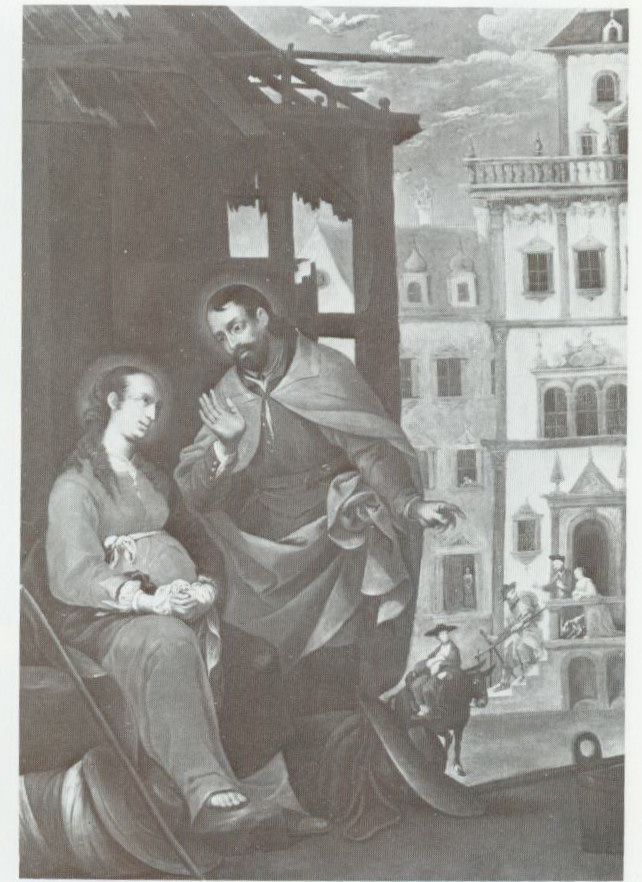
“From Matthew we learn that already in the first months of Jesus’ life, he experienced the lot of a refugee (cf. Mt 2:13-15).
His hidden life at Nazareth was lived in extremely modest conditions; the head of the family was a carpenter (cf. Mt 13:55) and Jesus himself worked with his putative father (Mk 6:3).”
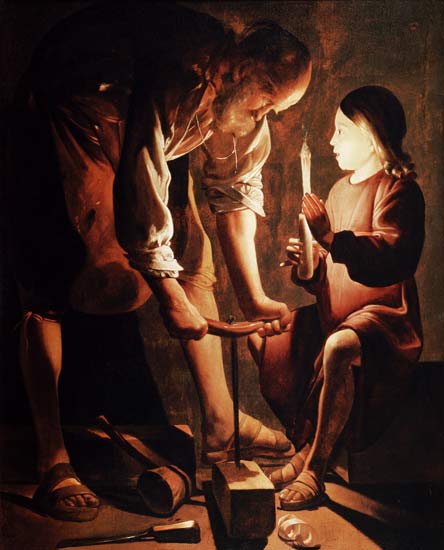
“When he began his teaching, his situation continued to be one of extreme poverty, as he himself bore witness to in a certain way by referring to the precarious conditions of life imposed by his ministry of evangelization. ‘Foxes have dens and birds of the sky have nests, but the Son of Man has nowhere to rest his head’ (Lk 9:58).
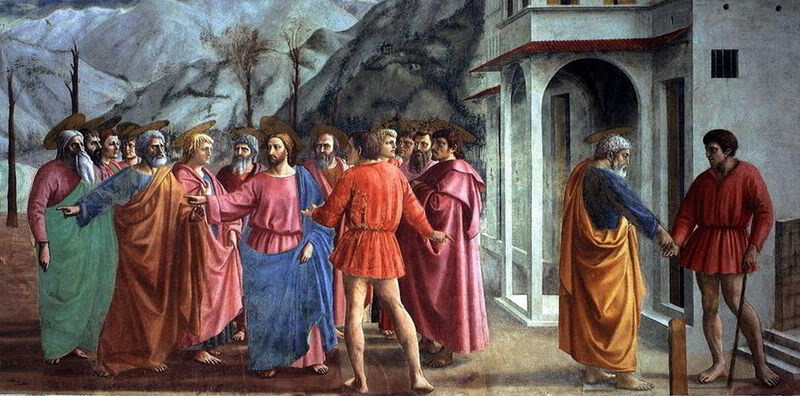
From its beginning, Jesus’ messianic mission encountered opposition and misunderstanding, despite the signs which he worked. He was observed and persecuted by those who had power and influence over the people.”
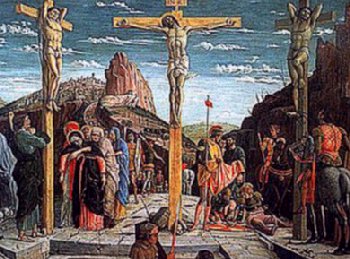
“Finally, he was accused, condemned and put to death on a cross, the most infamous of all forms of capital punishment. It was applied only for crimes of extreme gravity, especially to those people who were not Roman citizens, and to slaves. For this reason also it can be said with the Apostle that Christ literally took “the form of a slave” (Phil 2:7).
He wrote that Jesus Christ ‘humbled himself, becoming obedient to death, even death on a cross’ (Phil 2:8). Here Christ’s kenosis is described in its definitive dimension. From the human point of view it is the dimension of the self-emptying by means of his passion and cruel death.”
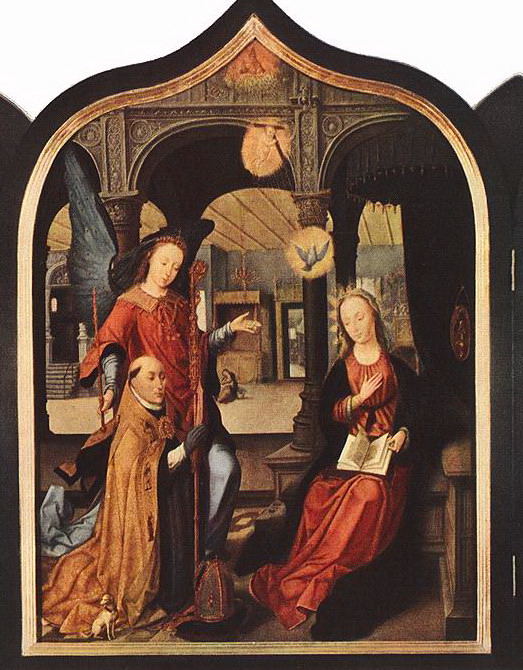
Annunciation Scene – Jean Bellegambe
“The Cross itself is already mysteriously present at the instant of the Incarnation, at the very moment of Jesus’ conception in Mary’s womb. Indeed, the ecce venio in the Letter to the Hebrews (cf. 10: 5-9)* is the primordial act of the Son’s obedience to the Father, an acceptance of his redeeming sacrifice already at the time ‘when Christ came into the world’.”
* “Consequently, when Christ came into the world, he said:
“Sacrifices and offerings you have not desired;
but a body have you prepared for me;
in burnt offerings and sin offerings
you have taken no pleasure.
Then I said, Lo, I have come to do your will, O God.”
(Hebrews 10:5-7)
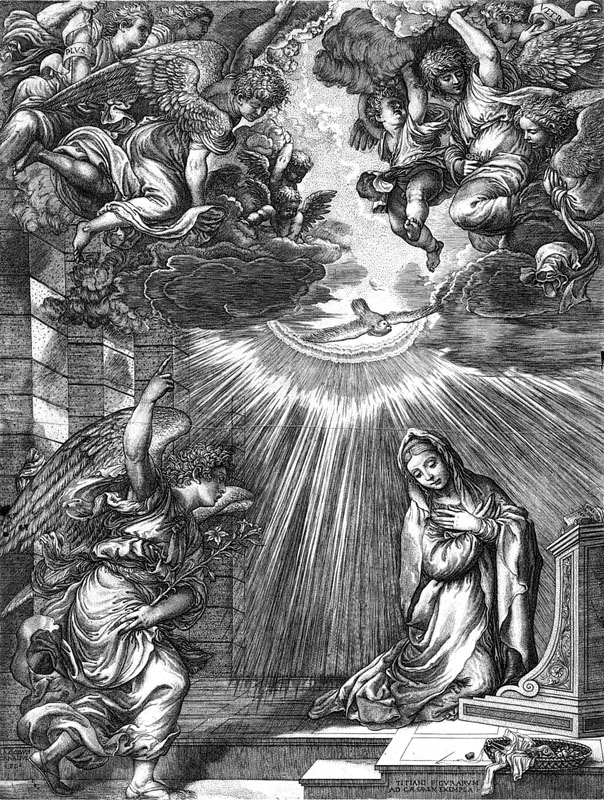
The Annunciation by Giovanni Jacopo Caraglio
On May14, 2009 Pope Benedict XVI visited the Basilica of the Annunciation in Nazareth, Israel. Here is an excerpt from his homily:
“What happened here in Nazareth, far from the gaze of the world, was a singular act of God, a powerful intervention in history, through which a child was conceived who was to bring salvation to the whole world. The wonder of the Incarnation continues to challenge us to open up our understanding to the limitless possibilities of God’s transforming power, of his love for us, his desire to be united with us….
The Spirit who “came upon Mary” (cf. Lk 1:35) is the same Spirit who hovered over the waters at the dawn of Creation (cf. Gen 1:2). We are reminded that the Incarnation was a new creative act. When our Lord Jesus Christ was conceived in Mary’s virginal womb through the power of the Holy Spirit, God united himself with our created humanity, entering into a permanent new relationship with us and ushering in a new Creation.”
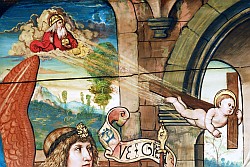
The narrative of the Annunciation illustrates God’s extraordinary courtesy (cf. Mother Julian of Norwich, Revelations 77-79). He does not impose himself, he does not simply pre-determine the part that Mary will play in his plan for our salvation: he first seeks her consent. In the original Creation there was clearly no question of God seeking the consent of his creatures, but in this new Creation he does so. Mary stands in the place of all humanity. She speaks for us all when she responds to the angel’s invitation. Saint Bernard describes how the whole court of heaven was waiting with eager anticipation for her word of consent that consummated the nuptial union between God and humanity. The attention of all the choirs of angels was riveted on this spot, where a dialogue took place that would launch a new and definitive chapter in world history. Mary said, “Let it be done to me according to your word.” And the Word of God became flesh.”
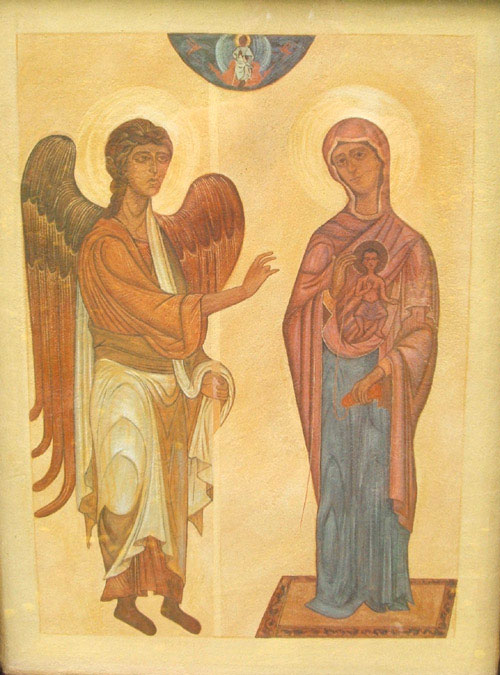
“When we reflect on this joyful mystery, it gives us hope, the sure hope that God will continue to reach into our history, to act with creative power so as to achieve goals which by human reckoning seem impossible.”
Pope Benedict, Homily at the Basilica of the Annunciation, May14, 2009
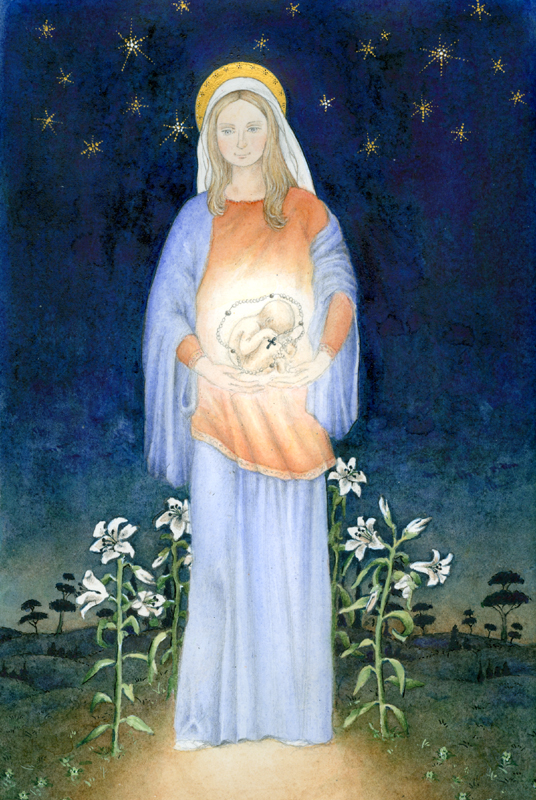 “Vessel of the Preborn Jesus in Watercolor” by Lea Marie Ravotti
Last week, we had a post about St. Louise de Marillac’s chaplet to Unborn Jesus. Amazingly, there is a new apostolate that has just formed with a similar idea to St. Louise’s. A few months ago we became aware of this new apostolate. This apostolate encourages Christians to make rosaries while praying the Joyful Mysteries and meditating on Preborn Jesus. These prayers would be said for mothers with unplanned pregnancies.
How did this originate? Bernie Conklin tells the story:
“It started in the spring of 2009 after completing the 33 day St. Louis de Montfort consecration to Jesus through Mary. A practicing OBGYN I know mentioned to me that a girl was considering an abortion. I told her that I would pray a rosary for the young girl and after seeing her baby on a sonogram, this young mother chose life for her child. Isn’t that a beautiful miracle?
This incident lead me to begin discerning about creating a ministry where cord rosaries, using knots instead of beads, could be made and prayed. Then, the mother with an unplanned pregnancy could be given one of these rosaries as a token of love. The following thoughts kept coming to me, ‘ We meditate on Jesus as the Risen Savior, the Crucified Lord, a Babe in the manger, but not as Preborn Jesus in the womb!’ I thought it would be enlightening if people could visualize Jesus’ presence in Mary’s womb. So as a favor to me for my birthday in July one of my sons sketched the image of Preborn Jesus.”
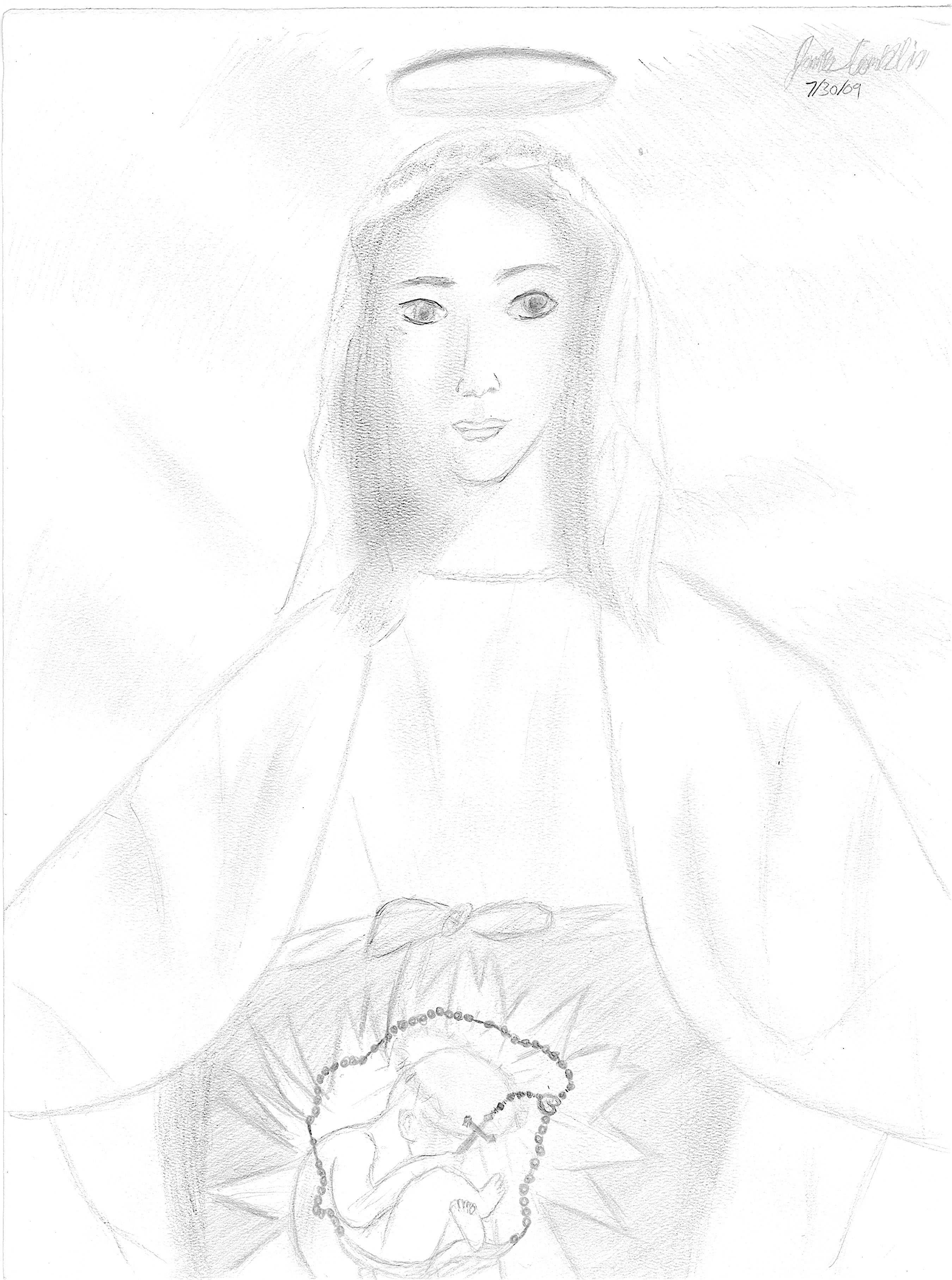 Here is the image of Preborn Jesus that he drew.
At this point Bernie prayed:
“Lord, this is a beautiful image of You in the womb. It is estimated at about $50.00 to enlarge it onto an 18×24 foam board, which seemed like a lot. If you want this done, I know You’ll open a window.”
And here is how our Lord answered her prayer:
“I had cleaned this patient’s teeth a few times before, but on this day in July when I was done with his cleaning, he placed money in my hand and complimented my work. Well, you certainly don’t tip your hygienist, but after a few rounds of back and forth he curled my hand around the money and left, yelling, ‘Merry Christmas’ as he went out the door of our office.
As my eyes fell upon the $50 bill, I recalled my prayer from the night before…‘If you want this done, I know You’ll open a window.’
Of course I immediately had the image of the Preborn Jesus enlarged and since then it has been at pregnancy centers, the ‘Truth Booth’ at the Butler Farm Show, an abortion clinic in Pittsburgh and at church functions.”
She adds: ” Presently, we are making the variegated pink and blue cord rosaries with a medal of Baby Jesus attached. As the rosary is made, the ‘Joyful Mysteries’ of the rosary are prayed. Meditation on the image of Preborn Jesus in the womb is central to this devotion. The rosary is a gift to the mother as well as her child.”
Recently Lea Ravotti, an artist from Pittsburgh, completed the watercolor after seeing the original sketch that Bernie’s son drew. They have worked together to distribute pamphlets that encourage others to take up this devotion. The pamphlets are beautifully illustrated with both images. Also included in the pamphlet is a poem from Preborn Jesus to the mother with child.
If you want to obtain one of these pamphlets you can email Preborn Jesus Ministry at:
PrebornJesusMinistry@zoominternet.net
or visit their website
Filed under: Pro-life
I received this email today from a wonderful pro-life Priest urging me to call my congressman. He listed 10 House representatives who he thinks it would be especially effective to call. I would urge you to call your House representative even if they are not listed below. Please pass this on….
Dear family and friends,
As you probably know, the US House of Representatives is getting ready to cast its final vote on the health care reform bill. The current version contains massive funding for abortion with our tax dollars. There are 10 key representatives whom I invite you to call today to express your opinion. My message has been: “Please, do not coerce me into paying for abortions with my tax dollars.”
The 10 representatives are:
Rep. Steve Driehaus (OH) 202-225-2216, 513-684-2723 Fax: (202) 225-3012
Rep. Brian Baird (WA) – 202-225-3536, 360-695-6292 Fax: (202) 225-3478
Rep. Jason Altmire (PA) – 202-225-2565, 724-226-1304 Fax: 202-226-2274
Rep. Jim Cooper (TN) – 202-225-4311, 615-736-5295 Fax: 202-226-1035
Rep. John Boccieri (OH) – 202-225-3876, 330-489-4414 Fax: (202) 225-3059
Rep. Mike Arcuri (NY) – 202-225-3665, 315-793-8146 Fax: (202)225-1891
Rep. Marcy Kaptur (OH) 202-225-4146, 419-259-7500 FAX: (202) 225-7711
Rep. Bart Gordon (TN) 202-225-4231, 615-896-1986 Fax: (202) 225-6887
Rep. Brad Ellsworth (IN) 202-225-4636, 812-465-6484 Fax: (812) 422-4761
Rep. Charlie Wilson (OH) 202-225-5705, 740-376-0868 Fax: (202) 225-5907
The first phone number is their Washington office; if busy, you can try their state number. (Note: we have added the fax number in case you have a hard time getting through by phone.)
I urge you to call between today and tomorrow, since they plan to finalize this voting by this Saturday. Thank you once again for speaking on behalf of those who cannot speak, the least amongst us, the unborn.
Fr. Alfred Cioffi
If you can’t get through – you can also email your representative at this link:
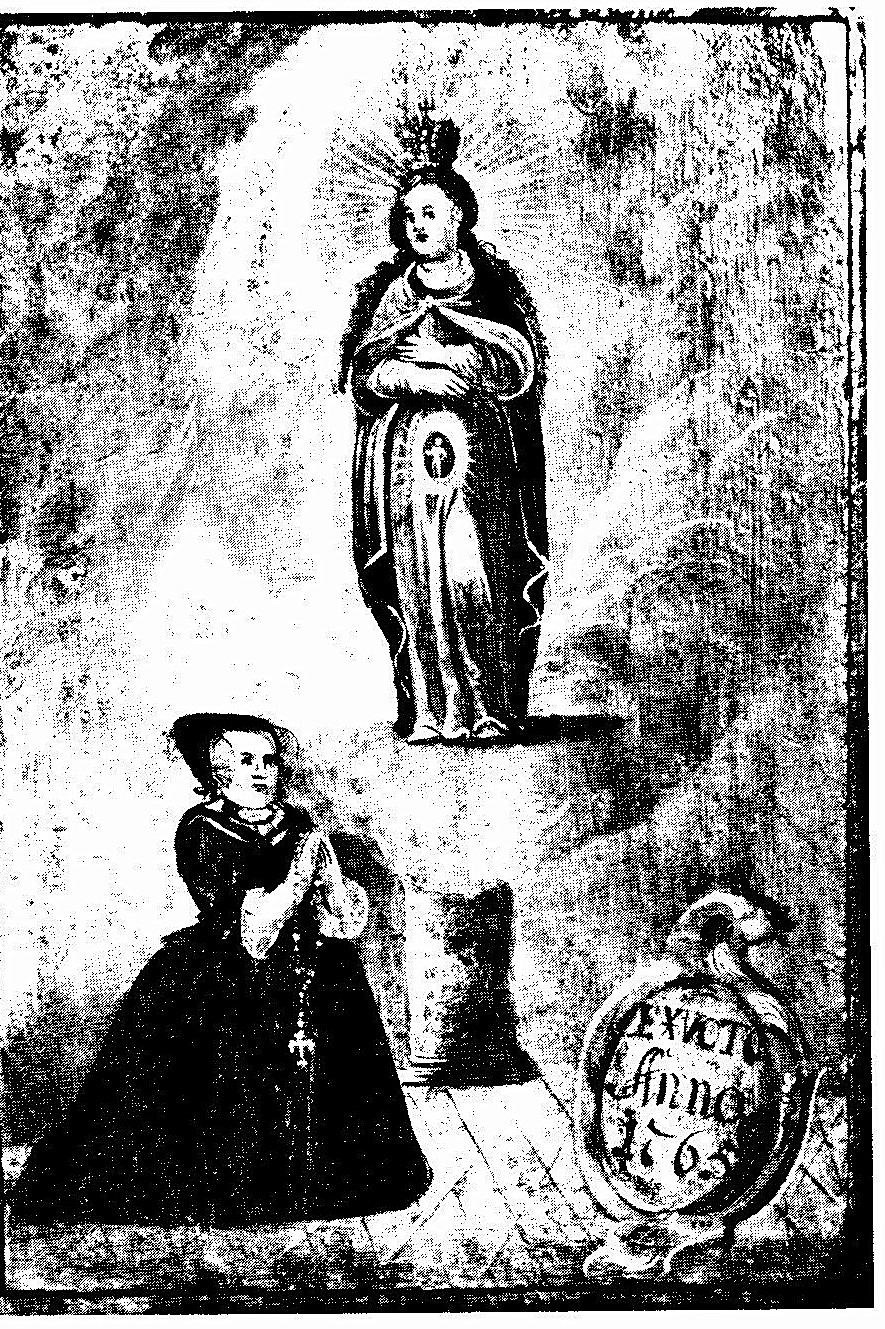
Today, Monday March 15 is the feast day of St. Louise de Marillac. In an October 10, 2009 post entitled St. Louise de Marillac and Unborn Jesus – we talked about the chaplet that St. Louise developed to honor Unborn Jesus. In a book published in 1884 by Benziger Brothers, Life of Mademoiselle Le Gras (Louise de Marillac) Foundress of the Sisters of Charity, we are given a little more insight into how she came up with this idea.
“What adds to the interest of these scattered leaves is a number of familiar details which people might find too minute, but which the family would gather up and preserve as relics. They reveal, among other things, divers practices of daily piety suggested to Mile. Le Gras (St. Louise de Marillac) by her increasing devotion to the hidden life of our Lord, and principally His sojourn in the womb of His Mother. ‘ Hearing this mysterious state spoken of,’ she writes in the year 1642, a little before Advent, ‘ I applied myself to it with deep reflection, and a new light was given me with a desire to honor this mystery by some appropriate prayers.’ It was at this time that she made the resolution of saying a rosary composed of nine grains (beads), in honor of the nine months preceding the birth of the Infant God; and to encourage in her Daughters a taste for this holy exercise, she prepared for them in a little box as many chaplets as were necessary for each to be given one, to be distributed after her death.”
As we pointed out in St. Louise and the Unborn Christ Child she never did distribute those rosaries because:
It seems that St. Vincent had agreed to this devotional practice three years earlier but at this point he asked her to discontinue it. Even though St. Louise continued to believe that this was a devotion that Our Lady wanted her to practice – in holy obedience to St. Vincent she discontinued it.
She alludes to this in a letter: “I feel that I must tell your Charity (St. Vincent) that I was and still am sorry at having to abandon those little prayers because I believe that the Blessed Virgin wanted me to render her this small tribute of gratitude. But with her, I console myself by offering my renunciation to her and by resolving to please her in some other way and to serve her with greater fervor….” Louise de Marillac, Spiritual Writings, L.304
Later this week we would like to present to you a new apostolate in Pennsylvania called Preborn Jesus Ministry. This new apostolate is promoting praying the joyful mysteries of the rosary to honor preborn Jesus and to pray for the unborn.
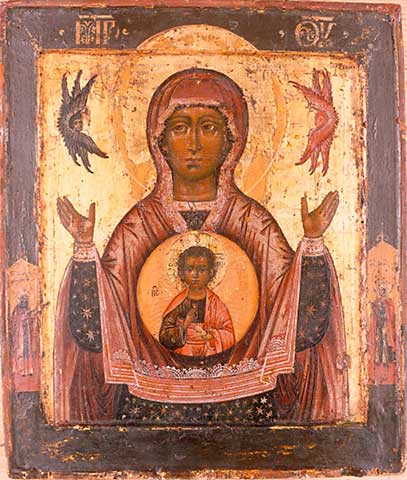
John Paul II the Great left the Church a vast legacy of abundant fruits! One of these incalculable contributions is his profound and extensive teaching about ‘Theology of the Body’. Beginning with the Book of Genesis, Chapter One, in September 1979, he began what turned out to be an extraordinary collection of teachings which are destined to bless the Church for centuries to come.
Here is one quote which is particularly relevant to the subject of this blog:
“The fact that theology also considers the body should not astonish or surprise anyone who is aware of the mystery and reality of the Incarnation. Theology is that science whose subject is divinity. Through the fact that the word of God became flesh, the body entered theology through the main door.” (April 2, 1980; #4)
Indeed! And Christ Himself commented on this fact immediately as it occurred as we read in Hebrews:
Consequently, when Christ came into the world, he said,
“Sacrifices and offerings thou hast not desired,
but a body hast thou prepared for me;
in burnt offerings and sin offerings thou hast taken no pleasure.
Then I said, ‘Lo, I have come to do thy will, O God,’
as it is written of me in the roll of the book.” Heb 10:5-7
You will find the above reading in the Mass for The Annunciation of the Lord on March 25th. Pope Paul VI commented on this passage from Hebrews, calling it the “fundamental offering that the Incarnate Word made to the Father when he entered the world” and St Alphonsus de Liguori, a Doctor of the Church, comments on this passage explaining that Christ spoke these words “immediately” (in other words, at the first cell stage of His life; His conception).
Christ acknowledges that He has received, as a gift from His Father in heaven, His body… and when He says “I have come to do thy will, O God”, He implies His own acceptance of and satisfaction with the Body received, and explicitly states His own holy intention to unite the gift of His body and soul to the holy and glorious purposes of His Father. So, an incipient theology of the body comes from the “lips” of Christ Zygote, Christ Embryo. This is a very positive view of one’s body and soul, as a gift bursting with potential and purpose. By the fact of His conception and “speaking”, we see the unity of His Person with His body, and by the fact of His “offering”, we see that this fundamental act is an act of holy love.
Further, frequently throughout His life on earth our Lord repeatedly re-stated this offering of His life and Himself to the holy will of His Father – a whole and complete offering, which includes His body being offered for the benefit of others. The Incarnation – viewed as a loving offering – teaches us the simple truth that God is Love.

Friday, March 5th, 2010
RADIO INTERVIEW
with Al Kresta at Ave Maria Radio
George Peate, M.T.S., will be interviewed about his book, Unborn Jesus Our Hope this Friday, March 5th by Al Kresta who broadcasts with Ave Maria Radio.
The show airs from 4-6 Eastern Standard Time and George will be interviewed at the beginning of the program from 4 – 4:30 pm Eastern Standard Time (1-1:30 pm Pacific). The Al Kresta show is also carried by EWTN radio and Sirius radio network.
LATER IN THE SHOW, CARDINAL ARINZE WILL BE LIVE IN THE STUDIO WITH AL KRESTA – IT WILL BE A FASCINATING INTERVIEW.
To find a radio station near you that carries this program or to listen to the show on your computer click here.
Filed under: Pro-life

This may be surprising, but in the last six months I have encountered the issue of medically assisted nutrition and hydration for those in the dying stage of life, on three separate occasions.
I want to discuss one of these times in which the person I spoke with did not come at the issue from an overtly spiritual or moral perspective, but rather spoke about it from a genuinely human perspective and demonstrated a commonsense gut reaction to the issue.
Last fall, I attended a luncheon for health insurance professionals and as you can imagine at such meetings the health care bill was a topic of discussion. A woman sitting at my table brought up Sarah Palin’s statement about death panels and stated that this was already happening.
She went on to recount the story of her sister’s death. Her sister had cancer and was told that she had about two months to live. She was told that Medicare would no longer pay for hospital care that included nutrition and hydration care. Medicare however would pay for hospice care which would not continue medically assisted nutrition and hydration care and without these her life expectancy was reduced to one or at most two weeks. This woman pointed out that since her sister’s family did not have the financial means to pay for hospital care they reluctantly chose hospice care. She ended her commentary with “It really stank.”
My impression was that this woman was not a Catholic or Christian, and the family did not pursue all of the alternatives, but her reaction to the situation was profoundly human and true. This was not the right way to die.
With this in mind, I decided that I would put a lot of links that might help the Catholic better understand the mind of Christ and the Church on this issue.
First of all the Church considers nutrition and hydration even when medically assisted, ordinary not extraordinary care. The following links are helpful in understanding this teaching.
The most concise statement that I have found on this issue was in the Guide to Health Care Directives on the North Dakota Catholic Conference of Bishops website – click here to download these directives. Here is the statement from these directives on this issue:
There should be a strong presumption in favor of providing a person with nutrition (food) and hydration (water), even if medically assisted. Providing nutrition and hydration should be considered ordinary care since it serves a life-preserving purpose and the means of supplying food and water are relatively simple and – barring complications – generally without pain. Exceptional situations may exist in which this is not the case, such as when a person is no longer able to assimilate nourishment, or when death is so imminent that withholding or withdrawing food and water will not be the actual cause of death. In no case should food or water be removed with the intent to cause death.
Here are a few more websites that are helpful:
Sister Paula Vandegaer who runs International Life Services also has a website on end of life issues:
Many hospice organizations have lost their original mission – here is an organization that is trying to preserve the original intent of hospice.
Hospice Patients Alliance (preserving the original mission of hospice)
Rita Marker has a good website on the issue of Euthanasia from a pro-life perspective.
 UNBORN WORD of the day