


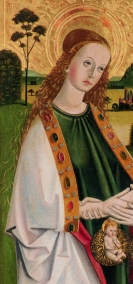
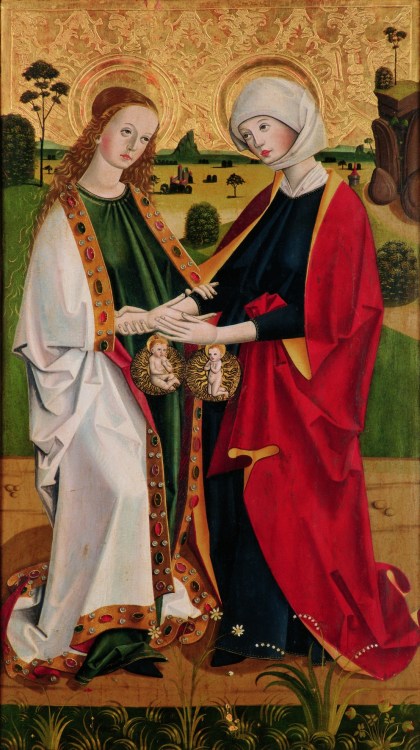
This post is the 3rd in our series on the Creed developing within Mary’s Intellect and Heart as the Christ Child develops within her womb. We turn now to the Visitation: Lk 1:39-55.
The Holy Spirit is extremely active during the various exchanges and actions when Mary (and Unborn Jesus) arrive at the home of Zechariah and Elizabeth and specifically when Mary greets Elizabeth (and Unborn John) and when Elizabeth responds. Luke tells us that “Elizabeth was filled with the Holy Spirit and she exclaimed with a loud cry, ‘Blessed are you among women, and blessed is the fruit of your womb! And why is this granted me, that the mother of my Lord should come to me? For behold, when the voice of your greeting came to my ears, the babe in my womb leaped for joy. And blessed is she who believed that there would be a fulfilment of what was spoken to her from the Lord.’” So, Elizabeth refers to Mary’s unborn child (about one week after conception) as “my Lord”. This is revelatory! Elizabeth has identified Unborn Jesus as Messiah and Lord, and Mary as the Messiah’s mother. Elizabeth states that it is a privilege to have the mother of the Messiah and Lord visit her.
What does Mary learn from Elizabeth’s inspired words? First, let it be said that everything about God is extremely personal. God is NOT distant, obtuse, detached from His Creation and creatures! He has become Incarnate. He has fulfilled what He promised. A week ago Gabriel said that Mary had “found favor with God” (Lk 1:30). Now Elizabeth is acknowledging that Mary has a special relationship with God and is blessed for believing “that there would be a fulfillment of what was spoken to her”. This highlights Mary’s personal relationship with God. It is a beautiful relationship; alive in trust, bursting with expectation! Mary is being rewarded for obeying God and believing in the words spoken to her. This is God’s way of thanking Mary for accepting this motherhood of a Divine Person; the Son of God. So Mary sees and tastes the Goodness of God in the words of Elizabeth. This is living the Creed. The Creed in Mary’s heart says that “God is All Good, God is Most Faithful”. This belief drove her onward to Bethlehem, to Egypt, to Cana, to the foot of the cross, to the Upper Room and to Heaven.
But most of all, Mary hears her unborn child called “Lord”! She hears herself called “mother of (the) Lord”. These are titles, and offices. Elizabeth is testifying – albeit, indirectly – that Mary has been given a singular office by Almighty God; ‘mother of the Lord’. This is a sacred duty and obligation in service to the Mission of her Son (see prior post for Gabriel’s description of her Son). With the leaping of unborn John in his mother’s womb (caused by Unborn Jesus) and Elizabeth’s comments, Mary has now seen that her Son’s mission has already begun. She knows from firsthand experience that God is acting here and now, and that the Son of the Most High is the focal point of everything – she is her Son’s handmaiden.
The next 10 verses are Mary’s famous inspired response and are called the Magnificat for the opening line: “My soul magnifies the Lord, and my spirit rejoices in God my Savior…” Note the two words “Lord” and “Savior”. Incredibly, Mary is perceiving that these two titles, which she would have used in the past to describe the God of Abraham, Isaac and Jacob, can now also be used to describe her (unborn) Son. This is a fundamental unfolding Revelation of the first order. Elizabeth used the word “Lord” and Mary responds using the same term. But she says “my soul magnifies the Lord” because He is within her, and she is reflective of His Presence as Elizabeth stated. Mary is inspired to use the term ‘Savior’ also. Mary is in a unique position, for when she speaks of God, she is speaking not only of her Creator Yahweh, but also of that Son growing within her. She is associating her Son with the term ‘Savior’, now pointing to the redemptive reality that is dawning upon Israel, twice referencing God’s mercy.
Mary’s Magnificat is centered upon the reality of God; referring at least 18 times to God (he, his, him, and so on). The last verse of the Magnificat recalls God’s relationship with Abraham. Mary is showing the continuity of God’s personal redemptive relationship with the people of Israel, and her Magnificat seems to recapitulate that historical relationship. Abraham was the Father of their faith – now Mary is the Mother of their Savior. She is discovering these truths of the Incarnation as she is living them (and she was inspired by the Holy Spirit as she gave voice to these truths). Her Magnificat offers a holy glimpse into the Creed that is taking hold of her heart, a unique Creed, a mixture of faith, hope, love and maternity – a tender personal Creed especially due to this fourth mentioned element; maternity. Every Christian can learn of this palpable Creed by sharing in Mary’s intimate perspective on her unborn Savior Son!
Our next post will consider the three months Mary (and Unborn Jesus) spent with Zechariah, Elizabeth (and unborn, then newborn John).
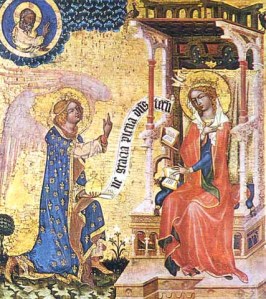
In our last post we listed the extraordinary events and Revelations which unfolded in the life of Mary (and Unborn Jesus) during the nine months of her pregnancy. Our list was presented trimester-by-trimester and relied upon the Gospels of Luke and Matthew for scriptural facts. Today’s post is part of a series of upcoming posts reflecting upon the content of the Revelations given to Mary, trimester-by-trimester; the meaning and significance of these Revelations will be discussed.
FIRST TRIMESTER:
Luke 1:28, 30: The initial mystery of her favored relationship to God is revealed to Mary by Gabriel.
Lk 1:31-33 The miraculous nature of her impending pregnancy is revealed to Mary. That her child will be a male, and will be “called the Son of the Most High”, that He will be given the throne of David, will reign forever and there will be no end to His kingdom. This means that her Son will be a King, not just an earthly King by an eternal King, with subjects. Many Christians think of Christ’s kingship as symbolic, but it is not merely symbolic – it is a real and true kingship, in fact Christ is the true measure of all Kings (and Queens) throughout history. There is an incredibly personal and poignant word given to Mary also about this pregnancy, this Son: “you shall call his name Jesus”. Here begins the magnificent Christian devotion to the Holy Name of Jesus. It was a name she would embrace in prayer, a name to whisper, a name to marvel at, a name like no other name – a name she discovered by the hour, a name sent down from Heaven upon the head of her baby.
Lk 1:35 This has to be the most fantastic truth ever revealed to a human being!!! The Archangel Gabriel explains how the Incarnation will take place. The child “will be called holy, the Son of God” because the child will be conceived, as the Nicene Creed says, “by the power of the Holy Spirit” and as Gabriel says “ The Holy Spirit will come upon you, and the power of the Most High will overshadow you…” Virtually the entire first half of the Nicene Creed is embedded here in the cumulative words of Gabriel to Mary! Mary represents the Church and Gabriel is the messenger of God “Most High”. He is revealing the first mystical kernel of the Christian Creed to Mary and she will embrace it body and soul – she will live the Creed. The Church’s belief in the Incarnation will be rooted in this evangelical exchange. Mary will tell the Church what she was told and the Church will cling to this holy revelation, her martyrs will cling to it with their dying breaths!
Lk 1:36-37 Gabriel tells Mary about the pregnancy of Elizabeth, putting everything into perspective: “For with God nothing will be impossible”. (Approximately a week later, when Mary sees with her own eyes that Elizabeth is, in fact, six months pregnant, she will understand all the more emphatically, the power in the words revealed to her.)
Lk 1:38 Mary’s response to this litany of heavenly revelations has calmed Christians for two thousand years: “Behold, I am the handmaid of the Lord; let it be to me according to your word.” In her heart she now has the key to human history, the hope of humanity, the revelation of all God’s promises in one Word. As the Fathers of the Church would say, she conceives in her heart before conceiving in her womb.
She immediately conceives in her womb – now Christ is physically growing within her womb and the Christian Creed is mystically growing within her intellect and heart. The Creed – in embryonic state – is taking root in a human heart.
Our next post will consider the Visitation (Lk 1:39-45, 46-55).
Matthew, Mark, Luke and John agree. When the Son of God came into the world He was not warmly received.
There was a saying in Israel: “Can anything good come out of Nazareth?” (Jn 1:46) Yet it was precisely there – to Nazareth – that God sent His holy messenger “the angel Gabriel” to address the woman chosen to be the Mother of Jesus – and Mary conceived of the Holy Spirit there in Nazareth. Yes, the salvation of humanity comes out of Nazareth!
Years later Jesus would explain that “Foxes have holes, and birds of the air have nests; but the Son of man has nowhere to lay his head.” (Mt 8:20, also Lk 9:57) Yet it is true, that the Unborn Son of man laid His head to rest within the womb of His mother for nine sacred months! Her womb, like her heart was full of the love of God!
The Lord told us also: “A prophet is not without honor, except in his own country, and among his own kin, and in his own house.” (Mk 6:4, also Lk 4:24). And yet when Mary (and her unborn Child) arrived at the home of her cousin Elizabeth (who was six months pregnant with John the Baptist), Unborn Jesus was warmly received by Elizabeth and her unborn son John who leaped in the womb for joy!
After spending three months with Elizabeth (and John…unborn, then finally born), Mary returned to Nazareth. “He came to his own home, and his own people received him not” (Jn 1:11).
So, we see that in the initial months of the Incarnation, the Son of God was lovingly welcomed and received by two women and an unborn baby: Mary, Elizabeth and unborn John the Baptist. The prophets had spoken of “a remnant” of faithful Israelites – here were three faithful ones, waiting for the prayers of their ancestors to be answered.
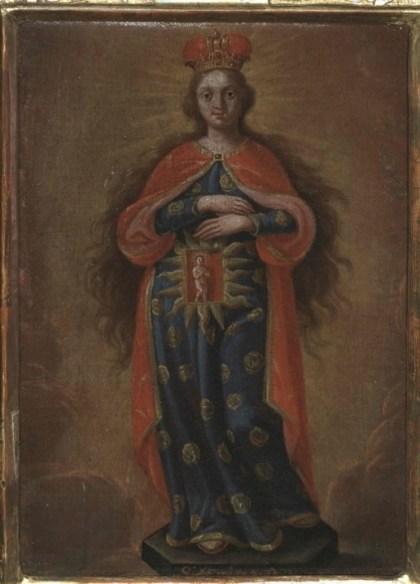
The most frequent representations of pregnancy in medieval and early-modern Christian art show the expectant Virgin Mary. Jesus is depicted as a child inside her transparent womb or, in sculptures, within a niche closed by glass doors. This early-18th-century oil painting is found in the Diocesan Museum, St Pölten, Austria.
With the stoning of St. Stephen, the first Christian martyr “a great persecution arose against the church in Jerusalem” and “Saul laid waste the church, and entering house after house, he dragged off men and women and committed them to prison” (Act 8:1,3). Paul got authorization from the High Priest to go to other cities and round about Christians, so he set out for Damascus. The story of his conversion is well known. A light flashes around him, he falls to the ground and he and his companions hear a voice: “’Saul, Saul, why do you persecute me?’ And he said, ‘Who are you, Lord?’ And he said, ‘I am Jesus who you are persecuting…’” (Acts 9:1-5).
It has frequently been noted that Saul was persecuting Christians (or as they were called back then, followers of ‘the Way’). So Saul, we assume was surprised by the question posed to him; “…why do you persecute me?”…”me” as it turned out being “Jesus”. Saul probably did not think he was persecuting “Jesus” who he thought to be merely a dead controversial rabbi. Yet, it is revealed to him that in persecuting followers of ‘the Way’ he indeed is directly persecuting Jesus.
Today, in a very different set of circumstances, we see a worldwide persecution of unborn babies…an unrelenting persecution. The persecutors all have legal authorization to do their deadly deeds, in fact, in some quarters many of them are considered heroes (just as Paul probably was in his zealous roundup of defenseless Christians). These unborn children – each on his or her ‘Way’ to being born – are each personally identified with Jesus. Millions of our fellow citizens would be shocked if they heard the words from Unborn Jesus calling them by name and asking them: “Why do you persecute me?” But we have similar words from Jesus in the New Testament: “Whoever receives one such child in my name receives me…” (Mt 18:5) And “Truly, I say to you, as you did it to one of the least of these my brethren, you did it to me” (Mt 25:40).
Many abortionists and women who have had abortions (and men involved with abortion) have had their own conversion on the road to Damascus when each, in his or her own way, have heard Jesus personally calling them and asking “Why do you persecute me?” And they have become inspired and eloquent defenders of the unborn, following in the footsteps of St. Paul. Let us continue to pray for those who support and promote abortion, just as St. Stephen prayed for Saul and his misguided companions (Acts 7:60).
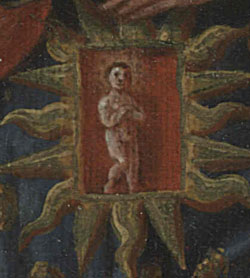
detail of Unborn Jesus from The pregnant Virgin
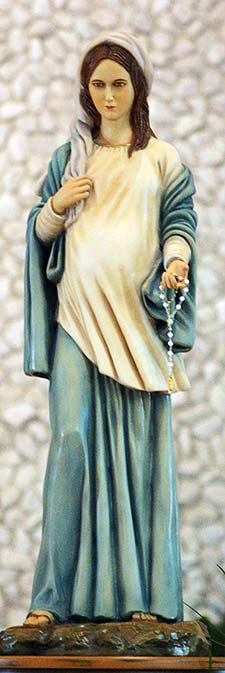
This statue of the “Virgin Mary of Hope Expectant” was on display at Resurrection of Our Lord Parish in Fort Myers July 25 during a Novena for Life Mass. The statue appeared at different parishes throughout the nine-month novena.
I wanted to let you know about a wonderful group called Laity for Life because one of their objectives is to “provide spiritual and moral support for lay Catholics who are active in the pro-life movement”. Other objectives of the group are to ‘train Catholics to be persuasive pro-life speakers and encourage Church financial support for pro-life efforts’.
One way that they are fulfilling this objective is by promoting a Novena of Masses for Life. They have “borrowed and broadened the term ‘Novena’ to refer to the nine months of Our Lady’s pregnancy”.
During 2008 a series of 28 Masses for Life were celebrated throughout the Diocese of Venice in Florida starting on the feast of the Annunciation and thereafter on the 25th of each month until Christmas. Click here to see a schedule of these Masses. A statue of “Virgin Mary of Hope Expectant” was brought to each of these Masses throughout the Diocese. The statue was designed by Antonio Reyes of Ecuador. These Masses for Life bring Catholics together to pray for the unborn and to open their hearts to God for the spiritual strength needed to bring about a new culture of life.
This year they have expanded the Masses for Life to include 48 parishes and 121 Novena Masses following the same schedule from the Annunciation to Christmas. Click here to see the 2009 schedule. Laity for Life wants to promote the Novena of Masses for Life all over the U.S.. If you would be interested in working with Laity for Life on this project you can contact them at :
LAITY for LIFE, Inc.
P.O. Box 111478
Naples FL 34108
VoiceMail : 239.352.6333
E-Mail: info@LaityForLife.org
Filed under: Quotes from Great Christians, Thriving Not Just Surviving!, Unborn Jesus

Here are three insightful quotes about patience.
“Defending the dignity of the human person requires detachment from immediate results. We’re in this for the long term.… We have no right to despair and we have no reason to despair. Rev. Richard John Neuhaus
From an article by Colleen Carroll Campbell: A Lgacy of Connection and Common Ground in a Fragmented World
One of my favorite quotes from Mother St. Paul’s book Ortus Christi is about patience.
“Patience is a twofold grace, that of waiting and that of suffering, both are a great aid to zeal. The Eternal Word’s zeal for the salvation of men had existed in all its perfection and all its fullness from all eternity, yet think how long He waited! When the conditions were changed and He had at length become incarnate, He still waited patiently for nine months, and after that He waited for thirty years! This was zeal, zeal in its perfection. Is my zeal tempered with patience?”
Here is a interesting and encouraging quote about patience and perseverance from John Quincy Adams.
“Patience and perseverance have a magical effect before which difficulties disappear and obstacles vanish.”John Quincy Adams (1767-1848)
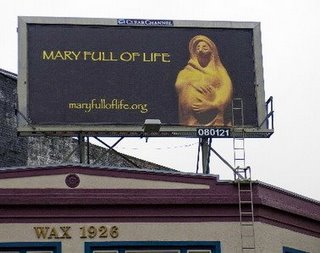
Can you help Valerie Aschbacher from Mary Full of Life erect a billboard similar to the one shown above, but in in St. Joseph Country for all at Notre Dame to see? Her request for approval of the billboard has been accepted, and the price for the month of May is $800. + $100 for production costs. She is donating $300 to the cause. If you can help with a donation please contact her at this email: info@maryfulloflife.org
Filed under: Unborn Jesus
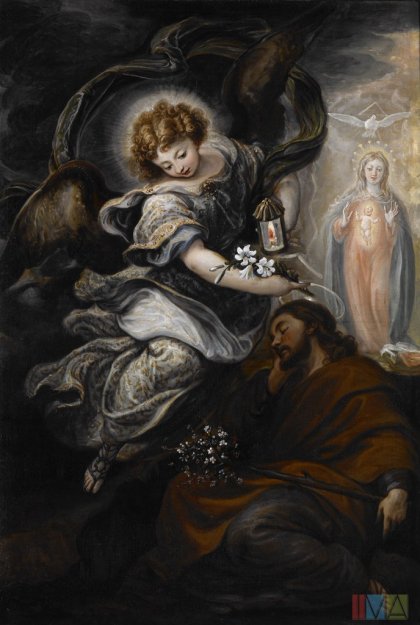
The Dream of St. Joseph (with unborn Christ Child) by Francisco Rizi (1608-1685)
In a subject that became popular in Spain during the 17th century, an angel appears to St. Joseph in a dream and explains that Mary has miraculously conceived a child. The luminous angel points to a vision of Mary with the infant Christ in her womb and the dove of the Holy Spirit above her. The veneration of the expectant Virgin as protectress of women in childbirth was prevalent at the Spanish court and was promoted by the royal confessor.
The angel comes to Joseph in a dream, pointing to the luminous vision of Mary crowned with stars (Apocalypse 12:1), with the Divine Spirit (dove and triangle) hovering over her and Jesus Incarnate in her womb. The angel also seems to carry a book and a light, perhaps indicating the fulfillment of the prophecies quoted in Matthew’s text. The white flowers may indicate the fruitful virginity that Joseph is to share with Mary and Jesus. Joseph’s halo shows him to be the “righteous man” of faith (Matthew 1:19). The angel communicates to Joseph his vocation as husband of the Mother of God.
Francisco Rizi was the Spanish-born son of a Bolognese painter who went to work for Philip II at the Escorial in 1583. Rizi, became the royal painter to Philip IV in 1658.
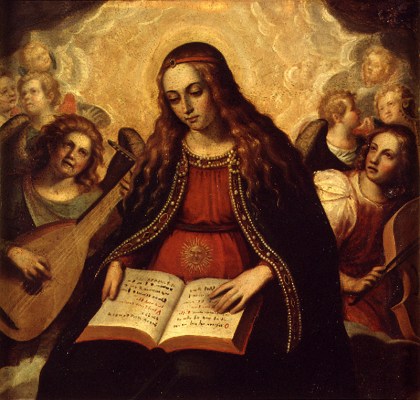
Virgen de la Esperanza-Our Lady of Expectation
Tuesday, April 28 is the feast day of St. Louis de Montfort. Here are a few quotes from him about Christ’s time in the womb.
God the Son came into her virginal womb as a new Adam into his earthly paradise, to take his delight there and produce hidden wonders of grace.
God-made-man found freedom in imprisoning himself in her womb. He displayed power in allowing himself to be borne by this young maiden. He found his glory and that of his Father in hiding his splendors from all creatures here below and revealing them only to Mary. He glorified his independence and his majesty in depending upon this lovable virgin in his conception, his birth, his presentation in the temple, and in the thirty years of his hidden life.
The Incarnation is the first mystery of Jesus Christ; it is the most hidden; and it is the most exalted and the least known. It was in this mystery that Jesus, in the womb of Mary and with her co- operation, chose all the elect. For this reason the saints called her womb, the throne-room of God’s mysteries
Our good Master stooped to enclose himself in the womb of the Blessed Virgin, a captive but loving slave, and to make himself subject to her for thirty years. As I said earlier, the human mind is bewildered when it reflects seriously upon this conduct of Incarnate Wisdom. He did not choose to give himself in a direct manner to the human race though he could easily have done so. He chose to come through the Virgin Mary. Thus he did not come into the world independently of others in the flower of his manhood, but he came as a frail little child dependent on the care and attention of his Mother.
From: Treatise on True Devotion To The Blessed Virgin
by St. Louis de Montfort
“We proclaim a God who became Incarnate. Jesus Christ, the Second Person of the Blessed Trinity. This Jesus walked the way of every human person. That included taking that extraordinary journey into the first home of the whole human race, his Mothers womb. This new chemical concoction ensures there will be no room in the womb for millions for whom He came.”
From:‘Plan B’ for 17 year old girls: Equipping Children to Kill Children? By Deacon Keith Fournier
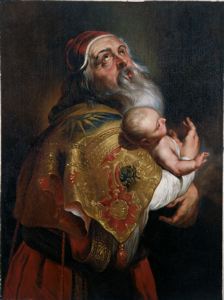
Simeon Holding the Christ Child
When the baby Jesus was still a newborn Mary and Joseph presented Him to the Lord according to Jewish custom. As they left the Temple they met a holy man named Simeon (Lk 2:25-35). He prayed to God and made a prophecy about the baby Jesus. In part, he said: “…this child is set for the fall and rising of many in Israel, and for a sign that is spoken against…” Other translations say “as a sign of contradiction” or a sign that will be “opposed”.
Yes Christ is “A Sign”. First He is a Person! A Divine Person! But He is also “A Sign of Contradiction”. Likewise – thanks be to God – The Unborn Christ Child is a Sign of Contradiction!
We learn from a Prophetic Sign! And if we study the life of Unborn Jesus we have lots of uplifting, beautiful, edifying and hopeful lessons to learn there!
But there is also this: Unborn Jesus is a sign of contradiction to the culture of death that is encroaching day-by-day into our culture and society. Thanks be to God, Unborn Jesus is at the spiritual heart of the Culture of Life that the Church is committed to.
Here are two examples: “…as you did it to one of the least of these my brethren, you did it to me” (Mt 25:40). “Whoever receives one such child in my name receives me.” (Mt 18:5). Mother Teresa of Calcutta, John Paul II and Benedict XVI have all commented on these words of Jesus in relation to unborn children. When your local abortion facility aborts a baby, it is aborting Christ. And when your local Pregnancy Counseling Center helps a pregnant woman carry her child to term, they are also helping Christ be born in Bethlehem!
There is an intersection between time and eternity, earth and heaven, the worldly powers and the Kingdom of God, the physical life and the spiritual realm, evil and Good, death and Life – and the newly conceived Christ Child at the one cell stage is at that very point of intersection! So is Christ Crucified & the Resurrected Christ! When Life meets death Christ is there! When adults kill babies Christ is there (with the babies)!
Thanks be to God, the Unborn Christ is Victor when He collides with this pathetic culture of death. We as Christians must be united with Him, in solidarity with all unborn children. To quote George Weigel, we must be busy about building “a culture-forming counterculture”. Two of its distinguishing marks will be: it is Christ-centered and Life-affirming!
To quote John Paul II: “…we are facing an enormous and dramatic clash between good and evil, death and life, the ‘culture of death’ and the ‘culture of life’. We find ourselves not only ‘faced with’ but necessarily ‘in the midst of’ this conflict: we are all involved and we all share in it, with the inescapable responsibility of choosing to be unconditionally pro – life.” (Evangelium Vitae #28).
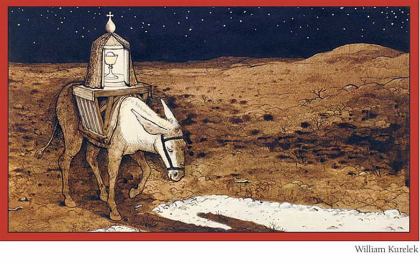
The Donkey Carrying God by William Kurelek
“The donkey that carried Our Lady to Bethlehem took another form in my thoughts. For he carried the Word—a dumb animal, carrying a Virgin who carried God—and so he was the carrier of God too. His bells were the first church bells, for Mary was the first Church, the first tabernacle of Christ.” Catherine Doherty foundress of Madonna House.
In another vein, St. Josemaria Escriva often compared himself to a donkey:
“One day at the beginning of the 1930s, the Founder of Opus Dei greeted Our Lord in the Tabernacle of the church of the St Elizabeth Foundation with these words: “Here is your mangy little donkey!” and heard in reply the gentle response, “A little donkey was my throne in Jerusalem.”
The donkey, docile, humble and hard-working, was an animal for which St Josemaria had always felt a special affection. He saw himself as a donkey – in the words of Psalm 73[72], ‘ut iumentum’. From The ‘theology of the donkey’.
‘I am like a beast (donkey) in your presence, but I am continually with you. You hold my right hand.’ (Psalm 72:23-24)

Nuestra Señora de la Esperanza
Today is the Feast of the Annunciation. Here are two beautiful quotes from Pope Pius XII which show us that right from the moment of His conception in Mary’s womb Christ our Savior embraced us with His redeeming love.
“But the knowledge and love of our Divine Redeemer, of which we were the object from the first moment of His Incarnation, exceed all that the human intellect can hope to grasp. For hardly was He conceived in the womb of the Mother of God, when He began to enjoy the beatific vision, and in that vision all the members of His Mystical Body were continually and unceasingly present to Him, and He embraced them with His redeeming love.” Pius XII Mystici Corporis , 75
“The Virgin Mary utters that generous word, “be it done”…Immediately the Heart of Jesus, ever to be adored, has begun to pulsate with love, divine and human” Pius XII, On Devotion to the Sacred Heart of Jesus, 63.
 Visitation by Fra Angelico
We find this line in the Litany of the Sacred Heart of Jesus.
Think of Mary, after she is visited by the Archangel Gabriel and she has conceived Christ the Lord within her womb…
“In those days Mary arose and went with haste, into the hill country, to a city of Judah…” Lk 1:39
“For you shall go out in joy, and be led forth in peace;
the mountains and the hills before you
shall break forth into singing…” Isaiah 55:12
All of Judah longed for the Messiah…When would he come?
How would he make his entrance in the hill country of Judea?
He was the long-awaited One, the people all desired to see his day!
Here comes a young woman, exuding peace to comfort her people,
How beautiful upon the mountains are her feet,
As she brings good tidings…
Good news of a great joy which will come to all the people…
The very hills of Judea desire her secret, which she carries beneath her heart,
She carries within her, in expectation, the One who Is…
THE DESIRE OF THE EVERLASTING HILLS!
But how will he be received?
Now Mary sees the house of Zechariah, she runs with excitement…
She enters the home and greets her cousin Elizabeth…
Elizabeth cries out:
“…when the voice of your greeting came to my ears,
the babe in my womb leaped for joy.”
HEART OF JESUS, DESIRE OF THE UNBORN CHILDREN,
HAVE MERCY ON US.
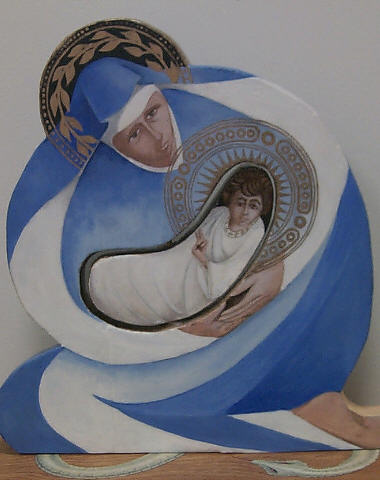
Virgin and Child, Tom Dusterberg
“To overcome the world we must become children. To become children we must fold our consciousness upon the Divine Infant who is the center of our being; who is our being itself; and all that we are must be absorbed in Him; whatever remains of self must be the cradle in which he lies.
This is the answer to Herod in all times, the answer of St. Teresa of Lisieux in our time: ‘the little way of Spiritual Childhood’, which is the oneing of the soul with God, in the passion of the Infant Christ.”
Caryll Houselander, The Passion of the Infant Christ, (1941).
Filed under: Pro-life, Quotes from Great Christians, The Incarnation, Unborn Jesus
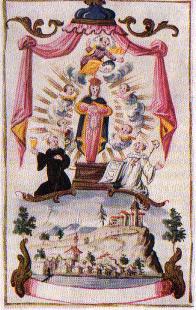
Our Lady of Expectation
“Let it be it done to me according to Thy word” (Luke 1:38 )
St Bernadine calls these words “A flame of transforming love”.
Mother St. Paul said of these words:
“It was a transformation for the world. This word of Mary’s, by which she gave her consent to God’s plan of Redemption, changed the face of the whole world. It began a new era A.D. instead of B.C. It settled the moment of the arrival of the ” fullness of time ” (Gal. 4.:4) – of God’s time. As a result of it, God was already tabernacling among men. The leaven of the Gospel, which was to leaven the whole world, was already beginning to work. Mary s word produced a transformation in the world, and though it “knew Him not,” it was never the same world again.” Mother St. Paul, Mater Christi, 1918
Let us ponder the power and grace that flooded the world when Christ was conceived in Mary’s womb. At the one cell stage, Christ fundamentally changed the world.
Christ wanted to show humanity how special that one cell stage is by fundamentally changing the world at that beginning point of His Incarnate life.
He raised that moment in each person’s life to a dignity and beauty that we will never fully comprehend.
The Culture of Death, like darkness, tries to encroach upon this light, this new illuminated life to extinguish it.
Let us pray that our world will say the same transforming words for each newly conceived child that Mary said for Jesus.
“Let is be done to (us) according to Thy word.” (Luke 1:38 )
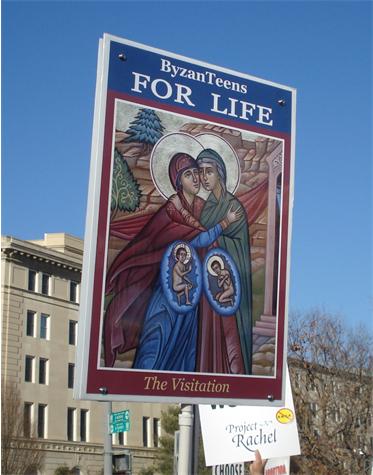
From the ByzanTEENS at the March for Life this year, an icon of the Visitation, showing not only Mary and Elizabeth, but John the Baptist and Jesus in their mothers’ wombs. Notice that John is kneeling and Jesus is blessing him. Photo and caption from Political Housewyf.
The One who is the Light of the World – Lumen Gentium – is also the ‘King’ in the Kingdom of God.
“In him was life, and the life was the light of men.
The light shines in the darkness, and the darkness has
not overcome it.” Jn 1:4-5
But what exactly is at the center of the Culture of Life? Without a doubt the Church is instrumental in creating and maintaining a Culture of life. Ultimately it is Christ who is the Centerpoint of the Culture of Life, its very Source.
“And the Word became flesh and dwelt among us, full of grace and truth;
we have beheld his glory, glory as of the only Son from the Father…
And from his fullness have we all received, grace upon grace.” Jn 1:14,16
The Culture of Life is a moral compass for the world of today. And our modern world desperately needs this compass! Christ asks each Christian each day; “Will you hold up this moral compass for your neighbor to see, for your community in its turbulent and often misguided searching?”
“You are the light of the world. A city set on a hill cannot be hid.
Nor do men light a lamp and put it under a bushel, but on a stand,
and it gives light to all in the house. Let your light so shine before men…” Mt 5:14-16
Yet the Source of this Life, the Source of this Light is Christ! If you look carefully, ‘midst the Glory and the Grace of it all, you will see a young pregnant woman standing in the glistening shadows of God. She is Mary, and within her womb – at the very Heart of the Culture of Life – is the Unborn Christ Child, hands outstretched, His tiny hidden heart rapidly pulsing with Love…merciful…redeeming…purifying…Love!
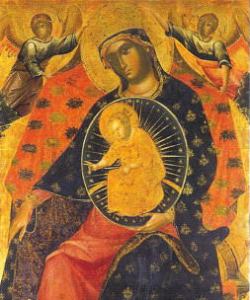
Oldest Madonna della Misericordia in Venice, dated circa 1325 detail Academia, by Paolo Veneziano
 UNBORN WORD of the day