Filed under: Mary, Quotes from Great Christians, The Incarnation, Unborn Jesus
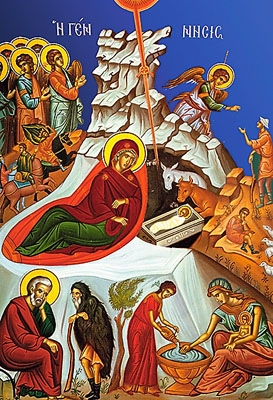

“Humanly speaking, the time of Advent must have been the happiest time of Our Lady’s life. The world about her must have been informed with more than its habitual loveliness, for she was gathering it all for the making of Her Son…
It must have been a season of joy, and she must have longed for His birth, but at the same time she knew that every step that she took, took her little Son nearer to the grave.
Each work of her hands prepared His hands a little more for the nails; each breath that she drew counted one more to His last.
In giving life to Him, she was giving Him death.
All other children born must inevitably die; death belongs to fallen nature; the mother’s gift to the child is life.
But Christ IS life; death did not belong to Him.
In fact, unless Mary would give Him death, He could not die.
Unless she would give Him the capacity for suffering, He could not suffer.
He could only feel cold and hunger and thirst if she gave Him HER vulnerability to cold and hunger and thirst.
He could not know the indifference of friends or treachery or bitterness of being betrayed unless she gave Him a human mind and a human heart.
That is what it meant to Mary to give human nature to God.
He was invulnerable; He asked her for a body to be wounded.
He was joy itself; He asked her to make Him a man.
He asked for hands and feet to be nailed.
He asked for flesh to be scourged.
He asked for blood to be shed.
He asked for a heart to be broken.
The stable at Bethlehem was the first Calvary.
The wooden manger was the first cross.
The swaddling bands were the first burial bands.
The passion had begun.
Christ was man.
This, too, was the first separation.
This was her Son, but now He was outside of her: He had a separate heart: He looked at the world with the blind blue eyes of a baby, but they were His own eyes.
The description of His birth in the Gospel does not say that she held Him in her arms but that she “wrapped Him up in swaddling clothes and laid Him in a manger”.
As if her first act was to lay Him on the cross.
She knew that this little Son of hers was God’s Son and that God had not given Him to her for herself alone, but for the whole world.”
A meditation by Caryll Houselander from “The Reed of God”.
One of the subscribers to the e-newsletter sent this beautiful meditation to us. Thanks Diana.
“St. Joseph presents us with a similar, yet somewhat different, type of devotion to the Sacred Infancy.

During the nine months the accumulation of grace upon him must have been beyond our powers of calculation. The company of Mary, the atmosphere of Jesus, the continual presence of the Incarnate God, and the fact of his own life being nothing but a series of ministries to the unborn Word, must have lifted him far above all other saints, and perchance all angels too.
Our Lord’s Birth, and the sight of His Face, must have been to him like another sanctification. The mystery of Bethlehem was enough of itself to place him among the highest of the saints.” From Bethlehem by Father Faber
St. Joseph is a model for all those in the pro-life movement. He took unborn Jesus and Mary into his heart and life. He took care of them, saved them from disgrace and even death, supported them and helped them find shelter. Father Faber talks about the grace Joseph received in this ministry – think of all of the graces you receive in your ministry to the unborn and their mothers.
‘And the king will say to them in reply, ‘Amen, I say to you, whatever you did for one of these least brothers of mine, you did for me.’ (Matthew 25:40)

Just one of the thousand’s of pregnancy counseling centers and homes!
…a place where the Corporeal and Spiritual Acts of Mercy are lived each day
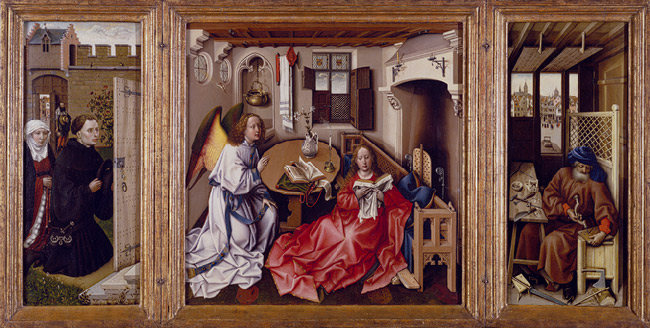

The Annunciation by Robert Campin (ca. 1375–1444)
This is a very unusual Annunciation picture by Robert Campin. The Metropolitan Museum of Art gives a detailed description of the painting.
“In a novel departure from tradition, the Annunciation is imagined as taking place not in a church but in a Netherlandish house, with objects providing visual cues for devotional instruction. The lily signifies the purity of the Virgin, who is seated on the ground, reading, to suggest her humility and piety. The Virgin’s husband, Joseph, is shown diligently at work; the mousetrap displayed on the window ledge is an allusion to the cross the unborn Christ carries in the center panel (according to Saint Augustine, the cross was the mousetrap with which God caught the Devil).”
You will notice that beneath the triptych we isolated and enlarged unborn Christ carrying the cross that was referred to in the above description. To see the triptych enlarged click on the above painting.
Blessed Columba Marmion who was devoted to the cross of Christ wrote the following:
“We ought not to consider Christ’s Sacrifice as offered only at the time of the Passion. Christ is a Victim from the moment of the Incarnation, and it is as Victim that He offers Himself…. He accepted to fulfill all that was decreed: He said to His Father: “Behold I come”: Ecce venio (Heb 10:7). The initial act of offering whereby He wholly yielded Himself up, virtually contained all His sacrifice….” .
Blessed Columba Marmion, O.S.B.
Christ The Ideal Of The Monk
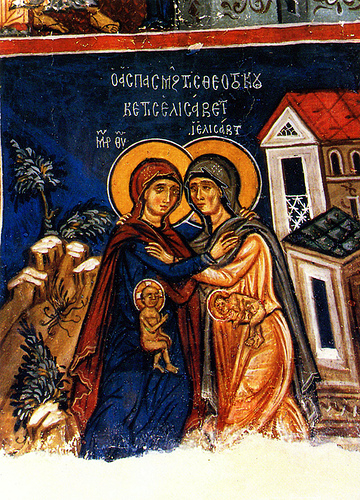
14th Century Wall Visitation
Today, Saturday March 31, 2008 is the Feast Day of the Visitation of the Blessed Virgin Mary. This Feast Day celebrates a great mystery of the Christian faith, one discussed by Blessed Teresa of Calcutta when she accepted her Nobel Peace Prize in 1979 and also by John Paul II in his great encyclical letter the Gospel of Life. Yet perhaps many Christians have not fully grasped the beautiful message we discover over and over again in this wonderful event related by St Luke, the Evangelist of the Child Jesus (see Luke 1:39-56).
For past posts, more theologically oriented than today’s see:
The Visitation – God visits His People
The Visitation – The unborn Christ begins his saving mission
What did Fulton Sheen think was One of the most beautiful moments in history?
Newly conceived Jesus acknowledged by John the Baptist
Now Mary’s cousin Elizabeth was not only older than her but also surpassed her (according to the world’s standards) in the dignity of her position as the wife of a priest (Zechariah) who served at the Jerusalem Temple. Yet in the mystery of the Visitation, Elizabeth bows to Mary (and her unborn child Jesus): “…and Elizabeth was filled with the Holy Spirit and she exclaimed with a loud cry, ‘Blesssed are you among women, and blessed is the fruit of your womb!” Elizabeth continues to bless Mary as “the mother of my Lord” and especially for her faith!
But we have another “match up” here. The older unborn baby – John – defers to or acknowledges, so to speak, the younger but greater unborn baby, Jesus. John leaps for joy at the approach of the Unborn Savior, but in a spiritual sense he kneels and worships the Unborn Christ Child. Three months later, just after John’s birth, the priest Zechariah (husband to Elizabeth and father to John) will sum things up quite simply: “Blessed be the Lord God of Israel, for he has visited and redeemed his people…” (Lk 1:68). Yes, Unborn Jesus, who is the Lord (according to Elizabeth and the Holy Spirit), has been visiting the home of Zechariah for three joyful months.
We too, like Unborn John, Elizabeth and Zechariah should worship Unborn Jesus and honor His mother Mary. We should also – along with all society and the medical and social service professions – show deference to all innocent unborn children, and their mothers, acknowledging the awesome dignity and reality of the hidden mystery of life, growing and maturing towards birth’s revelation.
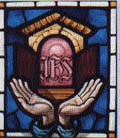
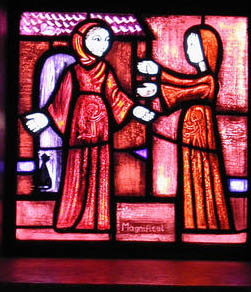
Hands of Elizabeth welcomes the yet unborn Jesus (IHS) into her home
Stained glass window from
BLESSED SACRAMENT CHAPEL
St. Edmunds College Canberra
How does God receive one’s intimate Christian prayer? If one prays simply: “Jesus I adore You”, how does the Lord view such a prayer? Or if one prays: “Jesus please protect the unborn children in my community who are at risk today”, what does the Lord do with such a simple prayer?
Doesn’t the Lord appreciate simplicity and heartfelt intimacy such as this?
And what if we whisper an intimate prayer to the Lord that He doesn’t hear from others, that is somewhat unusual, yet sincere and heartfelt, what does He do with such a prayer?
For example: “Unborn Jesus I adore You!” Or “Unborn Jesus please have pity upon the unborn children in my community who are at risk today”.
Is it possible that a prayer that is so different in its simplicity and intimacy could be perceived by God as something like a rare flower? Might it be that God especially cherishes one’s unique heartfelt expression of one’s love of Him or one’s petition to Him?
Let’s find out!

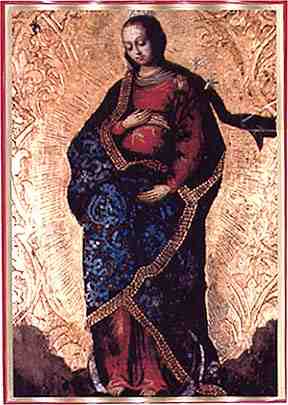
The emphasis of the French School of Spirituality (which had its beginning with Cardinal Pierre de Bérulle (1575-1629) and continued with his disciples such as the Venerable Jean-Jacques Olier (1608-1657) and St. John Eudes (1601-1680) was on the nine months during which Jesus lived in the womb of Mary. These men rightly perceived the mystery of the beauty and depth of the communication which took place between Mary and her Son during this blessed period. Olier and Eudes especially would speak of this communication as being between their hearts. St. Louis de Montfort also was influenced by this Spirituality when he entered Saint-Sulpice which was founded by Jean-Jacques Olier, one of the leading exponents of what came to be known as the ‘French School of Spirituality’.
Following are a few of the quotes about the Unborn Christ Child by St. Louis de Montfort from his Treatise on True Devotion to the Blessed Virgin:
“God the Son came into her virginal womb as a new Adam into his earthly paradise, to take his delight there and produce hidden wonders of grace. God-made-man found freedom in imprisoning himself in her womb. He displayed power in allowing himself to be borne by this young maiden.” 18
“Time does not permit me to linger here and elaborate on the perfections and wonders of the mystery of Jesus living and reigning in Mary, or the Incarnation of the Word. I shall confine myself to the following brief remarks. The Incarnation is the first mystery of Jesus Christ; it is the most hidden; and it is the most exalted and the least known. It was in this mystery that Jesus, in the womb of Mary and with her co- operation, chose all the elect. For this reason the saints called her womb, the throne-room of God’s mysteries.” 248
“Our good Master stooped to enclose himself in the womb of the Blessed Virgin, a captive but loving slave, and to make himself subject to her for thirty years. As I said earlier, the human mind is bewildered when it reflects seriously upon this conduct of Incarnate Wisdom. He did not choose to give himself in a direct manner to the human race though he could easily have done so. He chose to come through the Virgin Mary. Thus he did not come into the world independently of others in the flower of his manhood, but he came as a frail little child dependent on the care and attention of his Mother. Consumed with the desire to give glory to God, his Father, and save the human race, he saw no better or shorter way to do so than by submitting completely to Mary.” 139
Prominent Men and Women of or influenced by the French School:
· Cardinal Pierre de Bérulle (1575-1629)
· Jean-Jacques Olier (1608-1657), disciple of Cardinal Berulle. Olier founded the Society of St. Sulpice, in 1642, to train and form future priests
· Jeanne Chezard de Matel (1596-1670), foundress of the Sisters of the Incarnate Word in Avignon, France, in December, 1639.
· St.John Eudes, founder of the Eudists.
· St. Louis de Montfort. (1673-1716)
· Blessed William Joseph Chaminade (1761-1850)
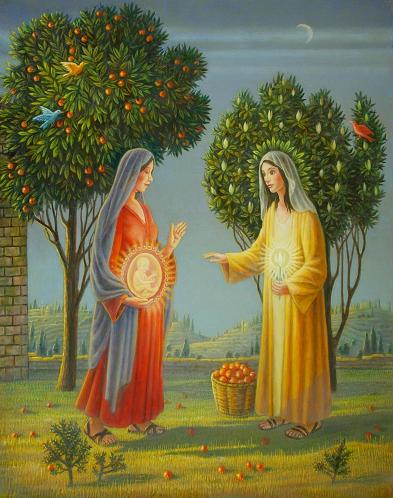
In his address to the conference on The Human Embryo in the Pre-Implantation Phase, Pope Benedict XVI points out that at the Visitation, when Jesus had been conceived only a few days earlier (therefore in the pre-implantation phase) His presence was perceived by another unborn baby, John the Baptist.
“As it is easy to see, neither Sacred Scripture nor the oldest Christian Tradition can contain any explicit treatment of your theme. St Luke, nevertheless, testifies to the active, though hidden, presence of the two infants.
He recounts the meeting of the Mother of Jesus, who had conceived him in her virginal womb only a few days earlier, with the mother of John the Baptist, who was already in the sixth month of her pregnancy: ‘When Elizabeth heard Mary’s greeting, the baby leapt in her womb’ (Lk 1: 41).
St Ambrose comments: Elizabeth ‘perceived the arrival of Mary, he (John) perceived the arrival of the Lord, the woman the arrival of the Woman, the child, the arrival of the Child’ (Comm. in Luc. 2: 19, 22-26).”
Clementine Hall
Monday, 27 February 2006
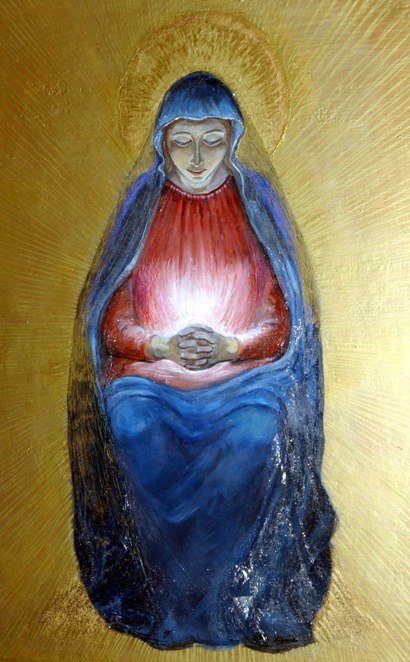
WITHOUT THE LORD’S DAY, SUNDAY, LIFE DOES NOT FLOURISH
At the conclusion of Mass, Pope Benedict went out into the adjoining square where he climbed a podium to pray the Angelus. Before the Marian prayer he said:
“Just as Mary bore Him in her womb – a defenseless little Child, totally dependent on the love of His Mother – so Jesus Christ, under the species of bread, has entrusted Himself to you, dear brothers and sisters.
Love Him as Mary loved Him! Bring Him to others, just as Mary brought Him to Elizabeth as the source of joyful exultation! The Virgin gave the Word of God a human body, and thus enabled Him to come into the world as a man.
Give your own bodies to the Lord, and let them become ever more fully instruments of God’s love, temples of the Holy Spirit! Bring Sunday, and its immense gift, into the world!”
Stephansplatz, Vienna
Sunday, 9 September 2007
The Holy Father needs our prayers as he brings the message of Christ to the United States this week.
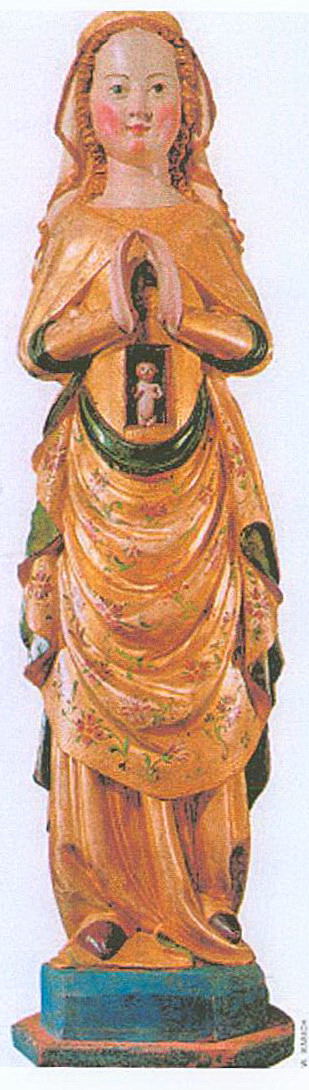
In 1996, Medievalist, Markus Bauer visited the Cistercian convent, St. Marienstern, in Panschwitz-Kuckau — a small village with a population of 2400 and located in the Sachsen part of the Lausitz area in search of material for an historical exhibit.
The historian found three sculptures of the Blessed Virgin Mary, each with an opening in the stomach,where the viewer could see a miniature carving of the unborn Christ Child. Such sculptures were highly valued devotional objects in the 14th and 15th centuries. In the 19th century, this type of devotional image no longer spoke to the souls of the sisters in the same way, so they hung a cloth over the stomach opening, or they nailed the opening closed. Since the covering for one of these Marian figures was missing, it was put away in a remote cell, where it stayed to the present time.

Father Faber once said of the Annunciation:
“The Annunciation is the hardest feast in the year to keep as it should be kept.” Fr. F.W. Faber, The Blessed Sacrament
One website called the Day of the Unborn Child is trying to encourage Christians to celebrate this feast day in a more profound and significant way. Here is how they describe what they are about:
“This site was developed to advance the movement toward international recognition of March 25th as the “Day of The Unborn Child,” and equally to promote among Christians the observance of this traditional feast day of the Incarnation honoring Christ’s conception which is currently named ‘The Feast of the Annunciation.’ “
This website is really informative – Some of the topics that you will find are:
Ideas for celebrating the feast
Fascinating facts about this feast
Historical Background on the feast
Worship Resources
Further Reading and Instructional Materials
They also will send you free prayer cards. They are really beautiful cards – I requested them about a year ago.
To see these and more topics click here.
This website also calls our attention to the fact that over the past 15 years there has been a movement to celebrate the Feast of the Annunciation, March 25 as the Day of the Unborn.
Quite a few countries especially in Central and South America have had this day officially recognized as the Day of the Unborn or are working towards this goal. Here is a partial list of these countries:
El Salvador, Argentina, Brazil, Chile, Ecuador, Guatemala, Nicaragua, Uruguay, Paraguay and The Philippines
Click here to see an article on the Hawaii Right to Life website which provides other details about this movement. The Knights of Columbus also encourage the celebration of Day of the Unborn Child on the feast of the Annunciation. Because March 25th falls on Easter Tuesday – the Annunciation will be celebrated on March 31 this year.
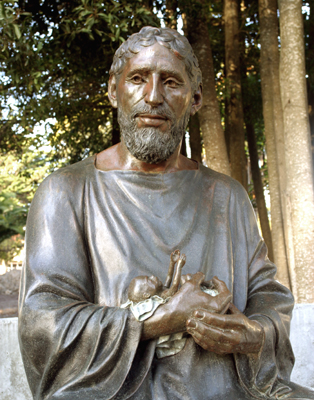
St. Joseph, Patron of the Unborn
(seen above holding an unborn baby)
Today, March 15 is the feast day of St. Joseph. The Statue in the above picture is found at the Shrine of St. Joseph, Guardian of the Redeemer in Santa Cruz, California. When Jesus was still an unborn baby Joseph learned about His saving mission. St. Thomas Aquinas tells us that:
“Mary and Joseph needed to be instructed concerning Christ’s birth before He was born, because it devolved on them to show reverence to the child conceived in the womb, and to serve Him even before He was born.” (St. Thomas Aquinas, O.P., Summa Theologica, III, Q. 36, art. 2, ad2.)
In a document on the Vatican website entitled Christ the only Saviour we are reminded that Mary and Joseph were given heavenly instruction about Christ’s mission as Saviour right before his conception and while he was in the womb. “Christ reveals himself throughout his earthly life as the Saviour sent by the Father for the salvation of the world. His very name, “Jesus”, expresses this mission. It actually means: “God saves”. It is a name he was given as a result of heavenly instruction: both Mary and Joseph (Lk 1:31; Mt 1:21) receive the order to call him by this name. In the message to Joseph the meaning of the name is explained: ‘for he will save his people from their sins’.”
Mary and Joseph believed in the words of angels and they acted in accordance with this belief. Again St. Thomas explains: “But His first coming was unto the salvation of all, which is by faith that is of things not seen. And therefore it was fitting that His first coming(in the womb) should be hidden.” (St. Thomas Aquinas, O.P., Summa Theologica, III, Q. 36, art. 1, ad 3)
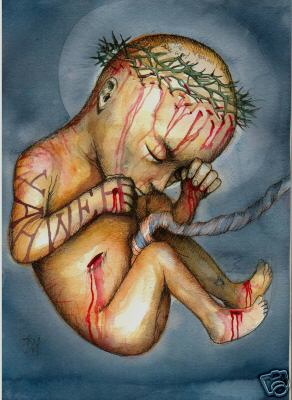
I recognize that not everyone will like this picture and I myself used it with some hesitancy. But it highlights a theme that quite a few saints and spiritual authors have written about which actually seems very relevant in our time (because of abortion), namely that Christ’s time in the womb was a time of suffering for our sins. Here are four quotes for our Lenten meditation:
Salvation to all that will is nigh;
That All, which always is all everywhere,
Which cannot sin, and yet all sins must bear,
Which cannot die, yet cannot choose but die,
Lo, faithful virgin, yields Himself to lie
In prison, in thy womb… John Donne, The Annunciation
“The third characteristic then of the obedience of Christ is that it was tried by suffering and humiliations. To accomplish the Will of His heavenly Father, the Infant Christ, with the full use of every faculty, consented to be enclosed for nine months in the dark prison of His Mother’s womb. Other infants feel not this privation as they have not the use of reason, but Christ had the use of reason and must have dreaded the confinement in the narrow womb, even of her whom He had chosen to be His Mother.
Through obedience to His Father, and from the love He bore to man, He overcame this dread, and the Church says: ‘When Thou didst take upon Thee to deliver Man, Thou didst not abhor the Virgin’s womb.’ Again, our dear Lord needed no small amount of patience and humility, to assume the manners and the weaknesses of a child, when He was not only wiser than Solomon, but was the Man ‘in Whom are hid all the treasures of wisdom and knowledge.’ ” St. Robert Bellarmine, The Seven Words on the Cross
“Consider the painful life that Jesus Christ led in the womb of his Mother, and the long‑confined and dark imprisonment that he suffered there for nine months. Other infants are indeed in the same state; but they do not feel the miseries of it, because they do not know them. But Jesus knew them well, because from the first moment of his life he had the perfect use of reason….The womb of Mary was therefore, to our Redeemer a voluntary prison, because it was a prison of love. But it was also not an unjust prison: he was indeed innocent himself, but he had offered himself to pay our debts and to satisfy for our crimes. It was therefore only reasonable for the divine justice to keep him thus imprisoned, and so begin to exact from him the due satisfaction.
Behold the state to which the Son of God reduces himself for the love of men, he deprives himself of his liberty and puts himself in chains, to deliver us from the chains of hell.” St. Alphonsus de Liguori,The Incarnation, Birth and Infancy of Jesus Christ
“He was filled with compassion for all the miseries of creation, and this never left Him henceforward; and most of all did He feel for sin, the greatest and the truest of our miseries, and He distinctly and separately pitied the sins of each one of us in particular.
…He surrendered Himself as a prisoner in His Mother s womb, for crime, for debt, and as a prisoner of war, as if He were a delinquent threefold by all those three liabilities. He only left His prison to suffer and to expiate, and it seems as though He loved it so, that He repeats His state of imprisonment in the Blessed Sacrament.” Father Faber, The Blessed Sacrament
When I think of Christ suffering in the womb for our sins it gives me great hope. Hope that He has obtained for us a special grace during His time of suffering in the womb – a grace that will enable us to overcome abortion in our time.
“Truly He is in haste to be about His Father s business. Truly He is an impatient conqueror, to be thus early beginning His conquests, and laying the foundations of His world-wide empire. He cannot bear to be in the world for even so short a while, but sin shall feel the weight of His unborn arm…. His first mission and ministry was in the womb and the babe unborn the first conquest of His divine apostolate.
By and bye we shall see Him pale and bleeding beneath the moonlit olives on the hill, whose umbrage shrouded the Creator in His astonishing mortal agony, and we shall know with what unutterable intensity He hated sin.
Yet the modest picturesque mystery of the Visitation hides a hatred of sin no less intense, and which almost seems to be more powerful and more divine.
The Baptist in His mother s womb has been conceived in guilt, like the rest of Adam’s children, Mary alone excepted. He is bound with the thralldom of the fall, with the chains of original sin. But the living Ark of the Covenant… brings her heavenly burden nigh to where he is; and the unborn Child destroys the sin and abolishes the curse of the unborn child.
The Baptist leaps with exultation in his mother’s womb, and worships, with the abounding gladness of his sinless soul, his Redeemer and His God hidden in the Virgin-Mother.”
Father Faber The Blessed Sacrament
Filed under: Evangelium Vitae, John Paul II, Quotes from Great Christians, Unborn Jesus
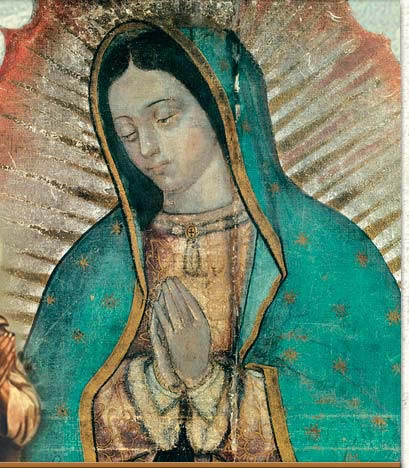
“Am I not here, I, who am your Mother? Are you not under my shadow and protection? Am I not the source of your joy? Are you not in the hollow of my mantle, in the crossing of my arms? Do you need anything more? Let nothing else worry you, disturb you .”
These wonderful words were the words of Our Lady of Guadalupe to Saint Juan Diego when she appeared to him in 1531.
These words are still relevant today as Archbishop Burke reminded us in a homily he gave in 2005 at the new Shrine of Our Lady of Guadalupe that he has helped establish in La Crosse, Wisconsin. Here are some interesting quotes from this homily.
“…our late and most beloved Pope John Paul II placed the mission of the Church in America, at the beginning of the Third Christian Millennium, under the protection of the Virgin of Guadalupe and commended her to us as the Star to lead us to Christ and, in Christ, to the conversion of our personal lives and the transformation of our world.”
Archbishop Burke calls this apparition “the mystery of the Visitation as it was experienced on our continent in 1531. The woman clothed with the sun, bearing the Infant Savior, the Anointed, in her womb, appeared to Saint Juan Diego, from December 9 to 12, 1531, in order that a chapel be built in which she might manifest the all-generous and never-failing merciful love of God for us, incarnate in her womb and alive for us in the Church, above all, in the Sacrament of the Real Presence, the Holy Eucharist.”
He reminds us that “…she has desired to remain with us always, in order that the mystery of the Visitation might be always new for us. She has miraculously left her living image on the tilma or mantle of Saint Juan Diego. In the magnificent basilica built to her honor, in which the tilma of Saint Juan Diego is enthroned, the Mother of God continues to visit pilgrims and to announce to them the great mystery of God’s all-loving and never-failing mercy.”
And that just as “… in 1531, she inspired her sons and daughters to abandon the horror of human sacrifice and to respect the inviolable dignity of every man, both the Native American and the European, so now she inspires us to be tireless disciples of the Gospel of Life, working to end the horror of procured abortion and so-called “mercy-killing,” and to promote the respect for the dignity of every human life from the moment of inception to the moment of natural death.”
This is relevant because “Pope John Paul II commended the Virgin of Guadalupe to us as the Mother of America and the Star of the New Evangelization.”
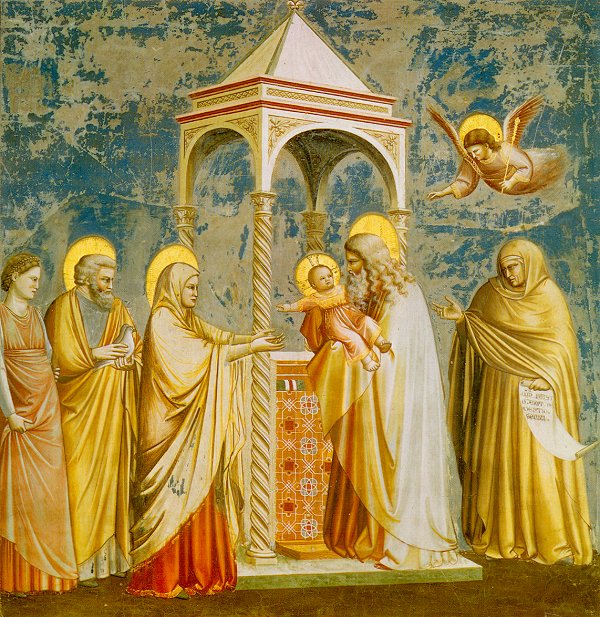
Giotto ca. 1267 – 1337
When Mary and Joseph were leaving the Temple with their newborn baby Jesus after the rite of purification had been celebrated according to the law of Moses, they encountered a man inspired by the Holy Spirit named Simeon (Lk 2:22-35). The evangelist Luke introduces Simeon this way: “this man was righteous and devout looking for the consolation of Israel”. Thanks be to God, Simeon realized then and there that the baby Jesus was “the consolation of Israel“! Yes, and “the hope of Israel“!
Similarly, for Pro Life people, we can look at Unborn Jesus and discover tremendous reasons for hope. Unborn Jesus is “the consolation of the Pro Life Movement”! If you contemplate Unborn Jesus, you see Him in solidarity with all unborn children. Just as a beautiful prism reveals glorious reflections, so unborn children when viewed through the prism-like life of the Unborn Christ, are seen anew in their sacred dignity. The image and likeness of God is beautifully magnified within these tiny persons.
When the adult Jesus wanted to capture the attention of the fisherman by the shores of Galilee he told them to cast their nets out and they were suddenly inundated by fish to the point of their nets breaking and their boats sinking (Lk 5:4-11). Well, one way Jesus captures the attention of Pro Life people is simply by coming to us as an unborn baby Himself. And He brings consolation, encouragement and hope to all who are Pro Life, so that we can imitate the faith of Abraham: “Hoping against hope, he believed…(Rom 4:18).”
Hoping against hope, the Pro – Life Movement prays and works for Life.
In honor of Cardinal de Bérulle who was born on February 4, 1575 we want to devote today’s post to him. He was the founder of the French School of Spirituality. The French School of Spirituality was a principle devotional influence within the Catholic Church, from the mid 17th Century through the mid 20th Century, not only in France but throughout the world.
Cardinal de Bérulle was friends with St. Vincent de Paul and St. Francis de Sales. In fact, St. Vincent de Paul was very influenced by Bérulle and once said of him,”he was one of the holiest men I have ever known”. Another saint, St. John Eudes, considered Cardinal de Bérulle to be one of his models of the spiritual life.
Cardinal Bérulle wrote extensively on the Unborn Christ Child. Here are two beautiful quotes. The first quote reflects on the Visitation when the unborn John the Baptist leaps with joy:
“God has become a child, and so he wants first to be known and adored by a child, and this is one of the first emanations of the childhood of God, manifesting himself to the universe. God is a child, the world ignores, heaven adores, and a child is the first person in the universe to recognize and adore him, and he does so by the homage and secret operation of God himself, who wants to act upon children. He wants to honor himself as child by giving the first knowledge of himself to a child in the world, making him his prophet in the universe. Thus the Infant-God is recognized and manifested, not by and angel, but by a child. So his first prophet is a child, just as shortly his first martyrs will be children.”
“There are three states of Jesus that deserve singular and daily consideration: in the womb of the Father as Son of God, God of God, consubstantial and equal with his Father; in the womb of the Virgin as Son of Man, both man and God, the Mediator of God and men; in the womb of the Church, which is his center and altar, as Lamb of God and victim of praise and propitiation, which she (the Church) presents to the Father.”
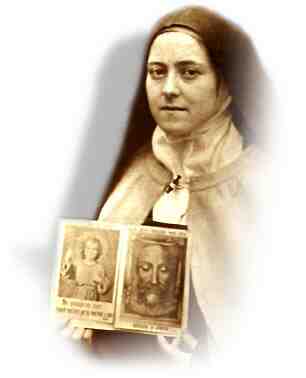
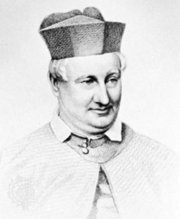
Answer: The great Father Faber (1814-1863) who pioneered devotional insights into the life of the unborn Christ Child. As some of you know we have quoted Father Faber on a number of occasions. Besides being an impressive preacher and spiritual writer Father Faber also wrote many wonderful hymns – including Faith of Our Fathers and There’s a Wideness in God’s Mercy. Two of his books that touch upon the mystery of the unborn Christ Child are Bethlehem and The Blessed Sacrament.
St. Therese of Lisieux is also known as St. Therese of the Child Jesus due to her well known devotion to the Infant Christ. Here is what St. Therese wrote in a letter to her aunt on November 16, 1896 about Father Faber:
“Fortunately, I have the deep Father Faber to console me. He understood that words and sentences here below are incapable of expressing feelings of the heart and that full hearts are the ones containing the most within themselves.” Letters of St. Therese of Lisieux, Volume II, ICS Publications.
Here is a surprising quote from Father Faber where he talks about devotion to ‘our dearest Lord’s life in the womb”.
“It would simply weary the reader to repeat almost word for word this description of our dearest Lord’s life in the Womb, changing the phrases to apply it to the Blessed Sacrament. The parallel is so complete, that it must already have suggested itself; and I have dwelt upon it at greater length, because, as the devotion to the life in the womb is especially a devotion of interior souls, so the corresponding thoughts with regard to the Blessed Sacrament are those which are most familiar to interior souls in their prayers before the tabernacle; and again as all the mysteries of the Sacred Infancy take their color and character from the life in the womb, to establish the analogy between it and the Blessed Sacrament is in truth to establish the analogy between the Blessed Sacrament and the Sacred Infancy altogether.”
The Blessed Sacrament, Fr. F. W. Faber
 UNBORN WORD of the day