


Filed under: Unborn Jesus
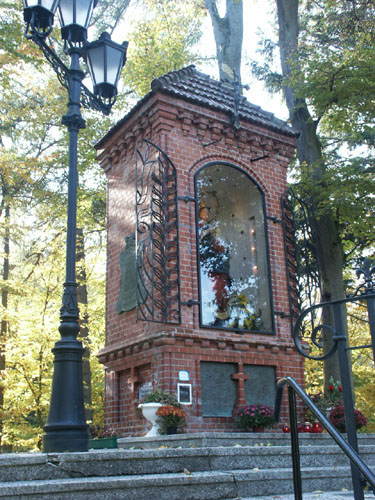
Sanctuary of Pregnant Virgin Mary in Gdansk-Matemblewo, Poland
“O sing to the Lord a new song; sing to the Lord, all the earth!” Ps 96:1
Ultimately, the Word of God, Jesus Christ, is the Church’s ever-new and ever-discovered Song! Through Him, with Him and in Him, this Song of the Church resounds, pulses and echoes.
But it has pleased God, in different ages and varied dominions throughout salvation history, to inspire New Christian Songs, that is Christian Devotions, like variations complimenting the constant theme of Jesus Christ. Take the rosary for example, which had its origins in the late middle ages, or devotions like the Stations of the Cross, Our Lady of Guadalupe, the Sacred Heart of Jesus, Lourdes, Fatima, and the Divine Mercy, to name a few.
With each new devotion “Song”, we “Sing to the Lord, bless his name; tell of his salvation from day to day. Declare his glory among the nations…” (Ps 96:2-3). Devotions help build up the Church and extend the proclamation of Jesus Christ to the ends of the earth.
Many pro – life Catholics believe that a new devotion is just beginning to spread throughout Christendom; devotion to the Unborn Christ Child! We know intuitively why this devotion is needed at this particular time in human history. When Joseph, Mary and the baby Jesus fled the Bethlehem region for fear of Herod, the Holy Innocents were slaughtered in place of Jesus:
“A voice was heard in Ramah, wailing and loud lamentation, Rachel weeping for her children; Because they were no more.” Mt 2:18
Today this “wailing and loud lamentation” is heard worldwide. Almost all nations have opened wide their arms to legalized abortion, to the Trojan horse of “choice”, which has brought unparalleled sadness to the world and the trampling of respect for human life in its vulnerable unborn/preborn state.
But God wants to turn our weeping into singing, our sadness into devotion. UNBORN JESUS beckons us: “Come to me, all who labor and are heavy laden…for I am gentle and lowly in heart, and you will find rest for your souls” (Mt 11:28-29).
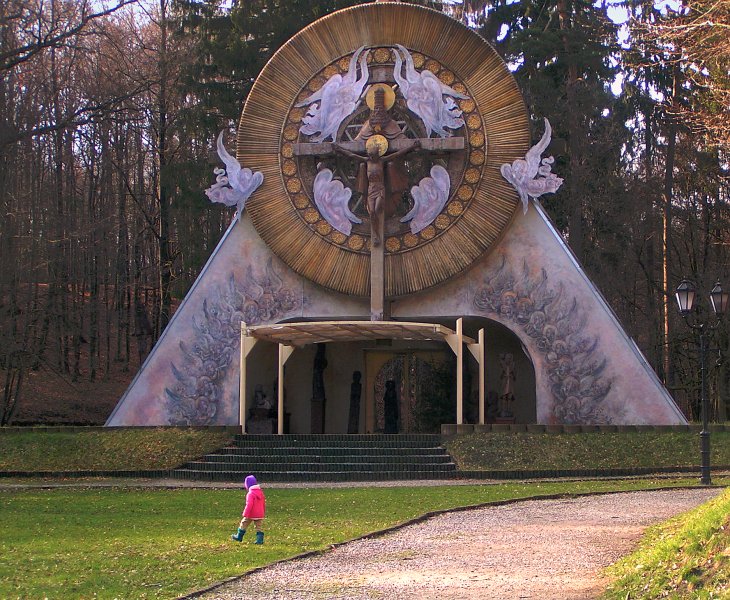
Papal altar in Gdansk Matemblewo can be found close to Our Pregnant Lady Sanctuary (the only such sanctuary all over the world). By this altar, Pope John Paul II celebrated the Holy Mass in Sopot, on 5th June 1999 during his 7th pilgrimage to Poland.

The Madonna of Port Lligat
(detail) by Salvador Dali
Do you remember the story Jesus told His followers one day about the rich man and the beggar at his gate, “full of sores”, named Lazarus (Lk 16:19-31). Both of them die, the beggar goes to Abraham’s bosom while the rich man goes to Hades. The rich man calls out to Abraham asking that Lazarus be sent to the rich man’s brothers to warn them to change their lives. The rich man cries out to Abraham: “…if some one goes to them from the dead, they will repent”. Abraham does not share the once-rich man’s unfounded optimism.
Well imagine if an unborn baby were to speak words that our modern world could understand, wouldn’t that be enough? Wouldn’t today’s pro-abortion doubters – especially those who claim to be “Christian” – finally repent?
An unborn baby has spoken!
“Consequently, when Christ came into the world, he said,
‘Sacrifices and offerings thou hast not desired,
but a body hast thou prepared for me;
in burnt offerings and sin offerings thou hast taken no pleasure.
Then I said, ‘Lo, I have come to do thy will, O God,
as it is written of me in the roll of the book.'” Heb 10:5-7
In this case, the Unborn Christ prays to His Father. When did this occur? It occurs after the Incarnation, traditionally it has been understood to have occurred immediately, that is, at the one cell stage of Our Lord’s development. In a General Audience December 10, 1997, Pope John Paul II says that Christ spoke these words “at the very moment he enters the world“. At “the very moment” would be at the one cell stage.
Centuries before John Paul II, the great doctor of the Church, St. Alphonsus de Liguori, said that Christ spoke these words “from the very first moment of his entrance into the world”. The Unborn Christ refers to His body with respect, acknowledging it as a gift from the Father…but for what purpose? He states it simply “…to do thy will, O God.” In fact, He acknowledges that He has been sent: “I have come to do thy will…”
This Unborn Christ is the exemplar for every unborn child. No other unborn child will be a redeemer. But all are blessed with the gift of life and certainly called to do the holy will of God.
The Unborn Christ has spoken. He has revealed a key mystery about life to all who have ears to listen.
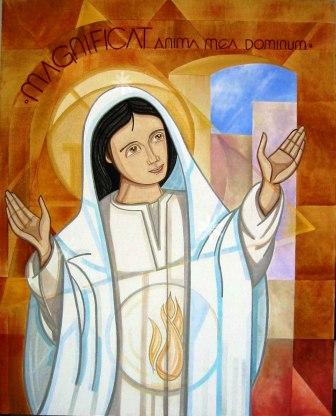
“Didn’t the Virgin Mary do the will of the Father? I mean, she believed by faith, she conceived by faith, she was chosen to be the one from whom salvation in the very midst of the human race would be born for us, she was created by Christ before Christ was created in her. Yes, of course, holy Mary did the will of the Father. And therefore it means more for Mary to have been a disciple of Christ than to have been the mother of Christ. It means more for her, an altogether greater blessing, to have been Christ’s disciple than to have been Christ’s mother. That is why Mary was blessed, because even before she gave him birth, she bore her teacher in her womb.”
From Mary, a disciple of Christ, St. Augustine, Sermon 72/A, 7
“So much can be gained by reflecting on the way Mary learned from Jesus! From her very first “fiat”, through the long, ordinary years of the hidden life, as she brought up Jesus, or when at Cana in Galilee she asked for the first sign, or when finally on Calvary, by the Cross, she looked on Jesus, she “learned” him moment by moment. Firstly in faith and then in her womb, she received the Body of Jesus and then gave birth to him. Day after day, enraptured, she adored him. She served him with solicitous love, singing the Magnificat in her heart.”
From: Pope Benedict, XVI in Poland May 26, 2006 VIAGGIO APOSTOLICO DI SUA SANTITÀ BENEDETTO XVI IN POLONIA (25-28 MAGGIO 2006) (V) , 26.05.2006
Filed under: Unborn Jesus

Icon of the Annunciation, with Jesus in Mary’s womb, in Nazareth
Let us mine today just one vein in those vast “unsearchable riches of Christ” (Eph 3:8) which can be found in the unpretentious Unborn Jesus – namely, as Model of all Virtues:
The Theological Virtues
Undaunted Faith
Unbounded Hope
Unsurpassed Love
The Cardinal Virtues
Unutterable Prudence
Unimpeachable Justice
Unfaltering Fortitude
Uncharted Temperance
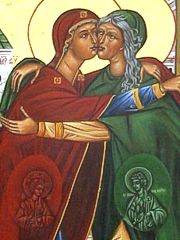
UNBORNWORDoftheday and our sponsoring organization UNBORN WORD ALLIANCE invite you to join us in 70 DAYS OF PRO-LIFE PRAYER for the U.S. Elections on Tuesday November 4, 2008. We offer our prayer to God for the election of pro-life politicians in all races, at all levels and in all states (and territories).
We take our inspiration from a most humble nun of the middle ages, St. Juliana of Cornillon (1193-1258) who was the original promoter of the Corpus Christi feast day and had a fascinating devotion to honor the Son of God within the womb of His mother Mary. St. Juliana said the “Magnificat” (Lk 1:46-55) nine times a day to honor “the nine months for which the singular Virgin bore the author of our salvation, the only-begotten Son of God, in her womb” (Acta Sanctorum, April, vol. i).
We begin our 70 DAYS OF PRO-LIFE PRAYER today, October 4, 2008, the feast day of St. Francis of Assisi, whose devotion to the infant Christ child led him to re-create the first Nativity Scene (also in the middle ages). We encourage those who join us to pray Mary’s Magnificat (Lk 1:46-55) every day. Mary was pregnant with the Unborn Christ Child when she prayed & proclaimed the Magnificat! We will end our 70 DAYS OF PRO-LIFE PRAYER on December 12, 2008, the feast day of Our Lady of Guadalupe. (Those days following the Election will be days of “thanksgiving”.) The Virgin of Guadalupe was pregnant with the Unborn Christ Child when she appeared to the peasant St. Juan Diego in 1531.
If you are able to match the contemplative St. Juliana in saying the Magnificat 9 times each day; bravo! But perhaps a more modest 3 times a day, in honor of the three trimesters during which Mary carried Unborn Jesus in her womb, would be more realistic for many. And yet, without a doubt, God would be greatly pleased even if you are only able to say just one Magnificat each day in honor of each day that Unborn Jesus spent in the womb of His mother.
The opening words of Mary’s Magnificat are Psalm-like: “My soul magnifies the Lord, and my spirit rejoices in God my Savior…” Indeed, she had the Unborn Christ Child within her and no doubt she did “reflect” the goodness of God in her thoughts, words and deeds, much as the moon beautifully reflects the bright shining rays of the magnificent Sun.
In his book The Feast of Faith, then Cardinal Ratzinger (now Benedict XVI) made this simple observation about prayer: “How can I learn to pray? By praying in fellowship…I learn to pray by praying with others, with my mother for instance, by following her words which are gradually filled out with meaning for me as I speak, live and suffer in fellowship with her.” During this 70 DAYS OF PRO-LIFE PRAYER, we can learn from the mother of the Unborn Christ Child, and our Mother in the faith, by repeating her words of praise and proclamation in the Magnificat. Words she uttered as the Unborn Word of God rested within her womb.
I
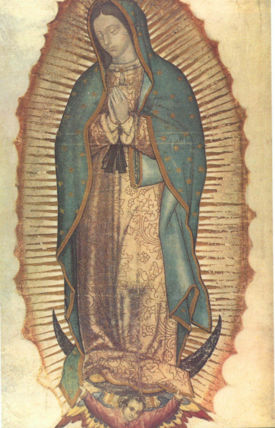
The two best known pro-life priests have written about Our Lady of Guadalupe and the unborn. Both recognize that this apparition is unique because when Mary appeared to Juan Diego she was pregnant. Some of you will ask how do we know that this is so.
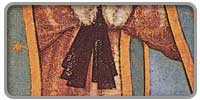
We know it because of the Maternity Band: The maternity band around the woman’s waist was the sign of a pregnant woman, a mother who is about to give birth, it was a sign to the Indians that someone is yet to come.
Calling it a surprising image this is what Father Frank Pavone of Priests for Life said about Our Lady of Guadalupe: “Today this image is still preserved on Juan Diego’s tilma, which hangs over the main altar in the basilica at the foot of Tepeyac Hill just outside of Mexico City. In the image, Our Lady is pregnant, carrying the Son of God in her womb. Her head is bowed in homage, indicating that she is not the Goddess, but rather the one who bears and at the same time worships the one true God.” and “…Our Lady of Guadalupe has been declared the ‘Patroness of the Unborn’.”
From: Our Lady of Guadalupe and the Pro-life Movement
Father Thomas Euteneuer of Human Life International states: “Of all the many manifestations of Mary’s loving presence among us throughout the centuries, in this apparition alone does she appear to us in the manner of a pregnant mother. She holds within her the unborn Christ, proclaiming the sanctity and blessedness of life within the womb. Her reverence and tenderness communicate to us the joy and awe with which we must approach each nascent life. In contemplating her simplicity we find the strength to emulate her faith, and proceed with confidence in the knowledge that God will overcome the seemingly insurmountable barriers looming all around us in the world today.”
From: Our Lady of Guadalupe: Protectress of the Unborn

This12th to 14th century statue is called the Vierge Ouvrante (the Opening Virgin) with the Trinity in her womb: we see Christ and God the Father (the Holy Spirit used to be here but has fallen away). The assembled crowd (in the fold out wings) consisting of crowned heads and humble folk who are praying to the Trinity. When this statue was closed, the viewer only saw Mary with the Christ Child in her lap
The following quotes are taken from a General Audience given by Pope John Paul II on December 10, 1997 entitled The Incarnation, the entry of eternity into time.
“Jesus’ birth makes visible the mystery of the Incarnation already realized in the Virgin’s womb at the time of the Annunciation. In fact, she gives birth to the child that, as the docile and responsible instrument of the divine plan, she had conceived by the power of the Holy Spirit. Through the humanity assumed in Mary’s womb, the eternal Son of God begins to live as a child, and grows “in wisdom and in stature, and in favour with God and man” (Lk 2:52). Thus he manifests himself as true man….
…The Incarnation is the fruit of an immense love, which spurred God willingly to share our human condition to the full. In becoming man, the Word of God brought about a fundamental change in the very condition of time. We can say that in Christ human time was filled with eternity….
…The entry of eternity into time is the entrance, in Jesus’ earthly life, of the eternal love that unites the Son to the Father. The Letter to the Hebrews alludes to this when it speaks of Christ’s inner attitude at the very moment he enters the world: “Lo, I have come to do your will, o God” (10:7). The immense “leap” from the heavenly life of the Son of God into the abyss of human existence is motivated by his will to fulfill the Father’s plan in total self-giving….
…Eternity has entered human life. Now human life is called to make the journey with Christ from time to eternity.”
We plan to feature other Vierge Ouvrante (The Opening Virgin) statues in future posts.
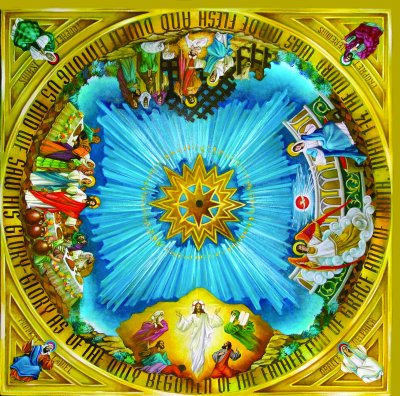
Today is the feast day of St. Robert Bellarmine. On the Canadian Catholic Conference of Bishops website they have a beautiful quote from St. Robert about the Incarnation.
So be still now, o my soul, and just listen to the way St. Robert Bellarmine compares the Incarnation to a marriage!
“The king is God the Father; the son is the Word of God; the marriage is the Incarnation; and the bride is human nature. It is most appropriate, indeed, that the Incarnation is compared to a marriage!
First, before a marriage is contracted, there is a time of courtship and engagement: hence the declaration of divine love, celebrated by the wise Solomon in his nuptial poem, the Song of Songs, and the solemn promise made by God to the patriarchs and the prophets that the nuptials would take place.
A marriage also requires mutual consent: this took place when God, through the angel Gabriel, voiced his Son’s intention to Mary, and she, the mother of the bride-to-be [the human race], answered for her daughter: ‘Behold the handmaid of the Lord; let it be with me according to your word’ (Lk 1:38).
The marriage is then consummated, whereby in all truth the two become one flesh-two natures so intimately united in one person that, unlike other marriages, not even death itself could long separate them.
And once a marriage has taken place, the couple hold everything in common: what had hitherto belonged to the Word-his unique titles, honors, and special privileges-are now bestowed on his bride; and similarly everything that belonged to human nature-its needs, aspirations, weaknesses and sufferings-is assumed by the bridegroom. Even more, a definite new relationship and familiarity begin to exist between the relatives and friends of the bride and groom: that happy intercourse between heaven and earth, which is called the “communion of saints”.
And finally, the traditional ends of marriage are also apparent in the Incarnation. Rightly, therefore, is this union called a marriage which the King of kings made for his divine Son.” (St. Robert Bellarmine)
Prayer
Listen kindly to my prayer, Lord God.
Help me to appreciate more fully the awesome beauty of this great mystery, the Incarnation, and so come to know the depth of your everlasting love. Give me an eye with which to recognize your beloved Incarnate Son; an ear that can understand his word; a heart like unto his; and teach me to ever place my hand trustingly in his.
Taken from The Canadian Catholic Conference of Bishops
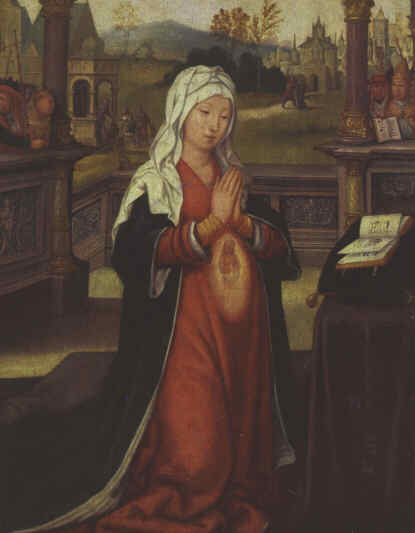
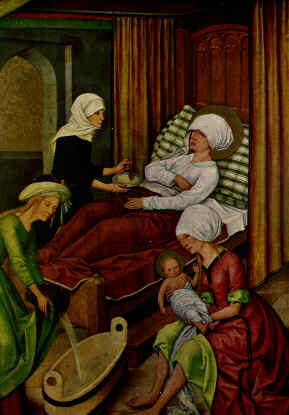
Anne Conceiving the Virgin; Bellegambe and Mary’s Birth; Master of the Pfullendorf Altar
Today, September 8 is celebrated as the feast day of the Birth of Mary. We would like to praise God for the birth of the Mother of our Savior.
“The Church usually celebrates the passing of a person, that is, the person’s entry into eternal life. Besides the birth of Christ, the Christian liturgy celebrates only two other birthdays: that of St. John the Baptizer and of Mary, the Mother of Jesus. It is not only the individual greatness of these saints that the Church celebrates, but their role in salvation history, a role directly connected to the Redeemer’s own coming into the world.” To learn more: The History of the Liturgical Celebration of Mary’s Birth
Here is a beautiful hymn about when Mary carried Jesus our Savior and God in her womb.
Mary’s womb filled me with wonder
that it should contain you,
my Lord, and enclose you.
The whole of creation was too
small to conceal your greatness,
Earth and Heaven too narrow to
serve as embracing arms, to
conceal your divinity,
The womb of the earth is too small
for you, and yet the womb of
Mary is large enough for you.
These lines from Saint Ephrem’s Hymn on the Nativity
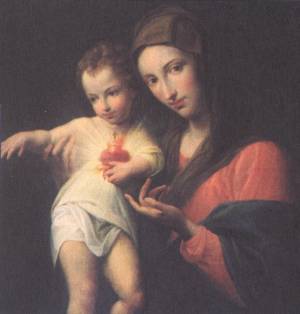
Tuesday, August 19th is the feast of St. John Eudes. I’m not an expert on Eudes, but I know of three pronounced devotions that he had: to the Heart of Jesus Christ, to Mary the Mother of the Lord and to Christ within the womb of Mary. We dedicate this reflection to John Eudes.
Through the words of his prophet Ezekiel, the Lord made a great promise to Israel:
“A new heart I will give you, and a new spirit I will put within you;
and I will take out of your flesh the heart of stone
and give you a heart of flesh.” Ezek 36:26
It is important to realize that this promise, this prophecy, could not be fulfilled until the Incarnation of Christ the Lord had occurred. It was the heart of flesh within the Body of Jesus that marked the change, for it was also the very Heart of God! Mary’s heart prefigured the heart of Jesus that would be formed within his Body, within her womb, for her heart was tender and full of Grace.
We see, in fact, that during those first nine months of the Incarnation while Jesus was an unborn baby within the womb of Mary, that the three devotions mentioned above are all linked. As one of the invocations in the Litany to the Sacred Heart of Jesus says: “Heart of Jesus, formed by the Holy Spirit within the Virgin Mother’s womb, have mercy on us.”
So the Incarnation made it possible for Israel and all Christians to take another step forward in God’s Plan of Salvation. Hence the old Catholic prayer: “Jesus, meek and humble of Heart, make my heart like unto Thine.”
John tells us: “And the Word became flesh and dwelt among us, full of grace and truth…And from his fullness have we all received, grace upon grace” (Jn 1:14,16). If the Word had never become flesh within the womb of Mary, Ezekiel’s prophecy would not have been realized.
About three weeks after His conception, the Heart of Christ was physically formed in a rudimentary fashion, pulsing with love for every human being. Although, His spiritual heart was beating thus from the first moment of conception as Pope Pius XII explains: “The Virgin Mary utters that generous word, “be it done”…Immediately the Heart of Jesus, ever to be adored, has begun to pulsate with love, divine and human” (On Devotion to the Sacred Heart of Jesus, #63).
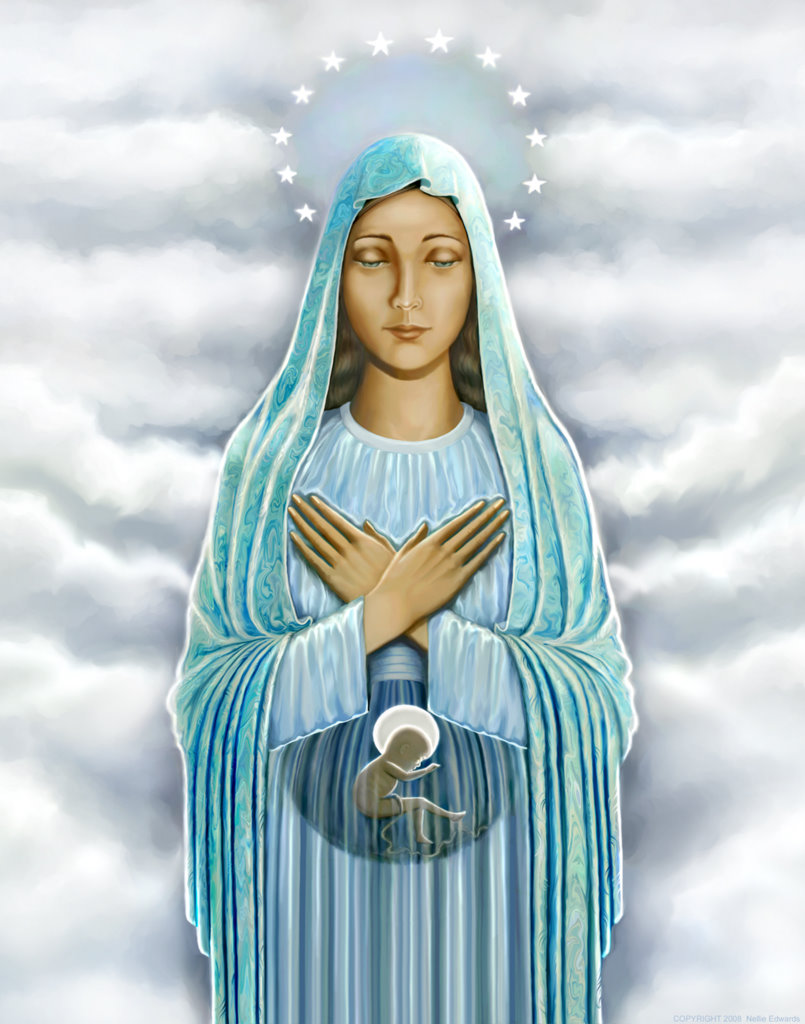
“PRAYER, PROVIDENCE AND A PRO-LIFE JOURNEY”
THE STORY BEHIND “THE LIGHT OF LIFE”
Nellie Edwards is the artist of this wonderful painting entitled “The Light of Life”. After moving to North Dakota in 1996 she prayed “that God would allow her to somehow make a difference – to help build the Culture of Life on a wider scale somehow.”
Here in her own words:
“Soon, we started a family business, which we called ‘Mother of Eight Designs’, which we knew would help promote the Faith and Family. Six of our eight children assisted in reproducing my sculpted products and before long we were selling to stores across the country. The highlight of our achievements is the fact that Bishop James Sullivan (R.I.P.) of the diocese of Fargo, personally placed some of our Pro Life Ornaments into the hands of our beloved Pope John Paul…who immediately pronounced a blessing on ‘The Edwards Family’. It is evident to me, that this blessing has been a big part of the story behind the paintings.”
Nellie began to “receive public speaking invitations from civic and business groups and I saw it as an opportunity to give witness to my Catholic faith.” She found that the more she talked about faith – “the more enthusiastic the audience response”.
It was in 2005, when she encouraged four of her sons to start a tiling business, that Nellie also started a new venture. Using a PC tablet, which is computerized, she began by making print translations of some of her sculpted plaque and ornament designs but soon turned to using this technology to paint. Her first painting was of Blessed Kateri Tekakwitha.
Nellie explains that soon after: ” I sensed I should paint an unborn child…I couldn’t think what sort of composition this would be, so I prayed for guidance. After about 2 weeks, I realized the unborn child would be Our Lord Jesus, in the womb of His Blessed Mother. I was afraid to attempt this but again, I could not get away from the idea. As with Kateri, I had no drawing to go by, nor visual aid…I simply started with the face of Mary and the composition seemed to develop almost organically. It was almost like watching someone else work.” The painting took nine months to complete.
Because of limited space I have only been able to summarize a small part of Nellie’s story. If you would be interested in contacting Nellie Edwards, or to view and perhaps purchase prints of her beautiful paintings click here.

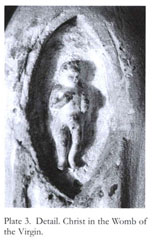
15th Century Visitation sculpture from Passau. As is customary in later representations of the Visitation, Mary and Elizabeth embrace, appearing as mirror images of one another, their unborn children, Christ and John the Baptist, can be seen in the mandoria-shaped hollows of their mother’s wombs. (see detail of Christ in the womb below)
I have a Catholic hero who 99.99% of Catholics have never heard of. I have lots of heroes, but this person is particularly distinguished for several reasons, one of which is that she has faded into utter obscurity – as most of us will do. But more importantly, she developed her own great devotion to the Unborn Christ Child back in the early 1920’s and 1930’s and wrote two outstanding books about Christ: Nativitas Christi and Ortus Christi. (No doubt her devotion to the unborn Christ was derived from the spirituality and writings of the French School of Spirituality founded centuries earlier.)
At the conclusion of this reflection I will quote one sentence from Ortus Christi, in which she turns to the Unborn Christ Child within Mary’s womb and prays.
“It is I who by my great power and my outstretched arm have made the earth…” Jer 27:5
“O Lord God of hosts, who is mighty as thou art, O Lord…Thou hast a mighty arm; strong is thy hand, high thy right hand.” Psalm 89:8,13
“And the Lord will cause his majestic voice to be heard and the descending blow of his arm to be seen…” Isaiah 30:30
“The Lord has sworn by his right hand and by his mighty arm…” Isaiah 62:8
But the arm of the Lord is also associated with deliverance, as when He delivered the people of Israel from bondage in Egypt: “I will deliver you from their bondage, and I will redeem you with an outstretched arm…” Ex 6:6
Finally, the prophet Isaiah associates the arm of the Lord with the youthful Messiah Savior: “Who has believed what we have heard? And to whom has the arm of the Lord been revealed? For he grew up before him like a young plant…” Isaiah 53:1-2
The arm of the Lord was revealed to us as a saving arm, bringing salvation through Jesus. So, even in the womb, the tiny unborn Savior’s arm represented the arm and hand of God reaching out to humanity to heal and save!
So, Mother St. Paul – a pro-life hero from the 1920’s and 1930’s – reflects on the mission of Moses and then on Isaiah’s words: “A little Child shall lead them” (Isa 11:6), then she prays to the Unborn Lord: “Oh! Come, little Saviour, come and redeem us by Thy outstretched Arm!” How humanly weak that unborn arm, yet how powerful its redemptive blessings. We too can turn to the Unborn Christ Child and beg Him to outstretch His tiny arm and work pro-life miracles in our own day.
Unborn Christ with His arm outstretched
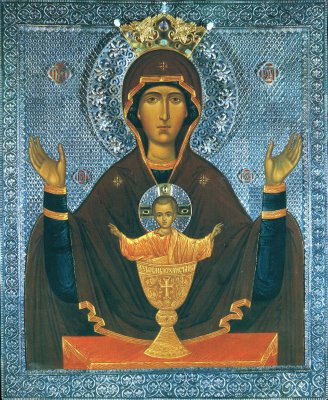
August 3rd is the feast day of St. Peter Julian Eymard. Here is a beautiful quote from him on the Incarnation:
“Now Jesus Christ, God and Man, enters into us and enacts a mystery similar to the one wrought in Mary’s womb….the Eucharist passes into our bodies and, uniting with us, prolongs, extends the Incarnation to each of us separately. In becoming incarnate in the Virgin Mary, the Word had in view this incarnation in each one of us, this Communion with the individual soul; it was one of the ends for which He came into the world. Communion is the perfect development, the full unfoldment of the Incarnation, as it is likewise the completion of the sublime sacrifice of Calvary, renewed each morning in the Mass….without Communion the Sacrifice would be incomplete. Thus the Body of Jesus Christ is united with our body, His Soul with our soul, and His Divinity hovers over both.”
St. Peter Julian Eymard
Holy Communion
Filed under: Unborn Jesus
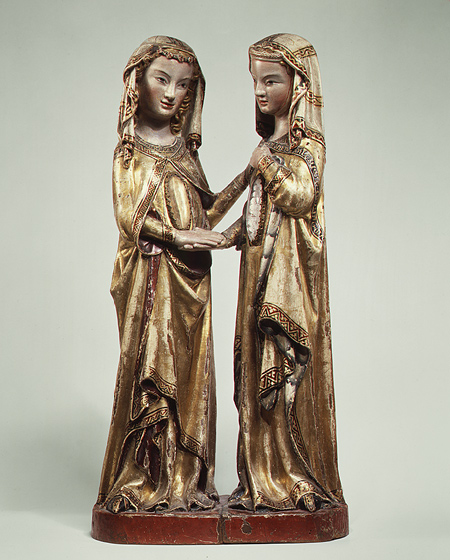
“Soon after the Virgin Mary learned of her miraculous conception of Jesus, she visited her kinswoman Elizabeth, who was also expecting a child, John the Baptist. This representation of their joyous meeting comes from the Dominican convent of Katharinenthal, in the Lake Constance region of present-day Switzerland. Carved of walnut, with the original paint and gilding almost completely preserved, the figures of Mary and Elizabeth are each inset with crystal-covered cavities through which images of their infants may originally have been seen. The representation of the Visitation incorporating images of the unborn Christ and John the Baptist is found with some frequency in late medieval works from German-speaking lands.”
From the Metropolitan Museum of Art, NYC
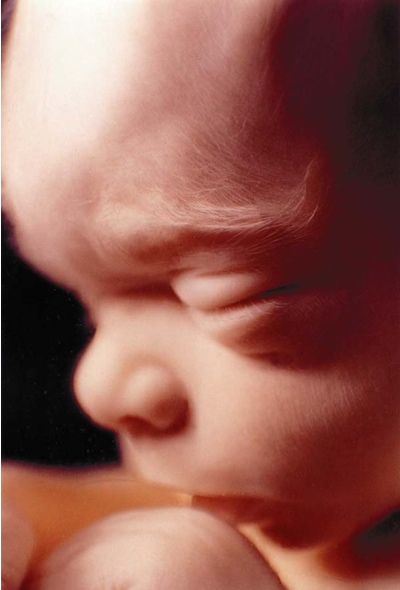
“Christ was humble of heart. Throughout his life he looked for no special consideration or privilege. He began by spending nine months in his Mother’s womb, like the rest of men, following the natural course of events. He knew that mankind needed him greatly. He was longing to come into the world to save all souls, but he took his time. He came in due course, just as every other child is born. From conception to birth, no one – except our Lady, St Joseph and St Elizabeth – realized the marvelous truth that God was coming to live among men.”
St. Josemaria Escriva from Christ is Passing By.
St. Josemaria Escriva’s feast day is June 26. He was canonized on October 6, 2002.
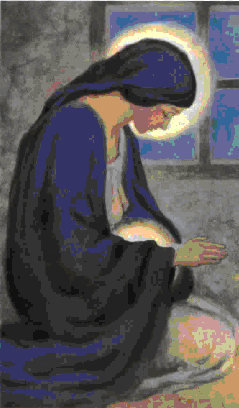
In our last post, we highlighted Catholic composer, Olivier Messiaen (1908-1992). As we pointed out 2008 is the centenary of his birth and he is being honored all over the world with concerts and symposiums. We went on to highlight one of his works: Vingt Regards sur l’enfant Jésus (“Twenty Gazes/Contemplations of the Infant Jesus”) and in particular one composition, ‘Premiere Communion de la Vierge‘. (No. 11, “Virgin’s First Communion”).
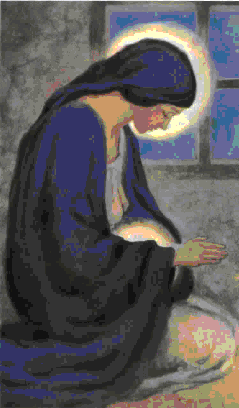
This composition represents the Virgin on her knees, worshipping the unborn Jesus within her. Because Messiaen wanted his listeners to be aware of his inspirations and how he constructed various passages, he wrote extensive program notes, which appear as prefaces to his scores or as liner notes for recordings of his music. Here is what Messiaen wrote about the Virgin’s First Communion:
“11. Première communion de la Vierge [First Communion of the Virgin]. A tableau in which the Virgin is shown kneeling, bowed down in the night-a luminous halo around her womb. Eyes closed, she adores the fruit hidden within her. This comes between the Annunciation and the Nativity: it is the first and greatest of all communions. Theme of God, gentle scrolls, in stalactites, in an inner embrace. (Recall of the theme of La Vierge l’Enfant from my Nativity du Seigneur for organ, 1935). Magnificat more enthusiastic. Special chords and durations of two and two in which the weighty pulsations represent the heartbeats of the Infant in the breast of his mother. Disappearance of the Theme of God. After the Annunciation, Mary adores Jesus within her…my God, my son, my Magnificat!-my love without the sound of words.”
These notes with explanations for all 20 gazes/compositions in Vingt Regards sur l’enfant Jésus can be found here. If you wish to purchase recordings of his songs or a book on his life here is a link to Amazon. We must mention that he is a modern composer and if you don’t like modern classical music – his compositions may not be your cup of tea.
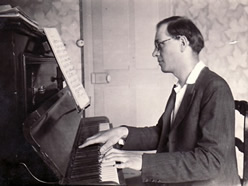
Olivier Messiaen (December 10, 1908 – April 27, 1992) was a devout French Catholic composer. This year marks the centenary of Olivier Messiaen’s birth. From June 20-24 2008 the MESSIAEN 2008 INTERNATIONAL CENTENARY CONFERENCE is being held in Birmingham, England. Another conference entitled ‘Olivier Messiaen: The Musician as Theologian’ will be held at Southern Methodist University/Dallas, September 25-26, 2008 Among the many Messiaen concerts/series around the world is another being held in England this year, the Philharmonia Orchestra Messiaen Celebrations (February 4 – October 23 ) and one in Chicago at the University of Chicago: 2008 MESSIAEN FESTIVAL October 2-11 Ten Concerts.
One of the reasons that we are highlighting Olivier Messiaen during the centenary of his birth is because of Vingt Regards sur l’Enfant-Jésus, a collection of pieces for solo piano. The French title translates “Twenty gazes/contemplations on the infant Jesus”. It is considered to be one of the greatest piano works of the twentieth century, and the summit of Messiaen’s keyboard writing. The idea of les regards, the spiritual gazes, came from the devotional book Le Christ dans ses Mystères by the Irish-Belgian Benedictine abbot Dom Columba Marmion.
The gaze is a profound moment of passionate contemplation, spiritual communication and two-way recognition: an exchange, to use one of Marmion’s favorite words, in which love and knowledge passed in both directions between God and humanity.
Some of Messiaen’s ‘gazes’ on the Infant Jesus include: Gaze of the Father, Gaze of the Star, The Exchange, Gaze of the Son upon the Son (click here to see all of the pieces)…the piece that touches on our blog’s theme is: ‘Premiere Communion de la Vierge’. (No. 11, “Virgin’s First Communion”) and represents the Virgin on her knees, worshiping the unborn Jesus within her.
Messiaen used his talents to praise God and share through his music his profound enthusiasm for the Truths of his Catholic faith. Many of his pieces were explicitly Catholic: Twenty glances upon the Infant Jesus, Hymn to the Holy Sacrament, The Lord’s Nativity, Three Small Liturgies of the Divine Presence, and the opera St. Francis of Assisi just to name a few.
In an article in the New York Times, Anthony Tommasini writes:
“The dimension of Messiaen’s music that may most set it apart derives from his spiritual life. His faith was innocent, not intellectual. As a child he loved the plays of Shakespeare, especially their “super-fairy-tale” aspects, he said. In the stories of the Catholic faith, as he told Mr. Samuel, he found the “attraction of the marvelous” he had coveted in Shakespeare, but “multiplied a hundredfold, a thousandfold.” For him the Christian stories were not theatrical fiction but true. Messiaen espoused a theology of glory, transcendence and eternity. Religious subjects permeate his works, though not the Passion and Crucifixion of Jesus. His embrace of the wondrousness of faith is reflected in the essence of his compositions.”
Our next post will feature Olivier Messaien’s personal notes explaining the “Virgin’s First Communion” with a link where to purchase this recording. We will also have a link to all his personal notes for Vingt Regards sur l’Enfant-Jésus ( “Twenty gazes/ contemplations on the infant Jesus” ).
 UNBORN WORD of the day