Filed under: The Incarnation
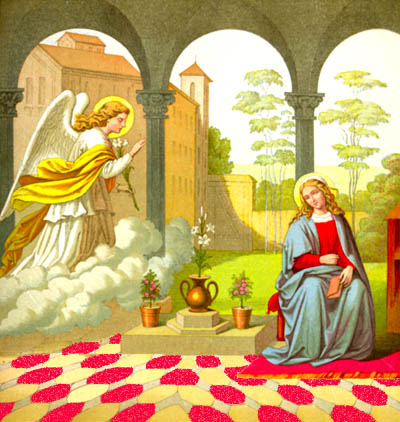
“…The Angel Gabriel brought the message of a new creation. Gabriel may have well remembered the message that was given to the created angels. He would recall that the creation of man was not followed by his acceptance of God’s message to him. Created angels rebelled; Created Adam rebelled. Now the message of the greatest creation, the creation of God-Man with the cooperation of Mary was announced.
…He gave to angels and to men a heart free to love. Without that freedom there is no true love. Alas, abusing the God-given freedom, the angels cried, “We will not serve,” and man cried, “I will not obey”. What then is Gabriel’s joy on the morn of this new creation when Mary answers with full love, “Behold the handmaid of the Lord.”
God’s greatest creation, the Incarnation of Jesus, is consummated by the consent of Mary. With gratitude to both (Mary and Jesus) I begin every new day which is like a new creation, and I welcome Mary’s Son who comes to dwell with me today.”
Francis P. Donnelly, S.J. The Heart of the Angelus and of The Hail Mary, 1947
Filed under: The Incarnation
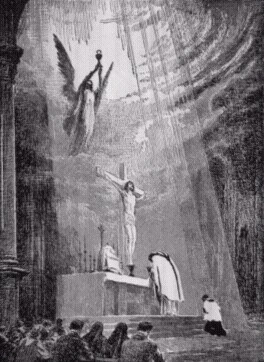
It’s hard not to notice that most of the blogs are talking about the Holy Father’s Motu Proprio on the Latin Mass, using the 1962 Missal. I thought that for today I would pick up on that theme. So I found the Collect for the Annunciation, said at Mass every day during Advent from the Latin Mass. It may not be quite the same since the book I am taking it from was published in 1921.
Deus, qui de beatae Mariae Virginis utero, Verbum Tuum, Angelo nuntiante, carnem suscipere voluisti; praesta supplicibus Tuis ut qui vere eam Genitricem Dei credimus ejus apud Te intercessionibus adjuvemur.
O God Who didst please that Thy Word should take flesh, at the message of an Angel, in the womb of the Blessed Virgin Mary; grant to Thy suppliants that we who believe her to be truly the Mother of God, may be helped by her intercession.
From Ortus Christi : meditations for Advent by Mother St. Paul, published in 1921.
Filed under: The Incarnation
The Gospel reading today, Saturday, July 7, 2007, is from Mt 9:14-17. Jesus explains to His disciples that “People do not put new wine into old wineskins. Otherwise the skins burst…”
He could have very well been speaking, of course, about His own Sacred Humanity which was all Holy and Wholly New at His conception. The above quote in our heading is from Ronald Knox’s book The Hidden Stream, and he is discussing the marvelous impact of the Incarnation upon humanity. God did not put the new wine of His redemption into an old wineskin, He instead became Incarnate. Cardinal Christoph Schonborn explains it well:
“Can we imagine a human existence that is free, from its inception, from implication in guilt? Can we imagine a life that is holy, sinless, right down to its roots? This is precisely what Jesus’ conception by the Spirit affirms…here is one man whose existence is entirely new, right from its root. In the midst of a world where anything new simply replaces something old, only to become old in its turn, there is now a new humanity, a human life which does not, at its conception, have the germ of death in it, but comes forth entirely out of God’s newness.” (from The Mystery of the Incarnation)
Vatican II comments: “Human nature, by the very fact that it was assumed, not absorbed, in him, has been raised in us also to a dignity beyond compare. For, by his incarnation, he, the son of God, has in a certain way united himself with each man.” (The Church in the Modern World, #22) This is accomplished at the one-cell stage of His earthly life, for He is then, true God and true man.
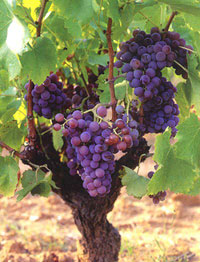
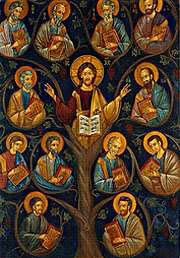
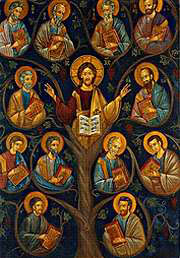
So, at His conception, the Incarnate Word establishes in Himself a New Humanity that is fresh and free of sin, having the unique capacity to refresh, redeem and renew humanity. St. Paul sums it up perfectly: “…if any one is in Christ, he is a new creation; the old has passed away, behold, the new has come” (II Cor 2:17) And Jesus sums it up, well, even more perfectly: “I am the vine, you are the branches. He who abides in me, and I in him, he it is that bears much fruit…” (Jn 15:5) The new wineskin is then, a new Vine, and we are invited to abide in Him.

Father Frederick W. Faber was born in England, June 28, 1814. A famous convert to the Catholic faith – he wrote 150 hymns, the most famous being “Faith of Our Fathers”and “There’s A Wideness in God’s Mercy”. We are honoring him on his birthday because he has written extensively about Unborn Jesus and has tried to help us all appreciate those early months of the Incarnation. He wrote the following in his book entitled The Blessed Sacrament.
“The Incarnation is as much the world in which we live as the globe on which we tread, with its earth, air, fire and water, its sun, moon and stars, its animal, vegetable and mineral kingdoms. If we look at our souls, their present wants and eternal expectations, their life, strength, health and maladies, the Incarnation is as indispensable to them, and as indispensable every hour of the day, as the heat and cold, the air and light, are to our natural subsistence. We live and move in the Incarnation. We are what we are, through it. It covers us, underlies us, and is all around us. It is incessantly affecting us in almost numberless ways, both within and without. We cannot get beyond the reach of its blessed influence, even by disbelieving it or dishonoring it.”
Look at what John Paul II said:
” Creation is thus completed by the Incarnation and since that moment is permeated by the powers of the Redemption, powers which fill humanity and all creation.”
Pope John Paul II
Dominum Et Vivificantem, The Holy Spirit in the Life of the Church and the World (#52)
Take heart all you who are trying to build a Culture of Life!
Filed under: The Incarnation
The Gospel reading today, Thursday 6-21-07, is Mt 6:7-15 which recounts the famous scene when Jesus teaches His disciples the Lord’s Prayer. Let us focus on seven words from this prayer: “thy Kingdom come, thy will be done”. How might these majestic words relate to the Unborn Christ at the one-cell stage of his earthly life?
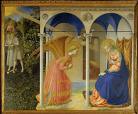
First, the Angel Gabriel explains to Mary that her Son will receive the “throne of his father David”, will reign over “the house of Jacob for ever” and that “of his kingdom there will be no end” (Lk 1:32-33). So, just prior to her “fiat” and her conceiving, she realizes her Son will be king. In fact, at the moment of His conception He is Lord and King!
Secondly, immediately at His conception He speaks a prayer of consecration to God the Father and says: “Lo, I have come to do thy will, O God”. (The whole prayer is found in Hebrews 10:5-7.) St. Ignatius of Loyola tells us that these words were uttered “from the first moment of His conception”, at the one-cell stage. (These verses from Hebrews are featured during the Mass on March 25th for the feast of the Annunciation.) To see extended commentaries on Hebrew 10:5-7 click here)
So, just before His conception the Angel makes three references to His Divine Kingship and at the moment of His conception He Himself says that He has “come to do thy will, O God”. The seven words which He teaches His disciples to address to God are linked to His coming into the world! In fact, His immediate prayer to the Father upon entering the world is like a Mission Statement for His Life.
But wait, this is the mission statement for every life: “Lo, I have come to do thy will, O God”. This is the intuitive spiritual orientation of every human being, at least initially- that there is an All Holy God and that we should seek and do His will in our lives. Therefore, at the one-cell stage of His earthly life the Unborn Christ, who was King, submits – figuratively He bows down in submission to the Father – and He teaches us how to live our lives.
Filed under: The Incarnation
The first reading in yesterday’s Sunday Mass for the Solemnity of Corpus Christi, spoke about the ancient priest Melchizedek making a sacrifice of bread and wine (Gen 14:18-20). This sacrifice prefigured the offering of Jesus during the Last Supper. In this short reading of three verses, a term appears three times which is a very instructive term: “God Most High”. But Melchizedek’s sacrifice, while prophetic, was incomplete and awaited the Body of God’s Son.
Now fast forward to the Annunciation/Incarnation. Gabriel explains to Mary that her son “will be called the Son of the Most High” (Lk 1:32) and that “The Holy Spirit will come upon you, and the power of the Most High will overshadow you (Lk 1:35). In a way, the credibility and authenticity of the message delivered to Mary is intensified by this majestic reference to God as “the Most High”. And the hint of “priesthood”, in the line of Melchizedek, has now been established. She then conceives miraculously the “Son of the Most High”.
A short time afterwards –maybe a week or so later – when she enters Elizabeth’s home and greets her, she utters her famous Magnificat (Lk 1:46-55). Twice during this prayer song she speaks of her lowliness and the lowliness of those who find favor with God: “…for He has regarded the low estate of his handmaiden” and “exalted those of low degree…”
So here we have it then, the matter-of-fact contrast, in terms of spiritual stature (‘height’ or ‘distance’): God Most High and Mary of low estate. Yet it is this humility in Mary which God “regards” with favor (Lk 1:30) and He exalts her above others and instructs us to exalt her as well: “For behold, henceforth all generations will call me blessed…” But why do we call her blessed? “…for he who is mighty has done great things for me, and holy is his name.”
The “great things” God had done for Mary at that point in her life, were primarily the same “great things” which He had also done for us, that is, the Incarnation – Christ Unborn within her, within His mother. These were incomparable things, things which cause awe and wonder in the Christian heart. And by virtue of these “great things”, we too have a share in Mary’s blessedness.
Filed under: The Incarnation
The Gospel reading at Mass today, Monday, 6-4-07, is: Mark 12:1-12. In this reading Jesus is speaking to the chief priests, scribes and elders. Things got a little heated, when Jesus finally said to them,
“Have you not read this scripture passage: ‘The stone that the builders rejected has become the cornerstone; by the Lord has this been done, and it is wonderful in our eyes’?”
As we know, Jesus is the wonderful “cornerstone” of a New Covenant and a New Creation, and He was pointing to this mystery and showing its fulfillment in Himself.
But Jesus also spoke of His Body as a temple (Jn 2:19-21). And St. Paul spoke of our bodies as temples (I Cor 3:16-17, II Cor 6:16-18). So let us go back now to the moment of the Incarnation, that one-cell stage of His life. At conception, that one cell was the “cornerstone” of His Body, just as the one cell stage of human development is the “cornerstone” of every human life. Not only is this “cornerstone cell” special, but it is engraved we might say by “the creative action of God”.
As Pope John XXIII said in his encyclical Mater et Magistra:
“Human life is sacred. From its very beginnings it calls for the creative action of God. By the violation of His laws, the Divine Majesty is offended…(#194).”
Those “builders of society” today, who reject new human lives in their earliest beginnings, that is, at the zygote or embryonic stage of life, who would experiment upon them and dispose of them as some waste product, are gravely offending God. They reject that very special “cornerstone cell” of a new person’s life, and then they destroy it. But this is an area where they lack expertise and jurisdiction. Only God has this sacred expertise and ultimate jurisdiction! The first living cell, the “cornerstone cell” of every person’s body and life must be respected not rejected!
Filed under: The Incarnation
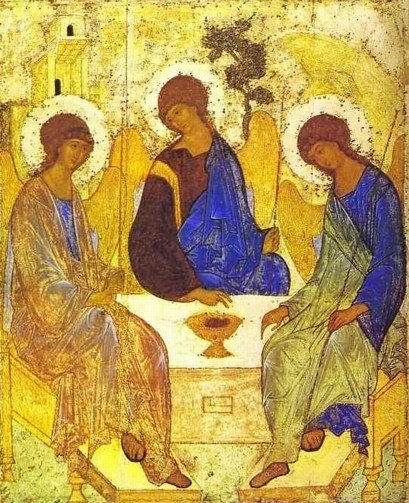
June 3rd, Solemnity of the Most Holy Trinity
St. Bonaventure (1221-1274) says of the Incarnation:
“For you must know that the sublime work of the Incarnation was the work of the whole Trinity, although it was only the Person of the Son of God who became incarnate. It was as if one who put on a tunic were helped by two standing on either side of him who held the tunic in their hands…For although the Holy Trinity is everywhere, nevertheless you must think of It in your meditation as being here in a very special manner, by reason of the great and unique work which is being done.” Meditations On The Life Of Christ
And St. Bernard in a prayer to Mary about the Incarnation says:
“Nor is God the Son alone with you, whom you clothe with your flesh; but also God the Holy Spirit, of whom you conceive; and God the Father, who has begotten that which you conceive.”
John Paul II says:
“In the salvific design of the Most Holy Trinity, the mystery of the Incarnation constitutes the superabundant fulfilment of the promise made by God to man after original sin…” Mother of the Redeemer, 11
 UNBORN WORD of the day