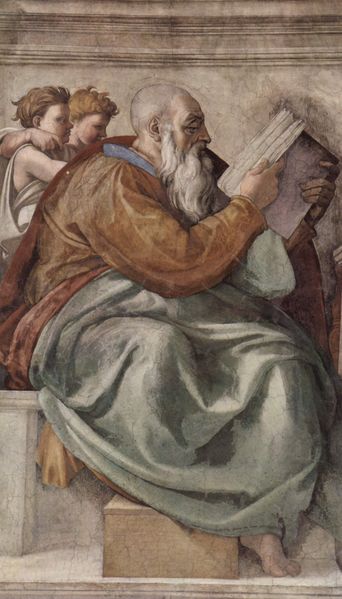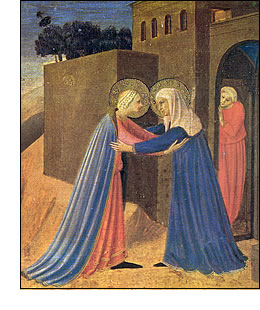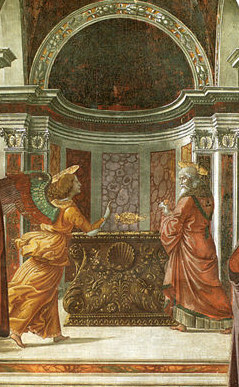
Today, November 5 is the feast day of Saints Zachary and Elizabeth, the parents of St. John the Baptist. Today the focus will be on Zechariah, (tomorrow we will concentrate on Elizabeth). The account of the Archangel Gabriel appearing to Zechariah is found in Luke 1:5-25.
- The priest Zechariah had been the first person told of the Messiah’s impending mission to the House of Israel. That God willed this is understandable as he was a faithful and holy priest. Zechariah represents the remnant of faithful souls within Israel awaiting the Messiah.
- Gabriel’s initial greeting to Zechariah had been full of tenderness as he recounted God’s attentiveness to the prayers of both Zechariah and Elizabeth. He then proclaimed the conception and future mission of Zechariah’s son John.
- But Zechariah confronts the Archangel with a doubting question: “How shall I know this? For I am an old man, and my wife is advanced in years.” Suddenly, this joyous breathtaking event sours.
- Zechariah of Ain‑Karim, would have had a keen interest in the prophecies and teaching concerning the long awaited Messiah, but now by his own doubt and lack of faith he had rebuffed the exalted Archangel Gabriel, the same angel who had appeared to the great prophet Daniel.
- The Archangel has no choice but to put aside the rest of the message as it was intended to be delivered. He delivers instead a brief angelic rebuke: “I am Gabriel, who stand in the presence of God and I was sent to speak to you, and to bring you this good news.”
- The divine message has, in effect, been cut short and there is nothing left to say. Indeed, the Angel will see to it that Zechariah has nothing else to say for a very long time: “…..you will be silent and unable to speak until the day that these things come to pass….” And when would “these things come to pass”?
- And so for the next six months, prior to the arrival of Mary (and unborn Jesus), Zechariah was a man ashamed, begging God to forgive him for his stubborn and hardened heart. He was acutely aware of his sinfulness and weakness and would have prayed often, readily identifying with many of the Psalms. “O Lord, rebuke me not in thy anger, nor chasten me in thy wrath…! I am utterly bowed down and prostrate; all the day I go about mourning” (Ps 38:1,6).
- Finally, with Mary and unborn Jesus came hope. Literally, physically, supernaturally, prophetically. A great ray of light broke through the clouds of Zechariah’s thoughts and musings. As he could witness God fulfilling His promises to Israel ‑ in spite of his own obstinacy ‑ hope began to grow in him and even the courage to believe more fiercely that yes, God could forgive him, God would forgive him and even rely on him again. For Zechariah this visit was a wonderful gift from God, an indescribable consolation. And in three short months his lips would again sing aloud the praises of God his Savior. (Luke1:67-79) Condensed from Unborn Jesus Our Hope.

When most people start taking down their Halloween decorations, stores around Los Angeles put up garland and wreaths.
One of my pet peeves is the fact that commercially the Christmas season now starts right after Halloween. When I was young businesses did not promote Christmas until after Thanksgiving. But we are living more and more in a consumer society – you guessed it Christmas = money.
Why don’t we try to beat them at their own game? Let’s make this a real Christmas season and start preparing spiritually now. Today Dan and Mike Engler sent us a link to a really great video on You-tube. It combines Christmas with the pro-life message. Click here:
O Holy Night-A Pro-life Christmas

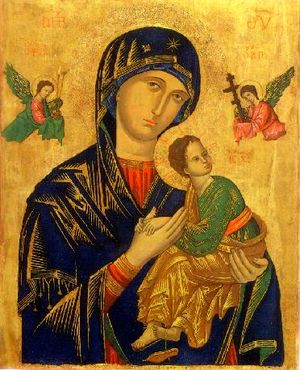
Our Lady of Perpetual Help *
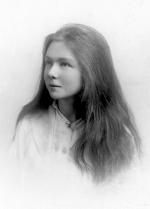
Caryll Houselander was born on October 29, 1901. Caryll was one of the most popular spiritual writers of her day. She is certainly still one of my favorites. Many of her books are still in print. Maisie Ward (Frank Sheed’s wife) wrote a wonderful biography about her “Caryll Houselander – The Divine Eccentric” which was published in 1962.

While in college (many eons ago) a friend of mine and I were reading this biography at the same time – I still remember a funny comment that she made to me at the time – ‘Hey, this is actually, the first person I’ve read about who might be a saint who drank a Martini.’ I think Maisie Ward had a story in the book about inviting Caryll over for dinner and giving her a before dinner drink. I don’t have the book so I can’t check on why my friend made this comment but it made me laugh at the time and has always stuck with me.
On the occasion of her death, Ronald Knox said of Caryll Houselander that she could have established a school of spirituality. In a letter to The Tablet on 23 October 1954, he wrote:
“…she seemed to see everybody for the first time, and the driest of doctrinal considerations shone out like a restored picture when she had finished with it. And her writing was always natural; she seemed to find no difficulty in getting the right word; no, not merely the right word, the telling word, that left you gasping.”
Of course I’m going to end this with a quote from Caryll Houselander about the Unborn Christ Child from her book, The Passion of the Infant Christ.
“There is in fact, a huge force, a tremendous power for love being neglected, not being used, at the time when it is needed as never before and when every sign seems to be pointing to it and challenging it as the only answer-the power of the Infancy of Christ.
The Infant Christ is the whole Christ. Christ was not more God, more Christ, more man, on the Cross than He was in His Mother’s womb. His first tear, His first smile, His first pulsation in the womb of His Mother, could have redeemed the world.”
*An icon venerated by Christians of the East and West for centuries. The Archangels Gabriel and Michael hold the instruments of the Lord’s Passion, while the Divine Child looks on and clings to His Mother’s hand. Also known as “Our Mother of Sorrows.”
As God, He knew that the angelic apparition was prophetic of His future passion. Yet in His human nature as a small child, He is frightened and runs to His Mother for protection. Our Lady hastily picks Him up and clasps Him to her bosom. This action is indicated by the fact that the Lord’s right foot is nervously curled about the left ankle and in such haste that His right sandal has become loosened and hangs by a single strap. Further action is indicated by the way the Child Jesus clasps His Mother’s right hand with both of His, holding tightly to Our Lady’s thumb.
Caryll Houselander’s (1901-1954) birthday is October 29. Here is a beautiful quote from her book The Passion of the Infant Christ.
“Rest is not idleness; indeed, restlessness is the torment of idle people….
Rest, far from being relaxation, is a culmination, a fullness of gathered peace, like the fullness and stillness of waters gathered to a flood tide.
Think of a child asleep in his mother’s arms; the abandon with which he gives himself to sleep can only be because he has complete trust in the arms that hold him. He is not lying asleep on that heart because he is worn out with anxiety. He is asleep there because it is a delight to him to be asleep there. The mother rests too. She rests in his rest. Her mind and her body rest in him. … Rest is a communion of love between them. It is a culmination of content.
…Not content to be a human being, Christ wishes to be each human being, and in fact is born in the soul of everyone who will receive Him; and in each one in whom He lives, whose life He lives, He is loved infinitely by the Father, loved for what He is, the only Son.
…If this were realized there could be no one who could not fulfill the first condition of rest, which is trust.”

There is a wonderful tradition in Christendom of beginning each day by offering oneself and one’s day to God. It has been called by some ‘morning devotions’ or more frequently in Catholicism a ‘morning offering’. One of the traditional morning offering prayers is that promoted by the Apostleship of Prayer.
The morning offering is a great way to start each day. I know when I make this offering as I begin my day I am often mindful of the offering Christ made to His Father, from Mary’s womb, as He entered the world:
“Consequently, when Christ came into the world, he said:
“Sacrifices and offerings you have not desired;
but a body have you prepared for me;
in burnt offerings and sin offerings
you have taken no pleasure.
Then I said, Lo, I have come to do your will, O God.”
(Hebrews 10:5-7)
Pope Paul VI called this “…the fundamental offering that the Incarnate Word made to the Father when He entered the world (cf. Heb. 10:5-7).” Marialis Cultus, #20
St. Alphonsus De Ligouri, a Doctor of the Church, made the following comment about this quote from Heb. 10:5-7:
“The divine Word, from the first instant that he was made man and an infant in Mary’s womb, offered himself of his own accord…” (The Incarnation, Birth and Infancy of Jesus Christ)
John Paul II, reflecting on these words in Hebrews states: “He places himself as a gift within the womb of Mary.” (The Word Made Flesh). Later, in the same book he says: “All Christians are in fact called to share in Christ’s priesthood and mirror his total gift of self to the Father and be a spiritual sacrifice…”
One way we can mirror this total gift of self that Christ made as He first came into the world is to offer ourselves to the Lord as we start each day.
Filed under: The Incarnation
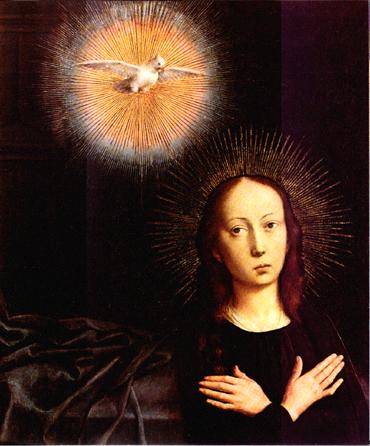
“The conception and birth of Jesus Christ are in fact the greatest work accomplished by the Holy Spirit in the history of creation and salvation…”Pope John Paul II , The Holy Spirit in the Life of the Church and the World (#50)
“John was “filled with the Holy Spirit even from his mother’s womb” by Christ himself, whom the Virgin Mary had just conceived by the Holy Spirit. Mary’s visitation to Elizabeth thus became a visit from God to his people.” Catechism of the Catholic Church (717)
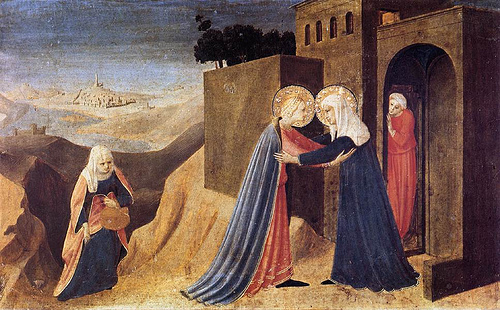
In the Visitation episode, St Luke shows how the grace of the Incarnation, after filling Mary, brings salvation and joy to Elizabeth’s house. The Saviour of men, carried in his Mother’s womb, pours out the Holy Spirit, revealing himself from the very start of his coming into the world…. St Luke also seems to invite us to see Mary as the first “evangelist”, who spreads the “good news”, initiating the missionary journeys of her divine Son. Pope John Paul II, General Audience, , October 2, 1996
In assuming human nature he has united to himself all humanity in a supernatural solidarity which makes of it one single family. Vatican II, Decree on the Apostolate of the Laity (#8)
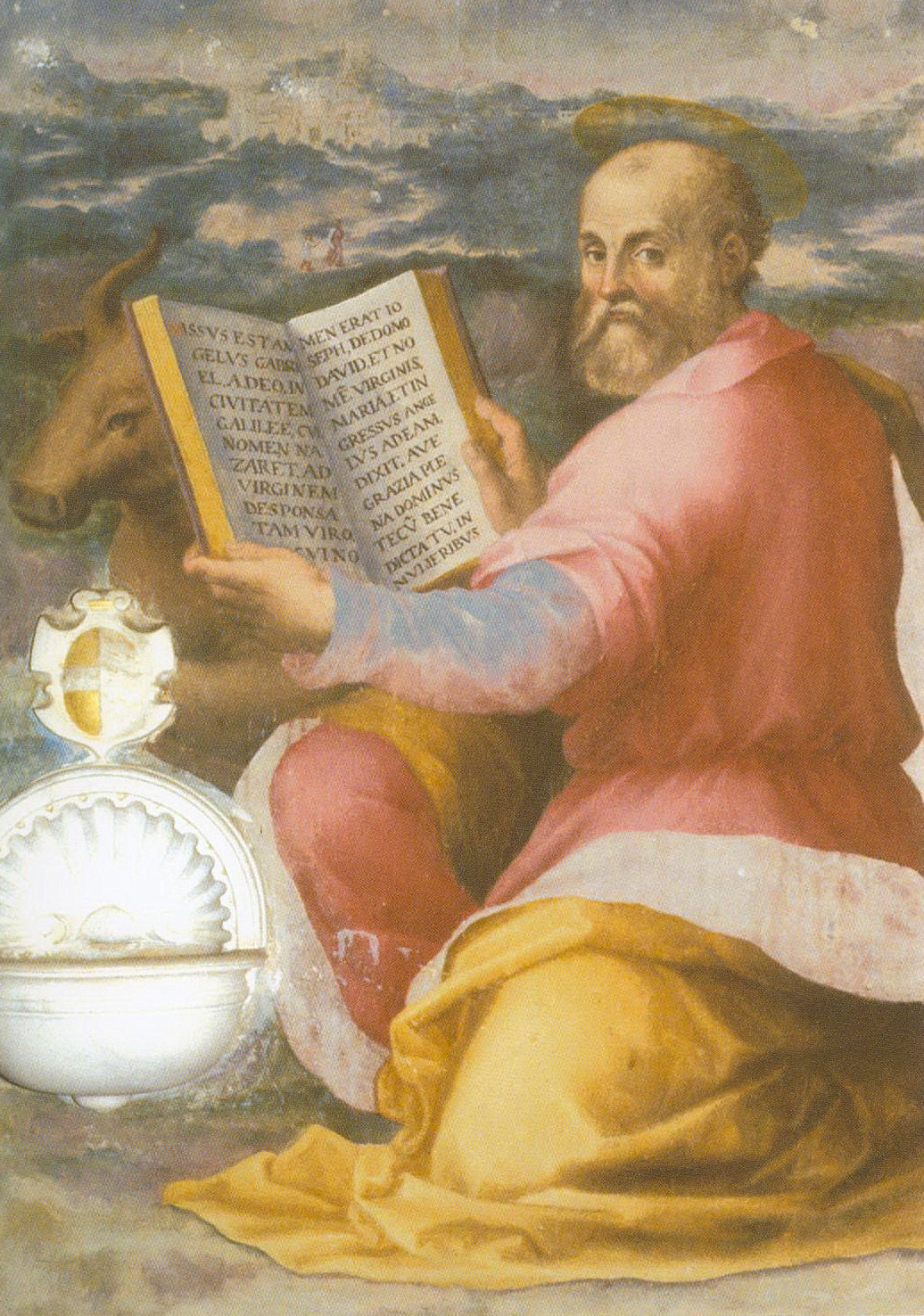
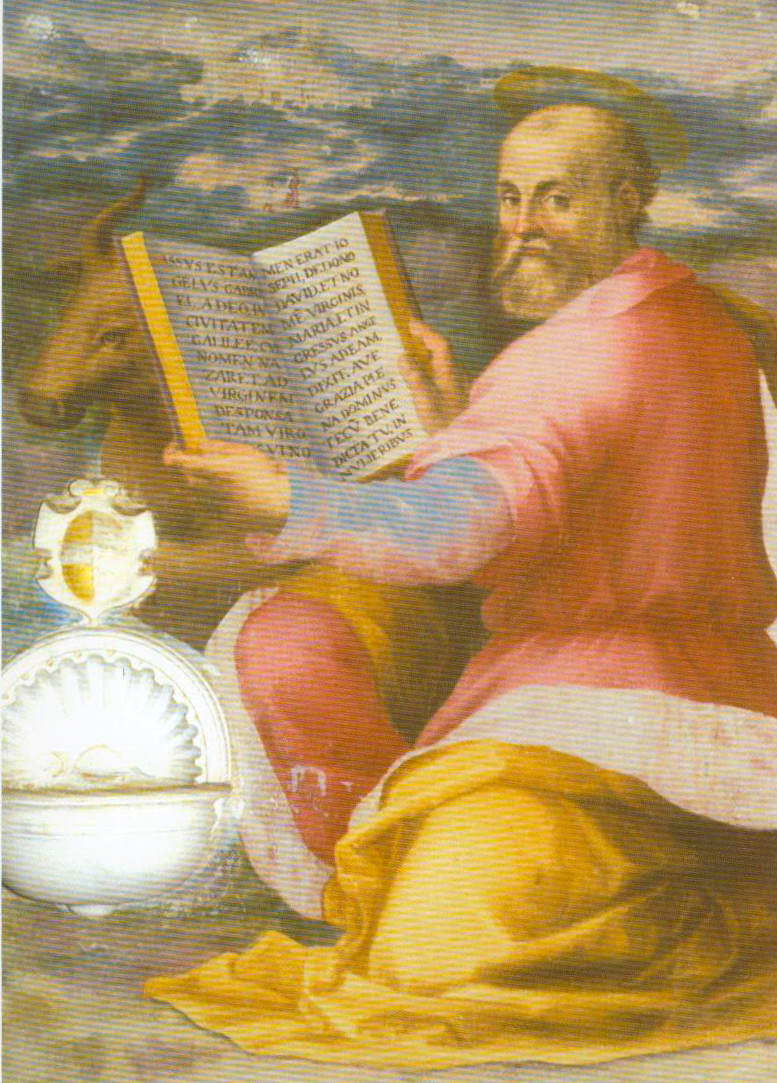
Michele Tosini (1503-77) St. Luke
October 18 is the feast day of St. Luke.
In chapters One and Two of the Gospel of St. Luke we have 127 verses of narrative concerning the infancy and childhood of Jesus Christ and mysteries surrounding His infancy (Lk 1:5 – 2:52). These verses are unique to Luke and outline the earliest vignettes known about the childhood of Jesus Christ. The verses restricted to the infancy period are slightly less: 114 verses (Lk 1:5 – Lk 2:39).
The extraordinary account of the Annunciation to Mary by the Archangel Gabriel, for example, is presented only in Luke and no where else. Likewise, the remarkable Visitation event (and Magnificat “song”) and Bethlehem birth saga are Lukan treasures only. Which might lead us to wonder how would Christianity be different if there was no Luke? Would we celebrate Christmas? (Matthew also provides 47 verses of invaluable introductory information as well concerning Mary, Joseph and Jesus, before and after the birth. Mt 1:18 – 2:23)
We are indebted to Luke in a thousand ways, but especially for the first two chapters of his Gospel which are in a way a “prologue”, comparable to the famous “Prologue” to the Gospel of John (Jn 1:1-18): “In the beginning was the Word, and the Word was with God…” But while the Prologue of John is about Mysteries and realities concerning the Word Incarnate, this “prologue” of Luke’s is focused on biological and historical events which reveal the Child Incarnate. While John is mystical, Luke is highly personal yet supernatural. All of this is to say that, the Incarnation Mystery of faith is so wondrous, that we need both Luke and John to unfold for us its beauty and reality. We can listen to John’s Prologue and see it with the eyes of the heart, but Luke’s we visualize all in fabulous images.
But it is only Luke who reveals to us the babyhood of Jesus and the attendant mysteries thereto. Luke is one of the Church’s great “Pro – Life” saints! There is no way around it. He alone tells of the conception of Jesus Christ, paints for us the tender mother who opens up her heart and soul to God’s plan and Spirit, then recounts the mysterious encounter between pregnant mothers and unborn children and finally recounts in all its poverty and glory the birth of humankind’s Savior in a manger.
St. Luke we thank you for the little details you carefully recorded about our Savior’s first nine months in the womb and then in the manger. You, St. Luke, have brought more tears of joy to human eyes than any other author in human history. You have revealed to us the mother of the baby Jesus and have transported us in our thoughts to kneel beside the beasts and shepherds, beneath the angels’ meditative gaze. It was first your descriptive words which gave rise to those Christmas hymns we sing now that cause our hearts to bow down in adoration again.
St. Luke, when we see you in heaven, we will get in that very long reception line of pro-life Christians who want to shake your hand, the hand which wrote down the sacred events of our Savior’s babyhood, events which gave us hope for all our earthly days.
George A. Peate, Unborn Word Alliance
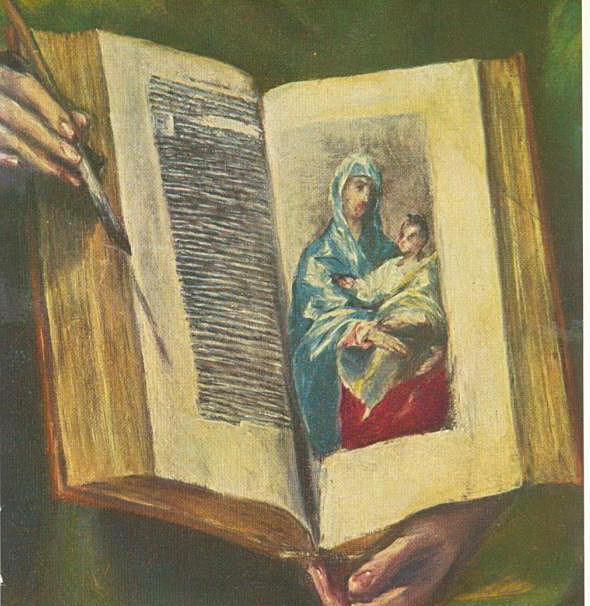
El Greco (1541-1614) St. Luke (detail)
Filed under: The Incarnation
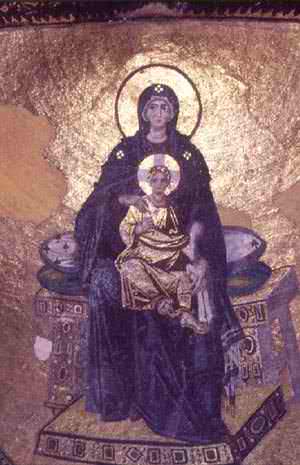
Today October 11 is the feast day of the Maternity of Our Lady:
Unimaginable beforehand, incomprehensible afterward: the Incarnation is a glorious crowning to all of human history.
In a reversal of the creation of Eve from Adam’s side, here Mary could say on behalf of all humanity: “The Son of God is bone of our bone, and flesh of our flesh!” (Catechism Of The Council Of Trent For Parish Priests, (1934), pg.48)
By divine intervention Mary’s maternity marks the beginning of the new creation in Christ (II Cor.5:17, Rev.21:5)
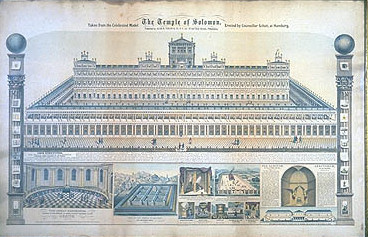
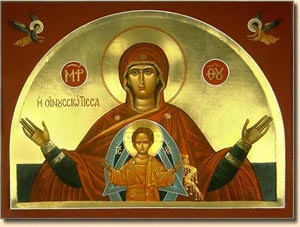
Today, October 5, 2007 is the feast day of St. Mary Faustina Kowalska, the Apostle of Divine Mercy. Here she speaks about the Mercy of God in the Incarnation.
“…Mercy has moved You to deign to descend among us and lift us up from our misery. God will descend to earth; the Immortal Lord of lords will abase Himself. But where will You descend, Lord; will it be to the temple of Solomon? Or will You have a new Tabernacle built for Yourself? Where do You intend to come down? O Lord, what kind of tabernacle shall we prepare for You, since the whole earth is Your footstool?
You have indeed prepared a tabernacle for Yourself; the Blessed Virgin. Her Immaculate Womb is Your dwelling place, and the inconceivable miracle of Your mercy takes place, O Lord. The Word becomes flesh; God dwells among us, the Word of God, Mercy incarnate. By Your descent, You have lifted us up to Your divinity. Such is the excess of Your love, the abyss of Your mercy. Heaven is amazed at the superabundance of Your love. No one fears to approach You now.”
From the The Diary of the Servant of God Saint M. Faustina Kowalska, Divine Mercy In My Soul, Notebook VI.

Today, October 4, 2007 is the feast day of St. Francis of Assisi.
Many Franciscans will tell you that the Christmas Crib holds a special place of honor in Franciscan spirituality. We know about Francis re-creating the Christmas scene one year as a living Nativity with real animals and so on. From his inspiration came the tradition of celebrating Christmas with a nativity scene. St. Bonaventure tells the story here.
One might even say that the Crib of Christ balances out, so to speak, the Cross of Christ. Not that the Cross needs to be balanced out or toned down or made pretty. No not at all. Rather, the reality of God’s Love and Incarnation have two marvelous windows for the soul – like sunrise and sunset – in the Crib and the Cross. And Francis lived these realities when he instituted the living Nativity and when he received the stigmata.
One of his modern day followers in writing about “The Simplicity of St. Francis of Assisi” lists five characteristics, the second of which is: A Childlike Quality. This is one of the gifts one can receive from Bethlehem, not under the Christmas tree, not from one of the wise men, but from the baby Jesus Himself. If we go to the crib to honor the baby God there He will bless us in a childlike manner. Here is a wonderful quote from Mother Angelica (a Franciscan nun) of EWTN fame:
“I want very much to spread devotion to the Divine Child Jesus. Not only is He powerful, but what you need and I need is family, and that Child Jesus will make us one again. He will put love in our hearts, back where it should be.“
Another Franciscan nun focusing on the Advent dimension of her Franciscan spirituality speaks of creating space for Jesus in one’s own heart; a “crib in our hearts”. This is definitely a childlike concept. Can we relate to it in our sophisticated world with our complicated perspectives?
The crucified Christ saves our souls, perhaps the infant Christ can heal our attitudes!
I didn’t realize it before, but apparently there are two litanies to “Our Lady of Lourdes”. I would like to comment on a few lines from what is probably the older litany. There are actually three lines in sequence which read as follows:
Mother poor and without shelter, PRAY FOR US*
Mother who did bear along forgotten roads the fruit of thy womb, *
Who did find no other shelter for thy Son and thy God than a wild cave,
and no other cradle than a manger, *
It is the second line above which caught my attention, but it is placed in perspective by the lines immediately preceding and following it. The third line speaks about our Lord’s birth at Bethlehem, so the second line is probably referring to the days of Mary’s pregnancy and perhaps the period of time as she made her way there.
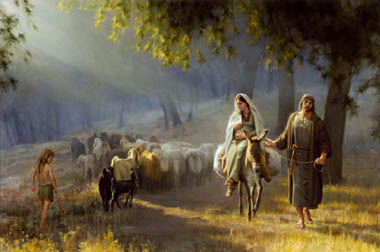
She carried her unborn baby Jesus “along forgotten roads” as all expectant mothers do. In her case, we think of the road from Nazareth to the hill country of Judea – probably to the town of Ain-Karim – where her cousin Elizabeth lived with her husband the priest Zechariah. This town is near Jerusalem so Mary would have probably gone to Jerusalem a number of times during her three month visit. Then she returned to Nazareth and spent another four or five months there. But occasionally she would be out on the nearby roads to visit someone or obtain some item.
Finally there is the journey to Bethlehem when Mary is perhaps in her eighth month of pregnancy. God Incarnate and unborn left His mark on the roads of Israel, vicariously through the footsteps of Mary as she did the Will of God. Later John the Baptist would “make straight in the desert a highway for our God” (Isa 40:3), preparing the way of the Lord. But, in her own way Mary tried to make His way comfortable and safe, bearing Him with love and devotion even before the day of His birth. “How beautiful upon the mountains are the feet of (her) who brings good news” (Isa 52:7).
For Mary, for all pregnant women – and for all unborn babies – all these roads lead to Bethlehem.
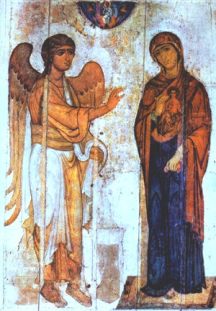
To be pregnant is not an easy thing. There is often much suffering for the mother in whom the new life is growing. But, there is also wondrous beauty attached to pregnancy and the pregnant mother becomes a reminder of the greatest good and the strongest hope known to humankind. She is a messenger in a sense. She is called expectant, a term which underscores the reward of patient endurance.
Well, Christians share in something like pregnancy in that they carry a Life within them other than their own – it is the Living God Who has humbled Himself to come into their hearts and dwell there. This Divine Life grows within them and they are called upon to share this Life, to manifest it, to express it, in a sense to give birth to it.
And as the pregnant mother feels the baby stirring within her body, so the Christian feels the Spirit of God stirring within. In a clever twist of imagery, St. Paul tells the Christians of Galatia “…I am again in travail until Christ be formed in you!” (Gal. 4.19)
It is simple to see why God has provided us with the pregnant Mother of the Lord as a model. Her nine months of pregnancy were not easy but they were tremendously beneficial. As the Child God formed and grew in her, she was formed by Him and grew closer to Him. We too must allow God to be formed in us and grow in us so that we, like Mary, can likewise be formed by Him and grow closer to Him.
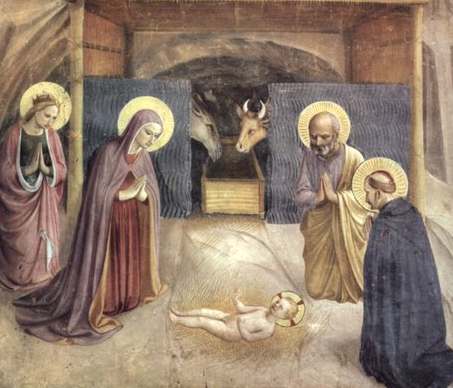
“Christ has only one mother in the flesh, but we all bring forth Christ in faith. Every soul receives the Word of God if only it keeps chaste, remaining pure and free from sin, its modesty undefiled.” St. Ambrose
“Blessed and true is that comfort which is derived inwardly from Truth.
A devout man everywhere carrieth about with him Jesus his Consoler, and saith to Him: Be with me, O Lord, in all places and at all times.” Imitation of Christ, chapter 16
“I kneel at the door of the empty stable and offer Thee my heart…but my body is not fit to be Thy temple and my heart is treacherous and faithless. I am ashamed to have so poor a shelter to offer Thee. If it were not that Thou didst ask for it, I dare not offer it. Oh! Thou Who didst not refuse the manger-bed, come to my heart, look at the contrition and…the aching longing to be what Thou dost want, and forget the faithlessness and the failures and the weakness. Come, my little King, incarnate for me, come and save me, If I were not a sinner I should not need a Saviour.” Mother St. Paul, Ortus Christi

Genevieve Kineke has pointed out in her blog that the Pontifical Council for the Laity is encouraging the faithful worldwide to observe the 20th anniversary of John Paul II’s document Mulieris Dignitatem (On the Dignity and Vocation of Woman) in the coming year (2008). For more information go to The Dignity of Woman website.
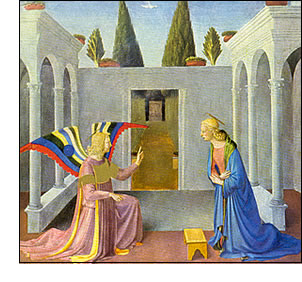
Here are two beautiful quotes from this document that speak of the Annunciation in beautiful and human terms:
“It may be easy to think of this event (the Annunciation) in the setting of the history of Israel, the Chosen People of which Mary is a daughter, but it is also easy to think of it in the context of all the different ways in which humanity has always sought to answer the fundamental and definitive questions which most beset it. Do we not find in the Annunciation at Nazareth the beginning of that definitive answer by which God himself “attempts to calm people’s hearts”?” # 3
“Grace never casts nature aside or cancels it out, but rather perfects it and ennobles it. Therefore the “fullness of grace” that was granted to the Virgin of Nazareth, with a view to the fact that she would become “Theotókos”, also signifies the fullness of the perfection of “what is characteristic of woman”, of “what is feminine”. Here we find ourselves, in a sense, at the culminating point, the archetype, of the personal dignity of women.” #5
Filed under: The Incarnation
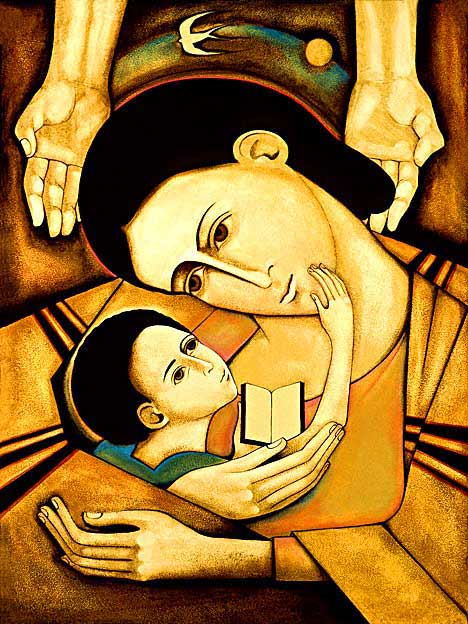
Mother and Child reading the Word—Michael D. O’brien
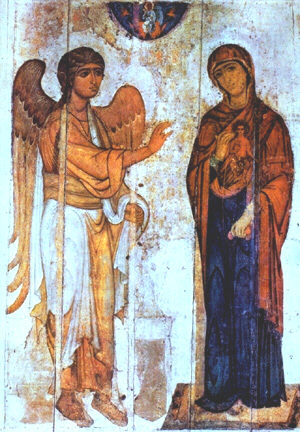
Annunciation
by Sister M. Linus Coyle, PBVM
When was it, Lord,
your Mother looked long and,
oh, so lovingly at You
as you sat down beside her?
For You had asked so eagerly
to have her tell you of your birth.
Then did she tell you how she felt
when Gabriel came?
What it was like to comprehend
his message or its meaning?
And did she say that
there she was — so little, so young..
her God so great!
She felt that awful sense of being
emptied out of all that she
might call “her ” own – so powerless
but yet so full, so very full of LOVE.
Then did she tell you, too,
how suddenly she felt compelled
because of LOVE
to answer, “Yes!”
Unburdened of all doubt, all fear,
Open to accept, to choose to be
in total trust, in total truth,
Mother of the “Promised One”.
And it was then, it was there
You grew
Within the silence of
Her VIRGIN womb.
Sister M. Linus Coyle belongs to the order of the Sisters of the Presentation. She receives our e-newsletter and sent us this beautiful poem/reflection on the Annunciation.
*Artist Commentary: (about above painting) The mother and the child are not reading letters on a page, but the “word” in each other’s faces. The mother of Christ is the first word Jesus sees, a face in which love and truth are perfectly in harmony. In the face of her son, Mary sees the Word of God incarnate, made from her own flesh.

Today, August 9, 2007 is the Feast day of St. Teresa Benedicta ( Edith Stein). Here are two inspiring quotes from her writings:
“The decision for the Redemption was conceived in the eternal silence of the inner divine life. The power of the Holy Spirit came over the Virgin praying alone in the hidden, silent room in Nazareth and brought about the Incarnation of the Savior. Congregated around the silently praying Virgin, the emergent church awaited the promised new outpouring of the Spirit that was to quicken it into inner clarity and fruitful outer effectiveness. In the night of blindness that God laid over his eyes, Saul awaited in solitary prayer the Lord’s answer to his question, “What do you want me to do?” In solitary prayer Peter was prepared for his mission to the Gentiles. And so it has remained all through the centuries. In the silent dialogue with their Lord of souls consecrated to God, the events of church history are prepared that, visible far and wide, renew the face of the earth.”
St. Teresa Benedicta, The Prayer of the Church
“Because hidden souls do not live in isolation, but are a part of the living nexus and have a position in a great divine order, we speak of an invisible church. Their impact and affinity can remain hidden from themselves and others for their entire earthly lives. But it is also possible for some of this to become visible in the external world. This is how it was with the persons and events intertwined in the mystery of the Incarnation. Mary and Joseph, Zechariah and Elizabeth, the shepherds and the kings, Simeon and Anna all of these had behind them a solitary life with God and were prepared for their special tasks before they found themselves together in those awesome encounters and events and, in retrospect, could understand how the paths left behind led to this climax. Their astounded adoration in the presence of these great deeds of God is expressed in the songs of praise that have come down to us.”
St. Teresa Benedicta, Three Addresses For the First Profession of Sister Miriam of Little St. Thérèse July 16, 1940
Pro-life work is always tough- going, and at times can even seem futile, but we must persevere and always continue in silent prayer before the Lord to prepare for great things.

Filed under: The Incarnation
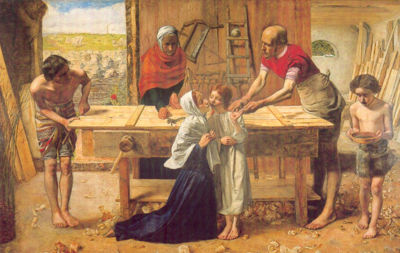
John Everett Millais, Christ in the House of His Parents
“Scripture describes Wisdom as gloriously beautiful. (Wisdom 7:22) In her teaching role Lady Wisdom builds herself a house and invites the unwise or simple to her rich feast (Prv 9: 1-6) In a reading assigned to 17 December, Pope Leo the Great (Epistola 31.2-3) not only writes of the ‘Word become Flesh” in Mary’s womb but also draws on Proverbs to picture the Unborn Jesus as ‘Wisdom building a house for itself.'”
From All Things New: Promise of Advent, Christmas and the New Year By Gerald O’Collins
 UNBORN WORD of the day