


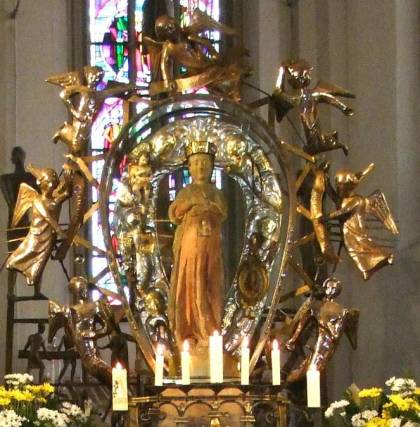
In a previous post on St. Elizabeth Ann Seton we mentioned that both she and St. Louise de Marillac had a devotion to Christ in the womb. (St. Elizabeth Seton formed her sisters in the Vincentian spirit according to the tradition of Louise de Marillac 1591-1660 and Vincent de Paul 1581-1660.) In that post, we highlighted some quotes from St. Elizabeth speaking of her devotion to Christ in the womb. In today’s post we would like to highlight St. Louise’s devotion.
In the book, Vincent de Paul and Louise de Marillac – Rules, Conferences and Writings, Vie Thorgren writes of St. Louise: ” They remind us of the importance of the hidden years of Jesus’ life-hidden within the womb and hidden in a village noted only for its insignificance. As early as 1626, Louise began a daily practice of meditation on Jesus within the womb receiving his flesh and blood, which became the means of our redemption. Recognizing the fruitfulness of this meditation, she offered it as an enduring legacy to the Daughters of Charity.”
In her Rule of Life in the world, St. Louise enumerates several devotional practices in honor of the Virgin Mary – one of these practices concerns Christ in the womb.
A quarter of an hour of prayer exactly at midday to honor the moment when the Incarnation of the Word took place in the womb of the Blessed Virgin.
In her own words, we learn from St. Louise herself, of a personal devotional practice she had honoring the unborn Christ Child. St. Louise drew up a little rosary. She wrote to St. Vincent: “This little chaplet is the devotion for which I asked permission of your Charity three years ago as a personal devotion. I have in a small box a quantity of these little chaplets, along with some thoughts on this devotion written on a piece of paper, which with your permission, I wish to leave to all our sisters after my death. Not one of them knows it. It honors the hidden life of Our Lord in his state of imprisonment in the womb of the Blessed Virgin and congratulates her on her happiness during those nine months. The three small beads hail her under her beautiful titles of Daughter of the Father, Mother of the Son, and Spouse of the Holy Spirit. That is the main thought behind the devotion. By the grace of God, unworthy as I am, I have continued this devotion since the time I mentioned, but I hope to discontinue it, aided by God’s same grace, if your Charity so orders. By means of this little exercise I intend to ask God, through the Incarnation of his Son and the prayers of the Blessed Virgin, for the purity necessary for the Company of the Sisters of Charity and for the steadfastness of this Company in keeping with his good pleasure.” Louise de Marillac, Spiritual Writings, L.303B
It seems that St. Vincent had agreed to this devotional practice three years earlier but at this point he asked her to discontinue it. Even though St. Louise continued to believe that this was a devotion that Our Lady wanted her to practice – in holy obedience to St. Vincent she discontinued it.
She alludes to this in a letter: “I feel that I must tell your Charity that I was and still am sorry at having to abandon those little prayers because I believe that the Blessed Virgin wanted me to render her this small tribute of gratitude. But with her, I console myself by offering my renunciation to her and by resolving to please her in some other way and to serve her with greater fervor….” Louise de Marillac, Spiritual Writings, L.304
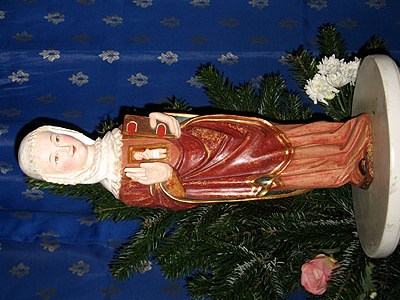
‘Maria Gravida’-Institute of St. Philip Neri in Berlin ( It is a reproduction of the original in Malta) Click here to see the original.
In his book entitled The Soul of Elizabeth Seton, Joseph I. Dirvin (Ignatius Press) writes that St. Elizabeth Ann Seton had a devotion to the motherhood of Mary and the hidden life of Jesus in his mother’s womb. Here are quotes from his book detailing her devotion:
“The saint shared her delighted contemplation of the love of Jesus and Mary as he lay hidden in her chaste womb with St. Louise de Marillac, foundress with St. Vincent de Paul of the Daughters of Charity, whose Rule and spirit Elizabeth had chosen for her own community and who like Elizabeth was a widow and mother. It was an established devotion of both, nurtured by their motherhood, as Elizabeth bore witness in a note to Brute perhaps at Christmastime: “Blessed, it would please your so kind heart to know that this week past or more, our Soul’s dear Baby has been much more present to me than the beloved babies of former days, when I carried and suckled them. He, the Jesus Babe, so unspeakably near and close, hugged by His poor, silently delighted wild one!” ” (pg. 84)
“The maternity that united the Virgin Mary with Elizabeth Seton is especially strong in an exquisite meditation for the feast of the Assumption. “Jesus nine months in Mary, feeding on her blood- Oh Mary! These nine months”. Elizabeth wrote in remembrance of a like joy she herself had known in carrying her children. Now she was savoring it again in transcendent communion with the divine motherhood.” (pg. 83)
“Elizabeth also pursued her mother’s intuitions of Mary with her Sisters. As an outline of a conference attests. “We honor her continually with Our Jesus.” she told them. “His nine months within her” – the thought inspired a fresh spate of spiritual insights – “what passed between them-she alone knowing Him. – there was indeed a time when Mary alone of all mankind knew that the Messiah had come – He her only tabernacle…Mary full of grace, Mother of Jesus! Oh we love and honor Our Jesus, when we love and honor her.” “ (pg. 84)
“…she did not hesitate to close one letter (to her daughter) with these exalted words: “My Rebecca, we will at last unite in His eternal praise, lost in Him, you and I, closer still than in the nine months so dear when, as I told you, I carried you in my bosom as He in Our Virgin Mother’s – than no more separation.” ” (pg. 120)
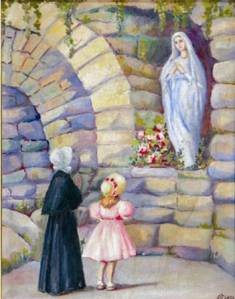
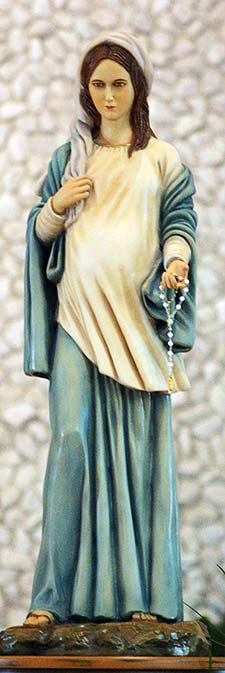
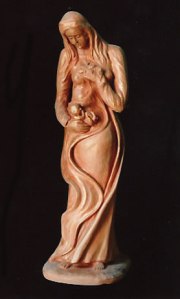
This statue of the “Virgin Mary of Hope Expectant” was on display at Resurrection of Our Lord Parish in Fort Myers July 25 during a Novena for Life Mass. The statue appeared at different parishes throughout the nine-month novena.
I wanted to let you know about a wonderful group called Laity for Life because one of their objectives is to “provide spiritual and moral support for lay Catholics who are active in the pro-life movement”. Other objectives of the group are to ‘train Catholics to be persuasive pro-life speakers and encourage Church financial support for pro-life efforts’.
One way that they are fulfilling this objective is by promoting a Novena of Masses for Life. They have “borrowed and broadened the term ‘Novena’ to refer to the nine months of Our Lady’s pregnancy”.
During 2008 a series of 28 Masses for Life were celebrated throughout the Diocese of Venice in Florida starting on the feast of the Annunciation and thereafter on the 25th of each month until Christmas. Click here to see a schedule of these Masses. A statue of “Virgin Mary of Hope Expectant” was brought to each of these Masses throughout the Diocese. The statue was designed by Antonio Reyes of Ecuador. These Masses for Life bring Catholics together to pray for the unborn and to open their hearts to God for the spiritual strength needed to bring about a new culture of life.
This year they have expanded the Masses for Life to include 48 parishes and 121 Novena Masses following the same schedule from the Annunciation to Christmas. Click here to see the 2009 schedule. Laity for Life wants to promote the Novena of Masses for Life all over the U.S.. If you would be interested in working with Laity for Life on this project you can contact them at :
LAITY for LIFE, Inc.
P.O. Box 111478
Naples FL 34108
VoiceMail : 239.352.6333
E-Mail: info@LaityForLife.org
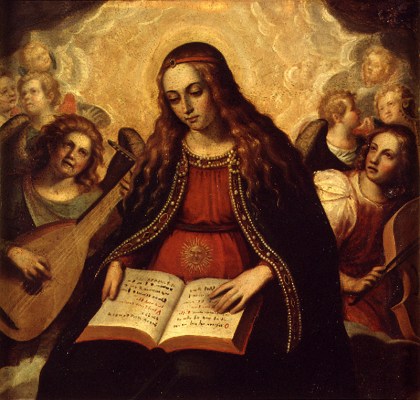
Virgen de la Esperanza-Our Lady of Expectation
Tuesday, April 28 is the feast day of St. Louis de Montfort. Here are a few quotes from him about Christ’s time in the womb.
God the Son came into her virginal womb as a new Adam into his earthly paradise, to take his delight there and produce hidden wonders of grace.
God-made-man found freedom in imprisoning himself in her womb. He displayed power in allowing himself to be borne by this young maiden. He found his glory and that of his Father in hiding his splendors from all creatures here below and revealing them only to Mary. He glorified his independence and his majesty in depending upon this lovable virgin in his conception, his birth, his presentation in the temple, and in the thirty years of his hidden life.
The Incarnation is the first mystery of Jesus Christ; it is the most hidden; and it is the most exalted and the least known. It was in this mystery that Jesus, in the womb of Mary and with her co- operation, chose all the elect. For this reason the saints called her womb, the throne-room of God’s mysteries
Our good Master stooped to enclose himself in the womb of the Blessed Virgin, a captive but loving slave, and to make himself subject to her for thirty years. As I said earlier, the human mind is bewildered when it reflects seriously upon this conduct of Incarnate Wisdom. He did not choose to give himself in a direct manner to the human race though he could easily have done so. He chose to come through the Virgin Mary. Thus he did not come into the world independently of others in the flower of his manhood, but he came as a frail little child dependent on the care and attention of his Mother.
From: Treatise on True Devotion To The Blessed Virgin
by St. Louis de Montfort
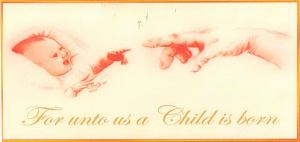
God’s Language of Harmony
by Sister M. Linus Coyle
I looked into the mind of God,
His Will residing in the Son.
I looked into the heart of Christ,
and saw His Will fulfilled.
I looked into the Will of God
and saw its breath of Love.
I looked into the depth of Love
so Spirit shadowed from above.
This led me to each human child
Where God’s glory-hopes of love are fed.
And then I knew God’s fatherhood
as cherished image of His Son;
for life within a mother’s womb
would share Life’s weaving loom
freedom to begin again
in YES to life from Him.
The breath of Love might cherish yet
A life Christ entering would become
Sister M. Linus Coyle belongs to the order of the Sisters of the Presentation. She receives our e-newsletter and sent us this beautiful poem/reflection on the dignity of each unborn child conceived in the image and likeness of God.
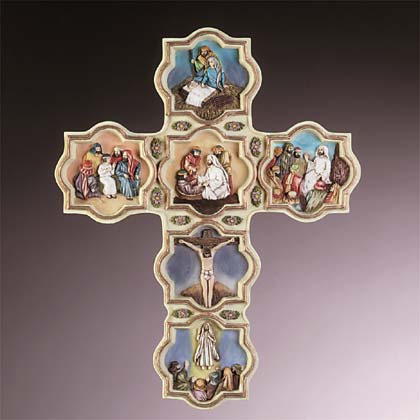
“Taking up St. John’s expression, “The Word became flesh”, the Church calls “Incarnation” the fact that the Son of God assumed a human nature in order to accomplish our salvation in it.” Catechism of the Catholic Church 461
“Christ’s Resurrection is closely linked to the Incarnation of God’s Son, and is its fulfillment in accordance with God’s eternal plan.” Catechism of the Catholic Church 653
Filed under: Pro-life, Quotes from Great Christians, The Incarnation, Unborn Jesus
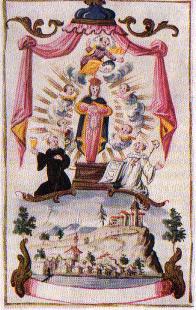
Our Lady of Expectation
“Let it be it done to me according to Thy word” (Luke 1:38 )
St Bernadine calls these words “A flame of transforming love”.
Mother St. Paul said of these words:
“It was a transformation for the world. This word of Mary’s, by which she gave her consent to God’s plan of Redemption, changed the face of the whole world. It began a new era A.D. instead of B.C. It settled the moment of the arrival of the ” fullness of time ” (Gal. 4.:4) – of God’s time. As a result of it, God was already tabernacling among men. The leaven of the Gospel, which was to leaven the whole world, was already beginning to work. Mary s word produced a transformation in the world, and though it “knew Him not,” it was never the same world again.” Mother St. Paul, Mater Christi, 1918
Let us ponder the power and grace that flooded the world when Christ was conceived in Mary’s womb. At the one cell stage, Christ fundamentally changed the world.
Christ wanted to show humanity how special that one cell stage is by fundamentally changing the world at that beginning point of His Incarnate life.
He raised that moment in each person’s life to a dignity and beauty that we will never fully comprehend.
The Culture of Death, like darkness, tries to encroach upon this light, this new illuminated life to extinguish it.
Let us pray that our world will say the same transforming words for each newly conceived child that Mary said for Jesus.
“Let is be done to (us) according to Thy word.” (Luke 1:38 )
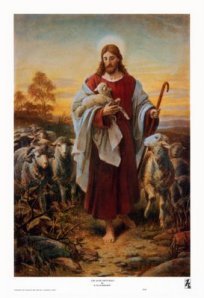
The second of three reflections on Psalm 23, considers verse 4.
The last line of verse 3 – “he leadeth me in the paths of righteousness for his name sake” – brings us to “walking the walk” in verse 4:
“Yea, though I walk through the valley of the shadow of death, I will fear no evil: for thou art with me; thy rod and thy staff they comfort me.”
Are we surprised that righteousness has led us into a certain element of risk and danger? Confronting evil in the world has become difficult. 21st century consequences – that is, problematic and unexpected ones – are now multiplying. What seemed simple has become much more complicated, partly due to the sins and weaknesses of the Good Shepherd’s followers, and partly due to the moral shambles of modern civilization.
We are walking through the sinister valley of the “culture of death”! But God is with us – that changes everything! “Where sin increased, grace abounded all the more” (Rom 5:20). So the Christian, that is, the follower of the Good Shepherd, should not be afraid. Just stay close to Him, don’t wander off…
King David, the author of this Psalm, was a shepherd and later a king. Christ the Lord is also both Shepherd and King. But when Christ was coming into the world it was an awesome fearsome thing. First, the Archangel Gabriel appeared to the priest Zechariah. His first words were: “Do not be afraid, Zechariah…(Lk 1:13). Then Gabriel appeared to Mary: “Hail, full of grace, the Lord is with you!…Do not be afraid, Mary…(Lk 1:28,30). Later, an angel of the Lord appeared to Joseph in a dream: “Joseph, son of David, do not fear to take Mary your wife…(Mt 1:20). And finally in the hills of Bethlehem an angel of the Lord came to the shepherds watching their flocks: “Be not afraid; for behold, I bring you good news of a great joy…(Lk 2:10).
He is Emmanuel, which means “God is with us” (Isa 7:14). So, as verse 4 tells us: “I will fear no evil: for (God) art with me”…God is with us.
“Thy rod and thy staff they comfort me”. The shepherd’s rod and staff remind us of the prophecy that the Messiah would come from the tribe of Judah: “The scepter shall not depart from Judah, nor the ruler’s staff from between his feet, until he comes to whom it belongs” (Gen 49:10). The rod (scepter-like) is for exercising power by striking an enemy, defending against evil. The staff is for steadying one on his journey, leaning upon it for comforting rest.
So the Messiah would be Emmanuel, “God with us”, a Shepherd King guiding and protecting us. His sign is a cross of two beams, much like a rod and staff intersecting and fastened together.With the cross He has already defeated death and evil. From our 21st century vantage point we look out to Nazareth and Bethlehem and we see Him coming: The Shepherd King of the Culture of Life.
See also: Another reflection on Psalm 23.
The first of three reflections on Psalm 23, considers verses 1-3.
In one of his great Messianic outpourings, Isaiah told us that the Messiah would be “like a shepherd”: feeding his flock, gently leading them, gathering them in his arms and holding them “in his bosom” (Isa 40:11). So when we read “The Lord is my shepherd” we are to picture the tenderhearted Christ who once told His followers “I am the good shepherd” (Jn 10:11). In verse 3 of the Psalm we read that the shepherd “leadeth me in the paths of righteousness”. Jesus alluded to this when He described the good shepherd: “…the sheep hear his voice, and he calls his own sheep by name and leads them out…he goes before them, and the sheep follow him, for they know his voice” (Jn 10:2-4). So Jesus the good shepherd leads us in the paths of righteousness, into all good.
When we read about the green pastures, first we should appreciate the fact that these are “His pastures”, but for our benefit. St. Cyril of Alexandria, an early Church Father, says the pastures are “the ever-fresh words of Holy Scripture, which nourishes the hearts of believers and gives them spiritual strength”.
But to my mind, perhaps the key to this entire Psalm is found in the following words: “He leadeth me beside the still waters. He restoreth my soul” (Ps 23:2-3). Many early Church Fathers took this reference to “waters” as a reference to baptism. So, just as Jesus Himself was baptized, so He leads us along this righteous path to also be baptized “in the name of the Father and of the Son and of the Holy Spirit” (Mt 28:18-20).
This baptism “restoreth my soul” in the proper and holy relationship it is meant to have with the Holy Trinity. These still waters, beside which we rest, are also very deep waters. That is, they are deep mystically speaking, like the waters of the Jordan River within which Jesus was baptized. When Jesus emerged from the water witnesses beheld a Trinitarian Theophany: a Dove (the Holy Spirit) came down upon Him and a Voice (the Father’s) resounded around Him: “This is my beloved Son, with whom I am well pleased” (Mt 3:13-17). We can quietly meditate beside these still waters, beside this pool of Revelation, discovering here the deep mysteries of the Holy Trinity.
Gaze again upon these still mystical waters into the mystery of the Incarnation. See how the Incarnate Unborn Jesus first meets John the Baptist when both dwelled within the deep amniotic waters of their mothers’ wombs. In this first meeting, Christ anointed the unborn baby John with His Spirit and John leaped for joy (Lk 1:39-44).
The Good Shepherd leads us “beside still waters”, where we rejoice as we contemplate the deep teaching of the Holy Trinity and the Incarnation. As baptized Christians we rest here, content. Another early Church Father, St. Gregory of Nyssa, reflecting on verses 2-3 of this Psalm refers to “the pastures and fountains of doctrine”. In due course, we hear again the voice of the Good Shepherd: “…whoever drinks of the water that I shall give him will never thirst; the water that I shall give him will become in him a spring of water welling up to eternal life” (Jn 4:14).
On December 12, 2008 the Congregation for the Doctrine of the Faith published its instruction on certain bioethical questions, entitled Dignitas Personae. Throughout the document there are wonderful quotes about Christ’s identification with humanity and unborn children. Here are three examples.
“In the face of this manipulation of the human being in his or her embryonic state, it needs to be repeated that God’s love does not differentiate between the newly conceived infant still in his or her mother’s womb and the child or young person, or the adult and the elderly person. God does not distinguish between them because he sees an impression of his own image and likeness (Gen 1:26) in each one…”
“In the mystery of the Incarnation, the Son of God confirmed the dignity of the body and soul which constitute the human being. Christ did not disdain human bodiliness, but instead fully disclosed its meaning and value: ‘In reality, it is only in the mystery of the incarnate Word that the mystery of man truly becomes clear'”
“At every stage of his existence, man, created in the image and likeness of God, reflects the face of his Only-begotten Son… This boundless and almost incomprehensible love of God for the human being reveals the degree to which the human person deserves to be loved in himself, independently of any other consideration – intelligence, beauty, health, youth, integrity, and so forth. In short, human life is always a good, for it ‘is a manifestation of God in the world, a sign of his presence, a trace of his glory’ (Evangelium vitae, 34).”
Dignitas Personae was published to give the Catholic Church’s teaching concerning the new technologies that relate to the unborn in our very confused Brave New World. Click here to read the document.
Here are some of the topics discussed at some length in the text:
Intracytoplasmic sperm injection (ICSI)
Freezing embryos
The freezing of oocytes
The reduction of embryos
Preimplantation diagnosis
New forms of interception and contragestation (abortive birth control)
Gene therapy
Human cloning
The therapeutic use of stem cells
Attempts at hybridization (the admixture of human and animal genetic elements)
The use of human “biological material” of illicit origin
To read a one page synopsis from the United States Catholic Conference of Bishops click here. This synopsis gives a brief overview of the topics listed below.
Ethical fertility treatments
Embryo adoption
Pre-implantation drugs and devices.
Gene therapy
Genetic enhancement/designer babies.
Human/animal hybrid embryos
Considers the challenge faced by researchers and families arising from the proposed use of unethically obtained cells and tissues.
In tomorrow’s post we will have two beautiful quotes about pre-born Jesus from Deacon Keith Fournier of Catholic Online that touch on this new document.
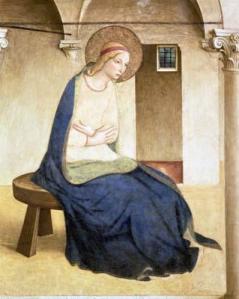
Fra Angelico – The Annunciation, detail of the Virgin
Saturday, Jan. 3, 2009 is the Feast day of The Most Holy Name of Jesus. The Archangel Gabriel was sent on a mission to deliver a message to the Virgin Mary who lived in Nazareth (Lk 1:26-38). A key component of that message was the Name of the Messiah, a further installment in the prophetic revelations through the millennia concerning the identity of the Messiah. Previously, the revelations and prophecies had been getting more and more specific as the year of his advent approached.
God the Father spoke to Adam and Eve about the Messiah (Gen 3:15). As centuries unfolded, so too the mystery of the Messiah unfolded. It was revealed – He would be from the tribe of Judah. It was revealed – He would be born in Bethlehem. It was revealed – He would be a descendant of King David.
But now, in these last days – actually moments before the Incarnation of the Son of God – His Holy Name was revealed – to one trusted custodian: “you shall call his name Jesus”. Here we must pause and reflect on Mary’s state of soul. The Angel departs, the Holy Spirit comes upon her, the power of the Most High overshadows her, and after all is said and done, she is left alone (almost), to marvel, with a handful of words in her heart which break open the sacred mystery of the Messiah:
“Do not be afraid”
“Son of the Most High”
“His kingdom”
“holy, the Son of God”
“Jesus”
Of these five “words”, the first and the last are the most “personal” with respect to Mary’s human heart: “Do not be afraid, Mary…” and “JESUS”, her baby’s name.
“Jesus” was a special name; the fruit of God’s Heart. A name with a message, it means “Yahweh is salvation”. But uppermost in Mary’s mind was that this was her child’s name. She would have repeated it, interiorly, with great frequency…out of love, out of reverence and awe, in thanksgiving and with expectation.
After the Holy Spirit revealed the “Divine” pregnancy of Mary to Elizabeth, it was now Mary’s privilege to announce to Elizabeth and her husband Zechariah the name of the Messiah; “Jesus”(Lk 1:39-56). This holy couple represented the “remnant” of Israel who faithfully awaited the fulfillment of God’s promises through the coming of the Messiah. So to them Mary revealed the Most Holy Name of Jesus. Later, the name was also revealed to Joseph.
For nine sacred months this name was pondered within this Mother’s Heart. She held the Divine Person in her womb and His Holy Name in her heart. Both hidden from the world until the proper time. Decades later, St. Paul would say of this “name”, that it was “the name which is above every name” (Phil 2:9). But for Mary, it was simply the most beautiful name she had ever heard or spoken.
Filed under: Quotes from Great Christians, The Incarnation, Unborn Jesus
Interior Of The Mezquita Cathedral Virgin Mary Icon*
“He has become incarnate for me; it behooves me then to keep as close to Him as possible, to love Him with all my heart and to copy Him as far as I can.
He is God and therefore there can be nothing imperfect about Him; from the first moment of the Word being made flesh in the womb of His Mother till ‘she brought forth her first-born Son’ on Christmas day, His faculties, His reason, His intelligence, His sensibilities were all in a state of perfection; He knew the past, the present, and the future; and He, the Source of grace, was pouring forth grace on all around Him.
Directly we understand this, we feel that we must draw near, not only to adore but to sympathize, to wonder, to love, to learn, to imitate. For those who understand the Incarnation, His work did not begin on Christmas Day, but on the Feast of the Annunciation, when Mary said: ‘Behold the handmaid of the Lord, be it done unto me according to Thy word.’
What happened at that moment? The Holy Ghost overshadowed her, the Body of Our Lord was formed from her pure blood; God created the human Soul to dwell in it, and by the act of the Incarnation that Soul and Body became the Soul and Body of the Word, the Second Person of the Blessed Trinity.
Mary became the Mother of God and Gabriel worshiped before the Tabernacle of the Word made flesh.”
From Ortus Christi:meditations for Advent (1921) by Mother St. Paul
*Detail – fresco of Virgin Mary “of the Sign”: she is carrying Jesus in her womb. This icon is found in The Mezquita of Cordoba, a Roman Catholic cathedral and former mosque, situated in the Andalusian city of Córdoba, Spain. Under the rule of Islam, it was built as the second-largest mosque in the world, and is perhaps the most accomplished monument of the Umayyad dynasty of Cordoba. After the Spanish Reconquista, it was transformed into a church, and some of the Islamic columns and arches were replaced by a basilica in early Baroque style. Today it houses the main church of the diocese of Cordoba in Spain.
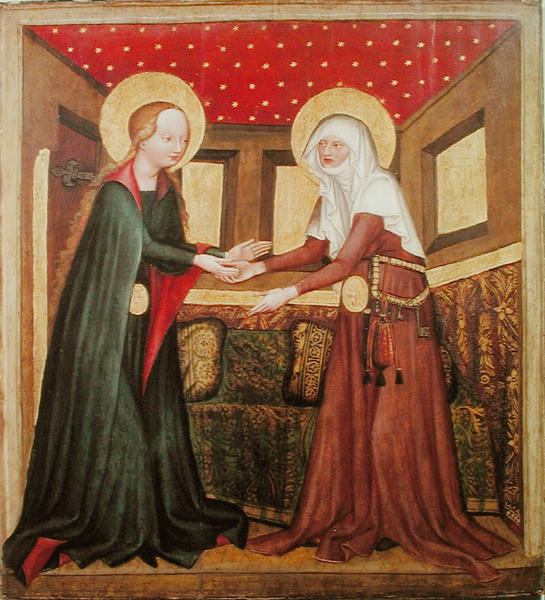
The Visitation, panel from the St. James Altarpiece, c.1440 Bohemian School, (15th century) (Czech) tempera on panel (visitation type fetus)
“In the Eucharist the Church is completely united to Christ and his sacrifice, and makes her own the spirit of Mary. This truth can be understood more deeply by re-reading the Magnificat in a Eucharistic key. The Eucharist, like the Canticle of Mary, is first and foremost praise and thanksgiving.
When Mary exclaims: ‘My soul magnifies the Lord and my spirit rejoices in God my Saviour’, she already bears Jesus in her womb. She praises God ‘through’ Jesus, but she also praises him ‘in’ Jesus and ‘with’ Jesus. This is itself the true ‘Eucharistic attitude’.
At the same time Mary recalls the wonders worked by God in salvation history in fulfillment of the promise once made to the fathers (cf. Lk 1:55), and proclaims the wonder that surpasses them all, the redemptive incarnation.
Lastly, the Magnificat reflects the eschatological tension of the Eucharist. Every time the Son of God comes again to us in the “poverty” of the sacramental signs of bread and wine, the seeds of that new history wherein the mighty are ‘put down from their thrones’ and ‘those of low degree are exalted’ (cf. Lk 1:52), take root in the world.
Mary sings of the ‘new heavens’and the ‘new earth’ which find in the Eucharist their anticipation and in some sense their programme and plan. The Magnificat expresses Mary’s spirituality, and there is nothing greater than this spirituality for helping us to experience the mystery of the Eucharist. The Eucharist has been given to us so that our life, like that of Mary, may become completely a Magnificat!“
John Paul II, Encyclical Letter Ecclesia de Eucharistia, section 58
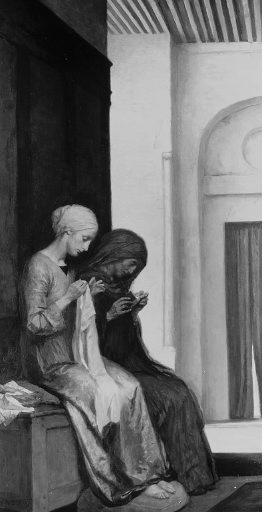
Mary in the House of Elizabeth , Robert Anning Bell 1863-1933
“All through those blessed three months during which Mary abode with Zachary and Elizabeth, she was singing Magnificat. All through her life she sang Magnificat, even though she was the Mother of Sorrows, for the thought of God’s glory ever lifted her out of herself and made her praise Him for all He did. It was because Mary had said her Fiat that she could say her Magnificat….
…We know nothing of what went on during those three months, but we may presume that things continued as they began. It is not likely that Elizabeth said her ‘Ave’ only once, and only once spoke of the honour she considered it to have the Mother of God in her house. It is not likely that the unborn Forerunner never again saluted His Master, in Whose presence he so continually was. It is impossible to conceive that Mary sang God’s praises and her own unworthiness no more during those three months. And what about Jesus ? These were the first three months of His life on earth, and grace was surely going out from Him to His Blessed Mother first, and then to all who knew the secret.”
From Mater Christi : meditations on Our Lady (1920). Mother St. Paul
UNBORNWORDoftheday and our sponsoring organization UNBORN WORD ALLIANCE invite you to join us in 70 DAYS OF PRO-LIFE PRAYER for the U.S. Elections on Tuesday November 4, 2008. We offer our prayer to God for the election of pro-life politicians in all races, at all levels and in all states (and territories).
We take our inspiration from a most humble nun of the middle ages, St. Juliana of Cornillon (1193-1258) who was the original promoter of the Corpus Christi feast day and had a fascinating devotion to honor the Son of God within the womb of His mother Mary. St. Juliana said the “Magnificat” (Lk 1:46-55) nine times a day to honor “the nine months for which the singular Virgin bore the author of our salvation, the only-begotten Son of God, in her womb” (Acta Sanctorum, April, vol. i).
We begin our 70 DAYS OF PRO-LIFE PRAYER today, October 4, 2008, the feast day of St. Francis of Assisi, whose devotion to the infant Christ child led him to re-create the first Nativity Scene (also in the middle ages). We encourage those who join us to pray Mary’s Magnificat (Lk 1:46-55) every day. Mary was pregnant with the Unborn Christ Child when she prayed & proclaimed the Magnificat! We will end our 70 DAYS OF PRO-LIFE PRAYER on December 12, 2008, the feast day of Our Lady of Guadalupe. (Those days following the Election will be days of “thanksgiving”.) The Virgin of Guadalupe was pregnant with the Unborn Christ Child when she appeared to the peasant St. Juan Diego in 1531.
If you are able to match the contemplative St. Juliana in saying the Magnificat 9 times each day; bravo! But perhaps a more modest 3 times a day, in honor of the three trimesters during which Mary carried Unborn Jesus in her womb, would be more realistic for many. And yet, without a doubt, God would be greatly pleased even if you are only able to say just one Magnificat each day in honor of each day that Unborn Jesus spent in the womb of His mother.
The opening words of Mary’s Magnificat are Psalm-like: “My soul magnifies the Lord, and my spirit rejoices in God my Savior…” Indeed, she had the Unborn Christ Child within her and no doubt she did “reflect” the goodness of God in her thoughts, words and deeds, much as the moon beautifully reflects the bright shining rays of the magnificent Sun.
In his book The Feast of Faith, then Cardinal Ratzinger (now Benedict XVI) made this simple observation about prayer: “How can I learn to pray? By praying in fellowship…I learn to pray by praying with others, with my mother for instance, by following her words which are gradually filled out with meaning for me as I speak, live and suffer in fellowship with her.” During this 70 DAYS OF PRO-LIFE PRAYER, we can learn from the mother of the Unborn Christ Child, and our Mother in the faith, by repeating her words of praise and proclamation in the Magnificat. Words she uttered as the Unborn Word of God rested within her womb.
I

Adoration of the Magi by Fra Angelico and Fra Filippo Lippi
The second reading at Mass this Sunday, September 28, 2008, is the oft’ quoted passage from Paul’s Letter to the Philippians: 2:5-11. Not only oft’ quoted, but frequently relied upon by theologians and other Christian scholars because of its richly compact theological truths.
First it tells us, beautifully, about the attitude or mindset which Christ had when He came into the world, His incarnational virtues of humility and obedience; “obedient to the point of death, even death on a cross”.
Then Paul transitions to the Father’s wonderful exaltation of His only-begotten Son, “that at the name of Jesus every knee should bend, of those in heaven and on earth and under the earth, and every tongue confess that Jesus Christ is Lord, to the glory of God the Father”.
Let’s go back in time, ‘salvation history time’, to the first time when this literally happened. It was nighttime in the hill country outside Bethlehem, two thousand years ago (Lk 2:8-20). The angel of the Lord appeared to shepherds watching their sheep: The angel “confessed with his tongue” the Lordship of Jesus Christ: “…for to you is born this day in the city of David a Savior, who is Christ the Lord”. Suddenly “a multitude of the heavenly host” joined this angel praising God. They were all confessing with their tongues, the Lordship of Jesus Christ. Some paintings of this scene even suggest that these angels in the sky are in a kneeling position.
Next, we see the shepherds kneeling around the babe wrapped in swaddling cloths lying in the manger. And they “made known the saying which had been told them concerning this child”. They too were “confessing” the Lordship of Jesus Christ, while kneeling.
We can be certain that Mary and Joseph, at least for part of that evening, were also kneeling and confessing the Lordship of Jesus Christ. Later, we hear of the wise men from the East. When “they saw the child with Mary his mother…they fell down and worshipped him” (Mt 2:11).
We can join with these Holy Ones of old, God’s angels, Mary and Joseph, the shepherds and wise men, and yes, with St. Paul, bending our knee to the Name of Jesus, and confessing with our tongue His glorious Lordship! But we can do more yet. Every physical action while acknowledging the Lordship of Christ, is likewise, an act of praise, honor or worship. With our eyes we can honor Him! With our hands – even if quietly folded in simple prayer – we can honor Him! With our head – whether bowed low or lifted high – we can honor Him! With our intellect! With our will! With our memory! With our imagination! With our time! Have I forgotten something?
Our lives are replete with opportunities to praise, honor and worship Jesus Christ our Lord. On the stairs, in the elevator, on the landing, in the hallway, on the bus, in the parking lot. We can sanctify the world, acknowledging His Lordship!

This12th to 14th century statue is called the Vierge Ouvrante (the Opening Virgin) with the Trinity in her womb: we see Christ and God the Father (the Holy Spirit used to be here but has fallen away). The assembled crowd (in the fold out wings) consisting of crowned heads and humble folk who are praying to the Trinity. When this statue was closed, the viewer only saw Mary with the Christ Child in her lap
The following quotes are taken from a General Audience given by Pope John Paul II on December 10, 1997 entitled The Incarnation, the entry of eternity into time.
“Jesus’ birth makes visible the mystery of the Incarnation already realized in the Virgin’s womb at the time of the Annunciation. In fact, she gives birth to the child that, as the docile and responsible instrument of the divine plan, she had conceived by the power of the Holy Spirit. Through the humanity assumed in Mary’s womb, the eternal Son of God begins to live as a child, and grows “in wisdom and in stature, and in favour with God and man” (Lk 2:52). Thus he manifests himself as true man….
…The Incarnation is the fruit of an immense love, which spurred God willingly to share our human condition to the full. In becoming man, the Word of God brought about a fundamental change in the very condition of time. We can say that in Christ human time was filled with eternity….
…The entry of eternity into time is the entrance, in Jesus’ earthly life, of the eternal love that unites the Son to the Father. The Letter to the Hebrews alludes to this when it speaks of Christ’s inner attitude at the very moment he enters the world: “Lo, I have come to do your will, o God” (10:7). The immense “leap” from the heavenly life of the Son of God into the abyss of human existence is motivated by his will to fulfill the Father’s plan in total self-giving….
…Eternity has entered human life. Now human life is called to make the journey with Christ from time to eternity.”
We plan to feature other Vierge Ouvrante (The Opening Virgin) statues in future posts.
 UNBORN WORD of the day