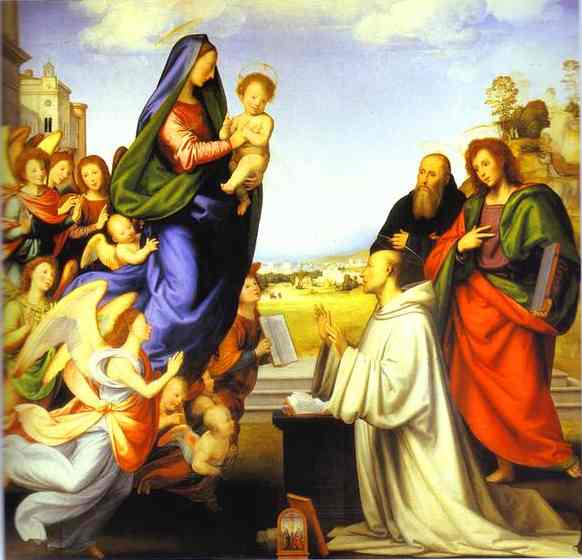
In his book, Treatise on the Love of God Creator, St. Francis de Sales tells of a vision that St. Bernard of Clairvaux had as a young boy.
“The most sweet St. Bernard, as yet a little boy at Chastillon-sur-Seine, was waiting in Church on Christmas night for the divine office to begin, and while waiting the poor child fell into a light slumber, during which he saw in spirit, yet in a vision very distinct and clear, how the Son of God, having espoused human nature, and becoming a little child in His Mother’s most pure womb, was with a humble sweetness mingled with a celestial majesty, virginally born of her:-As a bridegroom coming out of his bride-chamber: a vision, which so replenished the loving heart of the little Bernard with gladness, jubilation and spiritual delights, that he had all his life an extreme sense of it, and therefore, though afterwards as a sacred bee he ever culled out of all the divine mysteries the honey of a thousand sweet and heavenly consolations, yet had he a more particular sweetness in the solemnity of the Nativity, and spoke with a singular relish of this birth of his Master.”
Treatise on the Love of God Creator: St. Francis de Sales, (1567-1622)
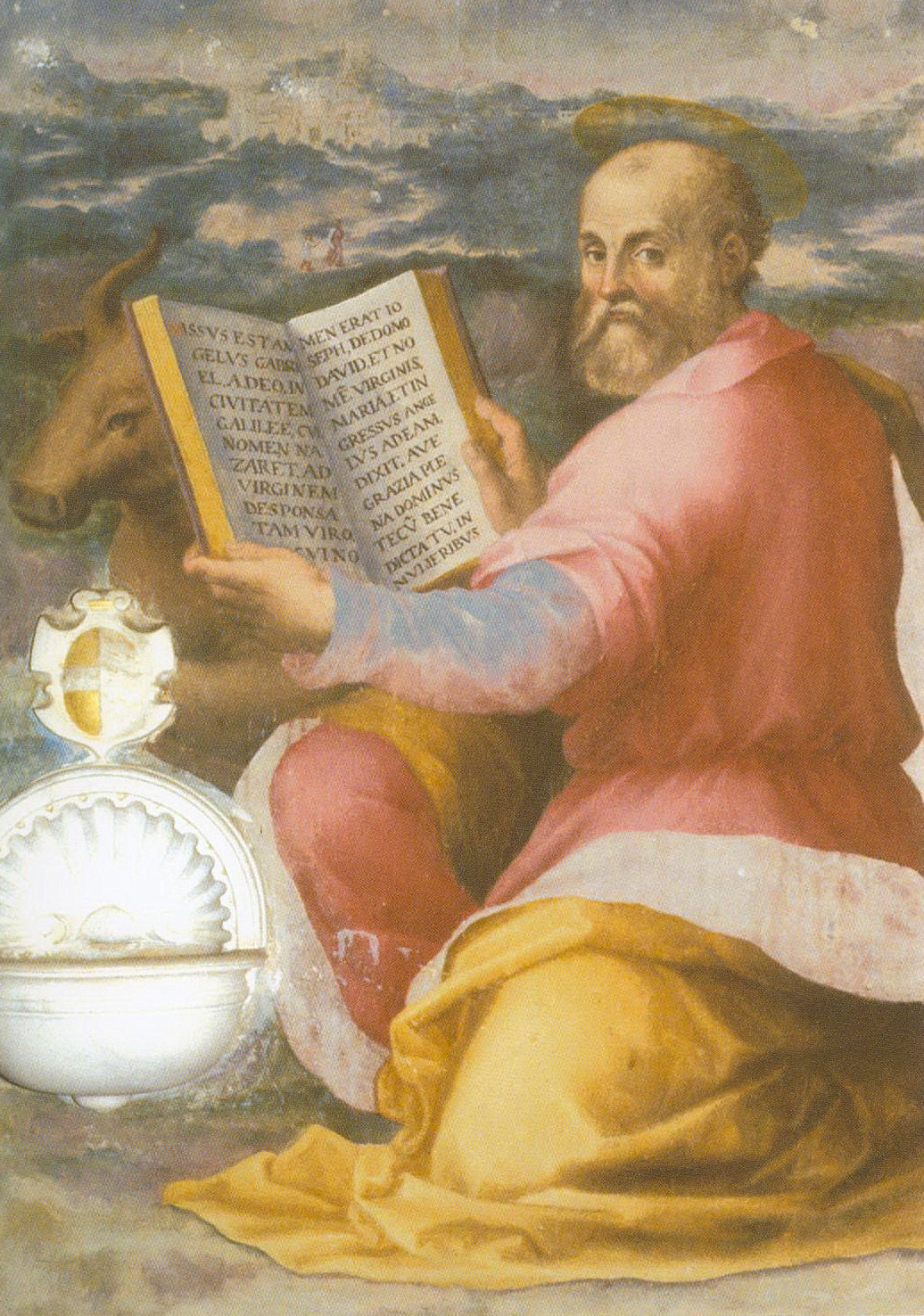
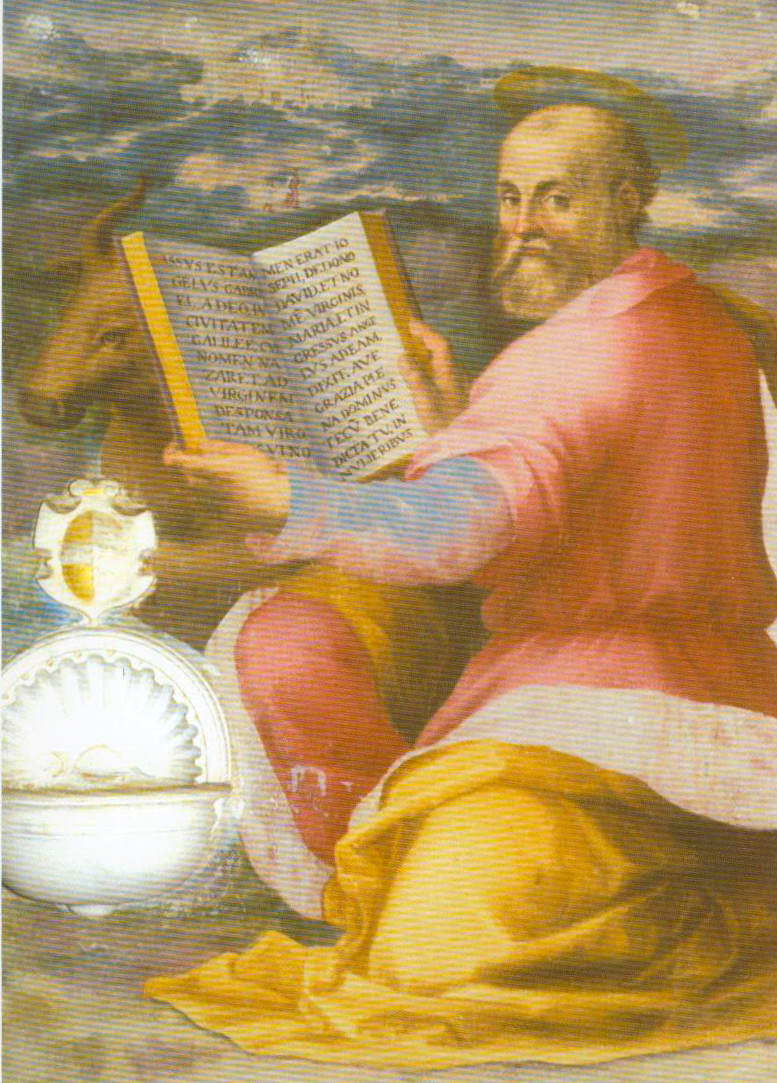
Michele Tosini (1503-77) St. Luke
October 18 is the feast day of St. Luke.
In chapters One and Two of the Gospel of St. Luke we have 127 verses of narrative concerning the infancy and childhood of Jesus Christ and mysteries surrounding His infancy (Lk 1:5 – 2:52). These verses are unique to Luke and outline the earliest vignettes known about the childhood of Jesus Christ. The verses restricted to the infancy period are slightly less: 114 verses (Lk 1:5 – Lk 2:39).
The extraordinary account of the Annunciation to Mary by the Archangel Gabriel, for example, is presented only in Luke and no where else. Likewise, the remarkable Visitation event (and Magnificat “song”) and Bethlehem birth saga are Lukan treasures only. Which might lead us to wonder how would Christianity be different if there was no Luke? Would we celebrate Christmas? (Matthew also provides 47 verses of invaluable introductory information as well concerning Mary, Joseph and Jesus, before and after the birth. Mt 1:18 – 2:23)
We are indebted to Luke in a thousand ways, but especially for the first two chapters of his Gospel which are in a way a “prologue”, comparable to the famous “Prologue” to the Gospel of John (Jn 1:1-18): “In the beginning was the Word, and the Word was with God…” But while the Prologue of John is about Mysteries and realities concerning the Word Incarnate, this “prologue” of Luke’s is focused on biological and historical events which reveal the Child Incarnate. While John is mystical, Luke is highly personal yet supernatural. All of this is to say that, the Incarnation Mystery of faith is so wondrous, that we need both Luke and John to unfold for us its beauty and reality. We can listen to John’s Prologue and see it with the eyes of the heart, but Luke’s we visualize all in fabulous images.
But it is only Luke who reveals to us the babyhood of Jesus and the attendant mysteries thereto. Luke is one of the Church’s great “Pro – Life” saints! There is no way around it. He alone tells of the conception of Jesus Christ, paints for us the tender mother who opens up her heart and soul to God’s plan and Spirit, then recounts the mysterious encounter between pregnant mothers and unborn children and finally recounts in all its poverty and glory the birth of humankind’s Savior in a manger.
St. Luke we thank you for the little details you carefully recorded about our Savior’s first nine months in the womb and then in the manger. You, St. Luke, have brought more tears of joy to human eyes than any other author in human history. You have revealed to us the mother of the baby Jesus and have transported us in our thoughts to kneel beside the beasts and shepherds, beneath the angels’ meditative gaze. It was first your descriptive words which gave rise to those Christmas hymns we sing now that cause our hearts to bow down in adoration again.
St. Luke, when we see you in heaven, we will get in that very long reception line of pro-life Christians who want to shake your hand, the hand which wrote down the sacred events of our Savior’s babyhood, events which gave us hope for all our earthly days.
George A. Peate, Unborn Word Alliance
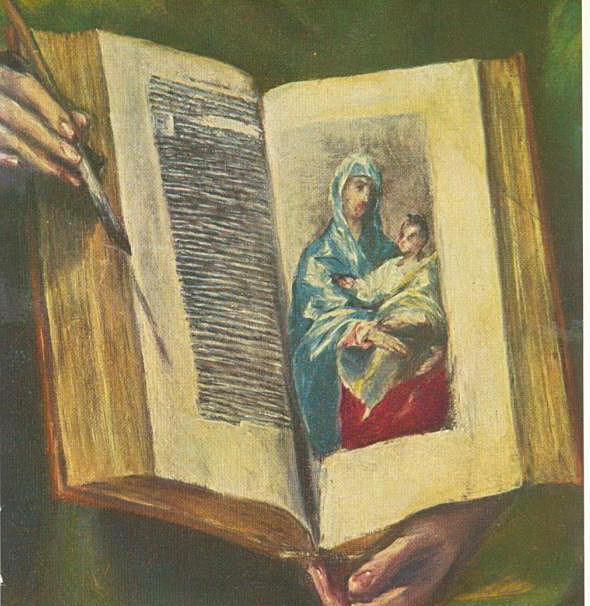
El Greco (1541-1614) St. Luke (detail)
Filed under: Saints
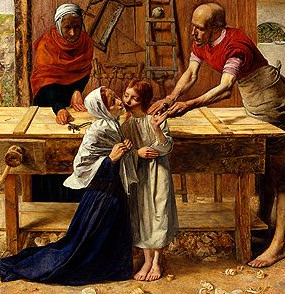
I have carved you in the palm of my hand (Isaiah 49:16)
Today, October 15 is the feast day of St. Teresa of Avila. In their book, Miracles of the Christ Child, Bob and Penny Lord recount this story of the Christ Child and St. Teresa of Avila:
“Teresa had such a great love of the Child Jesus that one day, as she was preparing to ascend stairs leading to the upper rooms of the convent she met a beautiful child. He asked her “Who are you?” She replied, “I am Teresa of Jesus, and who are you?” To which the child responded, “I am Jesus of Teresa.”
They say that encounter with the Lord, as a child, affected her so deeply, after that, when Saint Teresa set out to found a new house (she founded eighteen in all) she always brought a statue of the Child Jesus with her.”
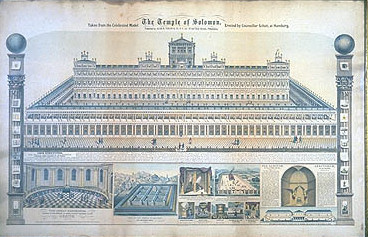
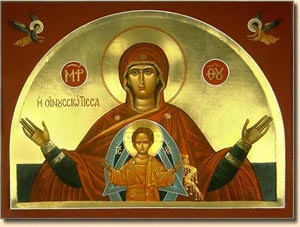
Today, October 5, 2007 is the feast day of St. Mary Faustina Kowalska, the Apostle of Divine Mercy. Here she speaks about the Mercy of God in the Incarnation.
“…Mercy has moved You to deign to descend among us and lift us up from our misery. God will descend to earth; the Immortal Lord of lords will abase Himself. But where will You descend, Lord; will it be to the temple of Solomon? Or will You have a new Tabernacle built for Yourself? Where do You intend to come down? O Lord, what kind of tabernacle shall we prepare for You, since the whole earth is Your footstool?
You have indeed prepared a tabernacle for Yourself; the Blessed Virgin. Her Immaculate Womb is Your dwelling place, and the inconceivable miracle of Your mercy takes place, O Lord. The Word becomes flesh; God dwells among us, the Word of God, Mercy incarnate. By Your descent, You have lifted us up to Your divinity. Such is the excess of Your love, the abyss of Your mercy. Heaven is amazed at the superabundance of Your love. No one fears to approach You now.”
From the The Diary of the Servant of God Saint M. Faustina Kowalska, Divine Mercy In My Soul, Notebook VI.

Today, October 4, 2007 is the feast day of St. Francis of Assisi.
Many Franciscans will tell you that the Christmas Crib holds a special place of honor in Franciscan spirituality. We know about Francis re-creating the Christmas scene one year as a living Nativity with real animals and so on. From his inspiration came the tradition of celebrating Christmas with a nativity scene. St. Bonaventure tells the story here.
One might even say that the Crib of Christ balances out, so to speak, the Cross of Christ. Not that the Cross needs to be balanced out or toned down or made pretty. No not at all. Rather, the reality of God’s Love and Incarnation have two marvelous windows for the soul – like sunrise and sunset – in the Crib and the Cross. And Francis lived these realities when he instituted the living Nativity and when he received the stigmata.
One of his modern day followers in writing about “The Simplicity of St. Francis of Assisi” lists five characteristics, the second of which is: A Childlike Quality. This is one of the gifts one can receive from Bethlehem, not under the Christmas tree, not from one of the wise men, but from the baby Jesus Himself. If we go to the crib to honor the baby God there He will bless us in a childlike manner. Here is a wonderful quote from Mother Angelica (a Franciscan nun) of EWTN fame:
“I want very much to spread devotion to the Divine Child Jesus. Not only is He powerful, but what you need and I need is family, and that Child Jesus will make us one again. He will put love in our hearts, back where it should be.“
Another Franciscan nun focusing on the Advent dimension of her Franciscan spirituality speaks of creating space for Jesus in one’s own heart; a “crib in our hearts”. This is definitely a childlike concept. Can we relate to it in our sophisticated world with our complicated perspectives?
The crucified Christ saves our souls, perhaps the infant Christ can heal our attitudes!
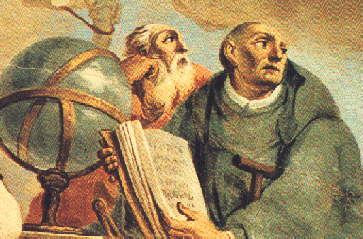
Today, Tuesday, September 25, 2007 is the feast day of Blessed Herman (1013-1054). He was born with many medical problems: cleft palate, cerebral palsy, and spina bifida. During his lifetime he was known as Blessed Herman the Cripple. Father Robert F. McNamara on his website, Saints Alive, calls him Blessed Herman the Disabled.
He was a remarkable man. Despite his daunting physical limitations he studied and wrote on astronomy, theology, math, history, poetry, Arabic, Greek, and Latin. He also built musical and astronomical equipment. He was considered a genius in his time. He wrote prayers and hymns – the most notable being the Salve Regina (Hail Holy Queen).
Father McNamara in his article on Blessed Herman the Disabled comments on the great meaning of Herman’s life with this closing insight:
“In his own day, the heroic cripple who achieved learning and holiness was called ‘The Wonder of His Age’.
In our day, many voices say that people with disabilities should be phased out of existence. Which were the Dark Ages, then or now!”
 UNBORN WORD of the day