


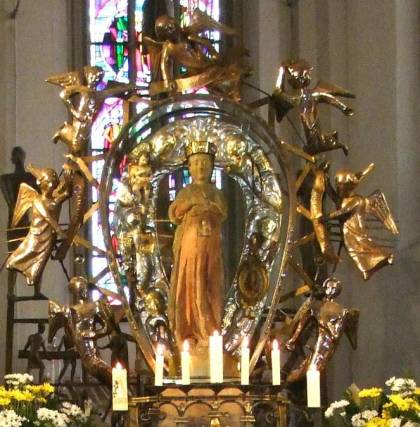
In a previous post on St. Elizabeth Ann Seton we mentioned that both she and St. Louise de Marillac had a devotion to Christ in the womb. (St. Elizabeth Seton formed her sisters in the Vincentian spirit according to the tradition of Louise de Marillac 1591-1660 and Vincent de Paul 1581-1660.) In that post, we highlighted some quotes from St. Elizabeth speaking of her devotion to Christ in the womb. In today’s post we would like to highlight St. Louise’s devotion.
In the book, Vincent de Paul and Louise de Marillac – Rules, Conferences and Writings, Vie Thorgren writes of St. Louise: ” They remind us of the importance of the hidden years of Jesus’ life-hidden within the womb and hidden in a village noted only for its insignificance. As early as 1626, Louise began a daily practice of meditation on Jesus within the womb receiving his flesh and blood, which became the means of our redemption. Recognizing the fruitfulness of this meditation, she offered it as an enduring legacy to the Daughters of Charity.”
In her Rule of Life in the world, St. Louise enumerates several devotional practices in honor of the Virgin Mary – one of these practices concerns Christ in the womb.
A quarter of an hour of prayer exactly at midday to honor the moment when the Incarnation of the Word took place in the womb of the Blessed Virgin.
In her own words, we learn from St. Louise herself, of a personal devotional practice she had honoring the unborn Christ Child. St. Louise drew up a little rosary. She wrote to St. Vincent: “This little chaplet is the devotion for which I asked permission of your Charity three years ago as a personal devotion. I have in a small box a quantity of these little chaplets, along with some thoughts on this devotion written on a piece of paper, which with your permission, I wish to leave to all our sisters after my death. Not one of them knows it. It honors the hidden life of Our Lord in his state of imprisonment in the womb of the Blessed Virgin and congratulates her on her happiness during those nine months. The three small beads hail her under her beautiful titles of Daughter of the Father, Mother of the Son, and Spouse of the Holy Spirit. That is the main thought behind the devotion. By the grace of God, unworthy as I am, I have continued this devotion since the time I mentioned, but I hope to discontinue it, aided by God’s same grace, if your Charity so orders. By means of this little exercise I intend to ask God, through the Incarnation of his Son and the prayers of the Blessed Virgin, for the purity necessary for the Company of the Sisters of Charity and for the steadfastness of this Company in keeping with his good pleasure.” Louise de Marillac, Spiritual Writings, L.303B
It seems that St. Vincent had agreed to this devotional practice three years earlier but at this point he asked her to discontinue it. Even though St. Louise continued to believe that this was a devotion that Our Lady wanted her to practice – in holy obedience to St. Vincent she discontinued it.
She alludes to this in a letter: “I feel that I must tell your Charity that I was and still am sorry at having to abandon those little prayers because I believe that the Blessed Virgin wanted me to render her this small tribute of gratitude. But with her, I console myself by offering my renunciation to her and by resolving to please her in some other way and to serve her with greater fervor….” Louise de Marillac, Spiritual Writings, L.304
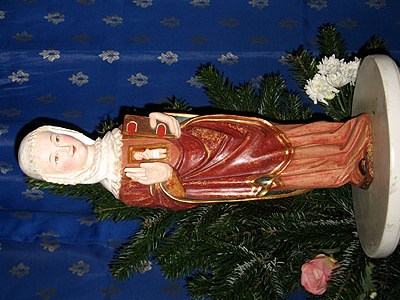
‘Maria Gravida’-Institute of St. Philip Neri in Berlin ( It is a reproduction of the original in Malta) Click here to see the original.
In his book entitled The Soul of Elizabeth Seton, Joseph I. Dirvin (Ignatius Press) writes that St. Elizabeth Ann Seton had a devotion to the motherhood of Mary and the hidden life of Jesus in his mother’s womb. Here are quotes from his book detailing her devotion:
“The saint shared her delighted contemplation of the love of Jesus and Mary as he lay hidden in her chaste womb with St. Louise de Marillac, foundress with St. Vincent de Paul of the Daughters of Charity, whose Rule and spirit Elizabeth had chosen for her own community and who like Elizabeth was a widow and mother. It was an established devotion of both, nurtured by their motherhood, as Elizabeth bore witness in a note to Brute perhaps at Christmastime: “Blessed, it would please your so kind heart to know that this week past or more, our Soul’s dear Baby has been much more present to me than the beloved babies of former days, when I carried and suckled them. He, the Jesus Babe, so unspeakably near and close, hugged by His poor, silently delighted wild one!” ” (pg. 84)
“The maternity that united the Virgin Mary with Elizabeth Seton is especially strong in an exquisite meditation for the feast of the Assumption. “Jesus nine months in Mary, feeding on her blood- Oh Mary! These nine months”. Elizabeth wrote in remembrance of a like joy she herself had known in carrying her children. Now she was savoring it again in transcendent communion with the divine motherhood.” (pg. 83)
“Elizabeth also pursued her mother’s intuitions of Mary with her Sisters. As an outline of a conference attests. “We honor her continually with Our Jesus.” she told them. “His nine months within her” – the thought inspired a fresh spate of spiritual insights – “what passed between them-she alone knowing Him. – there was indeed a time when Mary alone of all mankind knew that the Messiah had come – He her only tabernacle…Mary full of grace, Mother of Jesus! Oh we love and honor Our Jesus, when we love and honor her.” “ (pg. 84)
“…she did not hesitate to close one letter (to her daughter) with these exalted words: “My Rebecca, we will at last unite in His eternal praise, lost in Him, you and I, closer still than in the nine months so dear when, as I told you, I carried you in my bosom as He in Our Virgin Mother’s – than no more separation.” ” (pg. 120)
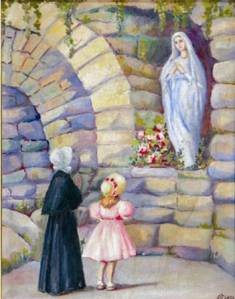
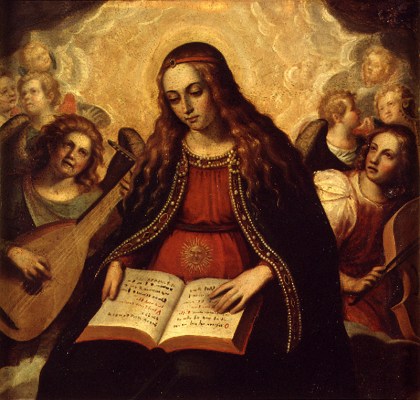
Virgen de la Esperanza-Our Lady of Expectation
Tuesday, April 28 is the feast day of St. Louis de Montfort. Here are a few quotes from him about Christ’s time in the womb.
God the Son came into her virginal womb as a new Adam into his earthly paradise, to take his delight there and produce hidden wonders of grace.
God-made-man found freedom in imprisoning himself in her womb. He displayed power in allowing himself to be borne by this young maiden. He found his glory and that of his Father in hiding his splendors from all creatures here below and revealing them only to Mary. He glorified his independence and his majesty in depending upon this lovable virgin in his conception, his birth, his presentation in the temple, and in the thirty years of his hidden life.
The Incarnation is the first mystery of Jesus Christ; it is the most hidden; and it is the most exalted and the least known. It was in this mystery that Jesus, in the womb of Mary and with her co- operation, chose all the elect. For this reason the saints called her womb, the throne-room of God’s mysteries
Our good Master stooped to enclose himself in the womb of the Blessed Virgin, a captive but loving slave, and to make himself subject to her for thirty years. As I said earlier, the human mind is bewildered when it reflects seriously upon this conduct of Incarnate Wisdom. He did not choose to give himself in a direct manner to the human race though he could easily have done so. He chose to come through the Virgin Mary. Thus he did not come into the world independently of others in the flower of his manhood, but he came as a frail little child dependent on the care and attention of his Mother.
From: Treatise on True Devotion To The Blessed Virgin
by St. Louis de Montfort
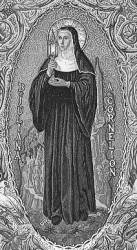
You may have never heard of Blessed Juliana of Cornillon (Juliana of Liege), 1192 -1258. She was an Augustinian nun who was the first promoter of a feast day in honor of the Blessed Sacrament. She has been recognized as the person primarily responsible for the introduction of the Corpus Christi feast day during the middle ages. According to Acta Sanctorum, she had a unique and extraordinary devotion. She said the Magnificat (Lk 1:46-55) nine times a day; once for each month that Our Lord spent in the womb of His mother. (The Magnificat was proclaimed by Mary while she was pregnant.) One can not help but see the beautiful connection here in Juliana’s spiritual life between her devotion to the Body of Christ in the womb and the Body of Christ upon the altar.
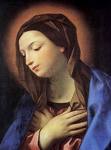
Which leads us to the second woman: Mary the Mother of Jesus. In his encyclical letter ECCLESIA DE EUCHARISTIA, On the Eucharist in Its Relationship to the Church, John Paul II discusses Mary and the Eucharist:
“In a certain sense Mary lived her Eucharistic faith even before the institution of the Eucharist, by the very fact that she offered her virginal womb for the Incarnation of God’s Word. The Eucharist, while commemorating the passion and resurrection, is also in continuity with the incarnation. At the Annunciation Mary conceived the Son of God in the physical reality of his body and blood, thus anticipating within herself what to some degree happens sacramentally in every believer who receives, under the signs of bread and wine, the Lord’s body and blood.”
“As a result, there is a profound analogy between the Fiat which Mary said in reply to the angel, and the Amen which every believer says when receiving the body of the Lord. Mary was asked to believe that the One whom she conceived “through the Holy Spirit” was “the Son of God” (Lk 1:30-35). In continuity with the Virgin’s faith, in the Eucharistic mystery we are asked to believe that the same Jesus Christ, Son of God and Son of Mary, becomes present in his full humanity and divinity under the signs of bread and wine.”
“Blessed is she who believed” (Lk 1:45). Mary also anticipated, in the mystery of the incarnation, the Church’s Eucharistic faith. When, at the Visitation, she bore in her womb the Word made flesh, she became in some way a “tabernacle” – the first “tabernacle” in history – in which the Son of God, still invisible to our human gaze, allowed himself to be adored by Elizabeth, radiating his light as it were through the eyes and the voice of Mary. And is not the enraptured gaze of Mary as she contemplated the face of the newborn Christ and cradled him in her arms that unparalleled model of love which should inspire us every time we receive Eucharistic communion?”(#55)
“The Eucharist has been given to us so that our life, like that of Mary, may become completely a Magnificat!” (#58)
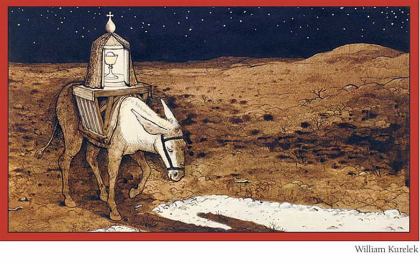
The Donkey Carrying God by William Kurelek
“The donkey that carried Our Lady to Bethlehem took another form in my thoughts. For he carried the Word—a dumb animal, carrying a Virgin who carried God—and so he was the carrier of God too. His bells were the first church bells, for Mary was the first Church, the first tabernacle of Christ.” Catherine Doherty foundress of Madonna House.
In another vein, St. Josemaria Escriva often compared himself to a donkey:
“One day at the beginning of the 1930s, the Founder of Opus Dei greeted Our Lord in the Tabernacle of the church of the St Elizabeth Foundation with these words: “Here is your mangy little donkey!” and heard in reply the gentle response, “A little donkey was my throne in Jerusalem.”
The donkey, docile, humble and hard-working, was an animal for which St Josemaria had always felt a special affection. He saw himself as a donkey – in the words of Psalm 73[72], ‘ut iumentum’. From The ‘theology of the donkey’.
‘I am like a beast (donkey) in your presence, but I am continually with you. You hold my right hand.’ (Psalm 72:23-24)
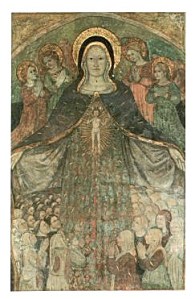
Andrea di Bartolo from Jesi, Platytera as Madonna Madonna della Misericordia, Ostrense Belvedere, Church of Our Lady of Mercy:
The new Vatican document Dignitas Personae refers to Christ’s identification with humanity but also points out that his identification began in the womb. Here are two beautiful quotes about this identification from Deacon Keith Fournier of Catholic Online.
“As a pre-born child, Jesus sanctified all mother’s wombs by dwelling within the temple of His beloved self-chosen mother. This is the greatest argument that Christians have against the horror of procured abortion. In an age which rejects the truths of revelation we also argue from the truth of reason, the Natural Law. However for those who believe that Jesus the Redeemer lived, ruled and reigned as King in that Holy womb, the evil of the taking of innocent human lives through abortion comes into focus. The latest instruction from the Holy See entitled ‘The Dignity of Persons’ speaks of ‘Embryonic Persons’. God became an embryonic person and has forever identified with these smallest members of our human family.” The Dignity of the Person’: The Catholic Church, Defender and Champion of Life by Deacon Keith Fournier
“As we move closer to the Day when those who bear the name Christian will commemorate the Nativity of the Lord, let us remember the incredible truth revealed in the Mystery which we will celebrate, there was a Redeemer in the Womb. The Incarnate Word became one of us, at every stage. In fact, Jesus was an ’embryonic person’, to use the salient phrase taken from this newest Vatican document, and is forever identified with all embryonic persons.” Merry Christmas: Incarnate Love is Born Today by Deacon Keith Fournier
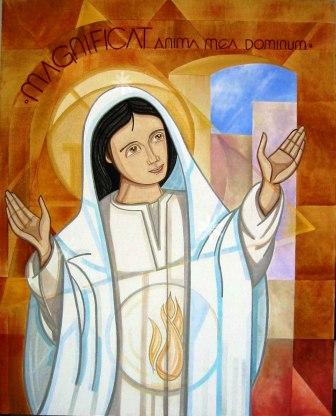
“Didn’t the Virgin Mary do the will of the Father? I mean, she believed by faith, she conceived by faith, she was chosen to be the one from whom salvation in the very midst of the human race would be born for us, she was created by Christ before Christ was created in her. Yes, of course, holy Mary did the will of the Father. And therefore it means more for Mary to have been a disciple of Christ than to have been the mother of Christ. It means more for her, an altogether greater blessing, to have been Christ’s disciple than to have been Christ’s mother. That is why Mary was blessed, because even before she gave him birth, she bore her teacher in her womb.”
From Mary, a disciple of Christ, St. Augustine, Sermon 72/A, 7
“So much can be gained by reflecting on the way Mary learned from Jesus! From her very first “fiat”, through the long, ordinary years of the hidden life, as she brought up Jesus, or when at Cana in Galilee she asked for the first sign, or when finally on Calvary, by the Cross, she looked on Jesus, she “learned” him moment by moment. Firstly in faith and then in her womb, she received the Body of Jesus and then gave birth to him. Day after day, enraptured, she adored him. She served him with solicitous love, singing the Magnificat in her heart.”
From: Pope Benedict, XVI in Poland May 26, 2006 VIAGGIO APOSTOLICO DI SUA SANTITÀ BENEDETTO XVI IN POLONIA (25-28 MAGGIO 2006) (V) , 26.05.2006
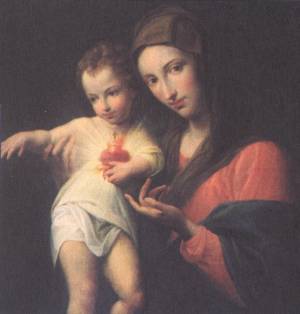
Tuesday, August 19th is the feast of St. John Eudes. I’m not an expert on Eudes, but I know of three pronounced devotions that he had: to the Heart of Jesus Christ, to Mary the Mother of the Lord and to Christ within the womb of Mary. We dedicate this reflection to John Eudes.
Through the words of his prophet Ezekiel, the Lord made a great promise to Israel:
“A new heart I will give you, and a new spirit I will put within you;
and I will take out of your flesh the heart of stone
and give you a heart of flesh.” Ezek 36:26
It is important to realize that this promise, this prophecy, could not be fulfilled until the Incarnation of Christ the Lord had occurred. It was the heart of flesh within the Body of Jesus that marked the change, for it was also the very Heart of God! Mary’s heart prefigured the heart of Jesus that would be formed within his Body, within her womb, for her heart was tender and full of Grace.
We see, in fact, that during those first nine months of the Incarnation while Jesus was an unborn baby within the womb of Mary, that the three devotions mentioned above are all linked. As one of the invocations in the Litany to the Sacred Heart of Jesus says: “Heart of Jesus, formed by the Holy Spirit within the Virgin Mother’s womb, have mercy on us.”
So the Incarnation made it possible for Israel and all Christians to take another step forward in God’s Plan of Salvation. Hence the old Catholic prayer: “Jesus, meek and humble of Heart, make my heart like unto Thine.”
John tells us: “And the Word became flesh and dwelt among us, full of grace and truth…And from his fullness have we all received, grace upon grace” (Jn 1:14,16). If the Word had never become flesh within the womb of Mary, Ezekiel’s prophecy would not have been realized.
About three weeks after His conception, the Heart of Christ was physically formed in a rudimentary fashion, pulsing with love for every human being. Although, His spiritual heart was beating thus from the first moment of conception as Pope Pius XII explains: “The Virgin Mary utters that generous word, “be it done”…Immediately the Heart of Jesus, ever to be adored, has begun to pulsate with love, divine and human” (On Devotion to the Sacred Heart of Jesus, #63).
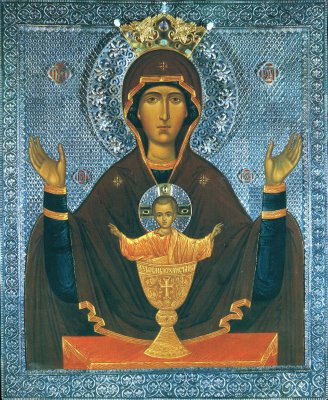
August 3rd is the feast day of St. Peter Julian Eymard. Here is a beautiful quote from him on the Incarnation:
“Now Jesus Christ, God and Man, enters into us and enacts a mystery similar to the one wrought in Mary’s womb….the Eucharist passes into our bodies and, uniting with us, prolongs, extends the Incarnation to each of us separately. In becoming incarnate in the Virgin Mary, the Word had in view this incarnation in each one of us, this Communion with the individual soul; it was one of the ends for which He came into the world. Communion is the perfect development, the full unfoldment of the Incarnation, as it is likewise the completion of the sublime sacrifice of Calvary, renewed each morning in the Mass….without Communion the Sacrifice would be incomplete. Thus the Body of Jesus Christ is united with our body, His Soul with our soul, and His Divinity hovers over both.”
St. Peter Julian Eymard
Holy Communion
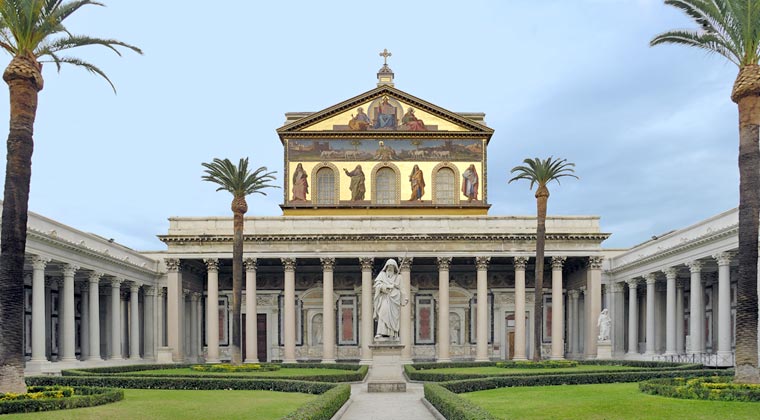
The Papal Basilica Saint Paul Outside-the-Walls
Pope Benedict has inaugurated “The Year of St Paul”, beginning on June 29, 2008, at the first Vespers of the traditional Church Feast of Saints Peter and Paul. Last night I watched some of the liturgical celebrations live from the Vatican (on EWTN) to usher in this extraordinary Pauline year of grace.
In keeping with the spirit of this special day, we offer the following short quote from UNBORN JESUS OUR HOPE concerning the mystical nature of Mary’s pregnancy and words from Paul (and Peter) which help to throw light on it:
“She is the first Christian missionary. She carries the Christ across the land from this town to that. But He dwells within her ‑ within and beneath her heart. The mystery of this particular heart‑to‑Heart, body‑to‑Body communion between mother and Child, Christian and Christ, is impossible to fathom. Many years later both Saints Peter and Paul described their own sense of oneness with Christ in words that may help us in our appreciation of Mary’s experience. Reflecting on his own personal identification with Christ’s death on the cross, St. Paul would say; “I have been crucified with Christ; it is no longer I who live, but Christ who lives in me…” (Gal 2:20).
But what of Mary’s intimate identification with our Lord’s Incarnation, the singular experience of Mary’s maternity? Her sentiments may have resembled those of St. Paul; paraphrasing now: “I have been conceived with Christ; it is no longer I who live, but Christ who lives in me…” And as each day passed, did she not sense that she was becoming, as St. Peter would later say, a partaker “of the divine nature” (II Pet 1:4)? No other human soul has experienced the wonder and grace of this mystical passage from youthful human simplicity into the eternal mystery of mothering God! Words fail us here: ” Christ is all, and in all” (Col 3:11).”
Every Christian must discover for himself or herself, and repeatedly, just how “Christ is all, and in all” for him and for her. In a unique way, during her nine month pregnancy, Mary must have pondered within her heart – in an archetypical manner – the Incarnational mystery that “Christ is all, and in all”. He certainly was “all and in all” in her! Following baptism and the onset of the life of God within each Christian soul, it is true on the spiritual level – a mystical truth and reality grasped and taught well by St Paul – that “Christ is all, and in all”! And just as the pregnant Mary saw intimate signs of Christ’s life within her own and desired to live well her nine months for Him, so too today’s Christian recognizes personal signs of Christ’s life within his or her heart and must strive to live well all his or her days for Christ.
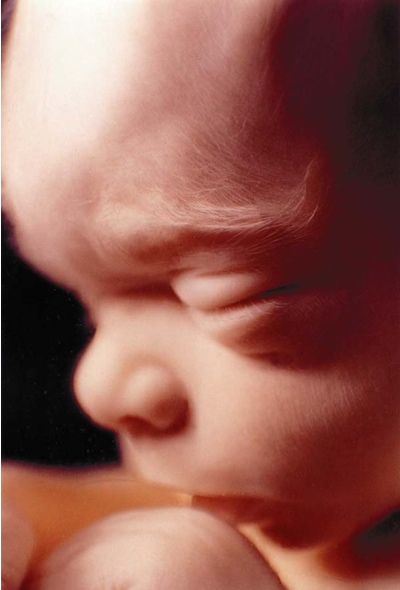
“Christ was humble of heart. Throughout his life he looked for no special consideration or privilege. He began by spending nine months in his Mother’s womb, like the rest of men, following the natural course of events. He knew that mankind needed him greatly. He was longing to come into the world to save all souls, but he took his time. He came in due course, just as every other child is born. From conception to birth, no one – except our Lady, St Joseph and St Elizabeth – realized the marvelous truth that God was coming to live among men.”
St. Josemaria Escriva from Christ is Passing By.
St. Josemaria Escriva’s feast day is June 26. He was canonized on October 6, 2002.
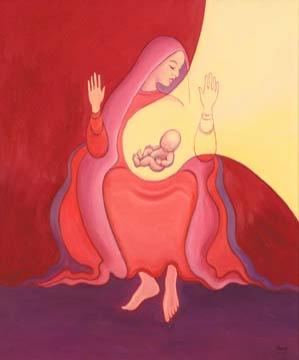
Mary is the ‘Holy House’ who bore God in her womb and is forever to be honoured by Elizabeth Want
In his Apostolic Exhortaion entitled Vita Consecrata (March 25, 1996) John Paul II has a thought provoking quote from St. Augustine:
“Beautiful is God, the Word with God … He is beautiful in heaven, beautiful on earth; beautiful in the womb, beautiful in his parents’ arms, beautiful in his miracles, beautiful in his sufferings; beautiful in inviting to life, beautiful in not worrying about death, beautiful in giving up his life and beautiful in taking it up again; he is beautiful on the Cross, beautiful in the tomb, beautiful in heaven. Listen to the song with understanding, and let not the weakness of the flesh distract your eyes from the splendour of his beauty.” #24

‘Fantastic Ruins with Saint Augustine and the Child’ François de NOME,
about 1593 – after 1630
In a vision Saint Augustine saw a child trying to empty the sea into a hole dug in the sand; when Augustine told him that this was impossible, the child replied that Augustine was engaged on the equally impossible task of explaining the Trinity.
Many have assumed that the child St. Augustine saw in his vision was the Christ Child – Below is a beautiful passage on the Incarnation from a sermon given by St. Augustine:
“He by whom all things were made was made one of all things. The Son of God by the Father without a mother became the Son of man by a mother without a father. The Word Who is God before all time became flesh at the appointed time. The maker of the sun was made under the sun. He Who fills the world lays in a manger, great in the form of God but tiny in the form of a servant; this was in such a way that neither was His greatness diminished by His tininess, nor was His tininess overcome by His greatness.”(St. Augustine, Sermon 187)
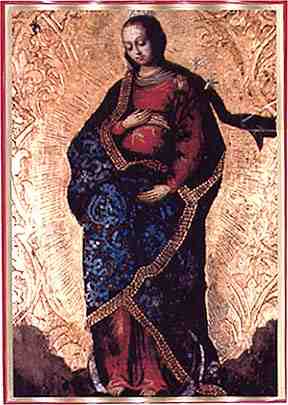
The emphasis of the French School of Spirituality (which had its beginning with Cardinal Pierre de Bérulle (1575-1629) and continued with his disciples such as the Venerable Jean-Jacques Olier (1608-1657) and St. John Eudes (1601-1680) was on the nine months during which Jesus lived in the womb of Mary. These men rightly perceived the mystery of the beauty and depth of the communication which took place between Mary and her Son during this blessed period. Olier and Eudes especially would speak of this communication as being between their hearts. St. Louis de Montfort also was influenced by this Spirituality when he entered Saint-Sulpice which was founded by Jean-Jacques Olier, one of the leading exponents of what came to be known as the ‘French School of Spirituality’.
Following are a few of the quotes about the Unborn Christ Child by St. Louis de Montfort from his Treatise on True Devotion to the Blessed Virgin:
“God the Son came into her virginal womb as a new Adam into his earthly paradise, to take his delight there and produce hidden wonders of grace. God-made-man found freedom in imprisoning himself in her womb. He displayed power in allowing himself to be borne by this young maiden.” 18
“Time does not permit me to linger here and elaborate on the perfections and wonders of the mystery of Jesus living and reigning in Mary, or the Incarnation of the Word. I shall confine myself to the following brief remarks. The Incarnation is the first mystery of Jesus Christ; it is the most hidden; and it is the most exalted and the least known. It was in this mystery that Jesus, in the womb of Mary and with her co- operation, chose all the elect. For this reason the saints called her womb, the throne-room of God’s mysteries.” 248
“Our good Master stooped to enclose himself in the womb of the Blessed Virgin, a captive but loving slave, and to make himself subject to her for thirty years. As I said earlier, the human mind is bewildered when it reflects seriously upon this conduct of Incarnate Wisdom. He did not choose to give himself in a direct manner to the human race though he could easily have done so. He chose to come through the Virgin Mary. Thus he did not come into the world independently of others in the flower of his manhood, but he came as a frail little child dependent on the care and attention of his Mother. Consumed with the desire to give glory to God, his Father, and save the human race, he saw no better or shorter way to do so than by submitting completely to Mary.” 139
Prominent Men and Women of or influenced by the French School:
· Cardinal Pierre de Bérulle (1575-1629)
· Jean-Jacques Olier (1608-1657), disciple of Cardinal Berulle. Olier founded the Society of St. Sulpice, in 1642, to train and form future priests
· Jeanne Chezard de Matel (1596-1670), foundress of the Sisters of the Incarnate Word in Avignon, France, in December, 1639.
· St.John Eudes, founder of the Eudists.
· St. Louis de Montfort. (1673-1716)
· Blessed William Joseph Chaminade (1761-1850)
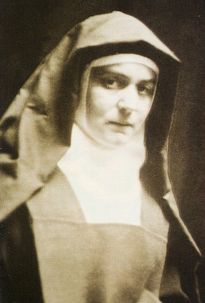
Here is a quote from Saint Teresa Benedicta of the Cross (Edith Stein)
” ‘He saw the holy city, the new Jerusalem, descending out of heaven from God, prepared like a bride adorned for her husband’ (Rv 21:2 and 9ff.). As Christ himself descended to earth from heaven, so too his Bride, the holy church, originated in heaven. She is born of the grace of God, indeed descended with the Son of God himself; she is inextricably bound to him. She is built of living stones; her cornerstone was laid when the Word of God assumed our human nature in the womb of the Virgin. At that time there was woven between the soul of the divine Child and the soul of the Virgin Mother the bond of the most intimate unity which we call betrothal…”
Marriage of the Lamb, For September 14, 1940
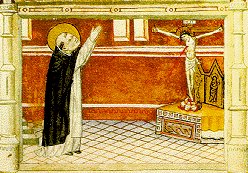
The Seventh Way of Prayer – St. Dominic
While praying, he (St. Dominic) was often seen to reach towards heaven like an arrow which has been shot from a taut bow straight upwards into the sky.*
Towards the end of the Gospel of Life, John Paul II gives us an important reminder about “prayer” and fasting. He does this to help us be properly prepared for the Pro – Life battle:
“Jesus himself has shown us by his own example that prayer and fasting are the first and most effective weapons against the forces of evil (cf. Mt 4:1-11). As he taught his disciples, some demons cannot be driven out except in this way (cf. Mk 9:29). Let us therefore discover anew the humility and the courage to pray and fast so that power from on high will break down the walls of lies and deceit: the walls which conceal from the sight of so many of our brothers and sisters the evil of practices and laws which are hostile to life.”
Notice in the above quote John Paul II points out the need for “humility and courage to pray and fast”. This reminds me of a sermon given by St. Francis de Sales on March 29, 1615 regarding “The Spirit of Prayer”. Here is an excerpt:
“for do you not see how a marksman with a crossbow, when he wishes to discharge a large arrow, draws the string of his bow lower the higher he wants it to go? Thus must we do when we wish our prayer to reach Heaven; we must lower ourselves by the awareness of our nothingness. David admonishes us to do so by these words: When you wish to pray, plunge yourself profoundly into the abyss of your nothingness that you may be able afterward, without difficulty, to let your prayer fly like an arrow even up to the heavens. [Cf. Ps. 130:1-2; Sir. 35:21].”
De Sales compares prayer to the shooting of an arrow “up to the heavens”. I would like to ask if we shoot our prayer up to God in Heaven, exactly what are we aiming at? His Heart perhaps? Imagine, if you will, a target in Heaven like that used by a common archer here below. We supplicants, weary and wayward as we are, shoot our prayer heavenward but the target seems to elude us – except that God hears our prayer before we say it and he sees that arrow before it is released. God moves that heavenly target so that it meets the arrow – your arrow – your prayer is mercifully heard by God, your prayer is lovingly received by God. God cheats sometimes because of our incapacity. What we lack He makes up for in Mercy.
*Taken from the Nine Ways of Prayer – the Nine Ways of Prayer was written by an anonymous Bolognese author, sometime between A.D. 1260 and A.D. 1288, whose source of information was, among other followers of St. Dominic, Sister Cecilia of Bologna’s Monastery of St. Agnes. Sister Cecilia had been given the habit by St. Dominic himself. “The Nine Ways of Prayer” has been sometimes printed as a supplement to “The Life of St. Dominic” by Theodoric of Apoldia, though they aren’t an actual part of that work.
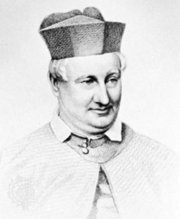
Answer: The great Father Faber (1814-1863) who pioneered devotional insights into the life of the unborn Christ Child. As some of you know we have quoted Father Faber on a number of occasions. Besides being an impressive preacher and spiritual writer Father Faber also wrote many wonderful hymns – including Faith of Our Fathers and There’s a Wideness in God’s Mercy. Two of his books that touch upon the mystery of the unborn Christ Child are Bethlehem and The Blessed Sacrament.
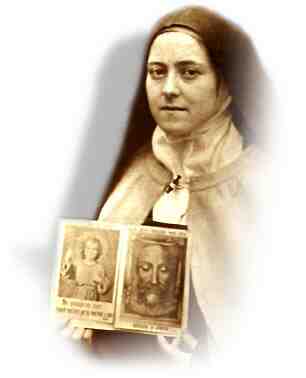
St. Therese of Lisieux is also known as St. Therese of the Child Jesus due to her well known devotion to the Infant Christ. Here is what St. Therese wrote in a letter to her aunt on November 16, 1896 about Father Faber:
“Fortunately, I have the deep Father Faber to console me. He understood that words and sentences here below are incapable of expressing feelings of the heart and that full hearts are the ones containing the most within themselves.” Letters of St. Therese of Lisieux, Volume II, ICS Publications.
Here is a surprising quote from Father Faber where he talks about devotion to ‘our dearest Lord’s life in the womb”.
“It would simply weary the reader to repeat almost word for word this description of our dearest Lord’s life in the Womb, changing the phrases to apply it to the Blessed Sacrament. The parallel is so complete, that it must already have suggested itself; and I have dwelt upon it at greater length, because, as the devotion to the life in the womb is especially a devotion of interior souls, so the corresponding thoughts with regard to the Blessed Sacrament are those which are most familiar to interior souls in their prayers before the tabernacle; and again as all the mysteries of the Sacred Infancy take their color and character from the life in the womb, to establish the analogy between it and the Blessed Sacrament is in truth to establish the analogy between the Blessed Sacrament and the Sacred Infancy altogether.”
The Blessed Sacrament, Fr. F. W. Faber
 UNBORN WORD of the day