Filed under: Quotes from Great Christians
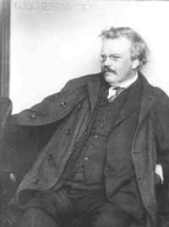
Here is what G.K. Chesterton had to say about abortion in the 1920’s. The following is from a chapter entitled The Meanness of Motive.
I could fill this book with examples of the universal, unconscious assumption that life and sex must live by the laws of “business” or industrialism, and not vice versa; examples from all the magazines, novels, and newspapers. In order to make it brief and typical, I take one case of a more or less Eugenist sort from a paper that lies open in front of me — a paper that still bears on its forehead the boast of being peculiarly an organ of democracy in revolt. To this a man writes to say that the spread of destitution will never be stopped until we have educated the lower classes in the methods by which the upper classes prevent procreation. The man had the horrible playfulness to sign his letter “Hopeful.” Well, there are certainly many methods by which people in the upper classes prevent procreation; one of them is what used to be called “platonic friendship,” till they found another name for it at the Old Bailey. I do not suppose the hopeful gentleman hopes for this; but some of us find the abortion he does hope for almost as abominable. That, however, is not the curious point. The curious point is that the hopeful one concludes by saying, “When people have large families and small wages, not only is there a high infantile death-rate, but often those who do live to grow up are stunted and weakened by having had to share the family income for a time with those who died early. There would be less unhappiness if there were no unwanted children.” You will observe that he tacitly takes it for granted that the small wages and the income, desperately shared, are the fixed points, like day and night, the conditions of human life. Compared with them marriage and maternity are luxuries, things to be modified to suit the wage market. There are unwanted children; but unwanted by whom? This man does not really mean that the parents do not want to have them. He means that the employers do not want to pay them properly. Doubtless, if you said to him directly, “Are you in favour of low wages?” he would say, “No.” But I am not, in this chapter, talking about the effect on such modern minds of a cross-examination to which they do not subject themselves. I am talking about the way their minds work, the instinctive trick and turn of their thoughts, the things they assume before argument, and the way they faintly feel that the world is going. And, frankly, the turn of their mind is to tell the child he is not wanted, as the turn of my mind is to tell the profiteer he is not wanted. Motherhood, they feel, and a full childhood, and the beauty of brothers and sisters, are good things in their way, but not so good as a bad wage. About the mutilation of womanhood and the massacre of men unborn, he signs himself “Hopeful.” He is hopeful of female indignity, hopeful of human annihilation. But about improving the small bad wage he signs himself “Hopeless.”
G.K. Chesterton, Eugenics and Other Evils, 1922

Today, August 6, is the Feast of the Transfiguration of Our Lord. Through much of His life Jesus preferred to remain hidden. Even the three short years that He preached and performed miracles were done in a way that seemed in many ways ordinary. The Transfiguration stands alone as a moment when Jesus allowed the veil between heaven and earth to drop, letting us see a measure of His glory generally hidden during His life on earth.
Father Faber comments on the hiddeness and glory of Christ before birth:
“Yet how wonderful are those few samples of the occupations of the Nine Months which we have been allowed to see! If these are few, and superficial, and not in their true depth comprehended by us, what must have been the works of that active and contemplative life, so full of reality, energy, substance, and accomplishment, as we have already seen it to be! What must they have been in multitude, since these were momentary; what in grandeur, since these lie within our reach; what in unknown wonders, of whose existence we cannot dream, because they are so far down in God.
Almost always we may be sure that what we see of God is less grand than what we do not see. He shows us what we can bear, and strengthens us to see much which our weak nature could never bear; and yet after all it is little better than the surface of His brightness, the back of His glory, as Moses calls it, which we see. Even the grandeur, which we see, we do not see in its real greatness, its absolute and essential gloriousness.”
From Bethlehem by Father Faber


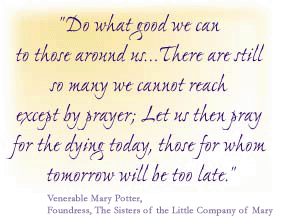
Recently two Potters have been in the spotlight. Harry Potter with a new book and movie and Beatrix Potter with the movie Miss Potter (which by the way, I thought was a really charming movie). But for us the Potter of distinction is Venerable Mary Potter who founded the Sisters of the Little Company of Mary on July 2, 1877. Here is quote which she directs to Mary:
“…Jesus, Body and Soul, rested in peaceful repose within your pure womb, and was wholly yours. Rapturous joy thrilled through your soul as your Immaculate Heart gave the Eternal Word His mortal life, His Precious Blood, and “the Word was made Flesh, and dwelt within you.” Great was your joy, O Mary, for you didst joy in the joy of your God, of your Son, and greater far than this joy was the joy of Jesus within you, as to your heart He spoke a voiceless word, and that word was Mother.”
from the book The Path of Mary

Today August 2, 2007 is the feast day of St. Peter Julian Eymard. In the following passage he reflects on the Gospel scene recorded in Luke 1:39-56.
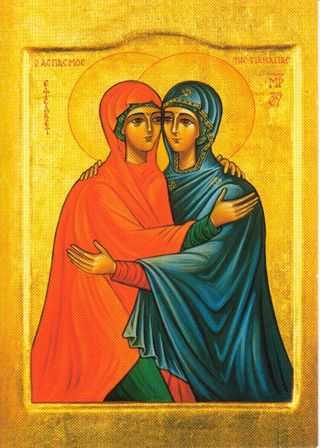
“St. John’s first grace was one of adoration. The Word was in Mary’s womb. He inspired His mother to visit Elizabeth; Mary carried to John his Master and King. John could not come, for his mother was too old to undertake that journey; Jesus Christ went to him. He did the same for us; we could not go to God; God came to us.
When Mary “saluted” Elizabeth, she loosened the power of her divine Son….How good our Lord was to John! He wanted to bless him and make Himself known to him from his mother’s womb. How pleasing to Him the adoration of His precursor must have been! It was so spontaneous!
Jesus stayed with him three months. They were both hidden within the maternal tabernacle. John constantly adored his God; he felt His hidden presence. Join in St. John’s adoration, which was so real and heartfelt in spite of the veils and barriers that separated him from his Lord.”
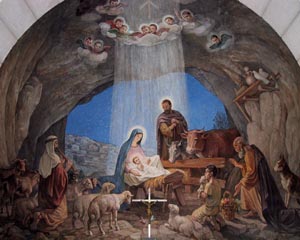
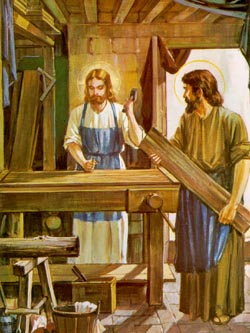

Today, August 1, 2007 is the feast day of St Alphonsus de Ligouri (1696-1787). Below are a reflection and an excerpt from a prayer written by Alphonsus:
“Consider that the Eternal Father addressed these words to the Infant Jesus at the instant of His conception: ‘I have given Thee to be the light of the Gentiles, that Thou mayest be My salvation’ (Isa 49:6). My Son, I have given Thee to the world for the light and life of all people, in order that Thou mightest procure for them their salvation, which I have as much at heart as if it were my own. Thou must therefore employ Thyself entirely for the well-being of men: ‘Wholly given to man, Thou must be wholly spent in his service’ (St. Bernard). Thou must therefore, at Thy birth, suffer extreme poverty, in order that men may become rich, ‘that Thou mayest enrich them by Thy poverty’”. (Meditation I, Novena for Christmas)
“O Divine Word, become man for me, though I behold Thee thus humbled and become a little infant in the womb of Mary, yet I confess and acknowledge Thee for my Lord and King, but a king of love…Ah, my infant King, how could I so often rebel against Thee, and live so long Thy enemy, deprived of Thy grace, when, to oblige me to love Thee, Thou hast put off Thy divine majesty, and hast humbled Thyself even to appearing, first, as a babe in a cave; then as a servant in a shop; then as a criminal on a cross?” (Meditation, 1st Wednesday of Advent)
From THE INCARNATION, BIRTH AND INFANCY OF JESUS CHRIST by St. Alphonsus de Liguori.
Filed under: Quotes from Great Christians

Today, July 30, 2007 is our 30th wedding anniversary, so I thought it would be appropriate to repeat this previous post.
Here is a quote about the patience of Christ from Mother St. Paul’s book Ortus Christi (published in 1921) .
“Patience is a twofold grace, that of waiting and that of suffering, both are a great aid to zeal. The Eternal Word’s zeal for the salvation of men had existed in all its perfection and all its fullness from all eternity, yet think how long He waited! When the conditions were changed and He had at length become incarnate, He still waited patiently for nine months, and after that He waited for thirty years! This was zeal, zeal in its perfection. Is my zeal tempered with patience?”
Yesterday Caryll Houselander was quoted reflecting on “the habit of Advent”. Part of this “habit” is living the virtue of patience. Through the decades the pro-life movement has had to be patient while trying to promote a Culture of Life. Many disappointments, trials and setbacks have been experienced. Those who are pro-life must persevere and patiently trust in God.
Mother St. Paul wrote this of the unborn Christ Child who rested in His mother’s womb.
“Come, my little King, Who art nevertheless the Eternal Wisdom, come and teach me this heavenly prudence….”
“…and in my own life when things seem, as they sometimes do inexplicable and beyond human ken. Oh! come and teach me that the way of prudence is to lie still like a little child in its mother’s arms, not to try to fathom nor to understand, but to say: I am in the Arms of the Eternal Wisdom, Who can do all things, Who loves me with an infinite love and Who is disposing all things sweetly, gently, mercifully for my sake. This is the lesson the Child (Christ) yet unborn would teach.”
Mother St. Paul, Ortus Christi, 1921

“A cloistered life among men may cover the whole earth with its activity, if it is a life of worship, while the conqueror, the statesmen, or the man of letters have at most but a circle which they only influence partially, and in which their influence is but one of many influences. Worship alone is power, intellectual power and moral power, the power of worldwide change and all beneficent revolution.
We not only learn this lesson from the life of confinement, which the Incarnate Word led in Mary’s (Womb), but it is that life which gives our life power to become universal like itself.”
Father F.W. Faber, (1814-1863) Bethlehem
Filed under: Quotes from Great Christians
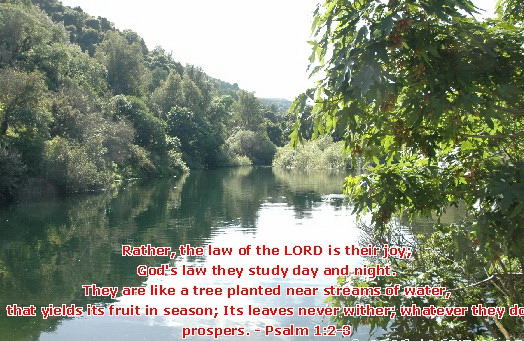
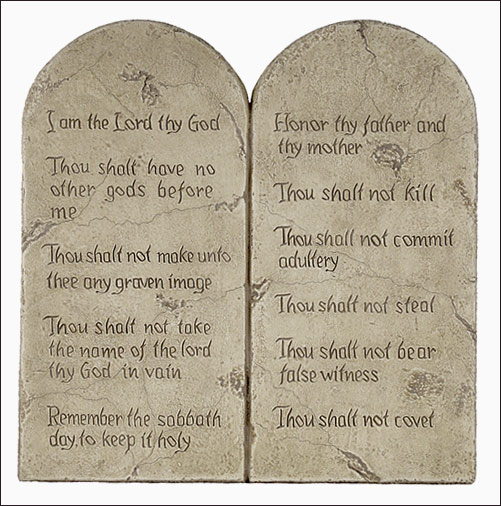
Today Friday, July 27, the first reading at Mass is about the 10 commandments (Genesis 20: 1-7).
In his biography about St. John Fisher, published in 1935, the inspirational Father Vincent McNabb writes:
“In reading the authentic records of how the Bishop (St. John Fisher) bore himself in his bishopric we are perhaps surprised to find him praised for qualities which might be expected of any good bishop. But as there are times of general moral depression when the average layman’s practice of the ten commandments demands heroic virtue, so there are circumstances when a bishop’s fidelity to the ordinary duties of his office argues the saint.”
Many of the 10 commandments are at the forefront of our society’s most grave battles – moral battles about the dignity and value of human life and marriage. We can see that the 10 commandments were a divine gift intended to elevate human living and direct it towards God and virtue. So today, for believers to live according to the 10 commandments, in this time of moral crisis, is no small accomplishment. Let us encourage each other continually to meet this challenge of our time, seeking opportunities to lift up these and other noble moral principles which point towards the Culture of Life. And let us pray for our families and our children.
Filed under: Quotes from Great Christians

Picture by Sherrill Knaggs
A Prayer by Caryll Houselander
Breath of Heaven,
carry us on the impulse
of Christ’s love,
as easily as thistledown
is carried on the wind;
that in the Advent season of our souls,
while He is formed in us,
in secret and in silence-
the Creator
in the hands of his creatures,
as the Host
in the hands of the priest-
we may carry Him forth
to wherever He wishes to be,
as Mary carried Him over the hills
on an errand of love,
to the house of Elizabeth.
From the Splendor of the Rosary by Maisie Ward
with prayers by
Caryll Houselander

And from His fulness have we all received, grace upon grace. John 1:16
“St. Thomas Aquinas tells us that Mary’s fulness of grace increased notably at the Incarnation through the presence of the Word of God made flesh.”
“…Mary was, of all creatures, the one who entered into closest contact with Him in His humanity since He took flesh in her womb. Hence, it was appropriate that she should have received a notable increase of grace at the Incarnation.”
“Speaking of the time when the Body of the Saviour was formed in Mary’s virginal womb, Fr. Hugon says: ‘She must have made uninterrupted progress in grace during those nine months – ex opere operato, as it were – through her permanent contact with the Author of holiness. If her plentitude of grace is incomprehensible at the time of the Incarnation, what must it have been at the Nativity…'”
“As we have said, grace is an effect of God’s active love for his creature…Hence His love for her produces grace in her soul – such an abundance of grace as to be capable of overflowing on souls.”
Father Reginald Garrigou-LaGrange, O.P., The Mother of the Saviour and Our Interior Life, 1948
Filed under: Quotes from Great Christians
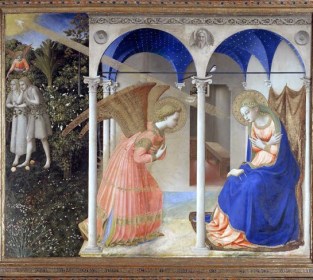
“God added to the natural gifts with which He endowed man supernatural ones, summed up in the gift of grace. What is that? A participation in His own life, something which makes us “partakers of the Divine nature”. (2 Pet. 1, 4) He created man thus in the beginning, for He meant man always to possess supernatural as well as natural gifts. He meant always to live with man and talk and walk with him in the paradise of his soul but Adam chased out the Divine Guest and lost this miraculous privilege for all his children.
God, however, could not rest content to be outside the souls which He had created solely that He might live in them, and He devised a way (the first Coming of Christ) by which He might get back to the dwelling which He cherished so much….
…He gave His only begotten Son to be incarnate for the world…He came to be Emmanuel, God with us and what His Father asks is that we should not shun Him and live far away from Him but that we should dwell with Him….He was incarnate for me in the womb of the Blessed Virgin but He is incarnate in me in a more special and personal way each time that I receive Him in Holy Communion. By means of my Communions and their effects I can dwell always without interruption in the tabernacle of the Most High, for it is of me (each of us) that the Eternal Wisdom speaks when He says: ‘My Father will love him, and We will come to him and will make Our abode with him.’ (John 14, 23)”
Mother St. Paul, Ortus Christi, 1921
Filed under: Quotes from Great Christians

St. Paul said “Nevertheless I live, yet not I, but Christ liveth in me…” (Gal. 2:20). Caryll Houselander calls the attitude that we must have as Christ forms in us “the Habit of Advent” which emulates the quiet nine months that Christ spent in Mary’s womb. Below she relates suffering to this “season of Advent”.
“People sometimes get disheartened because they have read that suffering ennobles and have met people who seem to have come out of the crucible like pure silver, made beautiful by suffering; but it seems to them that in their own case it is quite the opposite. They find that however hard they try not to be, they are irritable; that astonishing stabs of bitterness afflict them, that far from being more sympathetic, more understanding, there is a numbness, a chill in their emotions; they cannot respond to anyone anymore…
They say that in their case suffering is certainly a failure.
The truth is that they are too impatient to wait for the season of Advent in sorrow to run its course; a seed contains all the life and loveliness of the flower, but is contains it in a little hard black pip of a thing which the glorious sun will not enliven unless it is buried under the earth.
There must be a period of gestation before anything can flower.
If only those who suffer would be patient with their early humiliations and realize that Advent is not only the time of growth but also of darkness and hiding and waiting, they would trust, and trust rightly, that Christ is growing in their sorrow, and in due season all the fret and strain and tension of it will give place to a splendor of peace.”
Caryll Houselander, The Reed of God, 1944
Filed under: Quotes from Great Christians
Yesterday we quoted Bishop Vaughan from Bishop John Elya’s Address to the 7th Annual National Memorial for the Pre-Born and their Mothers and Fathers on Monday, January 22, 2001.
Bishop Elya made some good points in his address so I thought we would quote from it again:
“Once upon a time, a Christian congregation, spiritually alive formed a committee to find a preacher for their flock of believers. After a long search, the committee found a preacher who really impressed and inspired them. That preacher was called to serve that congregation. On the first Sunday the new preacher gave an eloquent and inspiring sermon, and the committee was happy and proud that they had made the right choice. On the next Sunday, the church was filled to capacity with standing room only. People were eager to hear our fiery preacher. Our fiery preacher gave exactly the same sermon as the week before. That puzzled the listeners. Then on the third and on the fourth Sundays he repeated the same sermon. A group came to him and asked him when he would give another sermon. The preacher replied: ‘What do you expect? I am going to give the same sermon again and again until you learn it. I will give a second sermon as soon as I have seen that you have paid attention to the first one.’
For 28 years now, we have been decrying the evils of abortion. We have been preaching the sanctity of human life from the moment of conception to the moment of natural death. But abortion is still legal. We are in the right. We hope that, eventually, enough people will not only realize that we are right but also will take action to end this shameful period of our country’s history. So I feel privileged to address your distinguished group today. But I wonder what new things shall I tell you and tell our American people, except to repeat the same sermon. We have to keep shouting, ‘abortion has within itself the seed of destruction of our society… We must give witness to the value of each and every human life from the moment of conception to the moment of natural death.’ “
Filed under: Quotes from Great Christians

Linda Kaul Robertson The Child Among the Reeds
This week the Old Testament readings at Mass concern Moses, beginning with Pharaoh’s proclamation: “Throw into the river every boy that is born to the Hebrews…”(Ex 1:22) We all are familiar with the story of his mother placing baby Moses in a watertight basket among the reeds along the river bank where he would be found.
In a speech given on January 22, 2001, Bishop John Elya shares a quote from his friend and fellow Bishop, recently deceased, Austin Vaughan, who had been arrested many times for peacefully protesting in front of abortion facilities. The quote relates to the Exodus readings of this week. The following is from Bishop Elya’s speech:
“I was brought to tears, ten years ago, when I heard a classmate of mine, Bishop Austin Vaughan , Auxiliary Bishop of the Archdiocese of New York, of blessed memory. At a meeting of the National Conference of Catholic Bishops in Washington, DC, He said:
‘Among the slaughters of innocent persons in the history of mankind, two slaughters stand out: the slaughter of Hebrew children by the Pharaoh, and the slaughter of the infants by Herod after the birth of our Lord. One infant saved from the earlier killing was Moses; the infant saved from Herod’s slaughter was Jesus. Any effort of ours to save even a single life is worthwhile.‘
Filed under: Quotes from Great Christians

The intriguing quote above is from Tertullian (155/160 A.D. – 240/250 A.D.), De Carnis Resurrectione. St. Francis de Sales (1567-1622) elaborates:
“…if someone intends to build a house or a palace he must first consider whether it is to be a lodging for a vine dresser or a peasant or if it is for a lord, since obviously he would use entirely different plans depending on the rank of the person who is to live there. Now the Eternal Father did just that when he built this world. He intended to create it for the Incarnation of His Son, the Eternal Word. The end or goal of His work was thus its beginning, for Divine Wisdom had foreseen from all eternity that His Word would assume our nature in coming to earth.” The Sermons of St. Francis de Sales for Advent and Christmas

“The worlds of philosophy and humor often intersect so that philosophers can sometimes be mistaken for comedians and vice versa. To the age old question “If a tree falls in the forest and no one is around to hear it, does it make a sound?” one might not be certain whether to respond with a frown or a smile. A contemporary variant of the question leaves no doubt about the appropriate response: “If a husband says something and his wife is not there to correct him, is he still wrong?”
“But there is decidedly nothing humorous about the question, “Does a human fetus feel pain during an abortion if no one is there to verify the pain scientifically?” We like to think that we citizens of the 21st century are compassionate people. …It is rather curious, then, that the subject of fetal pain, rather than activating the springs of compassion that exist in all of us, is often politicized, depersonalized, trivialized, and relativized. If a person is truly compassionate, it would seem that his sensitivity to another’s pain would not be subject to ideological compromise. It appears disingenuous to say, “I will feel your pain as long as it is politically correct to do so.”
From Fetal Pain: Real or Relative? by Dr. Donald DeMarco Adjunct Professor, Holy Apostles College and Seminary
 UNBORN WORD of the day