


“St. Joseph presents us with a similar, yet somewhat different, type of devotion to the Sacred Infancy.

During the nine months the accumulation of grace upon him must have been beyond our powers of calculation. The company of Mary, the atmosphere of Jesus, the continual presence of the Incarnate God, and the fact of his own life being nothing but a series of ministries to the unborn Word, must have lifted him far above all other saints, and perchance all angels too.
Our Lord’s Birth, and the sight of His Face, must have been to him like another sanctification. The mystery of Bethlehem was enough of itself to place him among the highest of the saints.” From Bethlehem by Father Faber
St. Joseph is a model for all those in the pro-life movement. He took unborn Jesus and Mary into his heart and life. He took care of them, saved them from disgrace and even death, supported them and helped them find shelter. Father Faber talks about the grace Joseph received in this ministry – think of all of the graces you receive in your ministry to the unborn and their mothers.
‘And the king will say to them in reply, ‘Amen, I say to you, whatever you did for one of these least brothers of mine, you did for me.’ (Matthew 25:40)

Just one of the thousand’s of pregnancy counseling centers and homes!
…a place where the Corporeal and Spiritual Acts of Mercy are lived each day
On September 17, 2004 Archbishop Myers had an insightful yet succinct article in The Wall Street Journal titled, A VOTER’S GUIDE Pro-Choice Candidates and Church Teaching.
He begins by talking about a statement released by the Congregation for the Doctrine of the Faith (headed at the time by Cardinal Joseph Ratzinger) called “On Worthiness to Receive Holy Communion“. He goes on:
“Cardinal Ratzinger stated that a “Catholic would be guilty of formal cooperation in evil, and so unworthy to present himself for Holy Communion, if he were to deliberately vote for a candidate precisely because of a candidate’s permissive stand on abortion.” But the question of the moment is whether a Catholic may vote for a pro-abortion candidate for other reasons. The cardinal’s next sentence answered that question: A Catholic may vote for a pro-abortion Catholic politician only ‘in the presence of proportionate reasons.’
What are “proportionate reasons”? …for a Catholic citizen to vote for a candidate who supports abortion and embryo-destructive research, one of the following circumstances would have to obtain: either (a) both candidates would have to be in favor of embryo killing on roughly an equal scale or (b) the candidate with the superior position on abortion and embryo-destructive research would have to be a supporter of objective evils of a gravity and magnitude beyond that of 1.3 million yearly abortions plus the killing that would take place if public funds were made available for embryo-destructive research.
Frankly, it is hard to imagine circumstance (b) in a society such as ours. No candidate advocating the removal of legal protection against killing for any vulnerable group of innocent people other than unborn children would have a chance of winning a major office in our country. Even those who support the death penalty for first-degree murderers are not advocating policies that result in more than a million killings annually.”
The rest of the article wrestles with that question: ‘What are proportionate reasons?’ He comments on lots of issues – the war in Iraq, the death penalty, welfare, social security, taxes, and others showing how abortion takes precedence over each of these issues. It is an excellent article and just as relevant today as it was in 2004. To read the entire article click here.
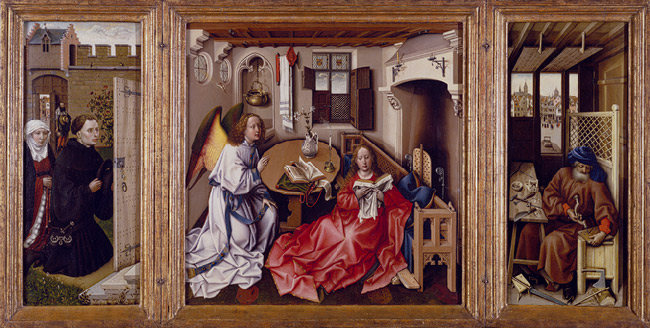

The Annunciation by Robert Campin (ca. 1375–1444)
This is a very unusual Annunciation picture by Robert Campin. The Metropolitan Museum of Art gives a detailed description of the painting.
“In a novel departure from tradition, the Annunciation is imagined as taking place not in a church but in a Netherlandish house, with objects providing visual cues for devotional instruction. The lily signifies the purity of the Virgin, who is seated on the ground, reading, to suggest her humility and piety. The Virgin’s husband, Joseph, is shown diligently at work; the mousetrap displayed on the window ledge is an allusion to the cross the unborn Christ carries in the center panel (according to Saint Augustine, the cross was the mousetrap with which God caught the Devil).”
You will notice that beneath the triptych we isolated and enlarged unborn Christ carrying the cross that was referred to in the above description. To see the triptych enlarged click on the above painting.
Blessed Columba Marmion who was devoted to the cross of Christ wrote the following:
“We ought not to consider Christ’s Sacrifice as offered only at the time of the Passion. Christ is a Victim from the moment of the Incarnation, and it is as Victim that He offers Himself…. He accepted to fulfill all that was decreed: He said to His Father: “Behold I come”: Ecce venio (Heb 10:7). The initial act of offering whereby He wholly yielded Himself up, virtually contained all His sacrifice….” .
Blessed Columba Marmion, O.S.B.
Christ The Ideal Of The Monk
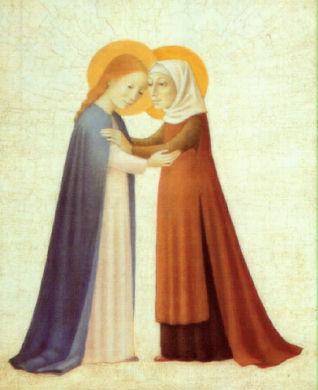
Archbishop Fulton Sheen, was born on May 08, 1895. Here is what he wrote about the Visitaion:
“One of the most beautiful moments in history was that when pregnancy met pregnancy ‑ when child bearers became the first heralds of the King of Kings. All pagan religions begin with the teachings of adults, but Christianity begins with the birth of a Child. From that day to this, Christians have ever been the defenders of the family and the love of generation.”
“If we ever sat down to write out what we would expect the Infinite God to do, certainly the last thing we would expect would be to see him imprisoned in a carnal ciborium for nine months; and the next to last thing we would expect is that the ‘greatest man ever born of a woman’ while yet in his mother’s womb, would salute the yet imprisoned God-man. But this is precisely what took place in the Visitation.”
Archbishop Fulton Sheen, Ph.D., D.D., The World’s First Love (Garden City, NY: Doubleday & Company, Inc., 1956), 31.
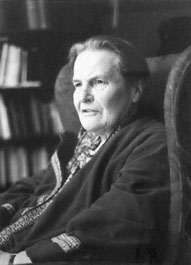
Robert George begins his obituary on G. E. M. Anscombe (born Gertrude Elizabeth Margaret Anscombe) this way:
.E.M. (“Elizabeth”) Anscombe, who died at the age of 81 was a titan in the world of philosophy, and one of the 20th century’s most remarkable women.
Elizabeth Anscombe was a convert to the Catholic Church and considered one of the great women philosophers of the 20th century. She was well-known for her work with the philosopher Ludwig Wittgenstein and her groundbreaking tome entitled Intentions.
She was also known for a debate that she had in 1948 with C. S. Lewis on one of the chapters in his book Miracles. She won the debate and as a “result of the weaknesses pointed out in the contest, Lewis substantially rewrote the chapter for future editions of the book. Admirers of Lewis have made much of this event – some associates (primarily George Sayer and Derek Brewer) remarked that this loss was so humiliating for Lewis that he abandoned theological argument and turned entirely to devotional writing and children’s literature.” She thought these youthful admirers greatly exaggerated the negative impact on Lewis and admired him for making the changes to the chapter.
She fully supported Pope Paul VI when he came out with his encyclical letter Humane Vitae and was an ardent pro-lifer. As a full professor of Philosophy at Cambridge University she shocked her colleagues by twice participating in, and being arrested at, peaceful pro-life protests in England adopting the ‘Operation Rescue’ approach. Two of her daughters were also arrested with her at these events.
In 1977 she came out with an incredible defense of the Catholic Church’s position against contraception entitled Contraception and Chastity. I just recently discovered this gem and would recommend that anyone interested in this topic read this article. It is a unique take on this subject and really gets to the heart of the matter. She provides historical context which is fascinating and her line of argumentation shows why the world we live in has changed so sadly and drastically since contraception came into widespread use.
Elizabeth married fellow convert and philosopher Peter Geach with whom she had 7 children.
Filed under: Biblical Reflections, Incarnation, Quotes from Great Christians
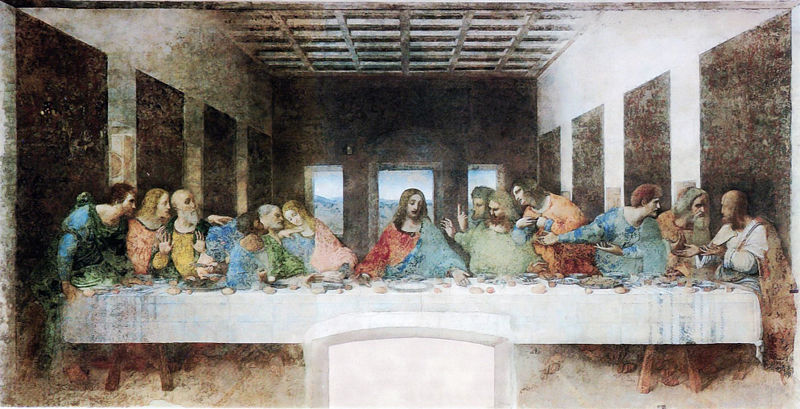
Here is an interesting quote from Msgr. Robert Hugh Benson on the Last Supper and the Incarnation.
“Thus, in that last emphatic act of the life of His Humiliation He took Bread, and cried, not Here is my Essential Self, but ‘This is my Body which is given for you,’ since that Body was the instrument of Redemption.
And, if the Christian claim is to be believed, this act was but a continuation (though in another sense) of that first act known as the Incarnation. He who leaned over the Bread at that “last sad Supper with His own” had, in another but similar manner, leaned over Mary herself with similar words upon His lips.“
From Msgr. Robert Hugh Benson, Christ In The Church (published 1913).
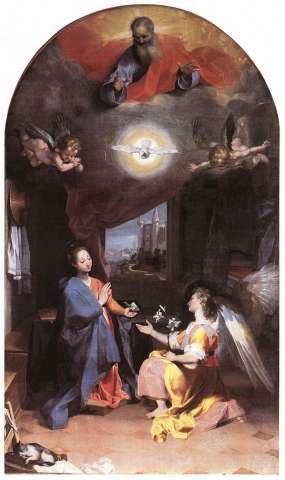
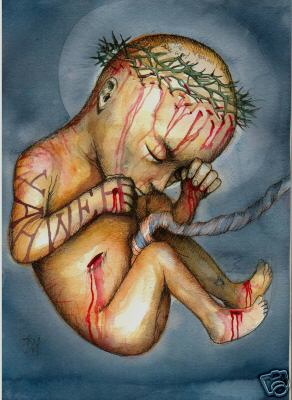
I recognize that not everyone will like this picture and I myself used it with some hesitancy. But it highlights a theme that quite a few saints and spiritual authors have written about which actually seems very relevant in our time (because of abortion), namely that Christ’s time in the womb was a time of suffering for our sins. Here are four quotes for our Lenten meditation:
Salvation to all that will is nigh;
That All, which always is all everywhere,
Which cannot sin, and yet all sins must bear,
Which cannot die, yet cannot choose but die,
Lo, faithful virgin, yields Himself to lie
In prison, in thy womb… John Donne, The Annunciation
“The third characteristic then of the obedience of Christ is that it was tried by suffering and humiliations. To accomplish the Will of His heavenly Father, the Infant Christ, with the full use of every faculty, consented to be enclosed for nine months in the dark prison of His Mother’s womb. Other infants feel not this privation as they have not the use of reason, but Christ had the use of reason and must have dreaded the confinement in the narrow womb, even of her whom He had chosen to be His Mother.
Through obedience to His Father, and from the love He bore to man, He overcame this dread, and the Church says: ‘When Thou didst take upon Thee to deliver Man, Thou didst not abhor the Virgin’s womb.’ Again, our dear Lord needed no small amount of patience and humility, to assume the manners and the weaknesses of a child, when He was not only wiser than Solomon, but was the Man ‘in Whom are hid all the treasures of wisdom and knowledge.’ ” St. Robert Bellarmine, The Seven Words on the Cross
“Consider the painful life that Jesus Christ led in the womb of his Mother, and the long‑confined and dark imprisonment that he suffered there for nine months. Other infants are indeed in the same state; but they do not feel the miseries of it, because they do not know them. But Jesus knew them well, because from the first moment of his life he had the perfect use of reason….The womb of Mary was therefore, to our Redeemer a voluntary prison, because it was a prison of love. But it was also not an unjust prison: he was indeed innocent himself, but he had offered himself to pay our debts and to satisfy for our crimes. It was therefore only reasonable for the divine justice to keep him thus imprisoned, and so begin to exact from him the due satisfaction.
Behold the state to which the Son of God reduces himself for the love of men, he deprives himself of his liberty and puts himself in chains, to deliver us from the chains of hell.” St. Alphonsus de Liguori,The Incarnation, Birth and Infancy of Jesus Christ
“He was filled with compassion for all the miseries of creation, and this never left Him henceforward; and most of all did He feel for sin, the greatest and the truest of our miseries, and He distinctly and separately pitied the sins of each one of us in particular.
…He surrendered Himself as a prisoner in His Mother s womb, for crime, for debt, and as a prisoner of war, as if He were a delinquent threefold by all those three liabilities. He only left His prison to suffer and to expiate, and it seems as though He loved it so, that He repeats His state of imprisonment in the Blessed Sacrament.” Father Faber, The Blessed Sacrament
When I think of Christ suffering in the womb for our sins it gives me great hope. Hope that He has obtained for us a special grace during His time of suffering in the womb – a grace that will enable us to overcome abortion in our time.
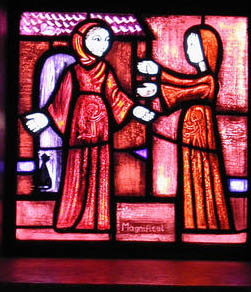
“Truly He is in haste to be about His Father s business. Truly He is an impatient conqueror, to be thus early beginning His conquests, and laying the foundations of His world-wide empire. He cannot bear to be in the world for even so short a while, but sin shall feel the weight of His unborn arm…. His first mission and ministry was in the womb and the babe unborn the first conquest of His divine apostolate.
By and bye we shall see Him pale and bleeding beneath the moonlit olives on the hill, whose umbrage shrouded the Creator in His astonishing mortal agony, and we shall know with what unutterable intensity He hated sin.
Yet the modest picturesque mystery of the Visitation hides a hatred of sin no less intense, and which almost seems to be more powerful and more divine.
The Baptist in His mother s womb has been conceived in guilt, like the rest of Adam’s children, Mary alone excepted. He is bound with the thralldom of the fall, with the chains of original sin. But the living Ark of the Covenant… brings her heavenly burden nigh to where he is; and the unborn Child destroys the sin and abolishes the curse of the unborn child.
The Baptist leaps with exultation in his mother’s womb, and worships, with the abounding gladness of his sinless soul, his Redeemer and His God hidden in the Virgin-Mother.”
Father Faber The Blessed Sacrament
Filed under: Evangelium Vitae, John Paul II, Quotes from Great Christians, Unborn Jesus
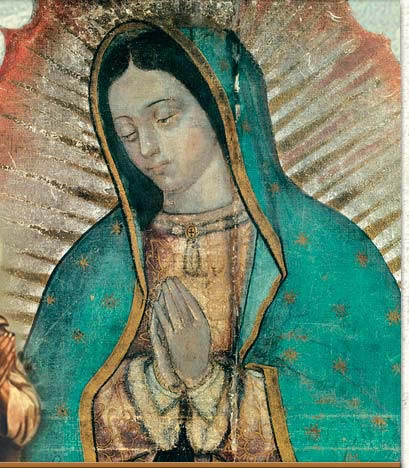
“Am I not here, I, who am your Mother? Are you not under my shadow and protection? Am I not the source of your joy? Are you not in the hollow of my mantle, in the crossing of my arms? Do you need anything more? Let nothing else worry you, disturb you .”
These wonderful words were the words of Our Lady of Guadalupe to Saint Juan Diego when she appeared to him in 1531.
These words are still relevant today as Archbishop Burke reminded us in a homily he gave in 2005 at the new Shrine of Our Lady of Guadalupe that he has helped establish in La Crosse, Wisconsin. Here are some interesting quotes from this homily.
“…our late and most beloved Pope John Paul II placed the mission of the Church in America, at the beginning of the Third Christian Millennium, under the protection of the Virgin of Guadalupe and commended her to us as the Star to lead us to Christ and, in Christ, to the conversion of our personal lives and the transformation of our world.”
Archbishop Burke calls this apparition “the mystery of the Visitation as it was experienced on our continent in 1531. The woman clothed with the sun, bearing the Infant Savior, the Anointed, in her womb, appeared to Saint Juan Diego, from December 9 to 12, 1531, in order that a chapel be built in which she might manifest the all-generous and never-failing merciful love of God for us, incarnate in her womb and alive for us in the Church, above all, in the Sacrament of the Real Presence, the Holy Eucharist.”
He reminds us that “…she has desired to remain with us always, in order that the mystery of the Visitation might be always new for us. She has miraculously left her living image on the tilma or mantle of Saint Juan Diego. In the magnificent basilica built to her honor, in which the tilma of Saint Juan Diego is enthroned, the Mother of God continues to visit pilgrims and to announce to them the great mystery of God’s all-loving and never-failing mercy.”
And that just as “… in 1531, she inspired her sons and daughters to abandon the horror of human sacrifice and to respect the inviolable dignity of every man, both the Native American and the European, so now she inspires us to be tireless disciples of the Gospel of Life, working to end the horror of procured abortion and so-called “mercy-killing,” and to promote the respect for the dignity of every human life from the moment of inception to the moment of natural death.”
This is relevant because “Pope John Paul II commended the Virgin of Guadalupe to us as the Mother of America and the Star of the New Evangelization.”
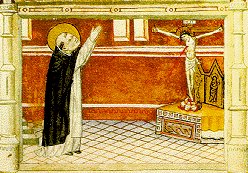
The Seventh Way of Prayer – St. Dominic
While praying, he (St. Dominic) was often seen to reach towards heaven like an arrow which has been shot from a taut bow straight upwards into the sky.*
Towards the end of the Gospel of Life, John Paul II gives us an important reminder about “prayer” and fasting. He does this to help us be properly prepared for the Pro – Life battle:
“Jesus himself has shown us by his own example that prayer and fasting are the first and most effective weapons against the forces of evil (cf. Mt 4:1-11). As he taught his disciples, some demons cannot be driven out except in this way (cf. Mk 9:29). Let us therefore discover anew the humility and the courage to pray and fast so that power from on high will break down the walls of lies and deceit: the walls which conceal from the sight of so many of our brothers and sisters the evil of practices and laws which are hostile to life.”
Notice in the above quote John Paul II points out the need for “humility and courage to pray and fast”. This reminds me of a sermon given by St. Francis de Sales on March 29, 1615 regarding “The Spirit of Prayer”. Here is an excerpt:
“for do you not see how a marksman with a crossbow, when he wishes to discharge a large arrow, draws the string of his bow lower the higher he wants it to go? Thus must we do when we wish our prayer to reach Heaven; we must lower ourselves by the awareness of our nothingness. David admonishes us to do so by these words: When you wish to pray, plunge yourself profoundly into the abyss of your nothingness that you may be able afterward, without difficulty, to let your prayer fly like an arrow even up to the heavens. [Cf. Ps. 130:1-2; Sir. 35:21].”
De Sales compares prayer to the shooting of an arrow “up to the heavens”. I would like to ask if we shoot our prayer up to God in Heaven, exactly what are we aiming at? His Heart perhaps? Imagine, if you will, a target in Heaven like that used by a common archer here below. We supplicants, weary and wayward as we are, shoot our prayer heavenward but the target seems to elude us – except that God hears our prayer before we say it and he sees that arrow before it is released. God moves that heavenly target so that it meets the arrow – your arrow – your prayer is mercifully heard by God, your prayer is lovingly received by God. God cheats sometimes because of our incapacity. What we lack He makes up for in Mercy.
*Taken from the Nine Ways of Prayer – the Nine Ways of Prayer was written by an anonymous Bolognese author, sometime between A.D. 1260 and A.D. 1288, whose source of information was, among other followers of St. Dominic, Sister Cecilia of Bologna’s Monastery of St. Agnes. Sister Cecilia had been given the habit by St. Dominic himself. “The Nine Ways of Prayer” has been sometimes printed as a supplement to “The Life of St. Dominic” by Theodoric of Apoldia, though they aren’t an actual part of that work.
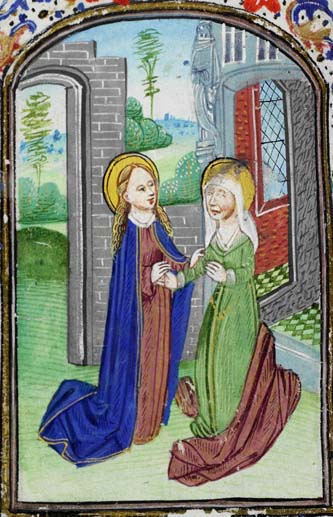
In honor of Cardinal de Bérulle who was born on February 4, 1575 we want to devote today’s post to him. He was the founder of the French School of Spirituality. The French School of Spirituality was a principle devotional influence within the Catholic Church, from the mid 17th Century through the mid 20th Century, not only in France but throughout the world.
Cardinal de Bérulle was friends with St. Vincent de Paul and St. Francis de Sales. In fact, St. Vincent de Paul was very influenced by Bérulle and once said of him,”he was one of the holiest men I have ever known”. Another saint, St. John Eudes, considered Cardinal de Bérulle to be one of his models of the spiritual life.
Cardinal Bérulle wrote extensively on the Unborn Christ Child. Here are two beautiful quotes. The first quote reflects on the Visitation when the unborn John the Baptist leaps with joy:
“God has become a child, and so he wants first to be known and adored by a child, and this is one of the first emanations of the childhood of God, manifesting himself to the universe. God is a child, the world ignores, heaven adores, and a child is the first person in the universe to recognize and adore him, and he does so by the homage and secret operation of God himself, who wants to act upon children. He wants to honor himself as child by giving the first knowledge of himself to a child in the world, making him his prophet in the universe. Thus the Infant-God is recognized and manifested, not by and angel, but by a child. So his first prophet is a child, just as shortly his first martyrs will be children.”
“There are three states of Jesus that deserve singular and daily consideration: in the womb of the Father as Son of God, God of God, consubstantial and equal with his Father; in the womb of the Virgin as Son of Man, both man and God, the Mediator of God and men; in the womb of the Church, which is his center and altar, as Lamb of God and victim of praise and propitiation, which she (the Church) presents to the Father.”
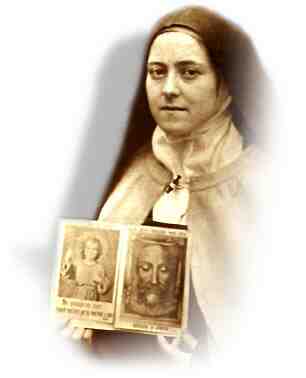
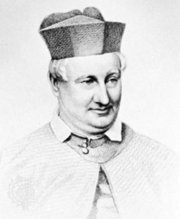
Answer: The great Father Faber (1814-1863) who pioneered devotional insights into the life of the unborn Christ Child. As some of you know we have quoted Father Faber on a number of occasions. Besides being an impressive preacher and spiritual writer Father Faber also wrote many wonderful hymns – including Faith of Our Fathers and There’s a Wideness in God’s Mercy. Two of his books that touch upon the mystery of the unborn Christ Child are Bethlehem and The Blessed Sacrament.
St. Therese of Lisieux is also known as St. Therese of the Child Jesus due to her well known devotion to the Infant Christ. Here is what St. Therese wrote in a letter to her aunt on November 16, 1896 about Father Faber:
“Fortunately, I have the deep Father Faber to console me. He understood that words and sentences here below are incapable of expressing feelings of the heart and that full hearts are the ones containing the most within themselves.” Letters of St. Therese of Lisieux, Volume II, ICS Publications.
Here is a surprising quote from Father Faber where he talks about devotion to ‘our dearest Lord’s life in the womb”.
“It would simply weary the reader to repeat almost word for word this description of our dearest Lord’s life in the Womb, changing the phrases to apply it to the Blessed Sacrament. The parallel is so complete, that it must already have suggested itself; and I have dwelt upon it at greater length, because, as the devotion to the life in the womb is especially a devotion of interior souls, so the corresponding thoughts with regard to the Blessed Sacrament are those which are most familiar to interior souls in their prayers before the tabernacle; and again as all the mysteries of the Sacred Infancy take their color and character from the life in the womb, to establish the analogy between it and the Blessed Sacrament is in truth to establish the analogy between the Blessed Sacrament and the Sacred Infancy altogether.”
The Blessed Sacrament, Fr. F. W. Faber
Last Thursday, January 24 was the feast day of St. Francis de Sales.
While at the March for Life I attended the Rose Dinner. At this dinner, the Primate of the Orthodox Church in America Most Blessed Herman prayed a beautiful prayer in which he detailed the many times in the Old and New Testament that Biblical figures were called by God or mentioned in the Bible while still in their mother’s womb. (I am trying to get a copy of this beautiful prayer.) This reminded me of a quote from St. Francis.
“God also appointed other favors for a small number of rare creatures who he would preserve from the peril of damnation, as is certain of S. John Baptist and very probable of Jeremias and some others, whom the Divine providence seized upon in their mother’s womb, and thereupon established them in the perpetuity of his grace, that they might remain firm in his love, though subject to checks and venial sins, which are contrary to the perfection of love though not to love itself…” Treatise on the Love of God : St. Francis de Sales, (1567-1622)
Here are the prophets that St. Francis was referring to:
Isaiah
“And now says the LORD, who formed Me from the womb to be His Servant, To bring Jacob back to Him, in order that Israel might be gathered to Him (For I am honored in the sight of the LORD, And My God is My strength)” (Isaiah 49:5)
Jeramiah
“Before I formed you in the womb I knew you, And before you were born I consecrated you; I have appointed you a prophet to the nations.” (Jeremiah 1:5)
John the Baptist
“For he will be great in the sight of the Lord, and he will drink no wine or liquor; and he will be filled with the Holy Spirit, while yet in his mother’s womb.” (Luke 1:15)
Two other great men who were called from their mother’s womb but probably don’t quite fit St. Francis’ description:
Samson
“Then the woman came and told her husband, saying, ‘A man of God came to me and his appearance was like the appearance of the angel of God, very awesome. And I did not ask him where he came from, nor did he tell me his name.’ But he said to me, `Behold, you shall conceive and give birth to a son, and now you shall not drink wine or strong drink nor eat any unclean thing, for the boy shall be a Nazirite to God from the womb to the day of his death.'” (Judges 13:6-7, see also Judges 16:17)
Paul
“But when He who had set me apart, even from my mother’s womb, and called me through His grace, was pleased…” (Galatians 1:15)
Jacob and Esau are also mentioned as wrestling in their mother’s womb
“Isaac entreated the LORD on behalf of his wife, since she was sterile. The LORD heard his entreaty, and Rebekah became pregnant. But the children in her womb jostled each other so much that she exclaimed, ‘If this is to be so, what good will it do me!’
She went to consult the LORD, and he answered her: ‘Two nations are in your womb, two peoples are quarreling while still within you; But one shall surpass the other, and the older shall serve the younger.’
When the time of her delivery came, there were twins in her womb.” Genesis 25: 22-24
And of course Blessed Herman highlighted the most important unborn person mentioned in the Bible – Preborn Jesus.
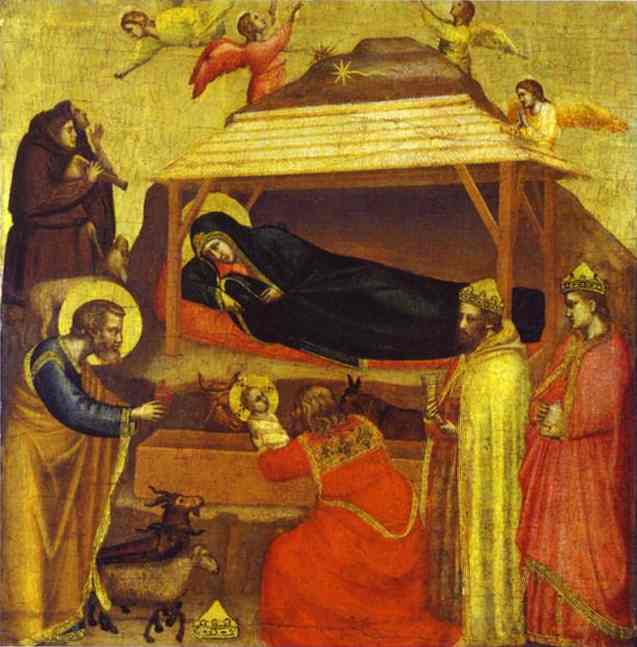
“The wise men passed onwards to the humble village. Again the star shone out in the blue heavens, and slowly sank earthward over the Cave of Bethlehem, and presently the devout Kings were at the feet of Jesus.
…The babe, it seems, will move the heights of the world as well as the lowlands. He will now call wisdom to His crib, as He has but lately called simplicity.
Yet how different is His call! For wise men and for Kings some signs were wanted, and, because they were wise Kings, scientific signs.
As the sweet patience and obscure hardships of a lowly life prepared the souls of the Shepherds, so too the Kings their years of oriental wisdom were as the preparation of the gospel.
Yet true science has also its child-like spirit, its beautiful simplicity. Learning makes children of its professors, when their hearts are humble and their lives pure.
It was a simple thing of them to leave their homes, their latticed palaces or their royal tents. They were simple too, when they were in their trouble at Jerusalem, because of the disappearance of the star.
But when the end of all broke upon them, when the star left them at that half stable and half cave, and they beheld a Child of abject poverty, lying in a manger upon straw between an ox and an ass, with, as the world would speak, an old artisan of the lower class to represent His father, and a girlish, ill- assorted Mother, then was the triumph of their simplicity.
They hesitated not for one moment.”
From Bethlehem by Father F. W. Faber
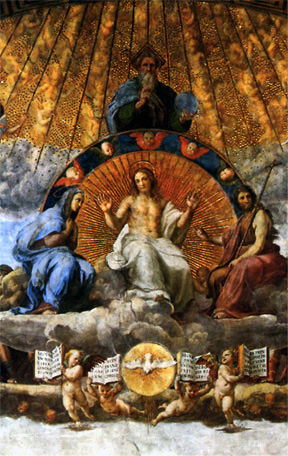
The Trinity with Mary and John the Baptist – detail from The Triumph of the Christian Faith fresco by Raphael – Stanzo della segnatura – Vatican
During Christmas season we meditate on the birth of Jesus in Bethlehem – but in fact, according to Cardinal Berulle (1575-1629), Our Lord had three births. In his book, Discourse on the State and Grandeurs of Jesus, he states:
“We find in the book of life three wondrous births of Jesus, who is the life of God and men. They are his birth in the womb of his Father in eternity, his birth in the womb of the Virgin in time, and his birth in the tomb to immortality.”
The words “Today I have begotten you” (Ps 2:7, Heb 1: 5) are associated with each of these births.
1. St. Paul in the first chapter of Hebrews (Heb 1: 5 ) applies these words to the eternal generation of the Son by the Father. Cardinal Berulle goes on to explain: ‘Through a clever use of words, the present is joined to the past, Today I have begotten you. This expresses him who is forever born and is forever being born and whose procession is such that it is without end or beginning.”
“In these last days, he spoke to us through a son, whom he made heir of all things and through whom he created the universe…For to which of the angels did God ever say: ‘You are my son; this day I have begotten you‘ “ (Hebrews 1:2,5)
2. Cardinal Berulle explains that this phrase found in Psalm 2 and Heb 1 is also used by the Church in its ‘office’ for Christmas day. This Christmas 2007, the Heb. 1 passage was the second reading for Christmas Day Mass (see above). Thus the Church applies these words to Christ’s birth in Bethlehem.
3. He then points out that: “Again Saint Paul guided by the same Spirit of God, …in Acts, chapter 13, presents this same text (Today I have begotten you) and applies it to the resurrection of the Son of God, which is a type of birth for Jesus into immortality.”
“We ourselves are proclaiming this good news to you that what God promised our ancestors he has brought to fulfillment for us, their children, by raising up Jesus, as it is written in the second psalm, ‘You are my son; this day I have begotten you.’ ” (Acts: 13:32-33)
Cardinal Berulle concludes:
“…God who is fecund and fertile in his works and in his words, wished that that this same memorable word be applied in the same spirit to these three different meanings, to these three states and mysteries of the eternal Word: to the mystery of his birth from his Father, to the mystery of his birth from his mother, and to the birth from the tomb, from which he is reborn like a phoenix to new life.”
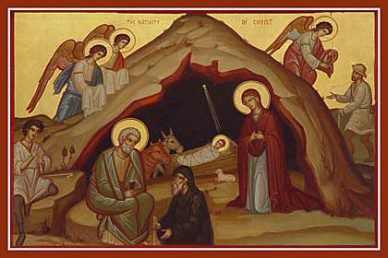
“God does not come in the thunder, but in the April breeze. Because he does not shout but only whispers, the soul must be careful not to neglect the visitation.” Archbishop Fulton Sheen, Lift Up Your Hearts.
When God first came to us it was in the most hidden, silent and ordinary way; first in his mother’s womb and then, as a baby in a manger. In the Old Testament God prepared His people for this hidden way.
“There shall come forth a shoot from the stump of Jesse, and a branch shall grow out of his roots.” Isaiah: 11: 1
“Therefore the Lord himself will give you this sign: the virgin shall be with child, and bear a son, and shall name him Immanuel.” Isaiah 7 13-14
“The LORD has created a new thing upon the earth: the woman must encompass the man with devotion.” Jeremiah 31:22
“But you, O Bethlehem Ephrathah, who are little to be among the clans of Judah, from you shall come forth for me one who is to be ruler in Israel, whose origin is from old, from ancient days…” Micah 5: 2
Recall also how the prophet Elijah sought God in a cave on Mount Horeb (I Kings 19:9‑13). God made Himself known to Elijah not in power and might, but rather in “a still small voice” which Elijah heard from within the cave. So, too, here in this Bethlehem cave, amidst the hushed prayers and whisperings of humans and angels alike, soon would come a little cry of newborn Divinity, muffled so as not to frighten any away – “a still small voice”.
Let us listen to the ‘whisper’ of Christ in the womb. Let us quiet ourselves so we can hear the still, small voice in the manger. It is in such quiet events that God normally speaks to us.
JUST 19 MORE PRAYING DAYS ‘TIL CHRIST’S BIRTH!

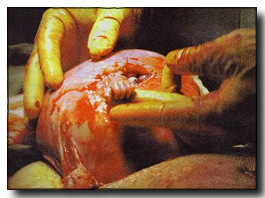
These two pictures show a hand reaching to touch another. The first is God’s hand reaching towards Adam’s. Dr. DeMarco in his article The Hand of Hope points out that in the first picture:
” Michelangelo depicts God the Creator vigorously thrusting the index finger of his right hand toward a reclining Adam, whose own hand withdraws just enough that a gap appears separating the author of life from his somewhat indecisive recipient. This gap symbolizes the drama of God and man, the divine and the human, the source of life and our hesitation in welcoming it.”
In commenting on the second picture Dr. DeMarco says:
“But such hesitation or reluctance does not apply to Samuel Alexander Armas. In a photograph which some observers say should be the “picture of the decade,” we see the tiny hand of Samuel when he was a 21-week-old fetus reaching up through an incision in his mother’s uterus and grabbing and squeezing the finger of the surgeon who had just performed a life-saving, though not life-forming, procedure.”
When Michael Clancy the photographer talked to the attending nurse about what had happened, she replied, rather matter-of-factly, “Oh, they do that all the time.”
Could little Samuel’s hand, and the hands of other unborn babies reaching out to touch us, be another way God’s hand is reaching out to a hesitant humanity? Or as Doctor DeMarco suggests in his article: “He represents life uncompromised. He is our pro-life role model.” A ‘little child shall lead us'(Is. 11:6). Samuel’s hand, grabbing hold of his physician’s hand, is a symbol of how our hands should reach out to grab The Divine Physician’s hand in love for life.
 UNBORN WORD of the day