


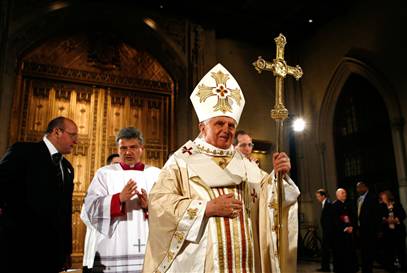
Pope Benedict XVI celebrates Mass at St. Patrick’s Cathedral in New York on Saturday. Shannon Stapleton / AP
Stating that the Church is called to “proclaim the gift of life, to serve life, and to promote a culture of life” at St. Patrick’s Cathedral today Pope Benedict paid tribute to two great Pro-life leaders, Cardinal Cooke and Cardinal O’Connor.
“The Church, as “a people made one by the unity of the Father, the Son and the Spirit” (cf. Lumen Gentium, 4), is called to proclaim the gift of life, to serve life, and to promote a culture of life. Here in this cathedral, our thoughts turn naturally to the heroic witness to the Gospel of life borne by the late Cardinals Cooke and O’Connor. The proclamation of life, life in abundance, must be the heart of the new evangelization. For true life – our salvation – can only be found in the reconciliation, freedom and love which are God’s gracious gift.”
HOMILY OF HIS HOLINESS BENEDICT XVI
St Patrick’s Cathedral, New York
Saturday, 19 April 2008
We would like to document some of the pro-life efforts of these two great men who were early and courageous defenders of the unborn.
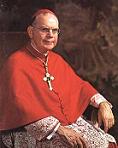
Terence Cardinal Cooke
In a May 22, 1972 article in Time magazine, entitled, The Abortion Issue, Cardinal Cooke’s early efforts to repeal the abortion law in New York are detailed. Issuing his own letter in New York against abortion from all of the pulpits in 1972, he supported New York citizens who were fighting this law. He also published a pro-life letter that President Nixon sent to him. The letter, endorsing the repeal (pro-life) movement and calling it a “noble endeavor,” was released by the Cardinal’s office-with tacit, if not explicit, White House approval. In 1972, Terence Cardinal Cooke was one of the first to describe abortion as “slaughter of the innocent unborn”.
Cardinal Cooke’s final letter read on October 8 and 9th, 1983, the weekend after his death was a letter on the sanctity of the gift of life.
And as many of you know, his successor, Cardinal O’Connor took up the pro-life cause and became another hero for the pro-life movement.
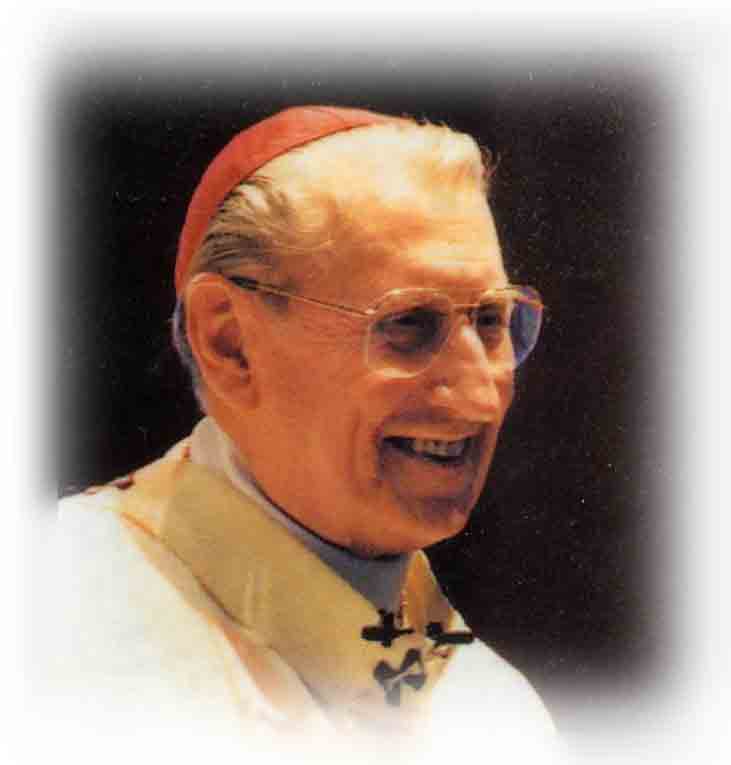
John Cardinal O’Connor
EWTN has a wonderful tribute to Cardinal O’Connor on his death which details many of his wonderful efforts on behalf of the unborn.
1. He was committed to the right to life and showed his concern by wearing on the lapel of his black clerical suit a tiny red rose with its stem spelling out “l–i–f–e“.
2. He participated at the annual Right to Life March held in Washington, DC.
3. He formed a religious community, the Sisters of Life who are dedicated to protecting the sacredness of all human life beginning with the infant in the womb to those vulnerable to the threat of euthanasia.
4. In addition, he repeated an offer many times to any woman in need: “go to him for help rather than abort her child”. The Archdiocese of New York and Catholic charities responded by providing hundreds of women with medical assistance, housing, adoption and legal services, as well as, the Cardinal himself counseling women in difficult situations.
These are the two men whom Pope Benedict held up as authentic pro-life heroes when he called on the Church to “proclaim the gift of life, to serve life, and to promote a culture of life”.
Pope Benedict is scheduled to visit U.N. headquarters on Friday to meet with Secretary-General Ban Ki-moon and to address the General Assembly. Archbishop Celestine Migliore, the Holy See’s U.N. observer, said the pope is coming to the U.N. as “a pilgrim of peace” to promote cultural and religious dialogue based on fundamental human rights that are non-negotiable.
In an Address given last September in Hofburg Germany Benedict said this:
“The fundamental human right, the presupposition of every other right, is the right to life itself. This is true of life from the moment of conception until its natural end. Abortion, consequently, cannot be a human right – it is the very opposite. It is “a deep wound in society”, as the late Cardinal Franz König never tired of repeating.
In stating this, I am not expressing a specifically ecclesial concern. Rather, I wish to act as an advocate for a profoundly human need, speaking out on behalf of those unborn children who have no voice. In doing so, I do not close my eyes to the difficulties and the conflicts which many women are experiencing, and I realize that the credibility of what we say also depends on what the Church herself is doing to help women in trouble.
In this context, then, I appeal to political leaders not to allow children to be considered as a form of illness…”
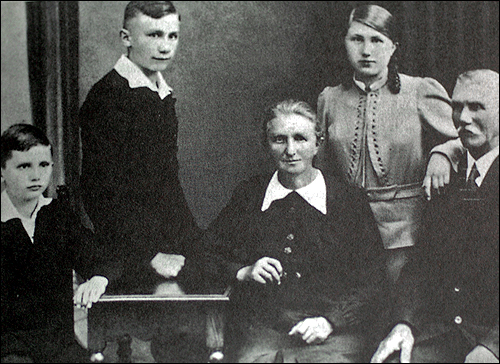
Joseph Ratzinger, far left, is seen with his family,father Josef, sister Maria, mother Maria, brother Georg. 1938 (AP Photo / German Catholic News Agency KNA)
LifeNews had an interesting biographical note about Pope Benedict this week:
“An author writing a new biography on Pope Benedict XVI says genocide during the Nazi regime in World War II played a key role in shaping the pro-life views of the Catholic leader. Author Brennan Pursell relates the story in his upcoming book Benedict of Bavaria.
Pursell learned of the tragic story while compiling material for the book. He found out that, as a 14-year-old boy, Joseph Ratzinger had a cousin born with Down Syndrome who was just a couple years younger. In 1941, German “therapists” arrived at the boy’s home and took him away — possibly telling his parents of the new governmental regulation against mentally disabled children living at home. Despite pleas from the boy’s family, German officials took him away and he very likely became a victim of the genocide that claimed hundreds of thousands of lives during the war.
“This was Joseph Ratzinger’s first experience of a murderous philosophy that asserts that some people are disposable,” Pursell explains. Because of the terrible incident, Pope Benedict presents a consistently pro-life world view that opposes abortion as well as euthanasia and assisted suicide. Full story at LifeNews.com.”
Here is a quote from Pope Benedict that relates to this subject:
“Life, which is a work of God, should not be denied to anyone, even the tiniest and most defenseless unborn child, and far less to a child with serious disabilities. At the same time, echoing the Pastors of the Church in Italy, I advise you not to fall into the deceptive trap of thinking that life can be disposed of, to the point of ‘legitimizing its interruption with euthanasia, even if it is masked by a veil of human compassion’
Benedict XVI, Angelus
St Peter’s Square
Sunday, 4 February 2007
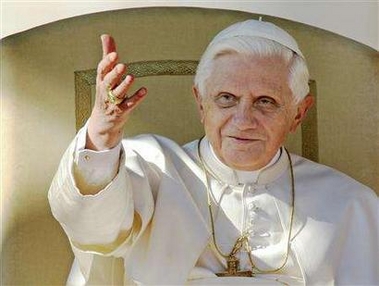
Pope Benedict will be visiting America in a few days. The above quote is taken from the Message of The Holy Father Benedict XVI to Catholics and People of the United States of America on the Occasion of the Upcoming Apostolic Journey.
When I think about our Holy Father’s words ‘Christ is the face of God present among us’, I think of how Christ was conceived, lived nine months in the womb, was born and lived an ordinary life for 30 years, as a baby, toddler, young boy, teenager and adult. He had a mother, an adoptive father – he went to school, synagogue, had friends and worked as a laborer. St. Francis of Assisi once said “Preach the Gospel always, and when necessary use words”. Christ first showed us the face of God by being present among us in ordinary life. He showed us that each stage of life is precious – precious enough for God to participate in each of these stages.
Then he preached and taught in the most wonderful way. He showed us his love in his actions and words.
On April 5 at a conference in Rome Benedict XVI spoke these words about how the Church should approach those who have participated in abortion:
“The Church has the primary duty to approach these people with love and delicacy, with kindness and maternal concern, in order to announce the merciful closeness of God and Jesus Christ. … Yes, the gospel of love and of life is also always the gospel of mercy.”
The Holy Father asks us to pray for his visit. He and the Bishops have picked as the theme of this visit, ‘Christ Our Hope”. Let us pray that Pope Benedict is able to help reveal the ‘face of Christ’ to our nation. Let us pray to Christ our hope that the Gospel of Life which Benedict referred to as the Gospel of Mercy will touch our nation this April. Pope Benedict reminds us: “I am convinced that without the power of prayer, without that intimate union with the Lord, our human endeavours would achieve very little.”
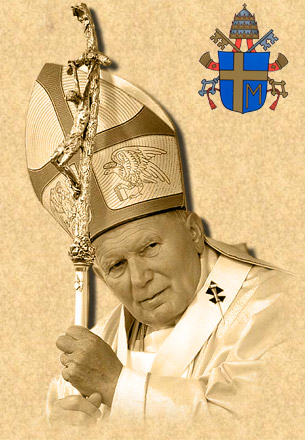
In 1999, at the age of 78, John Paul II wrote a fascinating letter. Fascinating, because as a senior citizen he wrote a Letter to the Elderly.
John Paul reminds us that: “In the past, great respect was shown to the elderly.” But today “among some peoples old age is esteemed and valued, while among others this is much less the case….”
He goes on to point out: “It has come to the point where euthanasia is increasingly put forward as a solution for difficult situations”.
There are many inspiring words of wisdom and counsel in this letter to the elderly but what I found interesting is that he points out the many prominent Biblical figures who in the later years of their lives did great things for God.
He gives 10 examples:
1. “Abraham, in whom the privilege of old age is stressed, this favour takes the form of a promise: ‘I will make of you a great nation, and I will bless you and make your name great. I will bless those who bless you and him who curses you I will curse; in you all the families of the earth will be blessed’ (Gen 12:2-3)”
2. “Sarah, a woman who sees her body growing old, yet experiences within the limitations of her aging flesh the power of God who makes good every human shortcoming.”
3. “Moses too was an old man when God entrusted him with the mission of leading the Chosen People out of Egypt. It was not in his youth but in his old age that, at the Lord’s command, he did mighty deeds on behalf of Israel.”
4. “Tobit, who humbly and courageously resolved to keep God’s Law, to help the needy and to endure blindness patiently, until the angel of God intervened to set his situation aright (cf. Tob 3:16-17).”
5. “Eleazar, whose martyrdom bore witness to an exceptional generosity and strength (cf. 2 Macc 6:18-31).”
6. “The Gospel of Luke begins by introducing a married couple ‘advanced in years’ (1:7): Elizabeth and Zechariah, the parents of John the Baptist. The Lord’s mercy reaches out to them (cf. Lk 1:5-25, 39-79)”
7. “…the aged Simeon, who had long awaited the Messiah. Taking the child in his arms, Simeon blesses God and proclaims the Nunc Dimittis: ‘Lord, now let your servant depart in peace’ (Lk 2:29).”
8. “Anna, a widow of eighty-four, a frequent visitor to the Temple, who now has the joy of seeing Jesus. The Evangelist tells us that ‘she began to praise God and spoke of the child to all who were looking for the redemption of Jerusalem’ (Lk 2:38).”
9. “Nicodemus too, a highly-regarded member of the Sanhedrin, was an elderly man. He visited Jesus by night in order not to be seen. To him the Divine Teacher reveals that he is the Son of God who has come to save the world (cf. Jn 3:1-21). Nicodemus appears again at the burial of Jesus, when, bringing a mixture of myrrh and aloes, he overcomes his fear and shows himself a disciple of the Crucified Lord (cf. Jn 19:38-40).”
10. “And what shall we say of Peter in his old age, called to bear witness to his faith by martyrdom? Jesus had once said to him: ‘When you were young you girded yourself and walked where you would; but when you are old, you will stretch out your hands, and another will gird you and carry you where you do not wish to go’ (Jn 21:18).”
He ends this list with a quote from the Psalms:
“The just will flourish like the palm-tree, and grow like a Lebanon cedar…, still bearing fruit when they are old, still full of sap, still green, to proclaim that the Lord is just” Psalm 92 (vv. 13, 15-16).
John Paul lived this fruitfulness in his own life – for after this letter – even in his old age he continued strong writing one more Encyclical letter Ecclesia de Eucharistia (17 April 2003) and 12 Apostolic letters. He also proclaimed a Jubilee year (2000) and met with the Youth in Canada in 2002. He wrote numerous letters and preached the Angelus message regularly till March 20, 2005 just a couple of weeks before his death.
Especially impressive were the 18 Pilgrimages (to 24 countries) that he made after 1999, which are listed here:
In 2000 (Fatima, Jubilee Pilgrimage to the Holy Land, and the Jubilee Pilgrimage to Mount Sinai) – in 2001 Kazakhstan, Armenia, Ukraine, and the Jubilee Pilgrimage “in the footsteps of Saint Paul the Apostle”: Greece, Syria, Malta) – in 2002 (Poland, Toronto, Ciudad de Guatemala and Ciudad de México, Azerbaijan, Bulgaria and Ischia) -in 2003 (Pompei (Italy), Slovakia, Bosnia and Herzegovina, Croatia and Spain) – in 2004 (Loreto (Italy), Lourdes (France) and Bern (Switzerland) ).
John Paul II certainly lived what he preached in this letter!
A great man whom I once met – Eddie Doherty – had been a writer when he was younger and received a special dispensation to become a priest at the age of 78. When I met Father Eddie he was even older – I will always remember a wonderful thing he said to me one day:
“I’m going to get older and older and then I am going to die and get younger and younger…”
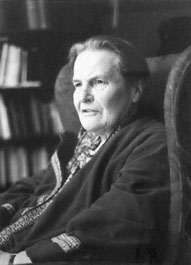
Robert George begins his obituary on G. E. M. Anscombe (born Gertrude Elizabeth Margaret Anscombe) this way:
.E.M. (“Elizabeth”) Anscombe, who died at the age of 81 was a titan in the world of philosophy, and one of the 20th century’s most remarkable women.
Elizabeth Anscombe was a convert to the Catholic Church and considered one of the great women philosophers of the 20th century. She was well-known for her work with the philosopher Ludwig Wittgenstein and her groundbreaking tome entitled Intentions.
She was also known for a debate that she had in 1948 with C. S. Lewis on one of the chapters in his book Miracles. She won the debate and as a “result of the weaknesses pointed out in the contest, Lewis substantially rewrote the chapter for future editions of the book. Admirers of Lewis have made much of this event – some associates (primarily George Sayer and Derek Brewer) remarked that this loss was so humiliating for Lewis that he abandoned theological argument and turned entirely to devotional writing and children’s literature.” She thought these youthful admirers greatly exaggerated the negative impact on Lewis and admired him for making the changes to the chapter.
She fully supported Pope Paul VI when he came out with his encyclical letter Humane Vitae and was an ardent pro-lifer. As a full professor of Philosophy at Cambridge University she shocked her colleagues by twice participating in, and being arrested at, peaceful pro-life protests in England adopting the ‘Operation Rescue’ approach. Two of her daughters were also arrested with her at these events.
In 1977 she came out with an incredible defense of the Catholic Church’s position against contraception entitled Contraception and Chastity. I just recently discovered this gem and would recommend that anyone interested in this topic read this article. It is a unique take on this subject and really gets to the heart of the matter. She provides historical context which is fascinating and her line of argumentation shows why the world we live in has changed so sadly and drastically since contraception came into widespread use.
Elizabeth married fellow convert and philosopher Peter Geach with whom she had 7 children.

Father Faber once said of the Annunciation:
“The Annunciation is the hardest feast in the year to keep as it should be kept.” Fr. F.W. Faber, The Blessed Sacrament
One website called the Day of the Unborn Child is trying to encourage Christians to celebrate this feast day in a more profound and significant way. Here is how they describe what they are about:
“This site was developed to advance the movement toward international recognition of March 25th as the “Day of The Unborn Child,” and equally to promote among Christians the observance of this traditional feast day of the Incarnation honoring Christ’s conception which is currently named ‘The Feast of the Annunciation.’ “
This website is really informative – Some of the topics that you will find are:
Ideas for celebrating the feast
Fascinating facts about this feast
Historical Background on the feast
Worship Resources
Further Reading and Instructional Materials
They also will send you free prayer cards. They are really beautiful cards – I requested them about a year ago.
To see these and more topics click here.
This website also calls our attention to the fact that over the past 15 years there has been a movement to celebrate the Feast of the Annunciation, March 25 as the Day of the Unborn.
Quite a few countries especially in Central and South America have had this day officially recognized as the Day of the Unborn or are working towards this goal. Here is a partial list of these countries:
El Salvador, Argentina, Brazil, Chile, Ecuador, Guatemala, Nicaragua, Uruguay, Paraguay and The Philippines
Click here to see an article on the Hawaii Right to Life website which provides other details about this movement. The Knights of Columbus also encourage the celebration of Day of the Unborn Child on the feast of the Annunciation. Because March 25th falls on Easter Tuesday – the Annunciation will be celebrated on March 31 this year.
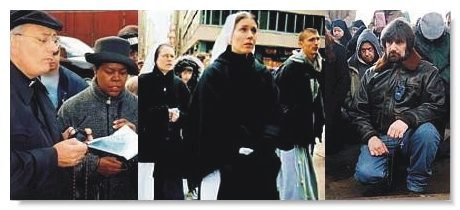
One of our readers who gathers each Saturday with a large group in front of an abortion mill sent us this prayer. They obtained this prayer from the Helpers of God’s Precious Infants. I was very moved by this prayer and thought that it was a very appropriate prayer for Holy Week. I thank God for all those who pray outside abortion mills and are a presence of love for these little ones.
___________________________________________
Heavenly Father, we are gathered here to spend some time with the little babies before they die. It is important that we be here. It is a way to redeem the abandonment of Jesus by His apostles when they refused to be with Him at His death. We do not fear the Cross.
These little ones dying today are intricately connected with the sufferings and death of Our Savior. There is a bond here that must not be overlooked. All the political action, educating, donation of funds, demonstrations, alternative work, important and necessary as these are, do not make up for an absence at the death scene. Thus, our presence at this killing center is where You, God, want us to be. With our rosaries and our prayers, this is our Calvary, where Christ is being crucified today in our midst.
We may not be able to save their lives, but we plead on their behalf. And should they die, as usually happens (God forgive us!), let us lift up our hearts to You on their behalf … it will be the only human love they will know on this earth… Amen
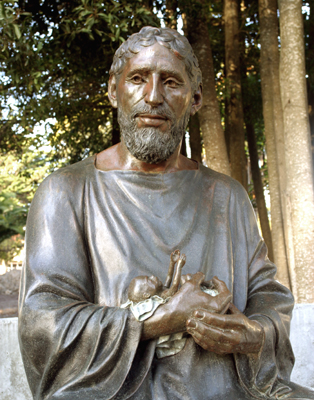
St. Joseph, Patron of the Unborn
(seen above holding an unborn baby)
Today, March 15 is the feast day of St. Joseph. The Statue in the above picture is found at the Shrine of St. Joseph, Guardian of the Redeemer in Santa Cruz, California. When Jesus was still an unborn baby Joseph learned about His saving mission. St. Thomas Aquinas tells us that:
“Mary and Joseph needed to be instructed concerning Christ’s birth before He was born, because it devolved on them to show reverence to the child conceived in the womb, and to serve Him even before He was born.” (St. Thomas Aquinas, O.P., Summa Theologica, III, Q. 36, art. 2, ad2.)
In a document on the Vatican website entitled Christ the only Saviour we are reminded that Mary and Joseph were given heavenly instruction about Christ’s mission as Saviour right before his conception and while he was in the womb. “Christ reveals himself throughout his earthly life as the Saviour sent by the Father for the salvation of the world. His very name, “Jesus”, expresses this mission. It actually means: “God saves”. It is a name he was given as a result of heavenly instruction: both Mary and Joseph (Lk 1:31; Mt 1:21) receive the order to call him by this name. In the message to Joseph the meaning of the name is explained: ‘for he will save his people from their sins’.”
Mary and Joseph believed in the words of angels and they acted in accordance with this belief. Again St. Thomas explains: “But His first coming was unto the salvation of all, which is by faith that is of things not seen. And therefore it was fitting that His first coming(in the womb) should be hidden.” (St. Thomas Aquinas, O.P., Summa Theologica, III, Q. 36, art. 1, ad 3)
Filed under: Pro-life
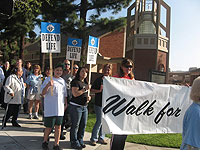
Father Peter West of Priests for Life (New York)
Janet Morana, Co-Founder and Director of Silent No More (New York)
Jo Tolck, Executive Director of Human Life Alliance (Minnesota)
Patti Flores, Los Angeles Coordinator of 40 Days for Life
Kortney Blythe, Director of Survivors (California)
Registration begins at 8 a.m. – The Walk begins at 9 a.m.
Thanks Father Peter for letting us know about this event.
Filed under: Pro-life

Many of you may have seen the cartoon Umbert the Unborn. Well, Umbert or rather his creator Gary Cangemi has a great website or as he calls it an Umbert the Unborn Wombsite. It is a fun website to visit and even has an Umbert the Unborn Kids Page with 5 different activities and a future contest in the works.
Gary Cangemi is a great and humble guy who came up with a wonderful and positive way to spread the Pro-life message. He even has his first book which is a collection of Umbert Cartoons. I have a copy of the book and really enjoyed it. Click on the icon below to learn more about the book.

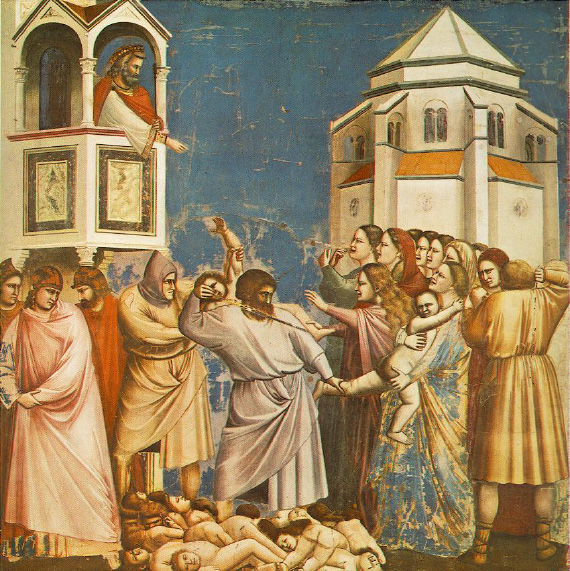
Let’s connect some Lenten dots by way of scriptural reflection and trace a sinister sequence of attempts to kill the Son of God, the Word of God – a connecting of black dots, each meant to end the sentence of the Word’s life on earth! Some spontaneous, others devilishly devised.
- First, and probably the most vicious of all – the crucifixion excepted – is Herod’s concerted effort to destroy the tiny newborn baby Jesus! We are all familiar with the story. The angel of the Lord warned Joseph: “…flee to Egypt …for Herod is about to search for the child to destroy Him” (Mt 2:13). Herod’s plans reach a rancid fruition just after Joseph flees by night with Mary and the newborn Jesus. Herod is “in a furious rage” and ordered the killing of “all the male children in Bethlehem and in all that region who were two years old or under” (Mt 2:16). These were the “Holy Innocents” killed in the very place of Jesus, because Herod suspected that each one of them might be the newborn King of the Jews. Each of these babies is an innocent martyr – a baby alter Christi. And there was mourning, the first attempt upon His life.
We know now that Herod helped inspire the paranoid “Planned Parenthood” mentality so common today, and that if he had had the opportunity to have Unborn Jesus aborted he would have done so instantly! Unborn Jesus, like any “unwanted” unborn baby, represents a threat to the status quo.
- We now fast forward about thirty years to the outset of our Lord’s public ministry. After Jesus was baptized by John, the Holy Spirit led Him out into the wilderness where He fasted for forty days. At the end of this period, the devil came to Him and tempted Jesus three times. The third deceitful temptation was a direct attempt upon the life of Jesus by the devil. They were on the pinnacle of the Temple in Jerusalem and the devil challenged Jesus: “If you are the Son of God, throw yourself down from here…” (Lk 4:9-12). Christ does not succumb and the devil leaves Him, but Luke observes “he departed from Him until an opportune time”. The second attempt upon His life.
- A little later Jesus returned to His hometown of Nazareth and went to the synagogue on the sabbath. He read a messianic prophesy from Isaiah and then explained that the text was being fulfilled in their midst. As he continued to speak the crowd became disenchanted: “…all in the synagogue were filled with wrath. And they rose up and put Him out of the city, and led Him to the brow of the hill on which their city was built, that they might throw Him down headlong. But passing threw the midst of them He went away” (Lk 4:28-30). The third attempt upon His life.
- One day, during the third year of His public ministry, Jesus was in the Temple in Jerusalem teaching, when things grew controversial. Surprisingly, He got into a debate with “the Jews who had believed in Him” (Jn 8:31). Finally, Jesus says to them: “Truly, truly, I say to you, before Abraham was, I am.” What did the Jews “who had believed in Him” do (along with others who didn’t believe in Him)? “So they took up stones to throw at Him; but Jesus hid himself, and went out of the temple” (Jn 8:57-59). The fourth attempt upon His life.
- Finally, it was wintertime, the feast of the Dedication and Jesus was in the Temple in Jerusalem at a spot called the portico of Solomon (Jn 10:22-23). He is challenged by the people and He gives a short answer, ending with: “I and the Father are one”. We read: “The Jews took up stones again to stone Him” (Jn 10:31, also 11:7-8), He speaks again, then they try to arrest Him but He “escaped from their hands” (10:39). The fifth attempt upon His life.
- We are all familiar with the sixth and final attempt upon our Lord’s life; His bloody Passion and crucifixion atop Golgotha! Jesus was targeted from infancy through adulthood. From the devil to His own countrymen, from political leaders to religious leaders, His innocence and authoritative teaching was difficult for sinners to bear. So too today, the innocence of the unborn baby and the “word” each would speak, is attacked by a self-absorbed hypocritical world that falsely champions human rights while daily plotting the deaths of the weakest among us.
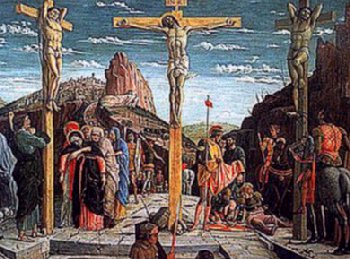
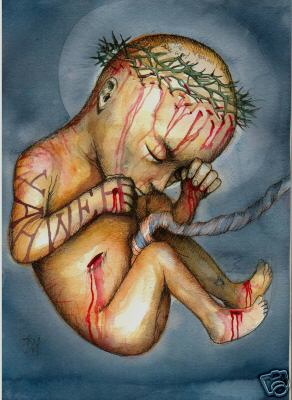
I recognize that not everyone will like this picture and I myself used it with some hesitancy. But it highlights a theme that quite a few saints and spiritual authors have written about which actually seems very relevant in our time (because of abortion), namely that Christ’s time in the womb was a time of suffering for our sins. Here are four quotes for our Lenten meditation:
Salvation to all that will is nigh;
That All, which always is all everywhere,
Which cannot sin, and yet all sins must bear,
Which cannot die, yet cannot choose but die,
Lo, faithful virgin, yields Himself to lie
In prison, in thy womb… John Donne, The Annunciation
“The third characteristic then of the obedience of Christ is that it was tried by suffering and humiliations. To accomplish the Will of His heavenly Father, the Infant Christ, with the full use of every faculty, consented to be enclosed for nine months in the dark prison of His Mother’s womb. Other infants feel not this privation as they have not the use of reason, but Christ had the use of reason and must have dreaded the confinement in the narrow womb, even of her whom He had chosen to be His Mother.
Through obedience to His Father, and from the love He bore to man, He overcame this dread, and the Church says: ‘When Thou didst take upon Thee to deliver Man, Thou didst not abhor the Virgin’s womb.’ Again, our dear Lord needed no small amount of patience and humility, to assume the manners and the weaknesses of a child, when He was not only wiser than Solomon, but was the Man ‘in Whom are hid all the treasures of wisdom and knowledge.’ ” St. Robert Bellarmine, The Seven Words on the Cross
“Consider the painful life that Jesus Christ led in the womb of his Mother, and the long‑confined and dark imprisonment that he suffered there for nine months. Other infants are indeed in the same state; but they do not feel the miseries of it, because they do not know them. But Jesus knew them well, because from the first moment of his life he had the perfect use of reason….The womb of Mary was therefore, to our Redeemer a voluntary prison, because it was a prison of love. But it was also not an unjust prison: he was indeed innocent himself, but he had offered himself to pay our debts and to satisfy for our crimes. It was therefore only reasonable for the divine justice to keep him thus imprisoned, and so begin to exact from him the due satisfaction.
Behold the state to which the Son of God reduces himself for the love of men, he deprives himself of his liberty and puts himself in chains, to deliver us from the chains of hell.” St. Alphonsus de Liguori,The Incarnation, Birth and Infancy of Jesus Christ
“He was filled with compassion for all the miseries of creation, and this never left Him henceforward; and most of all did He feel for sin, the greatest and the truest of our miseries, and He distinctly and separately pitied the sins of each one of us in particular.
…He surrendered Himself as a prisoner in His Mother s womb, for crime, for debt, and as a prisoner of war, as if He were a delinquent threefold by all those three liabilities. He only left His prison to suffer and to expiate, and it seems as though He loved it so, that He repeats His state of imprisonment in the Blessed Sacrament.” Father Faber, The Blessed Sacrament
When I think of Christ suffering in the womb for our sins it gives me great hope. Hope that He has obtained for us a special grace during His time of suffering in the womb – a grace that will enable us to overcome abortion in our time.
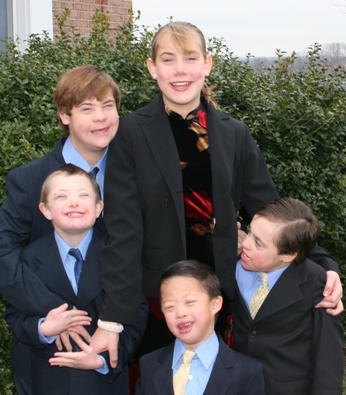
Maddie with her four brothers, all of whom have Down syndrome. Left to right: Jonny, Danial, Justin, Jesse
In our last post we talked about a new bill (The Prenatally and Postnatally Diagnosed Conditions Awareness Act) which will be going to the Senate for a vote in the near future.
This bill tries to address the lack of support for woman who are given a serious prenatal diagnosis. As a result of this lack of support a large percentage of woman when told that their unborn child will have a serious health or disability issue are choosing to abort these children.
Coincidentally, a new and important book just published on this subject is now available. The name of the book is:
A POSITIVE RESPONSE TO SERIOUS PRENATAL DIAGNOSIS
It was written by veteran author Madeline Pecora Nugent. For more information on this book you can view our previous post or visit the book’s website. The website not only talks about the book and how to order it but also has other resources for anyone who wants to know more about this topic. I believe that this book will not only be a great comfort to women who have been given a serious prenatal diagnosis but will be helpful to all pro-lifers especially those who help woman in pregnancy crisis centers.
To order this book click here:
As anyone who reads this blog knows we have a lot of respect for Father Pavone. Recently (Feb. 11, 2008) Father Pavone wrote the following on the upcoming election (8 months away). We felt it was an important statement and would clear up some of the questions and concerns that many people have posed during this election cycle. Here are links to both this particular statement as well as to Father’s blog.
“And What I Have Failed To Do…”
by
Fr. Frank Pavone
National Director, Priests for Life
What’s this I hear from some people that they might “sit out” the Presidential election because they aren’t comfortable with the likely choice of candidates?
Since when are elections supposed to make us “comfortable?” Since when do we exercise that right to vote, for which people fought and died, only when it’s easy and clear-cut, and our choices are just the way we want them to be?
At Mass we pray, “I confess to Almighty God…that I have sinned…in my thoughts and in my words, in what I have done, and in what I have failed to do…“
What we fail to do can make us just as guilty as what we do. A sin is a wrong choice, and to decide not to do something is just as much of a choice as to decide to do something.
A sin of omission is still a sin – and we are still responsible for the results.
What, then, makes us think that we are more responsible for the results of voting than for the results of not voting?
A vote is not a philosophical statement. It is a transfer of power. It is a pragmatic act to preserve, as much as possible under the circumstances, the common good, and to limit the evils that threaten it.
And in the pragmatic matter of elections, what matters is not how closely a candidate measures up to my preferences and convictions. Instead, it’s a question of who can and will actually get elected. It does little good if the person I felt most comfortable supporting doesn’t get to actually govern and implement those positions I like so much.
The vote can be used just as much to keep someone out of office as to put someone in.
If we fail to use that tool, however, and as a result the person who gets elected is far worse and does far more damage than the other person we did not like, then we still share responsibility for the damage that will be done.
Elections have seasons. In the earliest phases, the field is wide open. We can recruit candidates, or decide to run ourselves. We build up the name recognition and base of support for the person or people who would make the best candidate. This takes years of work.
Then the season of primaries arrives, during which voters choose between the candidates who have been recruited and who have been building up their strength.
Then the general election season arrives, and we may find that we don’t like any of the names on the ballot. At that point, we have to shift our thinking and focus on “better” rather than “best.” The reality usually is that one of several unsatisfactory candidates will in fact be elected. So we use our vote to create the better outcome and to limit the damage. That’s the shift that some fail to make.
And we are still responsible for what we fail to do.
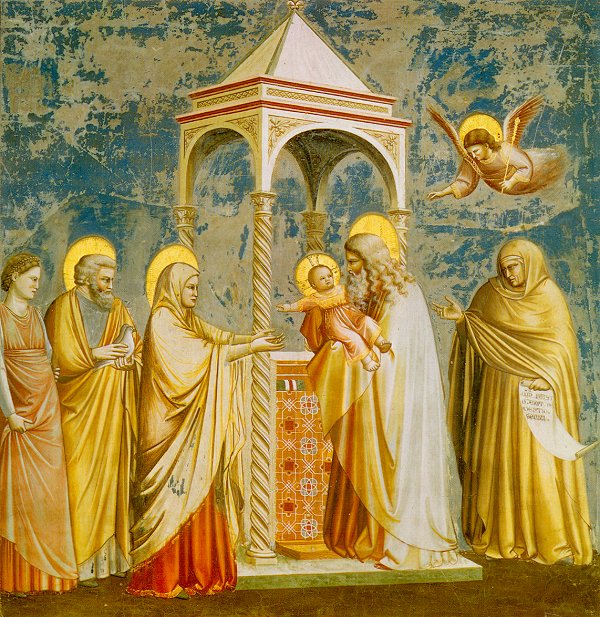
Giotto ca. 1267 – 1337
When Mary and Joseph were leaving the Temple with their newborn baby Jesus after the rite of purification had been celebrated according to the law of Moses, they encountered a man inspired by the Holy Spirit named Simeon (Lk 2:22-35). The evangelist Luke introduces Simeon this way: “this man was righteous and devout looking for the consolation of Israel”. Thanks be to God, Simeon realized then and there that the baby Jesus was “the consolation of Israel“! Yes, and “the hope of Israel“!
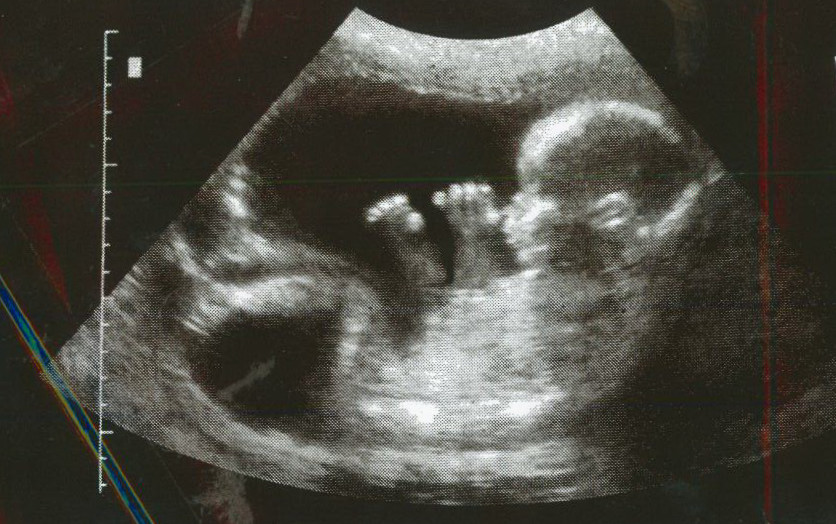
Similarly, for Pro Life people, we can look at Unborn Jesus and discover tremendous reasons for hope. Unborn Jesus is “the consolation of the Pro Life Movement”! If you contemplate Unborn Jesus, you see Him in solidarity with all unborn children. Just as a beautiful prism reveals glorious reflections, so unborn children when viewed through the prism-like life of the Unborn Christ, are seen anew in their sacred dignity. The image and likeness of God is beautifully magnified within these tiny persons.
When the adult Jesus wanted to capture the attention of the fisherman by the shores of Galilee he told them to cast their nets out and they were suddenly inundated by fish to the point of their nets breaking and their boats sinking (Lk 5:4-11). Well, one way Jesus captures the attention of Pro Life people is simply by coming to us as an unborn baby Himself. And He brings consolation, encouragement and hope to all who are Pro Life, so that we can imitate the faith of Abraham: “Hoping against hope, he believed…(Rom 4:18).”
Hoping against hope, the Pro – Life Movement prays and works for Life.

“Like the Church, Mary too had to live her motherhood amid suffering: ‘This child is set … for a sign that is spoken against – and a sword will pierce through your own soul also – that thoughts out of many hearts may be revealed’ (Lk 2:34-35). The words which Simeon addresses to Mary at the very beginning of the Saviour’s earthly life sum up and prefigure the rejection of Jesus, and with him of Mary, a rejection which will reach its culmination on Calvary.
‘Standing by the cross of Jesus’ (Jn 19:25), Mary shares in the gift which the Son makes of himself: she offers Jesus, gives him over, and begets him to the end for our sake.
The ‘yes’ spoken on the day of the Annunciation reaches full maturity on the day of the Cross, when the time comes for Mary to receive and beget as her children all those who become disciples, pouring out upon them the saving love of her Son: ‘When Jesus saw his mother, and the disciple whom he loved standing near, he said to his mother, Woman, behold, your son!’ (Jn 19:26).” Evangelium Vitae, #103
Mary was called in a special way and her heart was pierced in a way that we can never fathom. Among women, only she had a heart anointed, for her mission to love all as her children.
But don’t you also feel a sword pierce your heart when you look upon these innocent children who are aborted? Don’t you sense Christ calling you to love these little ones in a special way?
Note: First Eve was called ‘Woman’ (Gen 2:23 and also in Chapter 3). John the Evangelist records Jesus calling His mother by the title ‘Woman’ two times: during the marriage feast at Cana (Jn 2:4) and during His crucifixion (Jn 19:26). John also refers to Mary by the title ‘Woman’ (the ‘Second Eve’ as the Fathers of the Church also called her) many times in Chapter 12 of the Book of Revelations.
P.S. I obtained the bumper sticker featured above from Kara Vereault when I was at the March for Life January 22, 2008. She and Kim Achorn of Shepherd’s Path had the bumper stickers made up.
 UNBORN WORD of the day