Filed under: Pro-life
Travis Boudreaux writes:
As part of the 40 Days for life campaign, I will be running daily pro life, and abortion videos over at my video blog. Please check it out, and let all of your readers know about it. http://www.catholic-tube.com
Click here for the video he posted on October 1. I found it very moving.
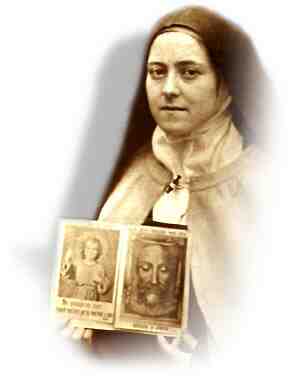
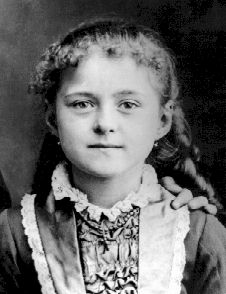
Also Kelly Clark at The Lady in the Pew has a beautiful post on Saint Therese of the Child Jesus and her little way:
October is Respect Life month in the U.S. Catholic Church.
The worldwide Pro – Life Movement is an organic grassroots rising-up of people appalled that others would advocate the killing of unborn children. The Society for the Protection of Unborn Children – founded in England in 1966 was the first pro-life group in the world. This of course also points to the sad distinction that England was leading the way in the killing of unborn babies in the free world (communist countries already had legalized abortion).
In the U.S., the Right to Life League of Southern California, founded in 1969 due to the liberalization of abortion laws there, was the first pro-life group in the U.S.
It wasn’t too long afterwards that the Catholic Church in the U.S. began to develop its “Respect for Life” programs.
We see in each of these names a message and commitment to human life. There is no doubt that in the abortion debate the Pro-Life Movement has taken the (inspired) high moral ground. Our opponents in this life-death struggle have placed themselves on the side of killing and death although they try to characterize their terms of engagement otherwise. Our terms of engagement are: Pro human life, desiring to protect innocent human life*, emphasizing the right-to-life – which in the U.S. was called a “self-evident” truth and an unalienable right (Declaration of Independence) – and promoting respect for human life which points to the dignity of each human being (a concept that is integral to any positive and progressive view of human beings).
Of course God said it first and most emphatically: “I have set before you life and death, blessing and curse; therefore choose life…” (Deut 30:19, and “Thou shall not kill.”)
In the 1990’s Pope John Paul II began pointing to yet another crucial distinction in our terms of engagement: a Culture of Life (as opposed to ‘culture of death’). This term, and the necessity of its realization, addresses the big picture and the long term view for humanity. He offers a cogent and prophetic explanation of the pro-life position in his ground-breaking, life-supporting document THE GOSPEL OF LIFE.
* Whereas the child, by reason of his physical and mental immaturity, needs special safeguards and care, including appropriate legal protection, before as well as after birth, (1959 United Nations Declaration of the Rights of the Child).
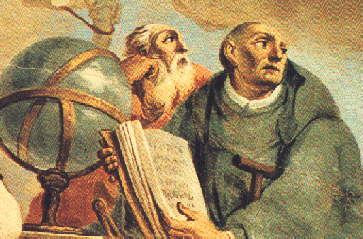
Today, Tuesday, September 25, 2007 is the feast day of Blessed Herman (1013-1054). He was born with many medical problems: cleft palate, cerebral palsy, and spina bifida. During his lifetime he was known as Blessed Herman the Cripple. Father Robert F. McNamara on his website, Saints Alive, calls him Blessed Herman the Disabled.
He was a remarkable man. Despite his daunting physical limitations he studied and wrote on astronomy, theology, math, history, poetry, Arabic, Greek, and Latin. He also built musical and astronomical equipment. He was considered a genius in his time. He wrote prayers and hymns – the most notable being the Salve Regina (Hail Holy Queen).
Father McNamara in his article on Blessed Herman the Disabled comments on the great meaning of Herman’s life with this closing insight:
“In his own day, the heroic cripple who achieved learning and holiness was called ‘The Wonder of His Age’.
In our day, many voices say that people with disabilities should be phased out of existence. Which were the Dark Ages, then or now!”
Filed under: Pro-life
As many of you know this site is dedicated to honoring the unborn Christ Child and promoting the Gospel of Life. So sometimes when you visit our blog we will have a quote about Christ’s time in the womb or the Gospel of Life or a post about another pro-life topic – we usually try to make it positive and/or inspirational .
Since, we do a lot with quotes, I thought today I would highlight some other websites that are dedicated to pro-life quotes.
First there is another blog called:
Pro-Life Quotes
Priests for Life website has a page called:
Stories, Anecdotes, and Inspiring Quotes
Here is a place you can find Pro-life quotes from Mother Teresa:
Pro Life Quotes Archive Right to Life New Zealand
Celebrity quotes on Abortion and Life
USCCB Pro-life Activities Selected quotes from
Church documents

As many of you already know Amnesty International recently abandoned its neutral stance on abortion and thereby abandoned the most vulnerable members of our society, the unborn.
On May 18, 2007 Fr Chris Middleton SJ, Principal at St Aloysius College (a Catholic independent day school, for boys from grade 3 to grade 12), Milson’s Point, in Sydney, Australia who has been an active member of Amnesty for many years made this statement:
As a Catholic priest and the Principal of a school with an active Amnesty group, such a change in policy places me in the unwanted position of contemplating the closing down of Amnesty’s presence in the school.
Recently, after Amnesty International reaffirmed its decision to endorse abortion on August 18, Fr. Chris did just that – severed his school’s ties with Amnesty and started a new group called The Benenson Society. Here is a statement that Father Chris sent out to announce his decision.
The society will be called the Benenson Society, after Peter Benenson, the Catholic lawyer who founded Amnesty, and will hopefully embody something of the spirituality, as well as idealism, that led to the formation of Amnesty. The Benenson Society will have as its symbol a stylised white rose. This symbol draws inspiration from the White Rose Society, a group of Catholic and Protestant students and teachers at Munich University, who opposed Nazism with letters and pamphlets, with nine paying the ultimate price of being guillotined for their stand for human rights. A film about one of its members, Sophie Scholl, was released recently. Over the next few months we will work on a charter for the group with Mrs Connolly and the boys. Already schools from Sydney and Melbourne have expressed interest in the project, and it may well be a model that many school groups could follow.
I would like to urge parents and teachers to consider approaching their Catholic and Christian schools to try to get them to sever their Amnesty ties and perhaps follow Father Chris’s courageous example.
Below are links to pages (along with the above links) that you might want to print up to bring to your principal/school:
Press Release United State Conference of Catholic Bishops
Vatican Official Urges Catholic Church to Boycott Amnesty International Over Abortion.
U.S. Bishops Decry Amnesty’s Pro-Abortion Stance
Australia Catholic Church Likely to Cut Amnesty Intl Ties Over Abortion
Cardinal O’Brien resigns from Amnesty International – Press Release
English Catholic bishop quits Amnesty International over abortion rights stance
Amnesty International Comes Under Fire for Taking Pro-Abortion Stance
Comments on AI’s abortion decision from around the web
And finally there is a great blog dedicated to this topic – where you can get more information on this issue.
Filed under: Pro-life
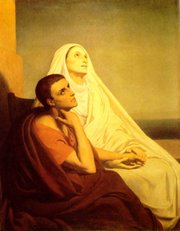
“St Augustine and Monica” (1846), by Ary Scheffer
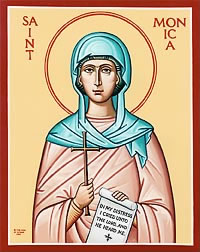
Today, August 27, is the feastday of St. Monica. Besides being the mother of St. Augustine, St. Monica is best known for her persistence in prayer. Her unfailing prayer has been credited as the reason for St. Augustine’s conversion.
“St. Monica was born of a Christian family, in Tagaste in Africa in 331. She had three children; Augustine, Navigius, and Perpetua. Through her patience and prayers, she was able to convert her husband and his mother to the Catholic faith in 370· He died a year later. Perpetua and Navigius entered the religious Life.
St. Augustine was much more difficult, as she had to pray for him for 17 years, begging the prayers of priests who, for a while, tried to avoid her because of her persistence at this seemingly hopeless endeavor. One priest did console her by saying, “it is not possible that the son of so many tears should perish.” This thought, coupled with a vision that she had received strengthened her. St. Augustine was baptized by St. Ambrose in 387. St. Monica died later that same year, on the way back to Africa from Rome in the Italian town of Ostia.” From Catholic Online
Persistent and urgent prayer is the lesson of St. Monica’s life. We should look to her example as we pray for the unborn. We had a post in May entitled JPII Says Pray Like Crazy . Here is in part what John Paul II said about praying for a culture of life.
“…a great prayer for life is urgently needed, a prayer which will rise up throughout the world. Through special initiatives and in daily prayer, may an impassioned plea rise to God, the Creator and lover of life, from every Christian community, from every group and association, from every family and from the heart of every believer.” Evangelium Vitae, 100
Filed under: Pro-life

The Gospel reading at Mass today, August 18, 2007, is from Mt 19:13-15: “…Jesus said, ‘Let the children come to me, and do not prevent them; for the Kingdom of heaven belongs to such as these.’”
At the base of the Statue of Liberty, in upper New York Bay at the mouth of the Hudson river, the famous words written by poet Emma Lazarus are inscribed: “Give me your tired, your poor, your huddled masses yearning to breathe free…”
The statue featured in the above photo is called Christ the Redeemer and it overlooks Rio de Janeiro. Last month this statue was named one of the New Seven Wonders of the World by the non-profit New Open World Corporation (NOWC). The two attributes associated with this marvelous statue by NOWC are: “welcoming and openness”. The statue, standing 130 feet tall, was completed in 1931.
Today’s Gospel reading epitomizes the “welcoming and openness” of Jesus to children. Perhaps we can link this statue and Gospel in our mind’s eye and even picture this verse engraved at the base of this Rio Wonder of the World:
“Give Me your unborn infants and newborns unwanted,
All those children most rejected and forsaken,
Yearning to be born and welcomed by loving hearts.
Send these, the hidden and lowly ones to Me and Mine,
That they may find true rest and solace upon my Heart.”
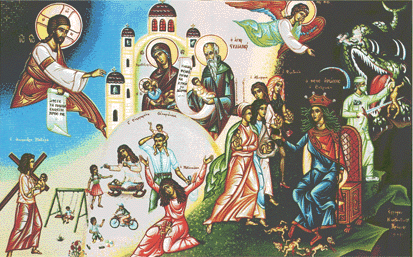
The Horror of Abortion – The Icon Explained
There is a powerful threshold-like verse in the Old Testament that is rather striking. Moses, the law giver, speaks the Lord’s words to the people: “…I have set before you life and death, blessing and curse; therefore choose life, that you and your descendants may live…” (Dt 30:19)
We today – every day – must also choose life! Here are some of the daily choices that Christians face: God or mammon (Mt 6:24), Christ or Anti-Christ (II Jn.7), Gospel of Life or a so-called gospel of death, a Culture of Life or a culture of death, and finally Incarnation or abortion.
This last choice is purposely posed in unusual terminology for several reasons. Jesus came into the world as an unborn baby, starting His human life at conception like the rest of us. And like the rest of us He was birth-bound, Bethlehem-bound, on a journey of development and growth. But He later put these nine months into a different light when He taught us: “…as you did it to one of the least of these my brethren, you did it to me” (Mt 25:40). When a child is conceived, God has an immediate interest in the temporal and eternal welfare of that child (I Tim 2:1-4). When a child is conceived, Christ Incarnate identifies Himself with that little one right from the start. Just as the Incarnation is a gift to all humanity, so the life of a little child is also a little gift to us all.
Filed under: Pro-life

Our story begins, not surprisingly, in the middle of a body of water, where our hero has mysteriously been found. For some reason he seems agitated. As he swallows the amniotic fluid he seems to have the hiccups. This unidentified unborn baby has been discovered – but what will happen next?
He is still in the first trimester; “The (Un)born Identity”. Suddenly his identity is being questioned, challenged really, “He’s not really human”, “just a blob of cells”, “it’s okay to kill him since he’s not alive”. This little baby has to fight, not only for his life, but also for his very identity. There seems to be a virtual conspiracy against truth, and in this case, the truth concerning his identity. This unborn baby seems to be the victim of a metaphysical identity theft.
Organizations are working feverishly with two goals: to hide his real identity and to kill him. There are so many groups involved it is hard to keep track of them: International Planned Parenthood (IPP), the Alan Guttmacher Institute (AGI), the National Organization of Women (NOW) and many more. Wow. The action is fast and furious as they locate his whereabouts and line him up in their sites.
But marvelously he has made it into his second trimester; “The Born Supremacy”. But still there is confusion – is this a supremacy of those who are already born against the unborn or is this the supremacy of nature and basic morality that seems to be dominating, winning back the day? Those with the power are clearly against the unborn. But our hero seems undaunted, his struggle to survive takes on epic proportions. Will he make it? To be born or not to be born, that is the question.
Is it a miracle or what? He makes it to his third trimester; “The Born Ultimatum”. While he was having dreams of his intrauterine experiences (noises, extreme buoyancy, touching, sucking his thumb and so on) even in his second trimester, now these dreams (almost flashbacks) are gaining in intensity. He has but one ultimate mission now – to be born. Of course it’s all in his mother’s hands (and God’s). Her decisions have been crucial all along.
Smiles all ‘round, two thumbs up, our baby has been born and we are happy. A mother’s love wins the day. Well, not everyone experiences happiness – IPP, AGI, NOW are all in disarray. But that’s okay – the rest of us are all happy!
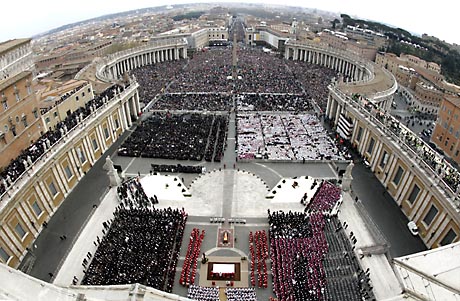
Pope John Paul II’s Funeral
When I was Director of Education for the Right to Life League of Southern California (1984-87) I worked with an older gentleman by the name of Frank Forve who had been a lawyer in his earlier days. He once told me that way back in 1959 the California Bar Assoc. passed a resolution calling for the liberalization of the abortion laws and consequently he withdrew his membership from that association. He took his first pro-life stand, the first of many, in 1959. But why did he do this? The Church had formed him, had helped him form his conscience and he knew both intuitively and intellectually what Vatican II would proclaim about six years later, in 1965: “Life must be protected with the utmost care from the moment of conception: abortion and infanticide are abominable crimes.” (Pastoral Constitution on the Church in the Modern world, #51)
Of course the Church has always taught that abortion is gravely, terribly wrong. The Church has consistently taught her children to cherish the gift of human life as a gift from Almighty God. There are thousands upon thousands of examples of how the Church is a good Mother to her children, and particularly by giving them good teaching and direction (in season and out of season) through these past two thousand years.
Which brings us to JPII. I could argue twenty different reasons for distinguishing him as one of the Church’s greatest popes, but here I will mention only one: his Gospel of Life encyclical letter issued in 1995. It is a prophetic teaching for our modern age and is rich in its content. He faces the abortion plague head on, he analyzes society’s contributing problems and weaknesses and presents a resounding call to promoting a Culture of Life. It is a manifesto of sorts for all Christians who are pro-life (which should be all Christians). In the years ahead more and more Christians will come to appreciate it. G.P.
Filed under: Pro-life
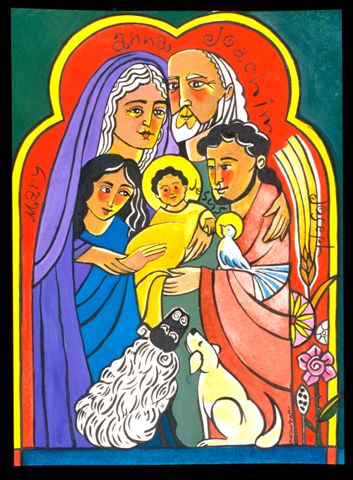
Today July 26, 2007, is the feast day of St. Joachim and St. Anne – the grandparents of Jesus (Mary’s parents), according to reliable early Church tradition.
In today’s Gospel reading Jesus hearkens back to the words of Isaiah: “You shall indeed hear but not understand, you shall indeed look but never see…” Then Jesus says to His disciples: “But blessed are your eyes, because they see, and your ears, because they hear. Amen, I say to you, many prophets and righteous people longed to see what you see but did not see it, and to hear what you hear but did not hear it.” Mt 13:10-17
Just as Joachim and Anne passed on the Sacred Traditions of their faith to their daughter Mary, so those of us who are Pro – Life are indebted to God and people around us (our parents, our grandparents and others) who witnessed to Pro – Life teaching and lived it, enabling us to see and hear the beautiful mystery of human life which wells up around us. We are blessed to have received this sacred message concerning the dignity of human life from our Church, especially in this modern time of moral turbulence and uncertainty. We have an Infant Christ to gaze upon. We have a Gospel of Life to listen to.
Thank You Lord for guiding Your Church through the moral confusion of our time towards our true and lasting heritage; A Holy Culture of Life.
Filed under: Pro-life

“Behold, I am sending you like sheep in the midst of wolves; so be shrewd as serpents and simple as doves.” This was what Jesus told His followers (and this was from the Gospel reading at Mass last Friday, Mt 10:16-23). Today’s reading, Sunday, July 15, 2007, is about the “Good Samaritan” (Lk 10:25-37). All Pro- Life workers and sympathizers who pray – that is the first responders to the “culture of death” surrounding us – would do well to remember these four images: “like sheep”, “shrewd as serpents”, “simple as doves” and “Good Samaritans”. These four images tell us a lot about what the Pro – Life movement has to be in order to be effective.
Yes, the “culture of death” fits the wolf description. Even more, it is well-described by another image from Jesus: “Beware of false prophets, who come to you in sheep’s clothing but inwardly are ravenous wolves” (Mt 7:15). False prophets are definitely ravenous wolves. In his Gospel of Life encyclical John Paul II spoke about these “false prophets” and their “objective ‘conspiracy against life’ involving even international institutions…the mass media are often implicated…” (#17).
On the other hand, the “sheep” know the Good Shepherd’s voice and He calls to them, guiding them, encouraging them, protecting them. The “shrewd serpent” is shrewd on offense and on defense, on offense when going out to build up the “Culture of Life” and on defense when protecting the innocent and vulnerable. “Simple doves” are focused on their mission and intent upon accomplishing it, without detour or distraction, and according to the clear and abiding “will of God”. And the “Good Samaritan” has a good heart and does what is right, with love, consideration and without counting the cost. All four images are linked to living by faith; faith in the One who became man for our sake so that He would be with us always, and in all ways except sin. These four images can give us perspective and like the four legs of a table can support us in this difficult assignment.
Just as the “Good Samaritan” is an image of healing, so the pro-life movement is meant for healing – “for the healing of the nations” (Rev 22.2).
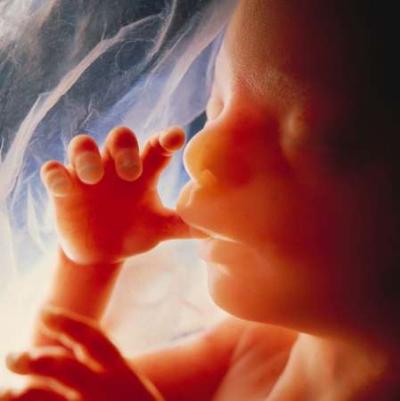
“The worlds of philosophy and humor often intersect so that philosophers can sometimes be mistaken for comedians and vice versa. To the age old question “If a tree falls in the forest and no one is around to hear it, does it make a sound?” one might not be certain whether to respond with a frown or a smile. A contemporary variant of the question leaves no doubt about the appropriate response: “If a husband says something and his wife is not there to correct him, is he still wrong?”
“But there is decidedly nothing humorous about the question, “Does a human fetus feel pain during an abortion if no one is there to verify the pain scientifically?” We like to think that we citizens of the 21st century are compassionate people. …It is rather curious, then, that the subject of fetal pain, rather than activating the springs of compassion that exist in all of us, is often politicized, depersonalized, trivialized, and relativized. If a person is truly compassionate, it would seem that his sensitivity to another’s pain would not be subject to ideological compromise. It appears disingenuous to say, “I will feel your pain as long as it is politically correct to do so.”
From Fetal Pain: Real or Relative? by Dr. Donald DeMarco Adjunct Professor, Holy Apostles College and Seminary
 UNBORN WORD of the day