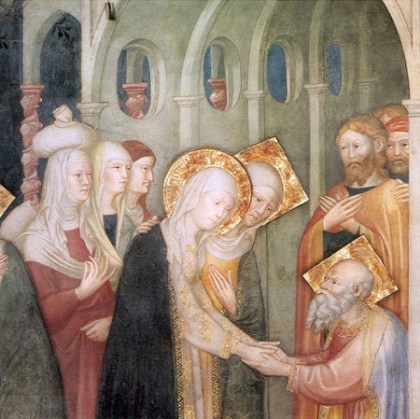
Mary and Elisabeth Meet Zachariah Lorenzo Salimbeni
Luke 1:56 tells us that Mary (and Unborn Jesus) stayed with Elizabeth (and unborn John) and Elizabeth’s husband Zechariah for three months. Most spiritual writers through the centuries have understood this to mean that Mary was present for John’s birth (and for the circumcision and naming of John eight days later). In fact, many believe that it was Mary who told Luke the details of these various events – or if not Mary directly, that Luke learned of them through a Marian tradition.
The priest Zechariah was the first representative of Israel to be informed of the immediate coming of the Messiah. See Lk 1:5-25. When Gabriel appeared to Zechariah he received but a lukewarm reception. Gabriel was not impressed and struck Zechariah silent, unable to speak. Nonetheless, Zechariah would have relayed the words and events in a written form to his wife Elizabeth and also to his guest and relative Mary (especially since Mary was the mother of the Messiah).
Mary would have been immensely interested in every word that Gabriel spoke. While most of the angelic message was actually about the son Elizabeth would bear, there were multiple references to the Lord (v. 15, 16, 17). Curiously, and in light of Gabriel’s next visit to a representative of Israel – that is, Mary in Nazareth – each of these references to “the Lord” could be understood also as references to Jesus. (Recall Elizabeth’s later comment when Mary arrived: “And why is this granted me that the mother of my Lord should come to me?” v.43)
All of these references to “the Lord” revealed that there would be a period of preparation during which John would have a tremendous ministry to the people of Israel. One reason this is significant is because it indirectly predicts the early success of “Christianity” within Israel (for example on Pentecost and following). At any rate, this was an optimistic message from the angel about what was to come, albeit, within an indefinite time frame.
Not only was Gabriel’s message to Zechariah very optimistic, but Gabriel even described it in a telling phrase: “I was sent…to bring you this good news” (v. 19). This characterization by God’s messenger of what is coming, confirms in Mary’s mind that God’s Mercy is at work and is a wondrous force for good and blessing. But perhaps the most extraordinary aspect of Gabriel’s message was when he said of Elizabeth’s son: “he will be filled with the Holy Spirit, even from his mother’s womb” (v. 15). This explains the mystery of John leaping for joy when the Unborn Christ approaches him and Mary greets Elizabeth. Would Mary remember that spectacular event more than thirty years later when she was in the Upper Room with the early Church on Pentecost Day when the Holy Spirit would fill each member of the Church? (see Acts 1:13-14, 2:1-4).
Finally after the baby’s birth, when Zechariah obediently names his son John – according to Gabriel’s instructions – Zechariah is now filled with the Holy Spirit and speaks! He proclaims what we now call the Benedictus (Lk 1:67-79). Zechariah points to the mystery of Salvation that is dawning upon Israel. He speaks of Christ as “a horn of salvation” raised up by God Most High. Mary is nearby with this “horn of salvation”, the Christ, growing within her womb (unbeknownst to the neighbors gathered around for the blessed ceremonies). Zechariah confirms that all of this is “as he spoke by the mouth of his holy prophets from of old” – a phrase reminiscent of the Nicene Creed reference: “We believe in the Holy Spirit…He has spoken through the prophets”.
So once again, Mary is the recipient of all of this Divinely inspired information about the Messiah, His mission, the meaning of it, the supporting characters involved and so on. Mary’s heart is like a holy depository of sacred Messianic information. Mary – because God has called her to this function, as part of her “office” as the mother of “the Son of God” – is now the filter, the arbiter of the message of salvation, carrying it within her heart, to deliver at the appropriate time (while she carries the Christ within her, to be delivered after nine months).
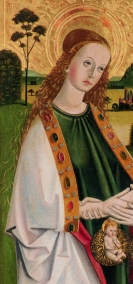
This post is the 3rd in our series on the Creed developing within Mary’s Intellect and Heart as the Christ Child develops within her womb. We turn now to the Visitation: Lk 1:39-55.
The Holy Spirit is extremely active during the various exchanges and actions when Mary (and Unborn Jesus) arrive at the home of Zechariah and Elizabeth and specifically when Mary greets Elizabeth (and Unborn John) and when Elizabeth responds. Luke tells us that “Elizabeth was filled with the Holy Spirit and she exclaimed with a loud cry, ‘Blessed are you among women, and blessed is the fruit of your womb! And why is this granted me, that the mother of my Lord should come to me? For behold, when the voice of your greeting came to my ears, the babe in my womb leaped for joy. And blessed is she who believed that there would be a fulfilment of what was spoken to her from the Lord.’” So, Elizabeth refers to Mary’s unborn child (about one week after conception) as “my Lord”. This is revelatory! Elizabeth has identified Unborn Jesus as Messiah and Lord, and Mary as the Messiah’s mother. Elizabeth states that it is a privilege to have the mother of the Messiah and Lord visit her.
What does Mary learn from Elizabeth’s inspired words? First, let it be said that everything about God is extremely personal. God is NOT distant, obtuse, detached from His Creation and creatures! He has become Incarnate. He has fulfilled what He promised. A week ago Gabriel said that Mary had “found favor with God” (Lk 1:30). Now Elizabeth is acknowledging that Mary has a special relationship with God and is blessed for believing “that there would be a fulfillment of what was spoken to her”. This highlights Mary’s personal relationship with God. It is a beautiful relationship; alive in trust, bursting with expectation! Mary is being rewarded for obeying God and believing in the words spoken to her. This is God’s way of thanking Mary for accepting this motherhood of a Divine Person; the Son of God. So Mary sees and tastes the Goodness of God in the words of Elizabeth. This is living the Creed. The Creed in Mary’s heart says that “God is All Good, God is Most Faithful”. This belief drove her onward to Bethlehem, to Egypt, to Cana, to the foot of the cross, to the Upper Room and to Heaven.
But most of all, Mary hears her unborn child called “Lord”! She hears herself called “mother of (the) Lord”. These are titles, and offices. Elizabeth is testifying – albeit, indirectly – that Mary has been given a singular office by Almighty God; ‘mother of the Lord’. This is a sacred duty and obligation in service to the Mission of her Son (see prior post for Gabriel’s description of her Son). With the leaping of unborn John in his mother’s womb (caused by Unborn Jesus) and Elizabeth’s comments, Mary has now seen that her Son’s mission has already begun. She knows from firsthand experience that God is acting here and now, and that the Son of the Most High is the focal point of everything – she is her Son’s handmaiden.
The next 10 verses are Mary’s famous inspired response and are called the Magnificat for the opening line: “My soul magnifies the Lord, and my spirit rejoices in God my Savior…” Note the two words “Lord” and “Savior”. Incredibly, Mary is perceiving that these two titles, which she would have used in the past to describe the God of Abraham, Isaac and Jacob, can now also be used to describe her (unborn) Son. This is a fundamental unfolding Revelation of the first order. Elizabeth used the word “Lord” and Mary responds using the same term. But she says “my soul magnifies the Lord” because He is within her, and she is reflective of His Presence as Elizabeth stated. Mary is inspired to use the term ‘Savior’ also. Mary is in a unique position, for when she speaks of God, she is speaking not only of her Creator Yahweh, but also of that Son growing within her. She is associating her Son with the term ‘Savior’, now pointing to the redemptive reality that is dawning upon Israel, twice referencing God’s mercy.
Mary’s Magnificat is centered upon the reality of God; referring at least 18 times to God (he, his, him, and so on). The last verse of the Magnificat recalls God’s relationship with Abraham. Mary is showing the continuity of God’s personal redemptive relationship with the people of Israel, and her Magnificat seems to recapitulate that historical relationship. Abraham was the Father of their faith – now Mary is the Mother of their Savior. She is discovering these truths of the Incarnation as she is living them (and she was inspired by the Holy Spirit as she gave voice to these truths). Her Magnificat offers a holy glimpse into the Creed that is taking hold of her heart, a unique Creed, a mixture of faith, hope, love and maternity – a tender personal Creed especially due to this fourth mentioned element; maternity. Every Christian can learn of this palpable Creed by sharing in Mary’s intimate perspective on her unborn Savior Son!
Our next post will consider the three months Mary (and Unborn Jesus) spent with Zechariah, Elizabeth (and unborn, then newborn John).
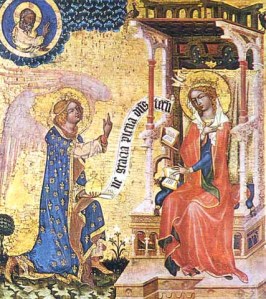
In our last post we listed the extraordinary events and Revelations which unfolded in the life of Mary (and Unborn Jesus) during the nine months of her pregnancy. Our list was presented trimester-by-trimester and relied upon the Gospels of Luke and Matthew for scriptural facts. Today’s post is part of a series of upcoming posts reflecting upon the content of the Revelations given to Mary, trimester-by-trimester; the meaning and significance of these Revelations will be discussed.
FIRST TRIMESTER:
Luke 1:28, 30: The initial mystery of her favored relationship to God is revealed to Mary by Gabriel.
Lk 1:31-33 The miraculous nature of her impending pregnancy is revealed to Mary. That her child will be a male, and will be “called the Son of the Most High”, that He will be given the throne of David, will reign forever and there will be no end to His kingdom. This means that her Son will be a King, not just an earthly King by an eternal King, with subjects. Many Christians think of Christ’s kingship as symbolic, but it is not merely symbolic – it is a real and true kingship, in fact Christ is the true measure of all Kings (and Queens) throughout history. There is an incredibly personal and poignant word given to Mary also about this pregnancy, this Son: “you shall call his name Jesus”. Here begins the magnificent Christian devotion to the Holy Name of Jesus. It was a name she would embrace in prayer, a name to whisper, a name to marvel at, a name like no other name – a name she discovered by the hour, a name sent down from Heaven upon the head of her baby.
Lk 1:35 This has to be the most fantastic truth ever revealed to a human being!!! The Archangel Gabriel explains how the Incarnation will take place. The child “will be called holy, the Son of God” because the child will be conceived, as the Nicene Creed says, “by the power of the Holy Spirit” and as Gabriel says “ The Holy Spirit will come upon you, and the power of the Most High will overshadow you…” Virtually the entire first half of the Nicene Creed is embedded here in the cumulative words of Gabriel to Mary! Mary represents the Church and Gabriel is the messenger of God “Most High”. He is revealing the first mystical kernel of the Christian Creed to Mary and she will embrace it body and soul – she will live the Creed. The Church’s belief in the Incarnation will be rooted in this evangelical exchange. Mary will tell the Church what she was told and the Church will cling to this holy revelation, her martyrs will cling to it with their dying breaths!
Lk 1:36-37 Gabriel tells Mary about the pregnancy of Elizabeth, putting everything into perspective: “For with God nothing will be impossible”. (Approximately a week later, when Mary sees with her own eyes that Elizabeth is, in fact, six months pregnant, she will understand all the more emphatically, the power in the words revealed to her.)
Lk 1:38 Mary’s response to this litany of heavenly revelations has calmed Christians for two thousand years: “Behold, I am the handmaid of the Lord; let it be to me according to your word.” In her heart she now has the key to human history, the hope of humanity, the revelation of all God’s promises in one Word. As the Fathers of the Church would say, she conceives in her heart before conceiving in her womb.
She immediately conceives in her womb – now Christ is physically growing within her womb and the Christian Creed is mystically growing within her intellect and heart. The Creed – in embryonic state – is taking root in a human heart.
Our next post will consider the Visitation (Lk 1:39-45, 46-55).
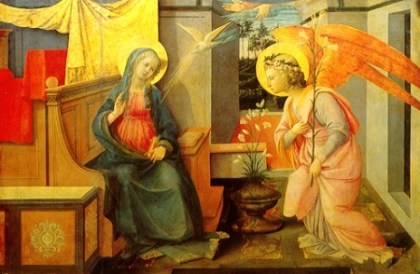
Mary’s pregnancy was unique for dozens of reasons. One aspect of her pregnancy that has been neglected is the corresponding Revelations she received regularly throughout the pregnancy which are explicitly referenced in the Gospels but almost universally overlooked. God wanted her to be illuminated in her intellect and heart while she was nurturing within her womb the growing mystery of salvation; the Incarnate Son of God.
Let’s do a quick review of these Revelations by trimester (approximated). Note that each Revelation is either directly given to her by an angel of God or by the Holy Spirit or by persons who were directly instructed by angels or inspired by the Holy Spirit. (And all of these direct Revelations presuppose a profound and holy grasp of her foundational Israelite faith, including a superior knowledge of Hebrew scripture).
FIRST TRIMESTER: Luke 1:26-38 (this Revelation was given in conjunction with the conception of Christ), Lk 1:39-45, Lk 1:46-55 (these two occurred about one week later). Mary stayed with Elizabeth and Zechariah for three months and the following Revelations were given her: Lk 1:5-25, Lk 1:57-79. (We are assuming that Mary who experienced these events or had them relayed to her firsthand, passed them on to Luke.)
SECOND TRIMESTER: Matthew 1:20-24 (cross reference Isaiah 7:14). Joseph is instructed by an angel and no doubt revealed to Mary exactly what he had been told.
THIRD TRIMESTER: Luke 2:1-7 (cross reference Micah 5:2).
FOURTH TRIMESTER ? – REVELATIONS IMMEDIATELY FOLLOWING
THE NATIVITY: Luke 2:8-20, Lk 2:21, Lk 2:22-38, Matthew 2:1-11, Mt 2:12-18.
Mary is tutored by God throughout her pregnancy and immediately following the birth of Jesus. As she was living God’s Plan of Salvation, minute-by-minute, experiencing these grace-charged events, she was also being given Revealed teachings from God (directly and indirectly). We have listed a sequence of both events and Revelations above. In our next post, we will reflect upon the “Revealed teachings” given to Mary during these months, in part to prepare and strengthen her as she embraced her role as an intimate supporting collaborator in the Incarnation Mission of Jesus Christ.
As Mary flees for Egypt, her womb is now empty, but her intellect is full, her heart even fuller…with love for the child in her arms.
El Greco (1541-1614) St. Luke (detail)
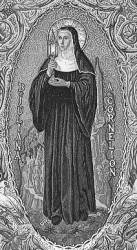
You may have never heard of Blessed Juliana of Cornillon (Juliana of Liege), 1192 -1258. She was an Augustinian nun who was the first promoter of a feast day in honor of the Blessed Sacrament. She has been recognized as the person primarily responsible for the introduction of the Corpus Christi feast day during the middle ages. According to Acta Sanctorum, she had a unique and extraordinary devotion. She said the Magnificat (Lk 1:46-55) nine times a day; once for each month that Our Lord spent in the womb of His mother. (The Magnificat was proclaimed by Mary while she was pregnant.) One can not help but see the beautiful connection here in Juliana’s spiritual life between her devotion to the Body of Christ in the womb and the Body of Christ upon the altar.
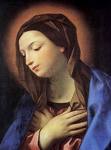
Which leads us to the second woman: Mary the Mother of Jesus. In his encyclical letter ECCLESIA DE EUCHARISTIA, On the Eucharist in Its Relationship to the Church, John Paul II discusses Mary and the Eucharist:
“In a certain sense Mary lived her Eucharistic faith even before the institution of the Eucharist, by the very fact that she offered her virginal womb for the Incarnation of God’s Word. The Eucharist, while commemorating the passion and resurrection, is also in continuity with the incarnation. At the Annunciation Mary conceived the Son of God in the physical reality of his body and blood, thus anticipating within herself what to some degree happens sacramentally in every believer who receives, under the signs of bread and wine, the Lord’s body and blood.”
“As a result, there is a profound analogy between the Fiat which Mary said in reply to the angel, and the Amen which every believer says when receiving the body of the Lord. Mary was asked to believe that the One whom she conceived “through the Holy Spirit” was “the Son of God” (Lk 1:30-35). In continuity with the Virgin’s faith, in the Eucharistic mystery we are asked to believe that the same Jesus Christ, Son of God and Son of Mary, becomes present in his full humanity and divinity under the signs of bread and wine.”
“Blessed is she who believed” (Lk 1:45). Mary also anticipated, in the mystery of the incarnation, the Church’s Eucharistic faith. When, at the Visitation, she bore in her womb the Word made flesh, she became in some way a “tabernacle” – the first “tabernacle” in history – in which the Son of God, still invisible to our human gaze, allowed himself to be adored by Elizabeth, radiating his light as it were through the eyes and the voice of Mary. And is not the enraptured gaze of Mary as she contemplated the face of the newborn Christ and cradled him in her arms that unparalleled model of love which should inspire us every time we receive Eucharistic communion?”(#55)
“The Eucharist has been given to us so that our life, like that of Mary, may become completely a Magnificat!” (#58)
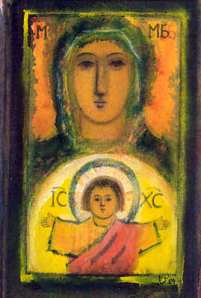
Key to Christ’s Kingdom Christine Granger
Here is a wonderful quote from Mother St. Paul (1861-1940) about Mary’s Pregnancy.
“She was ever holding colloquies with her God within her, pondering things over in her heart, that is, talking them over with Him from Whom she had no secrets and between Whom and her soul she put no obstacles.
Her life was spent with Him; whatever her duties might be, everything was done with Him, which is prayer. If duties or conservation demanded all her attention for a while, did it matter? No, for He was there all the same. He, in her, carried on the blessed converse with His Father; there was never any separation between Mary and the Blessed Fruit of her womb, Jesus. She would come back to Him…
…When we think of Jesus praying for nine months to His Father, when we think of Mary’s nine months colloquy with Jesus, we begin to think that there is something wrong about our methods of prayer, that they need re-modeling.
Let us try to understand something of what His prayer was. We think of Him, and quite rightly, as talking over with His Father all His plans for man’s salvation, praying for each individual thing that would be connected with it through all time. We love to think that He prayed particularly for each one of us.“
From Ortus Christi:meditations for Advent (1921) by Mother St. Paul
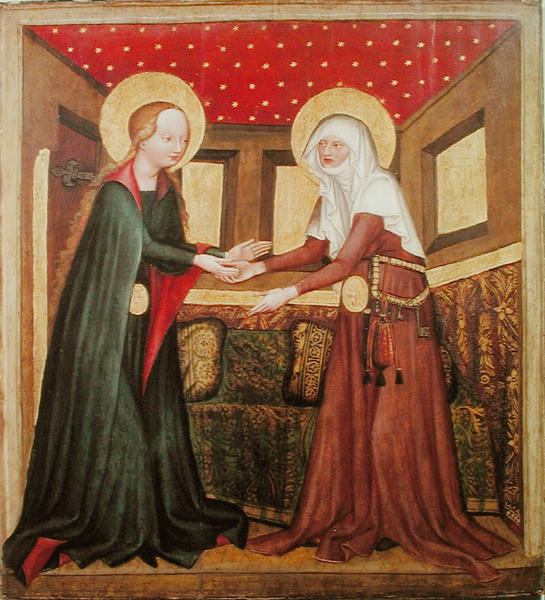
The Visitation, panel from the St. James Altarpiece, c.1440 Bohemian School, (15th century) (Czech) tempera on panel (visitation type fetus)
“In the Eucharist the Church is completely united to Christ and his sacrifice, and makes her own the spirit of Mary. This truth can be understood more deeply by re-reading the Magnificat in a Eucharistic key. The Eucharist, like the Canticle of Mary, is first and foremost praise and thanksgiving.
When Mary exclaims: ‘My soul magnifies the Lord and my spirit rejoices in God my Saviour’, she already bears Jesus in her womb. She praises God ‘through’ Jesus, but she also praises him ‘in’ Jesus and ‘with’ Jesus. This is itself the true ‘Eucharistic attitude’.
At the same time Mary recalls the wonders worked by God in salvation history in fulfillment of the promise once made to the fathers (cf. Lk 1:55), and proclaims the wonder that surpasses them all, the redemptive incarnation.
Lastly, the Magnificat reflects the eschatological tension of the Eucharist. Every time the Son of God comes again to us in the “poverty” of the sacramental signs of bread and wine, the seeds of that new history wherein the mighty are ‘put down from their thrones’ and ‘those of low degree are exalted’ (cf. Lk 1:52), take root in the world.
Mary sings of the ‘new heavens’and the ‘new earth’ which find in the Eucharist their anticipation and in some sense their programme and plan. The Magnificat expresses Mary’s spirituality, and there is nothing greater than this spirituality for helping us to experience the mystery of the Eucharist. The Eucharist has been given to us so that our life, like that of Mary, may become completely a Magnificat!“
John Paul II, Encyclical Letter Ecclesia de Eucharistia, section 58
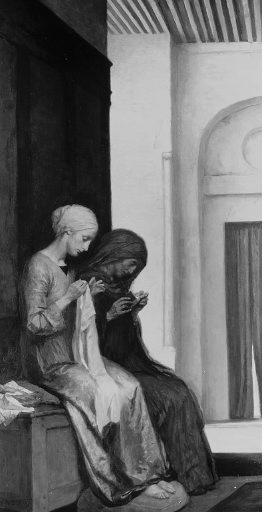
Mary in the House of Elizabeth , Robert Anning Bell 1863-1933
“All through those blessed three months during which Mary abode with Zachary and Elizabeth, she was singing Magnificat. All through her life she sang Magnificat, even though she was the Mother of Sorrows, for the thought of God’s glory ever lifted her out of herself and made her praise Him for all He did. It was because Mary had said her Fiat that she could say her Magnificat….
…We know nothing of what went on during those three months, but we may presume that things continued as they began. It is not likely that Elizabeth said her ‘Ave’ only once, and only once spoke of the honour she considered it to have the Mother of God in her house. It is not likely that the unborn Forerunner never again saluted His Master, in Whose presence he so continually was. It is impossible to conceive that Mary sang God’s praises and her own unworthiness no more during those three months. And what about Jesus ? These were the first three months of His life on earth, and grace was surely going out from Him to His Blessed Mother first, and then to all who knew the secret.”
From Mater Christi : meditations on Our Lady (1920). Mother St. Paul
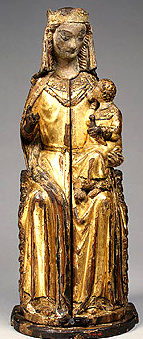
Vierge Ouvrante (Opening Virgin) click on picture to open and see scenes from the Gospel
Loving Mother of the Redeemer
Gate of heaven, Star of the Sea,
Assist your people who have fallen
yet strive to rise again.
To the wonderment of nature
you bore your Creator,
yet remained a virgin after as before.
You who received Gabriel’s joyful greeting,
have pity on us poor sinners.
Sister Linus sent this to me: During Advent, this is the antiphon used in Compline for the Divine Office. She points out that, “Today it’s like a prayer of sorrow and reparation.”
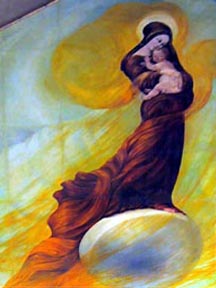
Today, August 15, 2008 is the feast of the Assumption of Mary into Heaven. The Gospel reading however is from the Visitation (Lk 1:39-56). We are reminded during this reading of Unborn John’s famous leap for joy at the coming of His Savior Jesus Christ. When Mary first conceived Christ, is it not likely that her soul leapt for joy too? This being the case, can we not see in the Assumption of Mary her extraordinary leap of joy into the Heavenly Presence of her Savior?
The second reading tells us that Christ is “the first fruits of those who have fallen asleep” (I Cor 15:20). It then goes on to say that in Christ all shall “be brought to life, but each one in proper order”. Mary is first in line for glory, after Christ! No, this is not Mary’s line per se, it is the line formed by Christ the first born from the dead (Col 1:18). But it is the Church’s line, the line for all the members of the Church redeemed by Christ their Savior – and Mary is the first in this line! Just as she was first to receive Christ the Savior into her heart (and in her case uniquely into her womb), so she is first to taste the fullness of redemption!
She was humanity’s representative, waiting faithfully in Nazareth for the Messiah, every day offering God Most High her invitation to send the long-awaited Messiah to Israel, and even to tiny humble Nazareth if it pleased the Most High. When Gabriel appeared to her she said Yes; “…let it be to me according to your word” (Lk 1:38). And so too, now at the close of this definitive chapter of salvation history, after saying “Yes” to God all her life, she again says, so to speak, “let it be to me according to your word” – and she is then taken up into heaven. Even Sacred scripture mystically commemorates this event as recorded by John the Evangelist in Revelation 12 (today’s first reading).
The line to Heaven is made up of those who say “yes” to God.
Filed under: Mary, Quotes from Great Christians, The Incarnation, Unborn Jesus
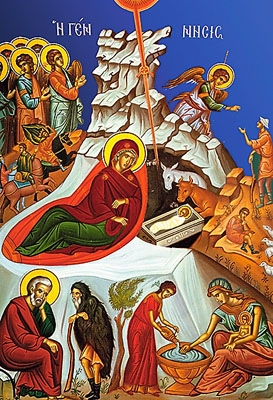

“Humanly speaking, the time of Advent must have been the happiest time of Our Lady’s life. The world about her must have been informed with more than its habitual loveliness, for she was gathering it all for the making of Her Son…
It must have been a season of joy, and she must have longed for His birth, but at the same time she knew that every step that she took, took her little Son nearer to the grave.
Each work of her hands prepared His hands a little more for the nails; each breath that she drew counted one more to His last.
In giving life to Him, she was giving Him death.
All other children born must inevitably die; death belongs to fallen nature; the mother’s gift to the child is life.
But Christ IS life; death did not belong to Him.
In fact, unless Mary would give Him death, He could not die.
Unless she would give Him the capacity for suffering, He could not suffer.
He could only feel cold and hunger and thirst if she gave Him HER vulnerability to cold and hunger and thirst.
He could not know the indifference of friends or treachery or bitterness of being betrayed unless she gave Him a human mind and a human heart.
That is what it meant to Mary to give human nature to God.
He was invulnerable; He asked her for a body to be wounded.
He was joy itself; He asked her to make Him a man.
He asked for hands and feet to be nailed.
He asked for flesh to be scourged.
He asked for blood to be shed.
He asked for a heart to be broken.
The stable at Bethlehem was the first Calvary.
The wooden manger was the first cross.
The swaddling bands were the first burial bands.
The passion had begun.
Christ was man.
This, too, was the first separation.
This was her Son, but now He was outside of her: He had a separate heart: He looked at the world with the blind blue eyes of a baby, but they were His own eyes.
The description of His birth in the Gospel does not say that she held Him in her arms but that she “wrapped Him up in swaddling clothes and laid Him in a manger”.
As if her first act was to lay Him on the cross.
She knew that this little Son of hers was God’s Son and that God had not given Him to her for herself alone, but for the whole world.”
A meditation by Caryll Houselander from “The Reed of God”.
One of the subscribers to the e-newsletter sent this beautiful meditation to us. Thanks Diana.
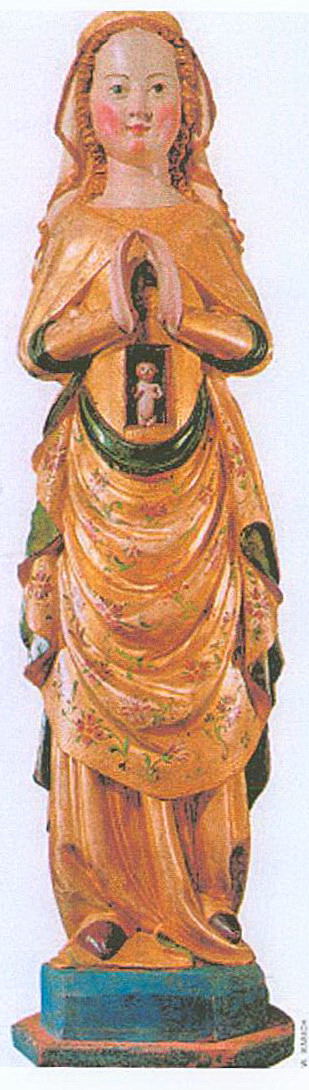
In 1996, Medievalist, Markus Bauer visited the Cistercian convent, St. Marienstern, in Panschwitz-Kuckau — a small village with a population of 2400 and located in the Sachsen part of the Lausitz area in search of material for an historical exhibit.
The historian found three sculptures of the Blessed Virgin Mary, each with an opening in the stomach,where the viewer could see a miniature carving of the unborn Christ Child. Such sculptures were highly valued devotional objects in the 14th and 15th centuries. In the 19th century, this type of devotional image no longer spoke to the souls of the sisters in the same way, so they hung a cloth over the stomach opening, or they nailed the opening closed. Since the covering for one of these Marian figures was missing, it was put away in a remote cell, where it stayed to the present time.
 UNBORN WORD of the day