


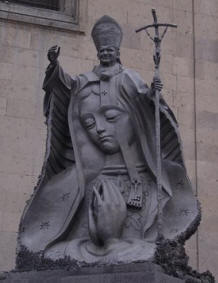
Our Lady of Guadalupe, Star of the New Evangelization by Mother Adela, SCTJM
During one of his visits to Mexico, Pope John Paul II said “No Mexican should dare to victimize the precious and sacred gift of life that grows in the womb.”
Sadly enough that all changed on April 24, 2007 when the Mexico City legislature approved a bill to make abortion legal during the first three months of pregnancy. On August 28, 2008 the Supreme Court of Justice of the Nation (SCJN) upheld the law legalizing abortion in Mexico City through 12 weeks of pregnancy, rejecting a constitutional challenge.
But according to an article entitled “A Wake-up Call” by Sean Salai in The Catholic World Report there is still a great deal of hope for Mexico. Here are some points from the article:
-“The Supreme Courts ruling merely states the city’s legislation is constitutional and makes no provision for wider legalization measures.”
-Fr. Marco Bran Flores, S.J. from Mexico states:”…Mexico City exhibits a very different cultural environment…Mexico City’s liberal reputation is almost mythical throughout the country, and contrasts sharply with the conservatism of the other big cities. This law will not easily be duplicated in other parts of Mexico.”
-Mexican Bishops have come out strongly even telling lawmakers who voted for this law that they are automatically excommunicated.
– Rosalind Villasenor, a Mexican born lay minister who conducts abstinence retreats in the U.S. and Mexico points out: “I wouldn’t consider (the law) typical, Mexico is known to be protective of its culture, faith and values. There can’t be anything more important (to Mexican) than life.”
And one other point that the article made was:
-“This law will have little effect on the rest of Mexico and will only serve to galvanize the Mexican pro-life movement.”
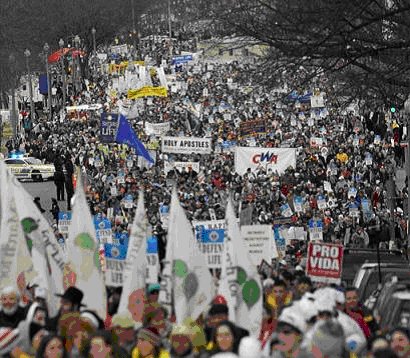
And that is exactly what has happened – since the March 2007 Mexico City pro-abortion law was passed there have been many demonstrations for life in Mexico. Here are links that show the Mexican people standing up for life:
Mexico Pro-Life Advocates Will Protest Abortions Once They Begin April 25, 2007
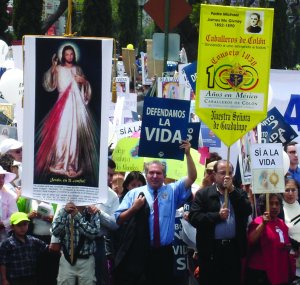
Silent No More Pro-Life March, Mexico March 2007
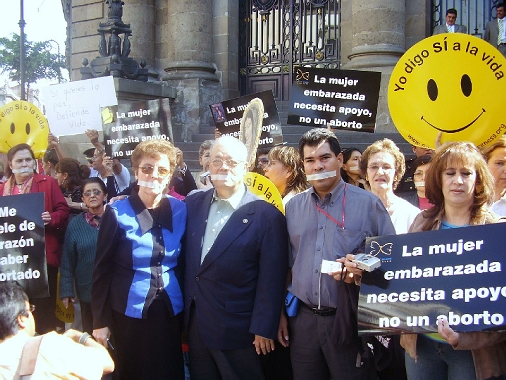
40,000 march against abortion in Guadalajara May 11, 2007
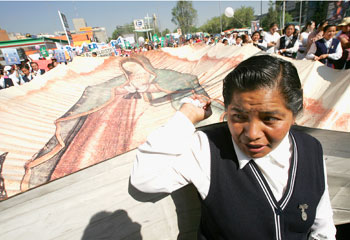
Massive Mexican Protest for life on May 25 /2008
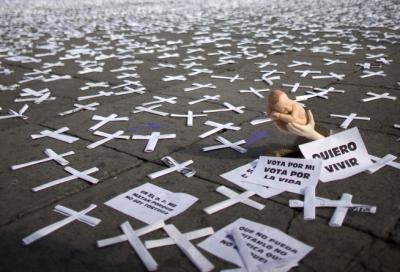
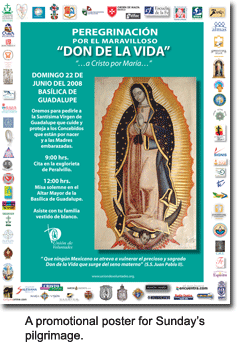
Mexico City Pilgrimage to Protest Abortion Law to be Held this Sunday “Pilgrimage for the Marvelous Gift of Life,” June 22.2008
Mexican Pro-Lifers to UN: Stop Murdering our Children Organization accuses United Nations of complicity in “genocide” against Mexicans July 16, 2008

Mexico Bells ordered to be rung as ‘sign of morning’ Aug 31, 2008
But there is even better news coming out of Mexico.
Last week, at the national meeting of the Mexican Bishops conference, they agreed to the following actions for the defense of life
- Prayer, Holy hours, Masses for life
- Teaching “Evangelium Vitae” everywhere
- Massive and permanent campaigns for life
- Promoting pro-life laws
- Creating pro-life and natural family planning committees at parish level.
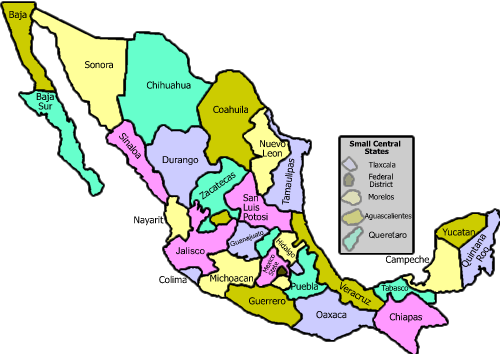
Pro-lifer’s are also working hard on the political level to outlaw abortion in the rest of the country.
In order to prevent the attempt to legalize abortion at the national level Mexico needs 16 of its 31 states to protect human life in their constitutions. Since the Supreme Court ruling in August many of the Mexican States have been putting this legislation on a fast track. Following are the states that have either passed this legislation or are working on protecting human life in their constitutions:
- Sonora October, 2008 (with exceptions in case of rape, mother’s life, miscarriage)
- Baja California October, 2008 (no exceptions)
- Morelos November, 2008 (no exceptions)
- Chihuahua already had protections for life in their constitution since 1994.
- Last week the Governor of Veracruz has sent his State congress a bill to protect life from conception.
- Jalisco and Nuevo Leon, the two most important Mexican states after Mexico City, are on the verge of approving constitutional amendments that will establish the right to life of the unborn from the moment of conception.
- Also, last June Legislators in the Mexican state of Tamaulipas, which borders the United States, rejected an attempt to decriminalize abortion, according to the news agency Infonorte.
- Guanajuato and Jalisco each have proposed Constitutional amendments, but they still don’t have enough votes from PRI legislators to approve them, so they are waiting.
We should be encouraged and find inspiration in the Pro-life response of the Mexican people. Please remember them in your prayers. Thanks to Marcela Vaquera for giving us current information on the situation in Mexico.
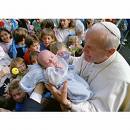
For many of us the most important issue is the right to life. We long for our beloved country to be freed from the scourge of abortion.
Between 1989 and 1990 Poland was freed from communist domination. Almost immediately, John Paul II began to fight for the right to life of unborn babies in his beloved Poland.
In an October 8, 1990 article in L’Osservatore Romano entitled Save the Unborn! Pope John Paul II is quoted from his Oct. 3, 1990 General Audience calling on the Poles to overthrow the inherited law “which strikes at the lives of unborn babies”.
He went on to say: “I am here before you today with the key issue in the entire moral order…This right is the first and most basic one. The law which strikes at life in the mother’s womb carries with it the marks of the totalitarian system.”
Answer: Dr. Jerome Lejeune and his wife, Birthe LeJeune.
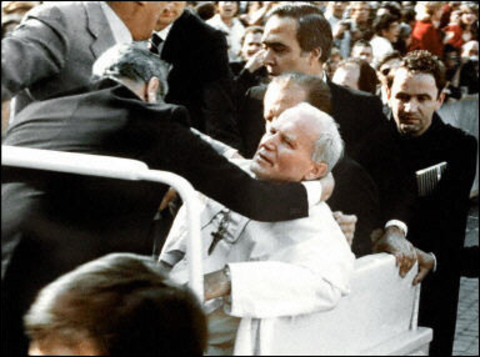
On May 13, 1981, Jerome and his wife were in Rome. The Holy Father wished to receive them in a private audience. After the discussion, the Pope spontaneously invited them to stay for lunch. The same evening, on their way back to Paris, they learned about the attack on John Paul II, a few hours after they had left him. Jerome’s health was shaken by this news.
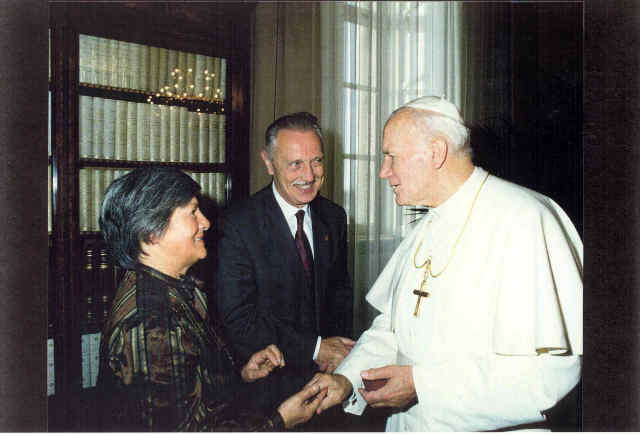
John Paul II later appointed Dr Lejeune to the Pontifical Academy of Sciences. When he created the Pontifical Academy for Life, he made Dr. Lejeune president of that Academy, just prior to his death of cancer in Paris in 1994.
Jérôme Lejeune died on Easter Sunday, 1994. The day after Dr. Lejeune’s death John Paul II spoke these words:
“We find ourselves today faced with the death of a great Christian of the twentieth century, a man for whom the defense of life had become an apostolate. It is clear that, in the situation of the world today, this form of apostolate among the laity is particularly necessary… “
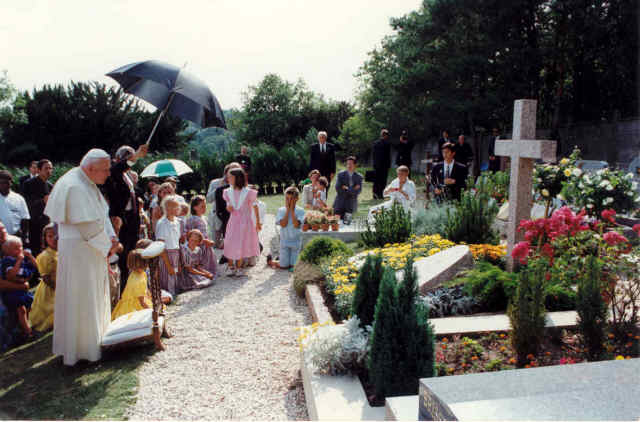
In 1997 John Paul II visited his friend’s grave during World Youth Day in Paris. One of the French journalists commented on the event with the following pun: The Pope visited “the young” (“les jeunes”) and Lejeune.
Filed under: John Paul II
Pope John Paul II speaking to Bishops:
“The assembly of the Synod of Bishops indicated several indispensable means for the sustenance and progress of the spiritual life. First among these is reading and meditating on the word of God….Before becoming one who hands on the word, the Bishop, together with his priests and indeed like every member of the faithful and like the Church herself, must be a hearer of the word. He should live ”within” the word and allow himself to be protected and nourished by it, as if by a mother’s womb. With Saint Ignatius of Antioch the Bishop must say: ”I commend myself to the Gospel as to the flesh of Christ”. Each Bishop will thus take to heart the well-known admonition of Saint Jerome quoted by the Second Vatican Council: ”Ignorance of the Scriptures is ignorance of Christ”. There can be no primacy of holiness without attentive listening to the Word of God, which is the guide and nourishment of all holiness.”
Pope John Paul II, On The Bishop, Servant of the Gospel of Jesus Christ For the Hope of the World.
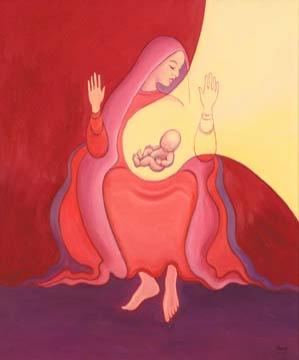
Mary is the ‘Holy House’ who bore God in her womb and is forever to be honoured by Elizabeth Want
In his Apostolic Exhortaion entitled Vita Consecrata (March 25, 1996) John Paul II has a thought provoking quote from St. Augustine:
“Beautiful is God, the Word with God … He is beautiful in heaven, beautiful on earth; beautiful in the womb, beautiful in his parents’ arms, beautiful in his miracles, beautiful in his sufferings; beautiful in inviting to life, beautiful in not worrying about death, beautiful in giving up his life and beautiful in taking it up again; he is beautiful on the Cross, beautiful in the tomb, beautiful in heaven. Listen to the song with understanding, and let not the weakness of the flesh distract your eyes from the splendour of his beauty.” #24
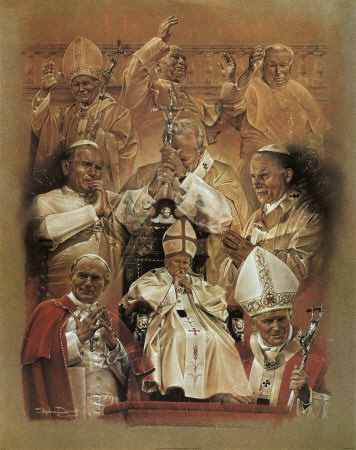
Original Unity of Man and Woman
“Catechesis on the Book of Genesis”
(1979-1980)
APOSTOLIC EXHORTATION
FAMILIARIS CONSORTIO 1981
ADDRESS OF THE HOLY FATHER
TO THE MEMBERS OF THE JOHN PAUL II INSTITUTE
FOR STUDIES ON MARRIAGE AND FAMILY 2001
“The union of love, based on matrimony between a man and a woman, which makes up the family, represents a good for all society that can not be substituted by, confused with, or compared to other types of unions.”
Pope Reaffirms Truth about Marriage and Family 5/17/2008
The good news is that there is a group in California that has collected enough signatures to get a constitutional amendment on the ballot this November to overturn this ruling by the California Supreme Court. Of course, they need our help. Here is a link to an article about the current status of this proposed ballot initiative:
California court may not have the last word on marriage
by Maggie Gallagher | 16 May 2008
To see how you can help – go directly to this group’s website:
National Organization for Marriage
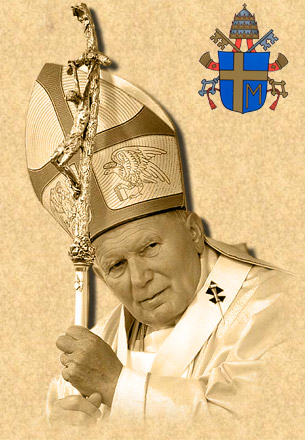
In 1999, at the age of 78, John Paul II wrote a fascinating letter. Fascinating, because as a senior citizen he wrote a Letter to the Elderly.
John Paul reminds us that: “In the past, great respect was shown to the elderly.” But today “among some peoples old age is esteemed and valued, while among others this is much less the case….”
He goes on to point out: “It has come to the point where euthanasia is increasingly put forward as a solution for difficult situations”.
There are many inspiring words of wisdom and counsel in this letter to the elderly but what I found interesting is that he points out the many prominent Biblical figures who in the later years of their lives did great things for God.
He gives 10 examples:
1. “Abraham, in whom the privilege of old age is stressed, this favour takes the form of a promise: ‘I will make of you a great nation, and I will bless you and make your name great. I will bless those who bless you and him who curses you I will curse; in you all the families of the earth will be blessed’ (Gen 12:2-3)”
2. “Sarah, a woman who sees her body growing old, yet experiences within the limitations of her aging flesh the power of God who makes good every human shortcoming.”
3. “Moses too was an old man when God entrusted him with the mission of leading the Chosen People out of Egypt. It was not in his youth but in his old age that, at the Lord’s command, he did mighty deeds on behalf of Israel.”
4. “Tobit, who humbly and courageously resolved to keep God’s Law, to help the needy and to endure blindness patiently, until the angel of God intervened to set his situation aright (cf. Tob 3:16-17).”
5. “Eleazar, whose martyrdom bore witness to an exceptional generosity and strength (cf. 2 Macc 6:18-31).”
6. “The Gospel of Luke begins by introducing a married couple ‘advanced in years’ (1:7): Elizabeth and Zechariah, the parents of John the Baptist. The Lord’s mercy reaches out to them (cf. Lk 1:5-25, 39-79)”
7. “…the aged Simeon, who had long awaited the Messiah. Taking the child in his arms, Simeon blesses God and proclaims the Nunc Dimittis: ‘Lord, now let your servant depart in peace’ (Lk 2:29).”
8. “Anna, a widow of eighty-four, a frequent visitor to the Temple, who now has the joy of seeing Jesus. The Evangelist tells us that ‘she began to praise God and spoke of the child to all who were looking for the redemption of Jerusalem’ (Lk 2:38).”
9. “Nicodemus too, a highly-regarded member of the Sanhedrin, was an elderly man. He visited Jesus by night in order not to be seen. To him the Divine Teacher reveals that he is the Son of God who has come to save the world (cf. Jn 3:1-21). Nicodemus appears again at the burial of Jesus, when, bringing a mixture of myrrh and aloes, he overcomes his fear and shows himself a disciple of the Crucified Lord (cf. Jn 19:38-40).”
10. “And what shall we say of Peter in his old age, called to bear witness to his faith by martyrdom? Jesus had once said to him: ‘When you were young you girded yourself and walked where you would; but when you are old, you will stretch out your hands, and another will gird you and carry you where you do not wish to go’ (Jn 21:18).”
He ends this list with a quote from the Psalms:
“The just will flourish like the palm-tree, and grow like a Lebanon cedar…, still bearing fruit when they are old, still full of sap, still green, to proclaim that the Lord is just” Psalm 92 (vv. 13, 15-16).
John Paul lived this fruitfulness in his own life – for after this letter – even in his old age he continued strong writing one more Encyclical letter Ecclesia de Eucharistia (17 April 2003) and 12 Apostolic letters. He also proclaimed a Jubilee year (2000) and met with the Youth in Canada in 2002. He wrote numerous letters and preached the Angelus message regularly till March 20, 2005 just a couple of weeks before his death.
Especially impressive were the 18 Pilgrimages (to 24 countries) that he made after 1999, which are listed here:
In 2000 (Fatima, Jubilee Pilgrimage to the Holy Land, and the Jubilee Pilgrimage to Mount Sinai) – in 2001 Kazakhstan, Armenia, Ukraine, and the Jubilee Pilgrimage “in the footsteps of Saint Paul the Apostle”: Greece, Syria, Malta) – in 2002 (Poland, Toronto, Ciudad de Guatemala and Ciudad de México, Azerbaijan, Bulgaria and Ischia) -in 2003 (Pompei (Italy), Slovakia, Bosnia and Herzegovina, Croatia and Spain) – in 2004 (Loreto (Italy), Lourdes (France) and Bern (Switzerland) ).
John Paul II certainly lived what he preached in this letter!
A great man whom I once met – Eddie Doherty – had been a writer when he was younger and received a special dispensation to become a priest at the age of 78. When I met Father Eddie he was even older – I will always remember a wonderful thing he said to me one day:
“I’m going to get older and older and then I am going to die and get younger and younger…”
Filed under: Evangelium Vitae, John Paul II, Quotes from Great Christians, Unborn Jesus
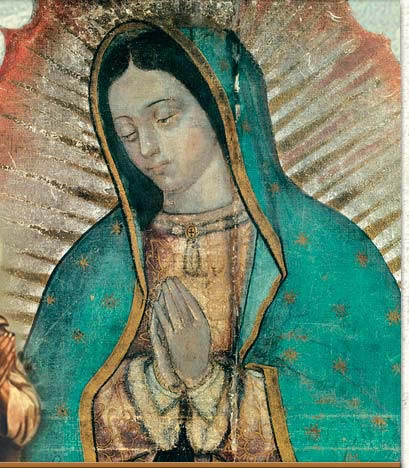
“Am I not here, I, who am your Mother? Are you not under my shadow and protection? Am I not the source of your joy? Are you not in the hollow of my mantle, in the crossing of my arms? Do you need anything more? Let nothing else worry you, disturb you .”
These wonderful words were the words of Our Lady of Guadalupe to Saint Juan Diego when she appeared to him in 1531.
These words are still relevant today as Archbishop Burke reminded us in a homily he gave in 2005 at the new Shrine of Our Lady of Guadalupe that he has helped establish in La Crosse, Wisconsin. Here are some interesting quotes from this homily.
“…our late and most beloved Pope John Paul II placed the mission of the Church in America, at the beginning of the Third Christian Millennium, under the protection of the Virgin of Guadalupe and commended her to us as the Star to lead us to Christ and, in Christ, to the conversion of our personal lives and the transformation of our world.”
Archbishop Burke calls this apparition “the mystery of the Visitation as it was experienced on our continent in 1531. The woman clothed with the sun, bearing the Infant Savior, the Anointed, in her womb, appeared to Saint Juan Diego, from December 9 to 12, 1531, in order that a chapel be built in which she might manifest the all-generous and never-failing merciful love of God for us, incarnate in her womb and alive for us in the Church, above all, in the Sacrament of the Real Presence, the Holy Eucharist.”
He reminds us that “…she has desired to remain with us always, in order that the mystery of the Visitation might be always new for us. She has miraculously left her living image on the tilma or mantle of Saint Juan Diego. In the magnificent basilica built to her honor, in which the tilma of Saint Juan Diego is enthroned, the Mother of God continues to visit pilgrims and to announce to them the great mystery of God’s all-loving and never-failing mercy.”
And that just as “… in 1531, she inspired her sons and daughters to abandon the horror of human sacrifice and to respect the inviolable dignity of every man, both the Native American and the European, so now she inspires us to be tireless disciples of the Gospel of Life, working to end the horror of procured abortion and so-called “mercy-killing,” and to promote the respect for the dignity of every human life from the moment of inception to the moment of natural death.”
This is relevant because “Pope John Paul II commended the Virgin of Guadalupe to us as the Mother of America and the Star of the New Evangelization.”
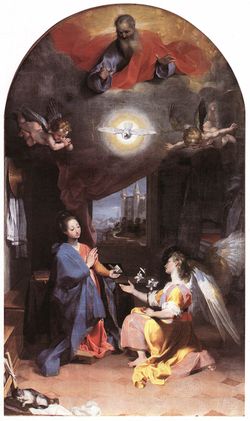
Today, November 21, is the feast day of the Presentation of the Blessed Virgin Mary. The first reading at Mass today is from Zechariah 2:14-17.
“Sing and rejoice, O daughter of Zion; for lo, I come and I will dwell in the midst of you, says the Lord. And many nations shall join themselves to the Lord in that day, and shall be My people; and I will dwell in the midst of you, and you shall know that the Lord of hosts has sent Me to you. And the Lord will inherit Judah as His portion in the holy land, and will again choose Jerusalem.
Be silent, all flesh, before the Lord; for He has roused Himself from His holy dwelling.”
This makes me think of something John Paul II wrote in his Apostolic Letter, Rosarium Virginis Mariae:
“The first part of the Hail Mary, drawn from the words spoken to Mary by the Angel Gabriel and by Saint Elizabeth, is a contemplation in adoration of the mystery accomplished in the Virgin of Nazareth.
These words express, so to speak, the wonder of heaven and earth; they could be said to give us a glimpse of God’s own wonderment as he contemplates his “masterpiece” – the Incarnation of the Son in the womb of the Virgin Mary. If we recall how, in the Book of Genesis, God “saw all that he had made” (Gen 1:31), we can find here an echo of that “pathos with which God, at the dawn of creation, looked upon the work of his hands”.
The repetition of the Hail Mary in the Rosary gives us a share in God’s own wonder and pleasure: in jubilant amazement we acknowledge the greatest miracle of history. Mary’s prophecy here finds its fulfillment: ‘Henceforth all generations will call me blessed’ (Lk 1:48).” #33.
Filed under: John Paul II
Traditionally October 7 is the feast day of Our Lady of the Rosary. The following is taken from Pope John Paul II’s Apostolic Letter on the Most Holy Rosary:
Mary, model of contemplation
“The contemplation of Christ has an incomparable model in Mary. In a unique way the face of the Son belongs to Mary. It was in her womb that Christ was formed, receiving from her a human resemblance which points to an even greater spiritual closeness. No one has ever devoted himself to the contemplation of the face of Christ as faithfully as Mary. The eyes of her heart already turned to him at the Annunciation, when she conceived him by the power of the Holy Spirit. In the months that followed she began to sense his presence and to picture his features. When at last she gave birth to him in Bethlehem, her eyes were able to gaze tenderly on the face of her Son, as she “wrapped him in swaddling cloths, and laid him in a manger”. (Lk2:7)
Thereafter, Mary’s gaze, ever filled with adoration and wonder, would never leave him.” #10
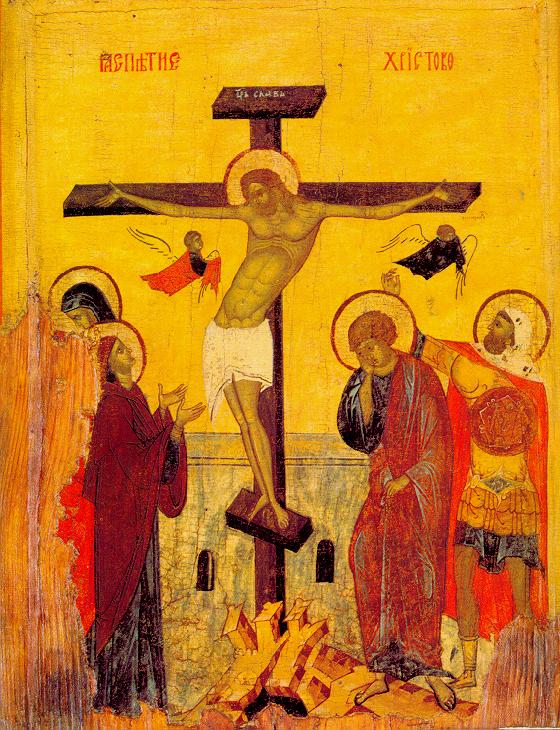

Genevieve Kineke has pointed out in her blog that the Pontifical Council for the Laity is encouraging the faithful worldwide to observe the 20th anniversary of John Paul II’s document Mulieris Dignitatem (On the Dignity and Vocation of Woman) in the coming year (2008). For more information go to The Dignity of Woman website.
Here are two beautiful quotes from this document that speak of the Annunciation in beautiful and human terms:
“It may be easy to think of this event (the Annunciation) in the setting of the history of Israel, the Chosen People of which Mary is a daughter, but it is also easy to think of it in the context of all the different ways in which humanity has always sought to answer the fundamental and definitive questions which most beset it. Do we not find in the Annunciation at Nazareth the beginning of that definitive answer by which God himself “attempts to calm people’s hearts”?” # 3
“Grace never casts nature aside or cancels it out, but rather perfects it and ennobles it. Therefore the “fullness of grace” that was granted to the Virgin of Nazareth, with a view to the fact that she would become “Theotókos”, also signifies the fullness of the perfection of “what is characteristic of woman”, of “what is feminine”. Here we find ourselves, in a sense, at the culminating point, the archetype, of the personal dignity of women.” #5
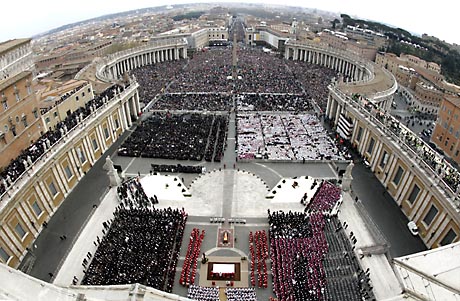
Pope John Paul II’s Funeral
When I was Director of Education for the Right to Life League of Southern California (1984-87) I worked with an older gentleman by the name of Frank Forve who had been a lawyer in his earlier days. He once told me that way back in 1959 the California Bar Assoc. passed a resolution calling for the liberalization of the abortion laws and consequently he withdrew his membership from that association. He took his first pro-life stand, the first of many, in 1959. But why did he do this? The Church had formed him, had helped him form his conscience and he knew both intuitively and intellectually what Vatican II would proclaim about six years later, in 1965: “Life must be protected with the utmost care from the moment of conception: abortion and infanticide are abominable crimes.” (Pastoral Constitution on the Church in the Modern world, #51)
Of course the Church has always taught that abortion is gravely, terribly wrong. The Church has consistently taught her children to cherish the gift of human life as a gift from Almighty God. There are thousands upon thousands of examples of how the Church is a good Mother to her children, and particularly by giving them good teaching and direction (in season and out of season) through these past two thousand years.
Which brings us to JPII. I could argue twenty different reasons for distinguishing him as one of the Church’s greatest popes, but here I will mention only one: his Gospel of Life encyclical letter issued in 1995. It is a prophetic teaching for our modern age and is rich in its content. He faces the abortion plague head on, he analyzes society’s contributing problems and weaknesses and presents a resounding call to promoting a Culture of Life. It is a manifesto of sorts for all Christians who are pro-life (which should be all Christians). In the years ahead more and more Christians will come to appreciate it. G.P.
Filed under: John Paul II

“The family founded on marriage is truly the sanctuary of life, ‘the place in which life — the gift of God — can be properly welcomed and protected against the many attacks to which it is exposed, and can develop in accordance with what constitutes authentic human growth’. Its role in promoting and building the culture of life against “the possibility of a destructive ‘anti-civilization’, as so many present trends and situations confirm”, is decisive and irreplaceable.
Christian families have then, in virtue of the sacrament received, a particular mission that makes them witnesses and proclaimers of the Gospel of life. This is a commitment which in society takes on the value of true and courageous prophecy. It is for this reason that ‘serving the Gospel of life … means that the family, particularly through its membership in family associations, works to ensure that the laws and institutions of the State in no way violate the right to life, from conception to natural death, but rather protect and promote it’.”
Compendium of the Social Doctrine of the Church, #231.
Filed under: John Paul II
Among the most important of these rights, mention must be made of the right to life, an integral part of which is the right of the child to develop in the mother’s womb from the moment of conception; the right to live in a united family and in a moral environment conducive to the growth of the child’s personality; the right to develop one’s intelligence and freedom in seeking and knowing the truth; the right to share in the work which makes wise use of the earth’s material resources, and to derive from that work the means to support oneself and one’s dependents; and the right freely to establish a family, to have and to rear children through the responsible exercise of one’s sexuality.
Also from the same document section:
The Church respects the legitimate autonomy of the democratic order and is not entitled to express preferences for this or that institutional or constitutional solution. Her contribution to the political order is precisely her vision of the dignity of the person revealed in all its fulness in the mystery of the Incarnate Word.
John Paul II, Centesimus annus, #47, (1991)
Filed under: John Paul II
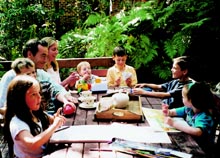
Everyone seems interested in preserving the natural habitats of different species while the natural habitat of the human species (the family) is being systematically destroyed. We need to start a new environmental movement to save the human species and its natural habitat. We’ll call it the “Human Ecology” Movement. See what John Paul II said about this:
“In addition to the irrational destruction of the natural environment, we must also mention the more serious destruction of the human environment, something which is by no means receiving the attention it deserves. Although people are rightly worried — though much less than they should be — about preserving the natural habitats of the various animal species threatened with extinction, because they realize that each of these species makes its particular contribution to the balance of nature in general, too little effort is made to safeguard the moral conditions for an authentic “human ecology”.
The first and fundamental structure for “human ecology” is the family, in which man receives his first formative ideas about truth and goodness, and learns what it means to love and to be loved, and thus what it actually means to be a person. Here we mean the family founded on marriage, in which the mutual gift of self by husband and wife creates an environment in which children can be born and develop their potentialities, become aware of their dignity and prepare to face their unique and individual destiny….
It is necessary to go back to seeing the family as the sanctuary of life. The family is indeed sacred: it is the place in which life — the gift of God — can be properly welcomed and protected against the many attacks to which it is exposed, and can develop in accordance with what constitutes authentic human growth. In the face of the so-called culture of death, the family is the heart of the culture of life….
Human ingenuity seems to be directed more towards limiting, suppressing or destroying the sources of life — including recourse to abortion, which unfortunately is so widespread in the world — than towards defending and opening up the possibilities of life.”
John Paul II, Centesimus annus, 38, 39
Filed under: John Paul II
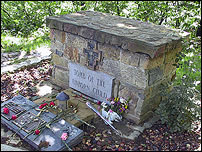
On June 4, 1991 in Radom, Warsaw, John Paul II spoke from the heart to his countrymen. In reading the following paragraph, one senses that this is not the normal formally prepared text that we typically receive from a Pontiff at a formal gathering. Rather, John Paul expresses anguish as he shares a personal memory with his beloved countrymen.
“Forgive me, dear Brothers and Sisters that I will go further. The cemetery of the victims of human cruelty in our century is extended to include yet another vast cemetery, that of the unborn, of the defenseless whose faces were not known by their own mother, agreeing or yielding under pressure to take their lives before they are born. And yet they had the life, they were conceived, grew under the hearts of their mothers, not sensing their deadly threat. But when the threat became real, these defenseless human beings tried to defend themselves. A film camera registered this desperate defense of an unborn child in the mother’s womb against aggression. Once I saw the film and until today I cannot get rid of it, I cannot erase it from my memory. It is hard to imagine a drama that is more horrible in its moral human expression…”
“…Let us also notice that the commandment ‘Thou shalt not kill’ does not only contain a command. It calls us to assume certain attitudes and positive behavior. Do not kill but rather protect life, protect health and respect the human dignity of every man, regardless of his race or religion, level of intelligence, level of awareness or age, health or illness. Do not kill but rather accept another being as God’s gift – especially if it is your own child.”
For the complete text of his homily in Polish.
For an English translation of four paragraphs.
Filed under: John Paul II
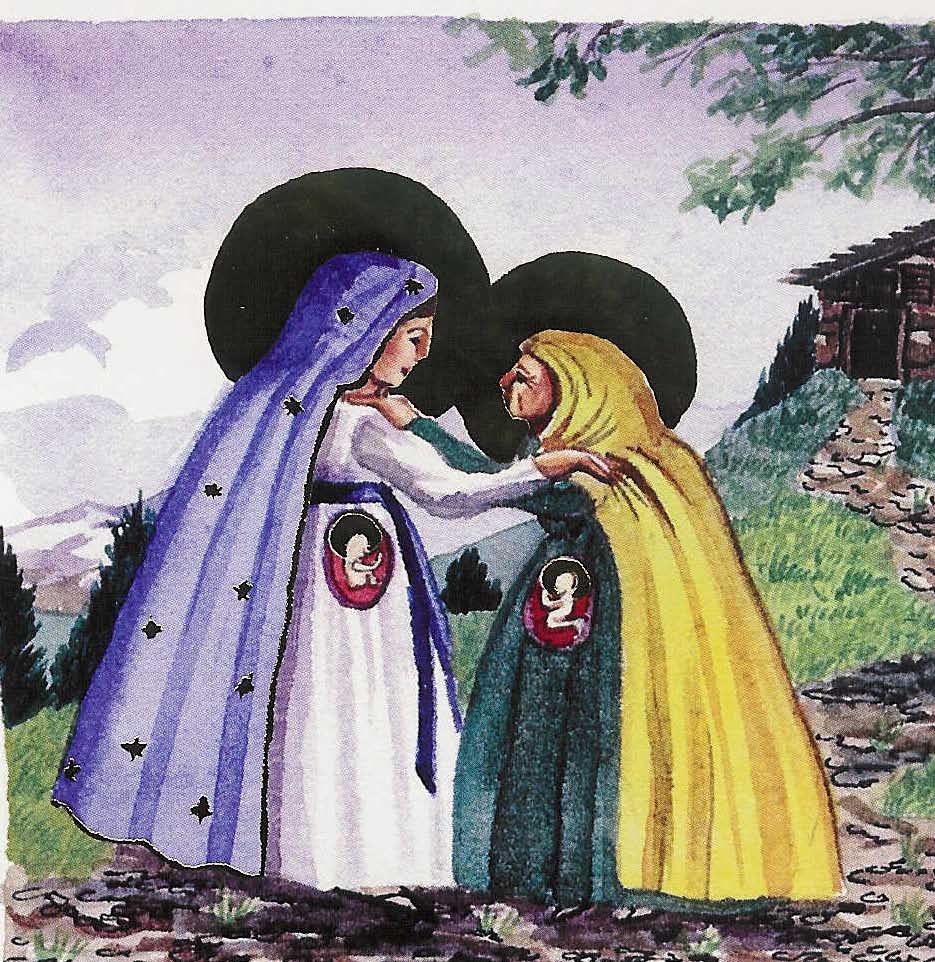
In today’s Gospel, Sunday, July 8, 2007, St. Luke recounts the Lord’s appointing of 72 others sent off, two by two, as evangelists. These 72 prefigured the great missionary journeys, years later, of the Apostles, St. Paul and others proclaiming the Gospel of Jesus Christ. But in the first chapter of St. Luke’s Gospel, Mary (pregnant with Unborn Jesus) is presented as the “first evangelist”! Pope John Paul II explains:
“In the Visitation episode, St Luke shows how the grace of the Incarnation, after filling Mary, brings salvation and joy to Elizabeth’s house. The Saviour of men, carried in his Mother’s womb, pours out the Holy Spirit, revealing himself from the very start of his coming into the world…. St Luke also seems to invite us to see Mary as the first “evangelist”, who spreads the “good news”, initiating the missionary journeys of her divine Son.” General Audience, Pope John Paul II, October 2, 1996
 UNBORN WORD of the day