“He was despised and rejected by men…” Isaiah 53:3
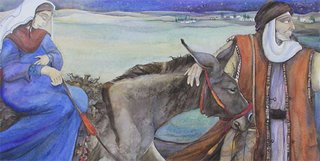
Joseph and Mary (and her unborn baby) approach the Inn at Bethlehem. Humanity is given yet another opportunity to shine, to welcome the poor and accept the pregnant woman in need. The door is shut in their faces. Their need goes unmet. Their prospects for this birth are not bright.
Yet overhead there is a star (Mt 2:2). In Heaven’s “off stage” stood “the angel of the Lord” and “a multitude of the heavenly host” (Lk 2:9-14) waiting impatiently, by Heaven’s standards. Humanity had fallen again in reaching out to God. But this time, God the Father would arrange a special reception for His Son. Beasts, angels and humans would be drawn to the manger in Bethlehem.
But for now, Joseph, Mary (and the Unborn Christ Child) are homeless. As Jesus would observe three decades later: “Foxes have holes, and birds of the air have nests; but the Son of man has nowhere to lay his head” (Mt 8:20). Joseph and Mary again exercise faith in Almighty God and trust in His Providential plan for their lives, even as they huddle together, looking this way and that, for some idea of where to go next.
The last day of Mary’s redemptive pregnancy is the first day of the rest of our salvation history. A revelation like no other is about to break upon humanity’s shoreline. A great manifestation is about to unfold on earth’s stage. From the hidden uncharted depths of the womb God will come to visit His people.
But not yet! Mary walks slowly, following Joseph’s lead. The sky is darkening now, but still there is that glimmer of a star on the horizon. At this point we can join our prayers with Mary and Joseph, for this Unborn Baby and all unborn babies.
JUST 1 MORE PRAYING DAYS ‘TIL CHRIST’S BIRTH!
Today, November 21, is the feast day of the Presentation of the Blessed Virgin Mary. The first reading at Mass today is from Zechariah 2:14-17.
“Sing and rejoice, O daughter of Zion; for lo, I come and I will dwell in the midst of you, says the Lord. And many nations shall join themselves to the Lord in that day, and shall be My people; and I will dwell in the midst of you, and you shall know that the Lord of hosts has sent Me to you. And the Lord will inherit Judah as His portion in the holy land, and will again choose Jerusalem.
Be silent, all flesh, before the Lord; for He has roused Himself from His holy dwelling.”
This makes me think of something John Paul II wrote in his Apostolic Letter, Rosarium Virginis Mariae:
“The first part of the Hail Mary, drawn from the words spoken to Mary by the Angel Gabriel and by Saint Elizabeth, is a contemplation in adoration of the mystery accomplished in the Virgin of Nazareth.
These words express, so to speak, the wonder of heaven and earth; they could be said to give us a glimpse of God’s own wonderment as he contemplates his “masterpiece” – the Incarnation of the Son in the womb of the Virgin Mary. If we recall how, in the Book of Genesis, God “saw all that he had made” (Gen 1:31), we can find here an echo of that “pathos with which God, at the dawn of creation, looked upon the work of his hands”.
The repetition of the Hail Mary in the Rosary gives us a share in God’s own wonder and pleasure: in jubilant amazement we acknowledge the greatest miracle of history. Mary’s prophecy here finds its fulfillment: ‘Henceforth all generations will call me blessed’ (Lk 1:48).” #33.
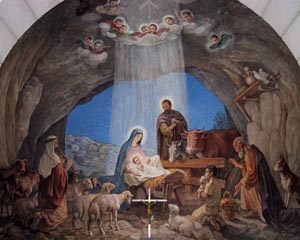
Christ is the light and center point of the Culture of Life. He embodies in Himself the good news of this Culture of Life; He is the Gospel of Life!
To the culture of death, which surrounds us, He is the counterpoint:
“The people who walked in darkness have seen a great light;
those who dwelt in a land of deep darkness, on them has light shined…
For to us a child is born, to us a son is given; and the government will be upon his shoulder, and his name will be called ‘Wonderful Counselor, Mighty God, Everlasting Father, Prince of Peace.'”
The people of the culture of death are afraid of children and afraid of this Light.
The people of the Culture of Life are emboldened by this Light.
When Gabriel appeared to Zechariah to announce the conception and birth of John, he said: “Do not be afraid Zechariah…” Lk 1:13
When Gabriel appeared to Mary to announce the conception and birth of Jesus, he said:“Do not be afraid Mary…” Lk 1:30
When the angel of the Lord appeared to Joseph to announce the conception and birth of Jesus, he said: “…do not fear…” Mt 1:20
When the angel of the Lord appeared to the shepherds in Bethlehem to announce the birth of Jesus, he said: “Be not afraid…” Lk 2:10
As Christ was coming into the world as a baby, a star appeared in the East to lead gentiles to Christ, ‘the Light of the World’ (Mt 2:1-12, Jn 8:12). Christ is our Light and Life today as well. In Christ we find a resounding call to courage, hope and confidence, which strengthens us to proclaim His Gospel of Life and to welcome children into our world.
“The light shines in the darkness, and the darkness has not overcome it.” Jn 1:5
Filed under: Incarnation
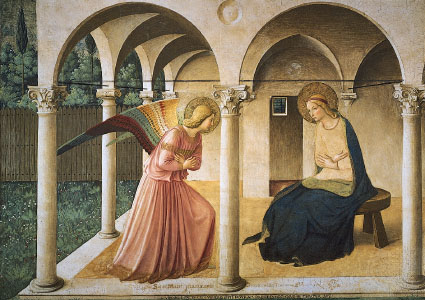
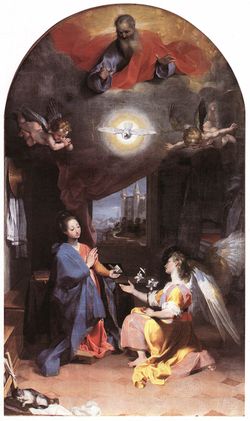
Today, September 29 is the feast day of St. Michael, St. Raphael and St. Gabriel. Gabriel appears to Daniel, Zachariah and Mary in the Bible. Harriet Beacher Stowe in her book, Footsteps of the Master, points to another noteworthy quality found in Mary by comparing her and the Prophet Daniel’s reactions to this awe inspiring Angel, whose name means “man of God,” or “God has shown himself mighty.”
“There is in her whole character a singular poise and calmness. When the Angel of the Annunciation appeared to her she was not overcome by the presence of the spiritual being as Daniel was, who records that ‘he fell on his face and there was no strength in him.’
Mary, in calm and firm simplicity, looks the angel in the face, and ponders what the wonderful announcement may mean. When she finds that it really does mean that she, a poor lonely maiden, is the chosen woman of all the human race – the gainer of the crown of which every Jewish woman had dreamed for ages – she is still calm.”

Today is the Feast day of St. Augustine (354 – 430 A.D.), one of the greatest Fathers of the Church. In the following brief quote Augustine reflects on Christ “as servant” within the womb of His mother and at His birth as well.
We have then proved that the birth of the Son was the work of the Father; now let us prove that it was the work of the Son also. Now what is the birth of the Son of the Virgin Mary? Surely it is His assumption of the form of a servant in the Virgin’s womb. Is the birth of the Son ought else, but the taking of the form of a servant in the womb of the Virgin? Now hear how that this was the work of the Son also. “Who when He was in the form of God, thought it not robbery to be equal with God, but emptied Himself, taking upon Him the form of a servant.” (Phil 2:6-7) “When the fullness of time was come, God sent forth His Son, made of a woman,” (Gal 4:4) who was “made His Son of the seed of David according to the flesh.” (Rom 1:3) In this then we see that the birth of the Son was the work of the Father; but in that the Son Himself “emptied Himself, taking the form of a servant,” we see that the birth of the Son was the work also of the Son Himself.
St. Augustine Sermons (51-60) On Selected Lessons of the New Testament/Sermon 2, point 11
Filed under: Incarnation
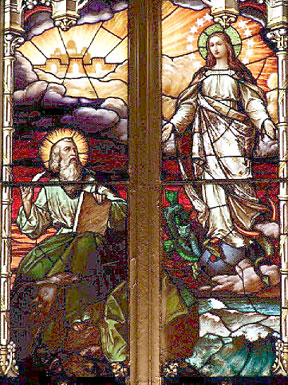
Today, August 22, 2007 is the feast of The Queenship of Mary.
In this age of democracies and wannabe or pretend-to-be democracies, many have forgotten that the New Testament contains numerous references to Christ as “King” (as well as to His Kingdom, His Reign, throne and so on). And again, many dismiss these titles as archaic and irrelevant in a time of such modern sophistication. It’s quite curious that the modern person pretty much disdains the concept of a monarchy.
So when Christians today come across a reference in the Bible to Christ as King many look at it as a mere symbolic concept not a real title connoting Power and Authority. But the personages who appear in the Book of Revelations seem to take His Kingship quite seriously! Christ is King! And we are most fortunate that He is our King!
Enter Mary, the Queen Mother. Does she further complicate the problem or further enhance the sublimity of the reality of Christ the King? The latter I wager. When Martin Luther discussed this briefly in his reflections on the Wedding Feast at Cana he states that the title ‘Queen of Heaven’ “is a true-enough name” but quickly adds that it “does not make her a goddess”. So in this I agree with Luther, the title “Queen of Heaven” is apt and Mary is human not Divine. No argument here. In the Book of Revelations the apostle John shows us Mary pregnant, with a crown of twelve stars upon her head (Rev 11:19-12:17).
By the way, all Christians have a little share in Christ’s royalty just as we have a little share in His Priesthood too. St. Peter says of Christians: “But you are a chosen race, a royal priesthood, a holy nation…” (I Pet 2:9). Does my tiny share in the priesthood of Christ diminish His Kingship? No, my humble participation is meant to point heavenward to His greater Glory! Does Mary’s Queenship diminish His Kingship? No. it is, in fact, His idea – see Revelations 11:19 -12:17.
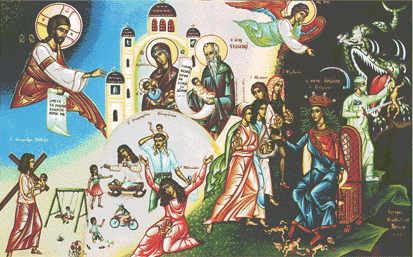
The Horror of Abortion – The Icon Explained
There is a powerful threshold-like verse in the Old Testament that is rather striking. Moses, the law giver, speaks the Lord’s words to the people: “…I have set before you life and death, blessing and curse; therefore choose life, that you and your descendants may live…” (Dt 30:19)
We today – every day – must also choose life! Here are some of the daily choices that Christians face: God or mammon (Mt 6:24), Christ or Anti-Christ (II Jn.7), Gospel of Life or a so-called gospel of death, a Culture of Life or a culture of death, and finally Incarnation or abortion.
This last choice is purposely posed in unusual terminology for several reasons. Jesus came into the world as an unborn baby, starting His human life at conception like the rest of us. And like the rest of us He was birth-bound, Bethlehem-bound, on a journey of development and growth. But He later put these nine months into a different light when He taught us: “…as you did it to one of the least of these my brethren, you did it to me” (Mt 25:40). When a child is conceived, God has an immediate interest in the temporal and eternal welfare of that child (I Tim 2:1-4). When a child is conceived, Christ Incarnate identifies Himself with that little one right from the start. Just as the Incarnation is a gift to all humanity, so the life of a little child is also a little gift to us all.
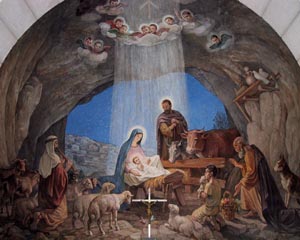
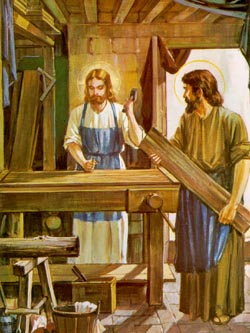

Today, August 1, 2007 is the feast day of St Alphonsus de Ligouri (1696-1787). Below are a reflection and an excerpt from a prayer written by Alphonsus:
“Consider that the Eternal Father addressed these words to the Infant Jesus at the instant of His conception: ‘I have given Thee to be the light of the Gentiles, that Thou mayest be My salvation’ (Isa 49:6). My Son, I have given Thee to the world for the light and life of all people, in order that Thou mightest procure for them their salvation, which I have as much at heart as if it were my own. Thou must therefore employ Thyself entirely for the well-being of men: ‘Wholly given to man, Thou must be wholly spent in his service’ (St. Bernard). Thou must therefore, at Thy birth, suffer extreme poverty, in order that men may become rich, ‘that Thou mayest enrich them by Thy poverty’”. (Meditation I, Novena for Christmas)
“O Divine Word, become man for me, though I behold Thee thus humbled and become a little infant in the womb of Mary, yet I confess and acknowledge Thee for my Lord and King, but a king of love…Ah, my infant King, how could I so often rebel against Thee, and live so long Thy enemy, deprived of Thy grace, when, to oblige me to love Thee, Thou hast put off Thy divine majesty, and hast humbled Thyself even to appearing, first, as a babe in a cave; then as a servant in a shop; then as a criminal on a cross?” (Meditation, 1st Wednesday of Advent)
From THE INCARNATION, BIRTH AND INFANCY OF JESUS CHRIST by St. Alphonsus de Liguori.
And from His fulness have we all received, grace upon grace. John 1:16
“St. Thomas Aquinas tells us that Mary’s fulness of grace increased notably at the Incarnation through the presence of the Word of God made flesh.”
“…Mary was, of all creatures, the one who entered into closest contact with Him in His humanity since He took flesh in her womb. Hence, it was appropriate that she should have received a notable increase of grace at the Incarnation.”
“Speaking of the time when the Body of the Saviour was formed in Mary’s virginal womb, Fr. Hugon says: ‘She must have made uninterrupted progress in grace during those nine months – ex opere operato, as it were – through her permanent contact with the Author of holiness. If her plentitude of grace is incomprehensible at the time of the Incarnation, what must it have been at the Nativity…'”
“As we have said, grace is an effect of God’s active love for his creature…Hence His love for her produces grace in her soul – such an abundance of grace as to be capable of overflowing on souls.”
Father Reginald Garrigou-LaGrange, O.P., The Mother of the Saviour and Our Interior Life, 1948
 UNBORN WORD of the day