


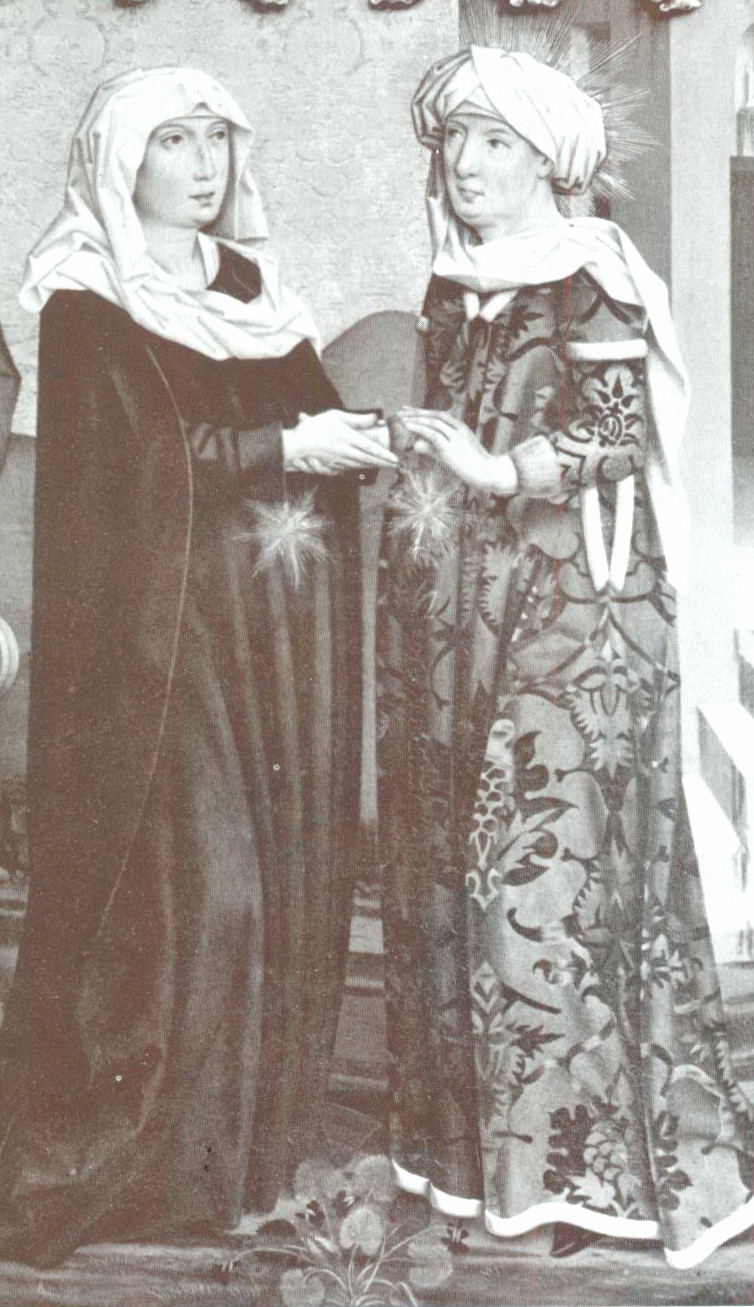
Fragment des Georgsaltares von Friedrich Herlin
Monday, May 31st is the Feast of the Visitation. After Mary conceived Christ in her womb, she “went with haste” to the home of her cousin Elizabeth (probably in Ain-Karim, on the outskirts of Jerusalem); about a 4 day journey. She traveled with confidence; Christ in her womb, the Spirit in her heart, the will of the Father clearly outlined within her intellect, and a peaceful harmony between God’s Will and her own.
The Gospel of Luke gives a wondrous account of Mary’s arrival at the home of Elizabeth (Lk 1:39-56). This encounter, this Gospel event of the first magnitude, is regrettably much neglected by believers in general. Yet it is a Pro-Life “Feast Day” of the first order! When Mother Teresa of Calcutta gave her famous Nobel Peace Prize acceptance speech she mentioned this prophetic scene of two unborn babies meeting. In his prophetic Pro -Life encyclical Evangelium Vitae (The Gospel of Life), John Paul II refers to this scene twice (#45, footnote to #61), calling it a “magnificent episode”. Others have marveled at this event as well, for example; Archbishop Fulton Sheen: “when pregnancy met pregnancy” we witness “A Pentecost came before Pentecost” (The World’s First Love).
Mary greets Elizabeth, unborn John leaps “for joy” in his mother’s womb. Luke feels compelled to relay this event twice (verses 41, 44). The Catechism of the Catholic Church weighs in on this beautiful mystery of our faith: “John was ‘filled with the Holy Spirit even from his mother’s womb’ by Christ himself, whom the Virgin Mary had just conceived by the Holy Spirit. Mary’s visitation to Elizabeth thus became a visit from God to His people” (CCC #717, emphasis added).
So, the just-conceived Unborn Christ acts deliberately here! He fills the unborn baby John with His Holy Spirit; virtually a gift of Himself, a redeeming gift which prefigures the salvation of the world. God has singled out one tiny unborn baby – just days after His Incarnation – into whose heart He pours His Spirit (fulfilling Gabriel’s promise of Lk 1:15). An exquisite prefiguring of His Redemptive Mission… and a tender sign of His impenetrable Love for all unborn babies (of whom John is a representative; every unborn baby).

Maria der erste Tabernakel von J. Hane
The reading for Mass today included these wonderful words:
“For God so loved the world that he gave his only son, that whoever believes in him should not perish but have eternal life.”
From the first cell stage of His conception and new human life, Christ loved His Father in heaven and all of us on earth. Pope Pius XII assures us that from the first moment of His conception, “the Heart of Jesus, ever to be adored, began to pulsate with love, divine and human” (On Devotion to the Sacred Heart of Jesus).
We know that from the first moment of His conception the Unborn Christ (as Zygote, the one cell stage) joined His will to the will of His Father (Heb 10:5-7). ) Pius XII tells us “But the knowledge and love of our Divine Redeemer, of which we were the object from the first moment of His Incarnation, exceed all that the human intellect can hope to grasp. For hardly was He conceived in the womb of the Mother of God, when He began to enjoy the beatific vision, and in that vision all the members of His Mystical Body were continually and unceasingly present to Him, and He embraced them with His redeeming love.” The Mystical Body Of Christ, #75
We believe too that Christ loved His mother from the first moment of His conception (and that she joined her will to His; “Behold, I am the handmaid of the Lord; let it be to me according to your word.” Lk 1:38
And a week later in her Magnificat, when Mary says “My soul magnifies the Lord…” first and foremost, she magnified the Love of Christ hidden within her. His love was bursting forth from the womb which contained Him. His love, in a sense could not be contained along with His tiny body, within the womb of His mother.
When Mary arrived at the home of Elizabeth (six months pregnant with John the Baptist), the Catechism of the Catholic Church tells us that it was “Christ Himself” who filled unborn baby John with His Spirit of Love (CCC #717). Christ demonstrates His love here for unborn baby John and all unborn babies!
Out of Love, Unborn Christ inspires His mother to stay for the entire pregnancy of Elizabeth, accompanying unborn John lovingly to birth.
When they return to Nazareth, Unborn Christ loves Joseph too. In Bethlehem He loves the shepherds, the wise men, even those who rejected Him and His pregnant mother at the door of the Inn. At His glorious birth in the manger, His powerful Love broke forth like a wave of Love across the earth, hidden for a time, but affecting Mary and Joseph and countless others who would discover in time the message of Redeeming Love!
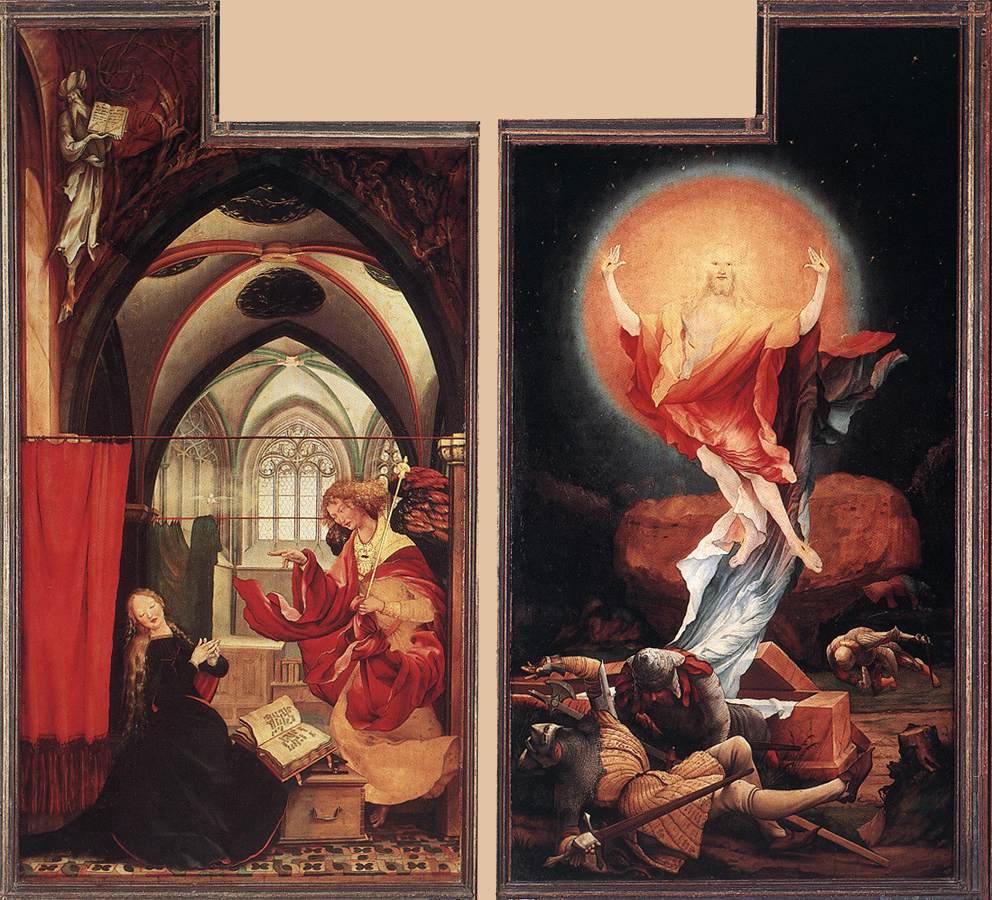
Matthias Grunewald, Annunciation and Resurrection
“Christ is the Lord of time; he is its beginning and end; every year, every day, every moment are embraced by his Incarnation and Resurrection, and thus become part of “the fullness of time’ ”
. “For me it is the virgin birth, the Incarnation, the resurrection which are the true laws of the flesh and the physical. Death, decay, destruction are the suspension of these laws. I am always astonished at the emphasis the Church puts on the body. It is not the soul she says will rise but the body, glorified…”
Flannery O’Connor, The Habit of Being, pg. 100
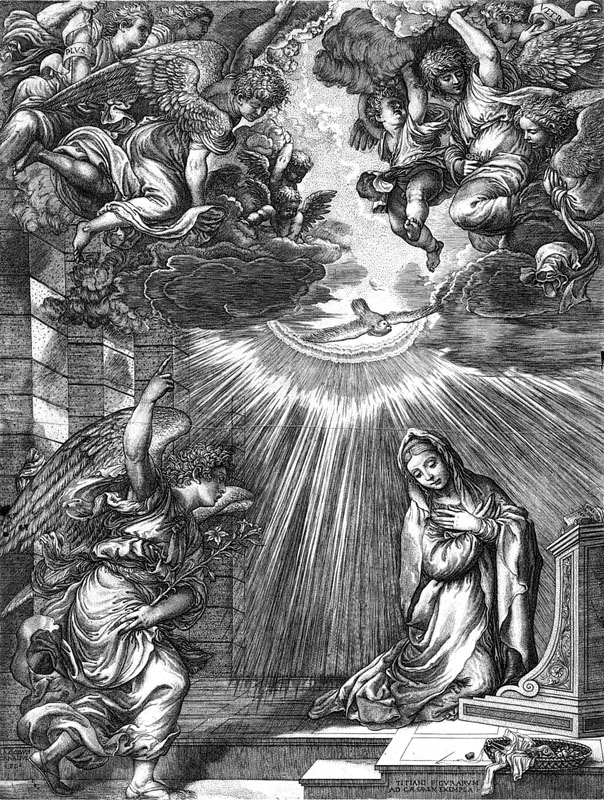
The Annunciation by Giovanni Jacopo Caraglio
On May14, 2009 Pope Benedict XVI visited the Basilica of the Annunciation in Nazareth, Israel. Here is an excerpt from his homily:
“What happened here in Nazareth, far from the gaze of the world, was a singular act of God, a powerful intervention in history, through which a child was conceived who was to bring salvation to the whole world. The wonder of the Incarnation continues to challenge us to open up our understanding to the limitless possibilities of God’s transforming power, of his love for us, his desire to be united with us….
The Spirit who “came upon Mary” (cf. Lk 1:35) is the same Spirit who hovered over the waters at the dawn of Creation (cf. Gen 1:2). We are reminded that the Incarnation was a new creative act. When our Lord Jesus Christ was conceived in Mary’s virginal womb through the power of the Holy Spirit, God united himself with our created humanity, entering into a permanent new relationship with us and ushering in a new Creation.”
The narrative of the Annunciation illustrates God’s extraordinary courtesy (cf. Mother Julian of Norwich, Revelations 77-79). He does not impose himself, he does not simply pre-determine the part that Mary will play in his plan for our salvation: he first seeks her consent. In the original Creation there was clearly no question of God seeking the consent of his creatures, but in this new Creation he does so. Mary stands in the place of all humanity. She speaks for us all when she responds to the angel’s invitation. Saint Bernard describes how the whole court of heaven was waiting with eager anticipation for her word of consent that consummated the nuptial union between God and humanity. The attention of all the choirs of angels was riveted on this spot, where a dialogue took place that would launch a new and definitive chapter in world history. Mary said, “Let it be done to me according to your word.” And the Word of God became flesh.”
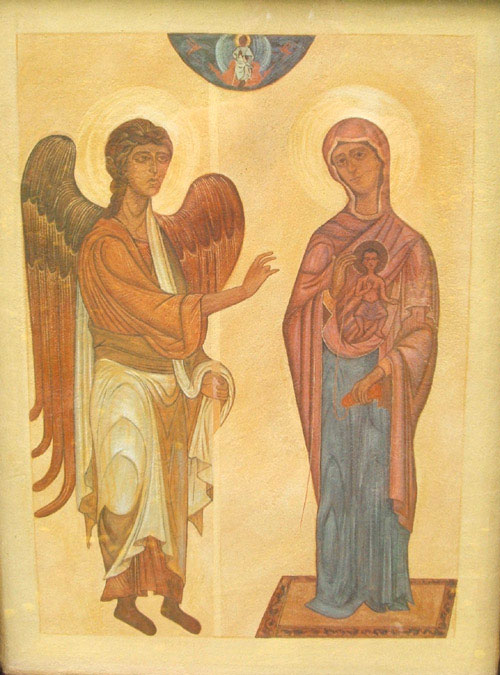
“When we reflect on this joyful mystery, it gives us hope, the sure hope that God will continue to reach into our history, to act with creative power so as to achieve goals which by human reckoning seem impossible.”
Pope Benedict, Homily at the Basilica of the Annunciation, May14, 2009
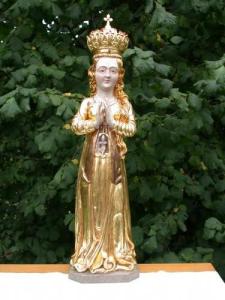
The Trutzhain Madonna. As a ‘Mater gravida’ she is the ‘pregnant Madonna’ with the infant Jesus under her heart.
“Our ailing sight, since the fall, was not able to look upon God to read in Him our duty; the Son of God, in making Himself a little child, has given us a salve wherewith to anoint our eyes and so enable them to see the divine majesty in the humility of our flesh, in order that we might conform our life to His.”
From: Christian Spirituality by Pere P. Pourrat, p. 232. Published in 1922, Burns, Oates and Washbourne, ltd. (London)
Filed under: Biblical Reflections, Incarnation, Mother of the Lord, Unborn Jesus
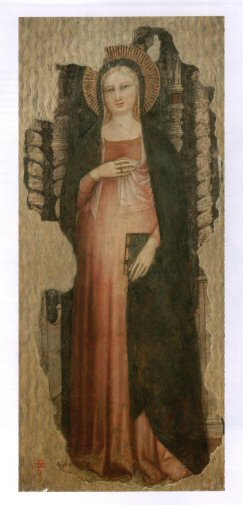
Nardo di Cione, 1346-m. 1365, Madonna del parto , Firenze, San Lorenzo: 1365
Our prior six posts* have considered the mystery of Mary’s contemplation and remembrance of all the significant events, revelations and Divine inspirations that occurred in her life, and in the lives of others nearby, during the course of her nine month pregnancy. With Christ alive just inches beneath her listening heart, she was the living echo of God’s abundant grace during those initial months of the Incarnation.
It fell upon her, that is, it was an integral part of her office as Mother to the Incarnate Word, to be exquisitely attentive to every event, revelation and inspiration concerning her Son during His entire life, but especially during the sacred months of her pregnancy while she was the only one in direct communion with Him.
Before the apostles had ever been chosen or an Apostles Creed had been formulated, she was the contemplative memory of the Church (as John Paul II would say). Before the great St. Paul was converted, Mary was pondering in her heart the deepest mysteries of Christ, and marveling at the Plan of Salvation as it was unfolding – first, within her body, as a softly lit light, and later as a glowing beacon for all of Israel to behold. She carried the church’s forming Creed in her heart while carrying humanity’s developing Unborn Redeemer within her womb.
With the birth of Christ came yet another cloudburst of inspired witnesses: the angels spoke to the shepherds and the shepherds came to worship and told Mary and Joseph what they had been told. Next, the three wise men from the East came and also shared their wisdom. At the Temple, holy Simeon and the prophetess Anna were inspired to speak of the Christ child. An angel appeared to Joseph to instruct him. As Mary and Joseph fled with their newborn Son, Christ now became a political problem and death for young children was the King’s answer to the problem of Christ.
We do not have time here to sift through all of these wondrous happenings in this “fourth trimester” – the months immediately following the Nativity – but the Holy Spirit was extremely active and gracious during this hallowed time as well.
*This 7th post concludes this series.
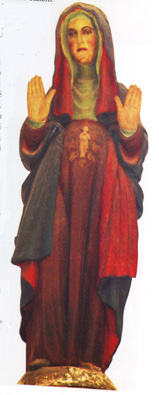
Statue de la Vierge enceinte, seul reste de cette L’abbaye des Allois (moniales bénédictines
This is our sixth post in a series exploring the Creed of Christian faith being revealed to Mary during her pregnancy, trimester by trimester, event by event. We now come to the third trimester. Lk 2:1-7 explains that Caesar has inadvertently determined the place for the Christ Child to be born. According to the census (enrollment) ordered by Caesar, Joseph would have to travel to Bethlehem to fulfill his obligation. Mary (and Unborn Jesus) would accompany him.
Micah the prophet had prophesied this eventuality (see Micah 5:2, Mt 2:4-6):
“And you, O Bethlehem, in the land of Judah,
are by no means least among the rulers of Judah;
for from you shall come a ruler
who will govern my people Israel.” Mt 2:6
Before hearing of the enrollment, Mary probably did not know for certain where her Son would be born. This news from Rome was like a piece of a puzzle, which enabled Mary to connect the dots and it is very possible she related the above text from Micah to her specific travel itinerary, and praised God. The verse not only identifies the place of the birth, but states that her Son will be “a ruler who will govern my people Israel”. Mary can now add this information to all of the prior information she had been receiving from angels (Gabriel and the angel of the Lord), remnant Saints (Elizabeth, Zechariah, Joseph) and the Holy Spirit. Now politicians and prophets are enlightening her concerning the Will of God and the mystery of the Incarnation.
It is worth noting also that during these nine months Mary clearly would have ascribed other Old Testament prophecies to her Son (and herself) and would have been thereby further enlightened. One example should suffice: “Behold, a virgin shall conceive, and bear a son, and shall call his name Immanuel” (Isa 7:14). If nothing else, she could derive from this verse the fact that she as virgin Mother held a Messianic office and the prophets through the centuries were preparing the people for this great dawning of the Messianic Age.
The third trimester ends when the child leaves the womb and is born. So we still have another third trimester event to consider. Mary and Unborn Jesus, along with Joseph, were turned away at the Inn “because there was no place for them”. Here is a profound message for Mary about the difficulty and rejection in store for her Son. Like many of the prophets before Him, her son would no doubt meet with some rejection. (Mary may have even gone so far as to possibly relate the Messianic Psalm 22 to her Son even now, before He had even been born: “My God, my God, why hast thou forsaken me?”; verse 1).
So they end up in a manger, in humility, and she senses the meekness of God’s Plan for her Son, even now before He is born. She intuitively senses here in this manger, the order of Creation, and perceives that her Son has come indeed to restore a proper order to all things; from the animal kingdom to the angelic realms. She will no longer be heavy with child, but her heart will remain full of Incarnation truths and mysteries, both lived and believed.
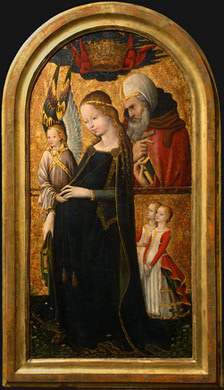
The Expectant Madonna with Saint Joseph, 15th century French, National Gallery of Art, Samuel H. Kress Collection
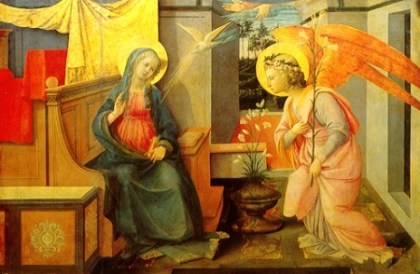
Mary’s pregnancy was unique for dozens of reasons. One aspect of her pregnancy that has been neglected is the corresponding Revelations she received regularly throughout the pregnancy which are explicitly referenced in the Gospels but almost universally overlooked. God wanted her to be illuminated in her intellect and heart while she was nurturing within her womb the growing mystery of salvation; the Incarnate Son of God.
Let’s do a quick review of these Revelations by trimester (approximated). Note that each Revelation is either directly given to her by an angel of God or by the Holy Spirit or by persons who were directly instructed by angels or inspired by the Holy Spirit. (And all of these direct Revelations presuppose a profound and holy grasp of her foundational Israelite faith, including a superior knowledge of Hebrew scripture).
FIRST TRIMESTER: Luke 1:26-38 (this Revelation was given in conjunction with the conception of Christ), Lk 1:39-45, Lk 1:46-55 (these two occurred about one week later). Mary stayed with Elizabeth and Zechariah for three months and the following Revelations were given her: Lk 1:5-25, Lk 1:57-79. (We are assuming that Mary who experienced these events or had them relayed to her firsthand, passed them on to Luke.)
SECOND TRIMESTER: Matthew 1:20-24 (cross reference Isaiah 7:14). Joseph is instructed by an angel and no doubt revealed to Mary exactly what he had been told.
THIRD TRIMESTER: Luke 2:1-7 (cross reference Micah 5:2).
FOURTH TRIMESTER ? – REVELATIONS IMMEDIATELY FOLLOWING
THE NATIVITY: Luke 2:8-20, Lk 2:21, Lk 2:22-38, Matthew 2:1-11, Mt 2:12-18.
Mary is tutored by God throughout her pregnancy and immediately following the birth of Jesus. As she was living God’s Plan of Salvation, minute-by-minute, experiencing these grace-charged events, she was also being given Revealed teachings from God (directly and indirectly). We have listed a sequence of both events and Revelations above. In our next post, we will reflect upon the “Revealed teachings” given to Mary during these months, in part to prepare and strengthen her as she embraced her role as an intimate supporting collaborator in the Incarnation Mission of Jesus Christ.
As Mary flees for Egypt, her womb is now empty, but her intellect is full, her heart even fuller…with love for the child in her arms.
El Greco (1541-1614) St. Luke (detail)

In the temporal order we say that the shortest distance between two points is a straight line.
In the spiritual order we can say that the truest path between two events in the Plan of Salvation is simply the will of God.
This can be demonstrated in the life of Jesus Christ. Let’s consider the Incarnation and the Resurrection. When Christ came into the world – according to the Letter to the Hebrews – He said:
“Sacrifices and offerings thou hast not desired,
but a body hast thou prepared for me;
in burnt offerings and sin offerings thou has taken no pleasure.
Then I said, ‘Lo, I have come to do thy will, O God,
as it is written of me in the roll of the book.’” Heb 10:5-7
St. Alphonsus de Ligouri, a Doctor of the Church, says Christ spoke these words at the first moment of His conception. The Church has traditionally believed this also and links this scripture passage to the Feast Day of the Annunciation/Incarnation on March 25 (nine months before Christmas Day).
Christ spoke often – directly and indirectly – about doing the Father’s will. For example, it is incorporated for all time into the Lord’s Prayer: “Thy will be done”.
But in Gethsemane He re-dedicated Himself to it – three times: “My Father, if it be possible, let this cup pass from me; nevertheless, not as I will, but as thou wilt.” (Mt 26:39,42,44). The prayer in Gethsemane was a holy point of reckoning, for humanity in general, and for the humanity of Our Lord in particular. Jesus Christ – fully God and fully man – not only adhered to the will of God, in fact, He bowed down to it and fastened His human will to it by the bloody sweat of His brow (Lk 22:44).
For one of the soldiers presiding at the crucifixion, the shortest distance between him and the Savior’s Heart was a spear – which he didn’t hesitate to thrust. For us that distance can be traveled in prayer – which we shouldn’t hesitate to offer.
The Catechism of the Catholic Church tells us that the Resurrection of Christ is the “fulfillment in accordance with God’s eternal plan” of His Incarnation (CCC#653). The true distance from the Incarnation to the Resurrection is the Will of God; a Merciful Will of Love poured out lavishly upon the human situation; cause for great joy!
January 22 In America
It’s “that day” again.
Like any other day except…
From the bench they attacked us,
Those Solomon impostors
Knowing not when to cease.
Their wisdom aborted, their justice inept.
Morality’s sweet milk tainted-
The sacred standard of life succumbed.
Even the children seem lifeless today.
But on the horizon lies March twenty-five.
The feast of all hope and Christ alive!
His Incarnation to answer “bad justice” –
God’s Child is with us!
And in nine months only
We can embrace this tiny mercy.
December twenty-five, I will bend my knee
With the true wise men three,
Not to man’s injustice, but to a little baby.
By George A. Peate
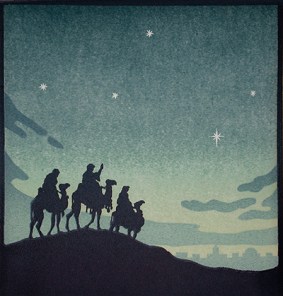
Filed under: Advent, Incarnation, Quotes from Great Christians, Unborn Jesus
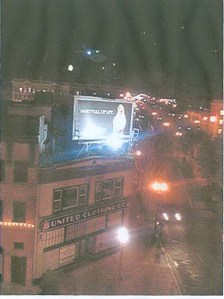
Mary full of Life brings light to a dark world. Photo taken by Rob Howells, Director of Development Union Gospel Mission
Recently, we did a post about this beautiful billboard, Mary Full of Life. The idea for the sculpture and billboard were developed by Valerie Aschbacher. (Click here to see the original news story about this billboard.) Valerie sent out an email about her efforts to make sure it was lit up at night. She finally succeeded but shared her thoughts about the darkness surrounding the billboard.
“Saddened by this dark experience, I had hoped Mary Full of Life would become illuminated for all to see – as a real beacon of LIGHT amongst the dark landscape in the city. This morning, the Clear Channel President has notified me – the light is working now.”
This made me think how Mary’s pregnancy and the Unborn Christ Child illuminate our dark culture of death. Karl Adam in his book The Son of God (Sheed and Ward, 1934) writes about how Christ “holy and exalted as was his nature…appeared to us in purely human form, in the dubious condition of all that is transitory and temporal.” What can be a more ‘dubious condition’ to this world than a single cell or a developing unborn baby.
Blessed Teresa of Calcutta reminded us that the poor were really Christ in a ‘distressing disguise’. In our sad world, what disguise could be more distressing than an unborn baby?
In a post entitled Life Incarnate, two views ‘the aspiring f.o.o.l.’ (an aspiring ‘friend of our Lord’) writes these beautiful lines: “He consigned Himself to a torturous life on earth so that we might see, embodied as it is, what love is.”
When I see the billboard of Mary full of Life spreading the light of Jesus unborn to the dark world beneath it, I know this is ‘what love is’ – Jesus unborn ‘in the dubious condition of all that is transitory and temporal’ – yes a beautiful yet , ‘ distressing disguise’ that this dark world needs to behold.
“In Him was life, and the life was the light of men. The light shines in the darkness, and the darkness has not overcome it” (John 1: 4-5)
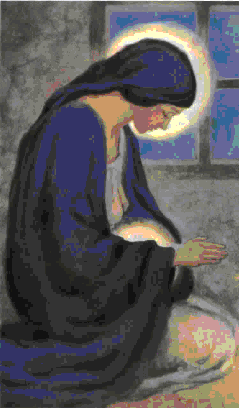
In our last post, we highlighted Catholic composer, Olivier Messiaen (1908-1992). As we pointed out 2008 is the centenary of his birth and he is being honored all over the world with concerts and symposiums. We went on to highlight one of his works: Vingt Regards sur l’enfant Jésus (“Twenty Gazes/Contemplations of the Infant Jesus”) and in particular one composition, ‘Premiere Communion de la Vierge‘. (No. 11, “Virgin’s First Communion”).
This composition represents the Virgin on her knees, worshipping the unborn Jesus within her. Because Messiaen wanted his listeners to be aware of his inspirations and how he constructed various passages, he wrote extensive program notes, which appear as prefaces to his scores or as liner notes for recordings of his music. Here is what Messiaen wrote about the Virgin’s First Communion:
“11. Première communion de la Vierge [First Communion of the Virgin]. A tableau in which the Virgin is shown kneeling, bowed down in the night-a luminous halo around her womb. Eyes closed, she adores the fruit hidden within her. This comes between the Annunciation and the Nativity: it is the first and greatest of all communions. Theme of God, gentle scrolls, in stalactites, in an inner embrace. (Recall of the theme of La Vierge l’Enfant from my Nativity du Seigneur for organ, 1935). Magnificat more enthusiastic. Special chords and durations of two and two in which the weighty pulsations represent the heartbeats of the Infant in the breast of his mother. Disappearance of the Theme of God. After the Annunciation, Mary adores Jesus within her…my God, my son, my Magnificat!-my love without the sound of words.”
These notes with explanations for all 20 gazes/compositions in Vingt Regards sur l’enfant Jésus can be found here. If you wish to purchase recordings of his songs or a book on his life here is a link to Amazon. We must mention that he is a modern composer and if you don’t like modern classical music – his compositions may not be your cup of tea.
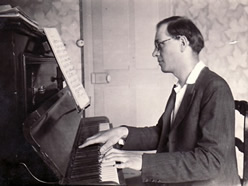
Olivier Messiaen (December 10, 1908 – April 27, 1992) was a devout French Catholic composer. This year marks the centenary of Olivier Messiaen’s birth. From June 20-24 2008 the MESSIAEN 2008 INTERNATIONAL CENTENARY CONFERENCE is being held in Birmingham, England. Another conference entitled ‘Olivier Messiaen: The Musician as Theologian’ will be held at Southern Methodist University/Dallas, September 25-26, 2008 Among the many Messiaen concerts/series around the world is another being held in England this year, the Philharmonia Orchestra Messiaen Celebrations (February 4 – October 23 ) and one in Chicago at the University of Chicago: 2008 MESSIAEN FESTIVAL October 2-11 Ten Concerts.
One of the reasons that we are highlighting Olivier Messiaen during the centenary of his birth is because of Vingt Regards sur l’Enfant-Jésus, a collection of pieces for solo piano. The French title translates “Twenty gazes/contemplations on the infant Jesus”. It is considered to be one of the greatest piano works of the twentieth century, and the summit of Messiaen’s keyboard writing. The idea of les regards, the spiritual gazes, came from the devotional book Le Christ dans ses Mystères by the Irish-Belgian Benedictine abbot Dom Columba Marmion.
The gaze is a profound moment of passionate contemplation, spiritual communication and two-way recognition: an exchange, to use one of Marmion’s favorite words, in which love and knowledge passed in both directions between God and humanity.
Some of Messiaen’s ‘gazes’ on the Infant Jesus include: Gaze of the Father, Gaze of the Star, The Exchange, Gaze of the Son upon the Son (click here to see all of the pieces)…the piece that touches on our blog’s theme is: ‘Premiere Communion de la Vierge’. (No. 11, “Virgin’s First Communion”) and represents the Virgin on her knees, worshiping the unborn Jesus within her.
Messiaen used his talents to praise God and share through his music his profound enthusiasm for the Truths of his Catholic faith. Many of his pieces were explicitly Catholic: Twenty glances upon the Infant Jesus, Hymn to the Holy Sacrament, The Lord’s Nativity, Three Small Liturgies of the Divine Presence, and the opera St. Francis of Assisi just to name a few.
In an article in the New York Times, Anthony Tommasini writes:
“The dimension of Messiaen’s music that may most set it apart derives from his spiritual life. His faith was innocent, not intellectual. As a child he loved the plays of Shakespeare, especially their “super-fairy-tale” aspects, he said. In the stories of the Catholic faith, as he told Mr. Samuel, he found the “attraction of the marvelous” he had coveted in Shakespeare, but “multiplied a hundredfold, a thousandfold.” For him the Christian stories were not theatrical fiction but true. Messiaen espoused a theology of glory, transcendence and eternity. Religious subjects permeate his works, though not the Passion and Crucifixion of Jesus. His embrace of the wondrousness of faith is reflected in the essence of his compositions.”
Our next post will feature Olivier Messaien’s personal notes explaining the “Virgin’s First Communion” with a link where to purchase this recording. We will also have a link to all his personal notes for Vingt Regards sur l’Enfant-Jésus ( “Twenty gazes/ contemplations on the infant Jesus” ).
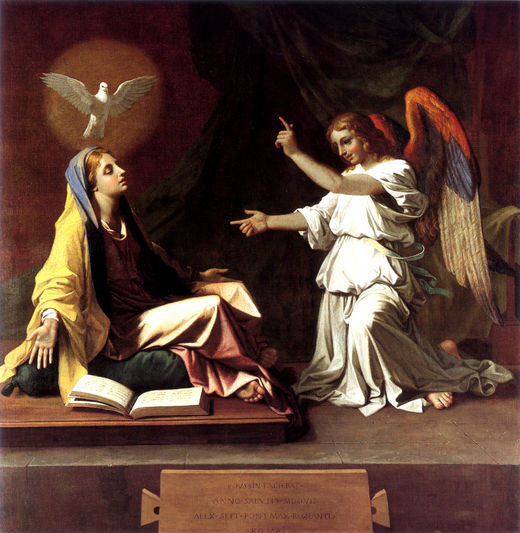
The Annunciation by Nicholas Poussin
Here are some excerpts from a homily that Pope Benedict XVI gave on March 25, 2006.
“In the Incarnation of the Son of God, in fact, we recognize the origins of the Church. Everything began from there.
Every historical realization of the Church and every one of her institutions must be shaped by that primordial wellspring. They must be shaped by Christ, the incarnate Word of God. It is he that we are constantly celebrating: Emmanuel, God-with-us, through whom the saving will of God the Father has been accomplished.
And yet – today of all days we contemplate this aspect of the Mystery – the divine wellspring flows through a privileged channel: the Virgin Mary.
St Bernard speaks of this using the eloquent image of aquaeductus (cf. Sermo in Nativitate B.V. Mariae: PL 183, 437-448). In celebrating the Incarnation of the Son, therefore, we cannot fail to honour his Mother. The Angel’s proclamation was addressed to her; she accepted it, and when she responded from the depths of her heart: “Here I am… let it be done to me according to your word” (Lk 1: 38), at that moment the eternal Word began to exist as a human being in time.
From generation to generation, the wonder evoked by this ineffable mystery never ceases. St Augustine imagines a dialogue between himself and the Angel of the Annunciation, in which he asks: “Tell me, O Angel, why did this happen in Mary?”. The answer, says the Messenger, is contained in the very words of the greeting: “Hail, full of grace” (cf. Sermo 291: 6).
In fact, the Angel, “appearing to her”, does not call her by her earthly name, Mary, but by her divine name, as she has always been seen and characterized by God: “Full of grace – gratia plena“, which in the original Greek is 6,P”D4JTµXv0, “full of grace”, and the grace is none other than the love of God; thus, in the end, we can translate this word: “beloved” of God (cf. Lk 1: 28). Origen observes that no such title had ever been given to a human being, and that it is unparalleled in all of Sacred Scripture (cf. In Lucam 6: 7)…
In the Second Reading, we heard the wonderful passage in which the author of the Letter to the Hebrews interprets Psalm 39 in the light of Christ’s Incarnation: “When Christ came into the world, he said: …”Here I am, I have come to do your will, O God'” (Heb 10: 5-7). Before the mystery of these two “Here I am” statements, the “Here I am” of the Son and the “Here I am” of the Mother, each of which is reflected in the other, forming a single Amen to God’s loving will, we are filled with wonder and thanksgiving, and we bow down in adoration.”
Filed under: Biblical Reflections, Incarnation, Quotes from Great Christians
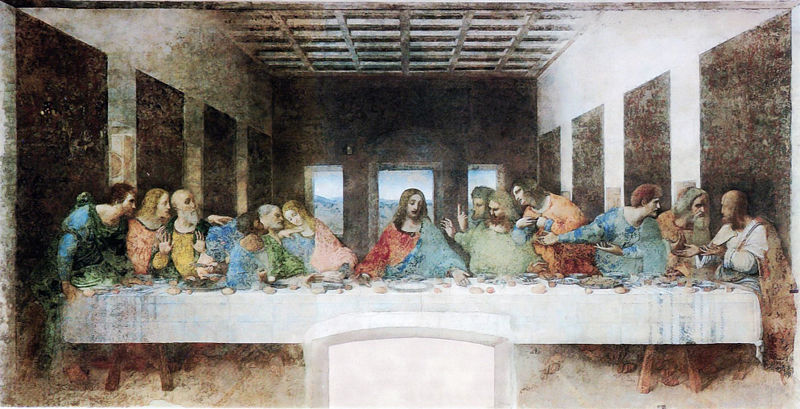
Here is an interesting quote from Msgr. Robert Hugh Benson on the Last Supper and the Incarnation.
“Thus, in that last emphatic act of the life of His Humiliation He took Bread, and cried, not Here is my Essential Self, but ‘This is my Body which is given for you,’ since that Body was the instrument of Redemption.
And, if the Christian claim is to be believed, this act was but a continuation (though in another sense) of that first act known as the Incarnation. He who leaned over the Bread at that “last sad Supper with His own” had, in another but similar manner, leaned over Mary herself with similar words upon His lips.“
From Msgr. Robert Hugh Benson, Christ In The Church (published 1913).
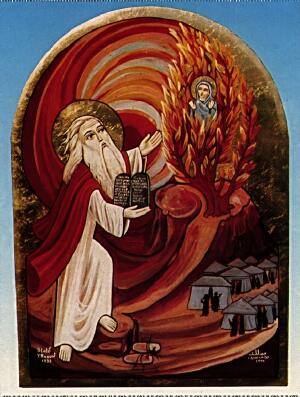
Today is Ash Wednesday – the first day of Lent. Forty is a number used often in the Bible and is the reason that Lent has 40 days (Sunday’s don’t count). In Noah’s time it rained for 40 days and nights, the people of Israel wandered in the desert for 40 years, Moses was on Mount Sinai for 40 days and most importantly Jesus fasted in the wilderness for 40 days.
In the Acts of the Apostles we are told that, after Moses fled Egypt he was in the land of Midian for 40 years: “And when forty years were expired, there appeared to him in the desert of mount Sinai, an angel in a flame of fire in a bush.” (Acts 7:30) So Moses was prepared by God for 40 years before the Burning Bush event, the turning point in his life and a turning point in human history.
But did you know that the Burning Bush has often been seen as a symbol of Mary who carried God within her womb?
“The bush, then (as some hold) is a prefiguration of the Virgin Mary since she made the Savior blossom forth, like a rose growing out of the bush of her human body; or rather, because she brought forth the power of the divine radiance without being consumed by it. Hence we read in Exodus: ‘The Lord appeared to Moses in a flame of fire out of the midst of a bush; and looked and behold the bush was burning, yet it was not consumed’ (Ex 3:2) ” Rabanus Maurus (Benedictine Monk d. 780)
St. Gregory, the fourth century Bishop of Nyssa, seems to have been the first to connect the idea of Moses and the burning bush to Mary, the mother of Jesus. Gregory wrote in his On the Birth of Christ that as the bush was in flames, but not consumed, so Mary had God present inside her and was not consumed.
In Eastern Christian tradition the Burning Bush is seen as a symbol of Mary – The burning bush appeared to Moses in Exodus 3:2. In the song of The Burning Bush sung during the month of Kiahk (the fourth month of the Coptic calendar between December 10 and January 8 ) they say:
The burning bush seen by Moses
The prophet in the wilderness
The fire inside it was aflame
But never consumed or injured it.
The same with the Theotokos Mary
Carried the fire of Divinity
Nine months in her holy body.
Again it was said of Christ that He is a “consuming fire” (Hebrews 12:29). The fire burning inside the bush is a symbol of Christ and the bush itself symbolizes the Virgin.
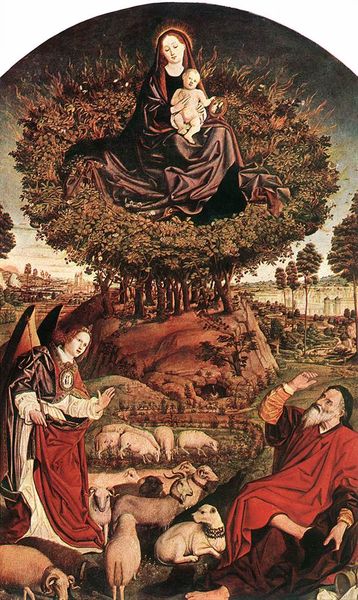
Triptych of the Burning Bush, by Nicolas Froment, in Aix Cathedral
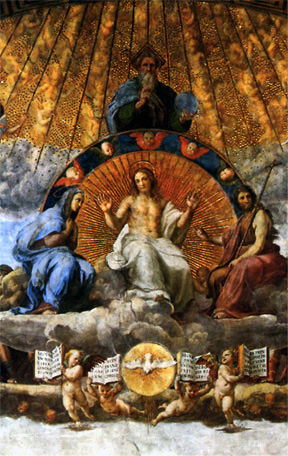
The Trinity with Mary and John the Baptist – detail from The Triumph of the Christian Faith fresco by Raphael – Stanzo della segnatura – Vatican
During Christmas season we meditate on the birth of Jesus in Bethlehem – but in fact, according to Cardinal Berulle (1575-1629), Our Lord had three births. In his book, Discourse on the State and Grandeurs of Jesus, he states:
“We find in the book of life three wondrous births of Jesus, who is the life of God and men. They are his birth in the womb of his Father in eternity, his birth in the womb of the Virgin in time, and his birth in the tomb to immortality.”
The words “Today I have begotten you” (Ps 2:7, Heb 1: 5) are associated with each of these births.
1. St. Paul in the first chapter of Hebrews (Heb 1: 5 ) applies these words to the eternal generation of the Son by the Father. Cardinal Berulle goes on to explain: ‘Through a clever use of words, the present is joined to the past, Today I have begotten you. This expresses him who is forever born and is forever being born and whose procession is such that it is without end or beginning.”
“In these last days, he spoke to us through a son, whom he made heir of all things and through whom he created the universe…For to which of the angels did God ever say: ‘You are my son; this day I have begotten you‘ “ (Hebrews 1:2,5)
2. Cardinal Berulle explains that this phrase found in Psalm 2 and Heb 1 is also used by the Church in its ‘office’ for Christmas day. This Christmas 2007, the Heb. 1 passage was the second reading for Christmas Day Mass (see above). Thus the Church applies these words to Christ’s birth in Bethlehem.
3. He then points out that: “Again Saint Paul guided by the same Spirit of God, …in Acts, chapter 13, presents this same text (Today I have begotten you) and applies it to the resurrection of the Son of God, which is a type of birth for Jesus into immortality.”
“We ourselves are proclaiming this good news to you that what God promised our ancestors he has brought to fulfillment for us, their children, by raising up Jesus, as it is written in the second psalm, ‘You are my son; this day I have begotten you.’ ” (Acts: 13:32-33)
Cardinal Berulle concludes:
“…God who is fecund and fertile in his works and in his words, wished that that this same memorable word be applied in the same spirit to these three different meanings, to these three states and mysteries of the eternal Word: to the mystery of his birth from his Father, to the mystery of his birth from his mother, and to the birth from the tomb, from which he is reborn like a phoenix to new life.”
 UNBORN WORD of the day