“Consequently, when Christ came into the world, he said,
‘Sacrifices and offerings thou hast not desired
but a body hast thou prepared for me…‘” Heb 10:5
We have mentioned previously (Hebrews 10: 5-7) that Christ spoke these and other words (verses 6-7) immediately upon entering the world – that is, at the one cell stage of His life. So that first cell of His existence was that body prepared for Him. And during the first nine months in the womb, in a special way, His body was being formed for that one acceptable sacrifice that would occur more than thirty years hence.
We invite you now to consider, in a most unique way, the offering of Jesus Christ – beginning in the Garden of Gethsemane and continuing on until His death upon the cross – but considered from the perspective of His body being formed and prepared within the womb for those events which would occur more than 30 years later.
Consider the crucifixion in this light. The blood which will be shed in this sacrifice began to course through His body about eight months before His birth and would continue to run freely until that final offering. Likewise, every physical feature of our Lord’s body, while forming in the womb, took on its own predestined sacrificial character, a character that would be eternally stamped upon it during His Passion and death:
First His Heart begins a spiritual bleeding in the
Garden of Gethsemane and he is “sorrowful, even
to death”. (Mk.14.34)
He gets on His knees in a prayer agony. (Lk.22.41)
He falls upon His face, in the dark, in the dirt, alone.
(Mt.26.39)
Now sweat as great drops of blood fell from His face
and head. His Heart’s spiritual bleeding is too
intense for this Body, so the Body begins to bleed itself.
(Lk.22.44)
He now receives a kiss upon His cheek and a feigned
embrace from His onetime friend Judas. (Mt.26.49)
He is forcefully seized. (Mt.26.50)
His hands are tied and He is led like a lamb to slaughter.
(Jn.18.12)
Now His face is struck because of the response He gave
to Annas, the father in law of Caiaphas the High Priest.
(Jn.18.13,22)
Wrists still bound, He is led to the home of Caiaphas.
(Jn.18.24)
They spit in His face as the interrogation begins, perhaps
because He is standing erect, head still held high.
(Mt.26.67)
They cover His face (Mk.14.65) to blindfold His eyes.
(Lk.22.64)
His face is slapped and struck and He is now the subject
of a game. “Prophesy to us, you Christ! Who is it that
struck you?” (Mt.26.67) His very Identity is mocked.
He is received with blows by Caiaphas’ guards, perhaps
as He walks past them. (Mk.14.65)
The next morning He is led to the Council, perhaps
like an animal with a cord around His waist or neck.
(Lk.22.66)
From the Council He is led to Pilate and then sent to
Herod. Herod’s soldiers ridicule Jesus and clothe Him
in a costume. (Lk.23.11)
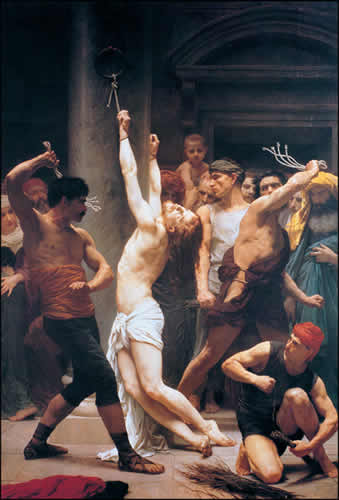
Our Lord’s back is scourged by order of Pilate.
(Jn.19.1)
He is stripped of the costume and a robe is again
put on Him. (Mt.27.28,Jn.19.2)
On His head a crown of thorns is placed, causing rivulets
of blood to trickle from His scalp down His forehead
and down the back of His neck. (Jn.19.2)
In His hands they mockingly place a reed to represent
a royal scepter. (Mt.27.29)
Now the soldiers spit on Him and take the reed back and
hit Him with it. (Mt.27.30)
And they continue to strike Him with their hands as well.
(Jn.19.3)
He is given the large wooden cross to carry. (Jn.19.17)
Its rough abrasive weight upon His recently scourged
back.
He has trouble carrying the cross (Simon of Cyrene is
therefore forced to help; Lk.23.26) Tradition tells us
that Jesus fell three times as He carried the cross.
(Reference: the Stations of the Cross)
At Golgotha they strip Him and nail His
hands and feet to the cross. (Lk.23.33 34)
Aching, exhausted, bruised, bleeding, weary of dying,
Christ hangs on the cross, resembling more a slaughtered
animal than a man in the final stage of dying.
(Ps.22.6,14 15)
He is offered sour vinegar to drink, probably extended
on a saturated sponge on a stick and placed against His
lips; all in jest. (Lk.23.36)
Finally, a spear is thrown into His side. (Jn.19.34)
Probably penetrating His Heart, causing the issuance
of “blood and water“.
Filed under: Biblical Reflections, Incarnation, Quotes from Great Christians
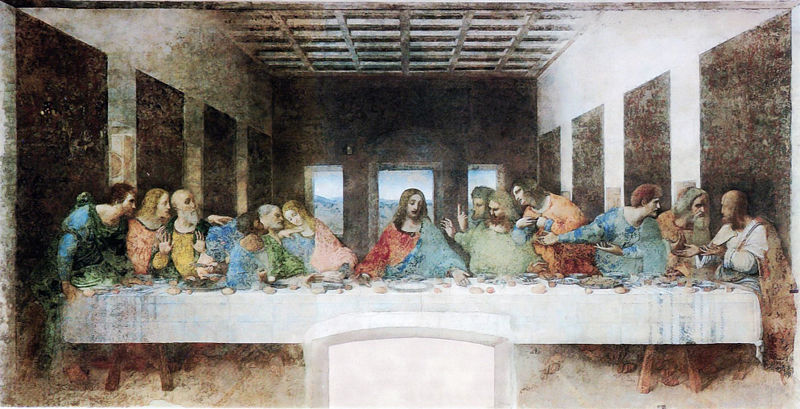
Here is an interesting quote from Msgr. Robert Hugh Benson on the Last Supper and the Incarnation.
“Thus, in that last emphatic act of the life of His Humiliation He took Bread, and cried, not Here is my Essential Self, but ‘This is my Body which is given for you,’ since that Body was the instrument of Redemption.
And, if the Christian claim is to be believed, this act was but a continuation (though in another sense) of that first act known as the Incarnation. He who leaned over the Bread at that “last sad Supper with His own” had, in another but similar manner, leaned over Mary herself with similar words upon His lips.“
From Msgr. Robert Hugh Benson, Christ In The Church (published 1913).
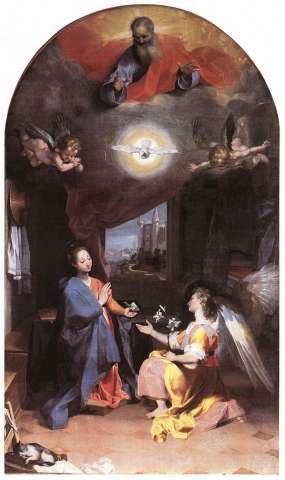
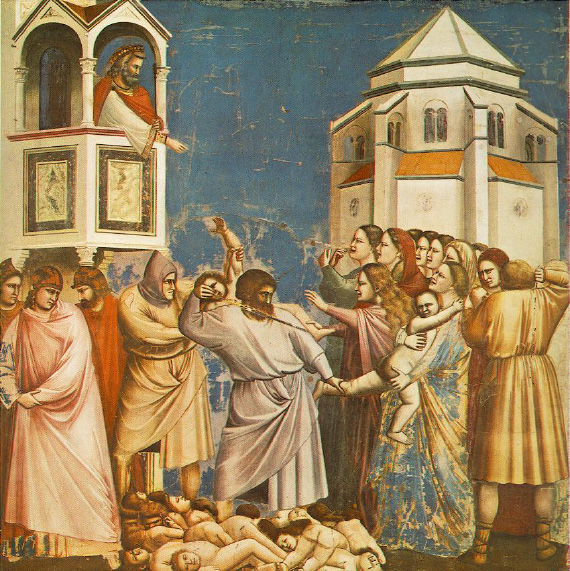
Let’s connect some Lenten dots by way of scriptural reflection and trace a sinister sequence of attempts to kill the Son of God, the Word of God – a connecting of black dots, each meant to end the sentence of the Word’s life on earth! Some spontaneous, others devilishly devised.
- First, and probably the most vicious of all – the crucifixion excepted – is Herod’s concerted effort to destroy the tiny newborn baby Jesus! We are all familiar with the story. The angel of the Lord warned Joseph: “…flee to Egypt …for Herod is about to search for the child to destroy Him” (Mt 2:13). Herod’s plans reach a rancid fruition just after Joseph flees by night with Mary and the newborn Jesus. Herod is “in a furious rage” and ordered the killing of “all the male children in Bethlehem and in all that region who were two years old or under” (Mt 2:16). These were the “Holy Innocents” killed in the very place of Jesus, because Herod suspected that each one of them might be the newborn King of the Jews. Each of these babies is an innocent martyr – a baby alter Christi. And there was mourning, the first attempt upon His life.
We know now that Herod helped inspire the paranoid “Planned Parenthood” mentality so common today, and that if he had had the opportunity to have Unborn Jesus aborted he would have done so instantly! Unborn Jesus, like any “unwanted” unborn baby, represents a threat to the status quo.
- We now fast forward about thirty years to the outset of our Lord’s public ministry. After Jesus was baptized by John, the Holy Spirit led Him out into the wilderness where He fasted for forty days. At the end of this period, the devil came to Him and tempted Jesus three times. The third deceitful temptation was a direct attempt upon the life of Jesus by the devil. They were on the pinnacle of the Temple in Jerusalem and the devil challenged Jesus: “If you are the Son of God, throw yourself down from here…” (Lk 4:9-12). Christ does not succumb and the devil leaves Him, but Luke observes “he departed from Him until an opportune time”. The second attempt upon His life.
- A little later Jesus returned to His hometown of Nazareth and went to the synagogue on the sabbath. He read a messianic prophesy from Isaiah and then explained that the text was being fulfilled in their midst. As he continued to speak the crowd became disenchanted: “…all in the synagogue were filled with wrath. And they rose up and put Him out of the city, and led Him to the brow of the hill on which their city was built, that they might throw Him down headlong. But passing threw the midst of them He went away” (Lk 4:28-30). The third attempt upon His life.
- One day, during the third year of His public ministry, Jesus was in the Temple in Jerusalem teaching, when things grew controversial. Surprisingly, He got into a debate with “the Jews who had believed in Him” (Jn 8:31). Finally, Jesus says to them: “Truly, truly, I say to you, before Abraham was, I am.” What did the Jews “who had believed in Him” do (along with others who didn’t believe in Him)? “So they took up stones to throw at Him; but Jesus hid himself, and went out of the temple” (Jn 8:57-59). The fourth attempt upon His life.
- Finally, it was wintertime, the feast of the Dedication and Jesus was in the Temple in Jerusalem at a spot called the portico of Solomon (Jn 10:22-23). He is challenged by the people and He gives a short answer, ending with: “I and the Father are one”. We read: “The Jews took up stones again to stone Him” (Jn 10:31, also 11:7-8), He speaks again, then they try to arrest Him but He “escaped from their hands” (10:39). The fifth attempt upon His life.
- We are all familiar with the sixth and final attempt upon our Lord’s life; His bloody Passion and crucifixion atop Golgotha! Jesus was targeted from infancy through adulthood. From the devil to His own countrymen, from political leaders to religious leaders, His innocence and authoritative teaching was difficult for sinners to bear. So too today, the innocence of the unborn baby and the “word” each would speak, is attacked by a self-absorbed hypocritical world that falsely champions human rights while daily plotting the deaths of the weakest among us.
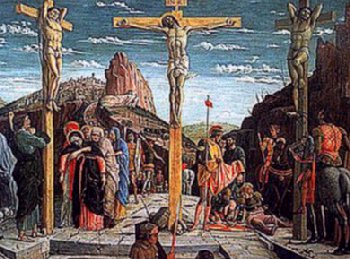

In yesterday’s post we talked about the number 40 (Noah, Moses, Jesus and so on).
But we didn’t mention all of the forty-something episodes. There are more than one would expect. (For example, the prophet Elijah was sent by God to Mount Horeb which was a 40 day journey; I Kg 19:8).

Interestingly, often the 40 days (or years) is linked to a journey or a time of enduring. So we were appropriately stunned today when one of our Newsletter subscribers (Thanks M_____!) pointed out that a pregnancy is typically 40 weeks long (actually the normal range is 38 to 42 weeks). This is fascinating when one considers that our faith holds up for us the 40 years the people of Israel wandered in the desert and the 40 days that Jesus spent in the wilderness as critical periods of formation for a people and a Person. So, in pregnancy we see that every growing unborn/preborn human is specially “formed” for his or her mission in life in those first 40 weeks. And the mother experiences a challenge also (Thanks Eve!).
The unborn baby and the mother are undergoing a primordial preparation TOGETHER! This is an incredible aspect of pregnancy, too obvious sometimes to appreciate, that mother and child together are striving towards a shared goal at the end of the 40 weeks. Both persons – in their bodies and in their souls – are being formed, prepared, challenged. God wants to help the woman through this time by providing her with the example of Christ (in the wilderness for 40 days) and also with a “communion of saints” of Israelites who endured the famous 40 year trek and all women past and present who have gone through this journey of pregnancy.
To carry a baby for 40 weeks and then give birth to him or her is a near mystical experience. During this 40 weeks of preparation, God heaps upon the woman opportunities to discover life’s tender and timeless mysteries. And for the unborn baby, well, Unborn Jesus is watching over this little one in supernatural solidarity!
Finally, the Pope’s Lenten Message (2008) can speak to the pregnant woman’s heart, for pregnancy, like Lent, is a “process of interior renewal” which “stimulates us to rediscover the mercy of God” and can help us to “learn to make of our lives a total gift”. Benedict reminds us that: “When we do things out of love, we express the truth of our being; indeed, we have been created not for ourselves but for God and our brothers and sisters (cf. 2 Cor 5,15).”
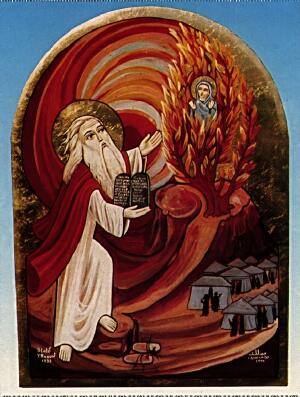
Today is Ash Wednesday – the first day of Lent. Forty is a number used often in the Bible and is the reason that Lent has 40 days (Sunday’s don’t count). In Noah’s time it rained for 40 days and nights, the people of Israel wandered in the desert for 40 years, Moses was on Mount Sinai for 40 days and most importantly Jesus fasted in the wilderness for 40 days.
In the Acts of the Apostles we are told that, after Moses fled Egypt he was in the land of Midian for 40 years: “And when forty years were expired, there appeared to him in the desert of mount Sinai, an angel in a flame of fire in a bush.” (Acts 7:30) So Moses was prepared by God for 40 years before the Burning Bush event, the turning point in his life and a turning point in human history.
But did you know that the Burning Bush has often been seen as a symbol of Mary who carried God within her womb?
“The bush, then (as some hold) is a prefiguration of the Virgin Mary since she made the Savior blossom forth, like a rose growing out of the bush of her human body; or rather, because she brought forth the power of the divine radiance without being consumed by it. Hence we read in Exodus: ‘The Lord appeared to Moses in a flame of fire out of the midst of a bush; and looked and behold the bush was burning, yet it was not consumed’ (Ex 3:2) ” Rabanus Maurus (Benedictine Monk d. 780)
St. Gregory, the fourth century Bishop of Nyssa, seems to have been the first to connect the idea of Moses and the burning bush to Mary, the mother of Jesus. Gregory wrote in his On the Birth of Christ that as the bush was in flames, but not consumed, so Mary had God present inside her and was not consumed.
In Eastern Christian tradition the Burning Bush is seen as a symbol of Mary – The burning bush appeared to Moses in Exodus 3:2. In the song of The Burning Bush sung during the month of Kiahk (the fourth month of the Coptic calendar between December 10 and January 8 ) they say:
The burning bush seen by Moses
The prophet in the wilderness
The fire inside it was aflame
But never consumed or injured it.
The same with the Theotokos Mary
Carried the fire of Divinity
Nine months in her holy body.
Again it was said of Christ that He is a “consuming fire” (Hebrews 12:29). The fire burning inside the bush is a symbol of Christ and the bush itself symbolizes the Virgin.
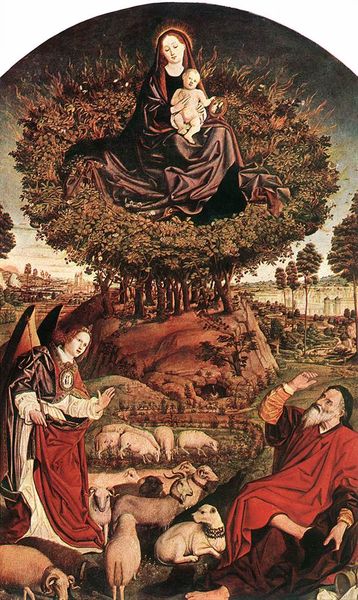
Triptych of the Burning Bush, by Nicolas Froment, in Aix Cathedral

Today I received my weekly issue of the Vatican Newspaper L’Osservatore Romano and read the Pope’s Homily for the Feast Day of Epiphany (1/6/08). Here is a short excerpt:
“…the birth of the King of the Jews had been announced by the rising of a star, visible from afar…Once again heaven and earth, the cosmos and history, call to each other and respond. The ancient prophecies find confirmation in the language of the stars…‘A star shall come forth out of Jacob, and a scepter shall rise out of Israel’ (Nm 24:17), announced Balaam, the pagan seer, when he was summoned to curse the people of Israel, whom he instead blessed because, as God had revealed to him, ‘they are blessed’ (Nm 22:12).
In his commentary on Matthew’s Gospel, Cromatius of Aquileia establishes a connection between Balaam and the Magi: ‘He prophesied that Christ would come; they saw him with the eyes of faith…The star was seen by everyone but not everyone understood its meaning. Likewise, our Lord and Saviour was born for everyone, but not everyone has welcomed him’ (4:1-2).”
The three wise men – pagans all – saw the star and were spiritually enlightened. Their intellects were illumined by it and their wills ignited; they set out on a journey to locate a baby King . But when they first saw the star the baby was still unborn, on His own journey, growing within the womb. A prophetic convergence would eventually take place when the unborn baby would come out from the dark womb to shine in His manger/cave and the wise men would arrive to behold this purer holier light, and even hold it in their arms.
We have decided to use our UNBORN WORD ALLIANCE logo as our visual image (above) for this post because it captures this sentiment: a star, containing within it a heart (which symbolizes the Word of God coming to us) as the star touches the earth, the Word goes forth to the very ends of the earth.
Last Thursday, January 24 was the feast day of St. Francis de Sales.
While at the March for Life I attended the Rose Dinner. At this dinner, the Primate of the Orthodox Church in America Most Blessed Herman prayed a beautiful prayer in which he detailed the many times in the Old and New Testament that Biblical figures were called by God or mentioned in the Bible while still in their mother’s womb. (I am trying to get a copy of this beautiful prayer.) This reminded me of a quote from St. Francis.
“God also appointed other favors for a small number of rare creatures who he would preserve from the peril of damnation, as is certain of S. John Baptist and very probable of Jeremias and some others, whom the Divine providence seized upon in their mother’s womb, and thereupon established them in the perpetuity of his grace, that they might remain firm in his love, though subject to checks and venial sins, which are contrary to the perfection of love though not to love itself…” Treatise on the Love of God : St. Francis de Sales, (1567-1622)
Here are the prophets that St. Francis was referring to:
Isaiah
“And now says the LORD, who formed Me from the womb to be His Servant, To bring Jacob back to Him, in order that Israel might be gathered to Him (For I am honored in the sight of the LORD, And My God is My strength)” (Isaiah 49:5)
Jeramiah
“Before I formed you in the womb I knew you, And before you were born I consecrated you; I have appointed you a prophet to the nations.” (Jeremiah 1:5)
John the Baptist
“For he will be great in the sight of the Lord, and he will drink no wine or liquor; and he will be filled with the Holy Spirit, while yet in his mother’s womb.” (Luke 1:15)
Two other great men who were called from their mother’s womb but probably don’t quite fit St. Francis’ description:
Samson
“Then the woman came and told her husband, saying, ‘A man of God came to me and his appearance was like the appearance of the angel of God, very awesome. And I did not ask him where he came from, nor did he tell me his name.’ But he said to me, `Behold, you shall conceive and give birth to a son, and now you shall not drink wine or strong drink nor eat any unclean thing, for the boy shall be a Nazirite to God from the womb to the day of his death.'” (Judges 13:6-7, see also Judges 16:17)
Paul
“But when He who had set me apart, even from my mother’s womb, and called me through His grace, was pleased…” (Galatians 1:15)
Jacob and Esau are also mentioned as wrestling in their mother’s womb
“Isaac entreated the LORD on behalf of his wife, since she was sterile. The LORD heard his entreaty, and Rebekah became pregnant. But the children in her womb jostled each other so much that she exclaimed, ‘If this is to be so, what good will it do me!’
She went to consult the LORD, and he answered her: ‘Two nations are in your womb, two peoples are quarreling while still within you; But one shall surpass the other, and the older shall serve the younger.’
When the time of her delivery came, there were twins in her womb.” Genesis 25: 22-24
And of course Blessed Herman highlighted the most important unborn person mentioned in the Bible – Preborn Jesus.
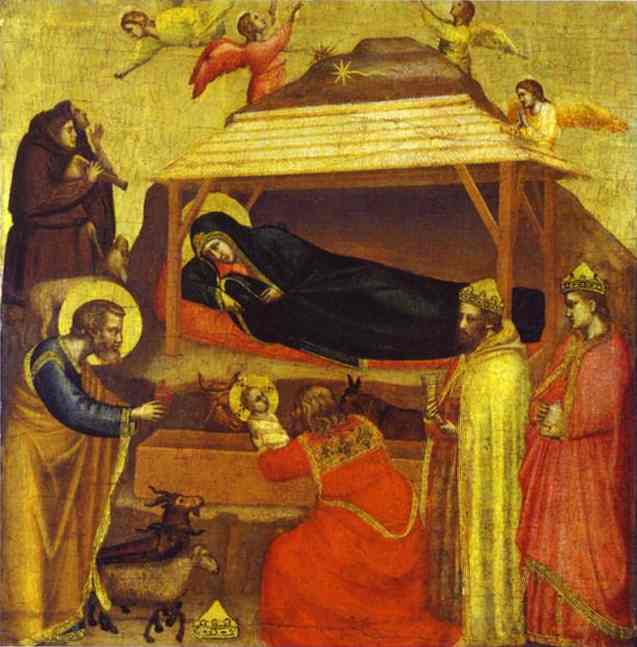
“The wise men passed onwards to the humble village. Again the star shone out in the blue heavens, and slowly sank earthward over the Cave of Bethlehem, and presently the devout Kings were at the feet of Jesus.
…The babe, it seems, will move the heights of the world as well as the lowlands. He will now call wisdom to His crib, as He has but lately called simplicity.
Yet how different is His call! For wise men and for Kings some signs were wanted, and, because they were wise Kings, scientific signs.
As the sweet patience and obscure hardships of a lowly life prepared the souls of the Shepherds, so too the Kings their years of oriental wisdom were as the preparation of the gospel.
Yet true science has also its child-like spirit, its beautiful simplicity. Learning makes children of its professors, when their hearts are humble and their lives pure.
It was a simple thing of them to leave their homes, their latticed palaces or their royal tents. They were simple too, when they were in their trouble at Jerusalem, because of the disappearance of the star.
But when the end of all broke upon them, when the star left them at that half stable and half cave, and they beheld a Child of abject poverty, lying in a manger upon straw between an ox and an ass, with, as the world would speak, an old artisan of the lower class to represent His father, and a girlish, ill- assorted Mother, then was the triumph of their simplicity.
They hesitated not for one moment.”
From Bethlehem by Father F. W. Faber

In this painting by William Holman Hunt – The Triumph of the Innocents – The Innocents are seen with the Holy Family, in spirit, during the Family‘s Flight to Egypt. Today, we ask them to be with and pray for the unborn of our day.
Today, December 28th is the feast day of the Holy Innocents. Throughout history the Church has honored these little ones with great reverence. For instance in his Letter to Families, John Paul II quotes a poet from the 2nd century:
“In the liturgy of their Feast, which has its origins in the fifth century, the Church turns to the Holy Innocents, invoking them with the words of the poet Prudentius (c. 105) as ‘the flowers of the martyrs whom, at the very threshold of their lives, the persecutor of Christ cut down as the whirlwind does to roses still in bud’ ”
St. Augustine (354-430) said of these Holy Innocents, that they are the “flowers of the martyrs” – “the first buds of the Church killed by the frost of persecution; they died not only for Christ but in His stead.”(St. Aug., Sermo 10us de sanctis)
The Venerable Bede (673-735) in A Hymn for Martyrs Sweetly Sing (translated by Joan Mason Neale) remembers these little martyrs.
1. A Hymn for Martyrs sweetly sing;
For Innocents your praises bring;
Of whom in tears was earth bereaved,
Whom heaven with songs of joy received…
4. After brief taste of earthly woe
Eternal triumph now they know;
For whom, by cruel torments rent,
A voice from Ramah was there sent.
5. And every tear is wiped away
By your dear Father’s hands for aye:
Death hath no power to hurt you more;
Your own is life’s eternal shore….
The following was taken from the Woman of Faith and Family
website:
The Coventry Carol
This beautiful English lullaby carol originated in the Coventry Corpus Christi Mystery Plays performed in the 15th century. In a play called The Pageant of the Shearmen and Tailors, the women of Bethlehem sing this song just before Herod’s soldiers come to slaughter their children. It tells the story of the murder of the Holy Innocents, and is sung on December 28, the feast of those tiny martyrs.
Lully, Lullay, thou little tiny child.
Bye, bye, lully, lullay.
Lullay thou little tiny child
Bye, bye, lully, lullay
O sisters, too, how may we do,
For to preserve this day;
This poor Youngling for whom we sing
Bye, bye lully, lullay
Herod the King, in his raging,
Charged he hath this day;
His men of might, in his own sight,
All young children to slay.
Then woe is me, poor child, for thee,
And ever mourn and say;
For thy parting neither say nor sing,
Bye, bye lully, lullay.
Today many in the pro-life movement invoke these Holy Innocents to help protect the young of our day who are being slaughtered. Here is a quote from A Pro-Life Homily for the Feast of the Holy Innocents on the Priests for Life website.
“Jesus took on our human flesh in the womb of the Blessed Virgin Mary, was born for us at Bethlehem and died for us in Jerusalem so that our sins would be forgiven and we might have everlasting life. There is no sin too big that God is unable or unwilling to forgive if we repent and turn back to Him. Ask the Holy Innocents to intercede for us that we may bring about a renewed respect for human life in our society, to build a culture of life, protect the innocents in our day and comfort those who mourn.“
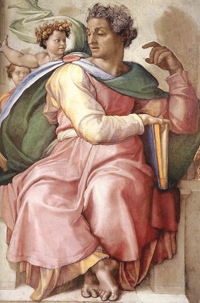
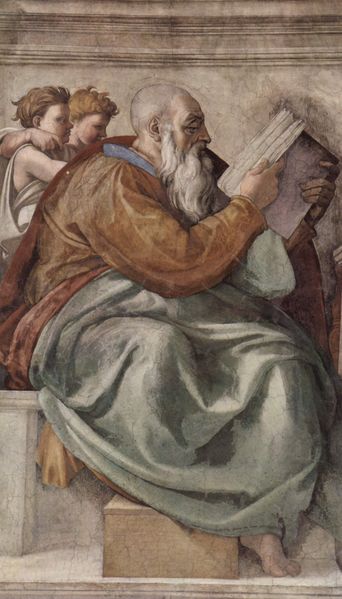
Sistine Chapel Ceiling: The Prophet Isaiah
Michelangelo Buonarroti
Many Bible scholars explain that chapters 7‑12 of Isaiah form a distinct section ‑ the Book of Immanuel ‑ in which we find repeated references to the Messiah. But within this “Book of Immanuel”, there are a number of references to the Messiah as a baby and small child. This unique prophetic perspective on the Child Messiah is fascinating, and should be of great interest to our modern world. Let’s consider some of these verses:
“Therefore the Lord himself will give you this sign: the virgin shall be with child, and bear a son, and shall name him Immanuel.” Isaiah 7:14
“For to us a child is born, to us a son is given; and the government will be upon his shoulder, and his name will be called ‘Wonderful Counselor, Mighty God, Everlasting Father, Prince of Peace’…. “Isaiah 9:6
“The wolf shall dwell with the lamb, and the leopard shall lie down with the kid, and the calf and the lion and the fatling together, and a little child shall lead them.” Isaiah 11:6
Isaiah, under the influence of the Spirit of God, focuses on a ‘child’ (a son) who is the Messiah and more, he is Immanuel (God with us), Mighty God and Prince of Peace. And in some real way, this ‘little child shall lead’ us. Not by mere coincidence has the Church come to love these prophetic passages with a tender passion. The Church sees the incarnational mystery revealed here in beauty, hope and peace.
Now if Isaiah was attracted by this ‘child’, can you imagine how Mary (after she had conceived the Son of God) felt as she recalled the words: “…the virgin shall be with child, and bear a son, and name him Immanuel”. For Mary was the virgin chosen by God to fulfill this prophecy and her unborn baby was the promised One. But all Christians should share in that same prophetic joy and anticipation at hearing “to us a child is born” and “to us a son is given”. To us Unborn Jesus was sent as a sign of hope ‑ and for every vulnerable unborn child: He is their only Hope.
JUST 20 MORE PRAYING DAYS ‘TIL CHRIST’S BIRTH!
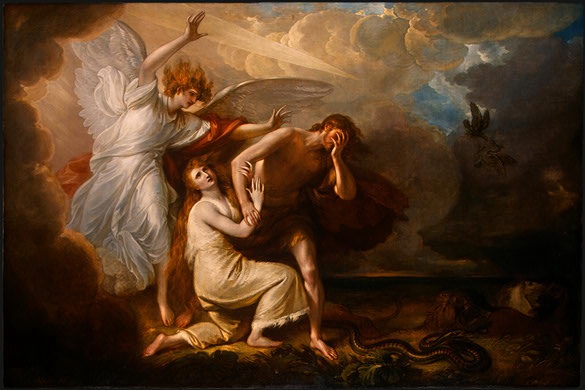
How appropriate that the first prophecy about the Messiah was spoken by God Himself while Adam and Eve stood dumbfounded in the Garden of Eden. But was it a spiritual slight to humanity that it wasn’t spoken to humans but rather to the serpent?
“I will put enmity between you and the woman,
and between your seed and her seed;
he shall bruise your head,
and you shall bruise his heel.” Gen 3:15
Four lines and four participants: “I” of course is God, “you” is the serpent (see Gen 3:14),”he” (also “his” and “her seed”) is the Messiah and “the woman” is the mother of the Messiah.
The point is that here we have God, right in the Garden of Eden, making a specific, definitive and hopeful promise to all of humanity using biological language “her seed”. Shall we understand this term as her ovum fertilized or as her male child delivered? Either way, it is a powerful promise. Notice that it is “her seed” and not “his seed”.
Yet throughout the Bible we read about male descendants, as in Matthew’s genealogy of Jesus. Remember the King James Version? “Abraham begat Isaac; and Isaac begat Jacob” and on and on. But here God directs us to the woman’s descendant. This is a tender prophecy spoken at a sad time when God has just discovered the rebellion of the first two parents. Already He knows it is Mary who will be the faithful and loving mother to His only begotten Son and His reference to “her seed” is pointed. In fact, He will preserve her specially for this unique office as ‘Mother of (the) Lord’ (see Lk 1:43).
We learn here of God’s merciful ‘impatience’. As soon as our first parents rebel against His Beautiful and Holy Will, God immediately reveals this wonderful plan for humanity centered around one Person, a Savior, Who will be born of that special woman deep in human history, beneath the Christmas star, with witnesses ‘round about: beasts and peasants, angels and kings.
And the ‘sign’, as the angels put it (Lk 2:12): it’s how His mother wraps Him up in swaddling cloths to keep Him warm after nursing Him and then lays her baby down in a manger to sleep.
JUST 22 MORE PRAYING DAYS ‘TIL CHRIST’S BIRTH!
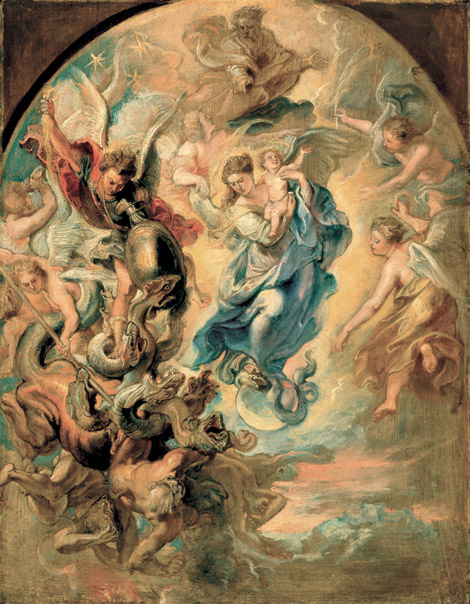
The Virgin as the Woman of the Apocalypse
 Peter Paul Rubens (1577-1640)
I found this really interesting and unusual – it was taken from section #104 of the Gospel of Life:
‘And the dragon stood before the woman … that he might devour her child when she brought it forth’ (Rev 12:4): life menaced by the forces of evil
In the Book of Revelation, the “great portent” of the “woman” (12:1) is accompanied by ‘another portent which appeared in heaven’: ‘a great red dragon’ (Rev 12:3), which represents Satan, the personal power of evil, as well as all the powers of evil at work in history and opposing the Church’s mission.
Here too Mary sheds light on the Community of Believers. The hostility of the powers of evil is, in fact, an insidious opposition which, before affecting the disciples of Jesus, is directed against his mother. To save the life of her Son from those who fear him as a dangerous threat, Mary has to flee with Joseph and the Child into Egypt (cf. Mt 2:13-15).
Mary thus helps the Church to realize that life is always at the center of a great struggle between good and evil, between light and darkness. The dragon wishes to devour ‘the child brought forth’ (cf. Rev 12:4), a figure of Christ, whom Mary brought forth ‘in the fullness of time’ (Gal 4:4) and whom the Church must unceasingly offer to people in every age.
But in a way that child is also a figure of every person, every child, especially every helpless baby whose life is threatened, because-as the Council reminds us-‘by his Incarnation the Son of God has united himself in some fashion with every person‘.140
It is precisely in the “flesh” of every person that Christ continues to reveal himself and to enter into fellowship with us, so that rejection of human life, in whatever form that rejection takes, is really a rejection of Christ.
This is the fascinating but also demanding truth which Christ reveals to us and which his Church continues untiringly to proclaim: ‘Whoever receives one such child in my name receives me’ (Mt 18:5); ‘Truly, I say to you, as you did it to one of the least of these my brethren, you did it to me’ (Mt 25:40).”
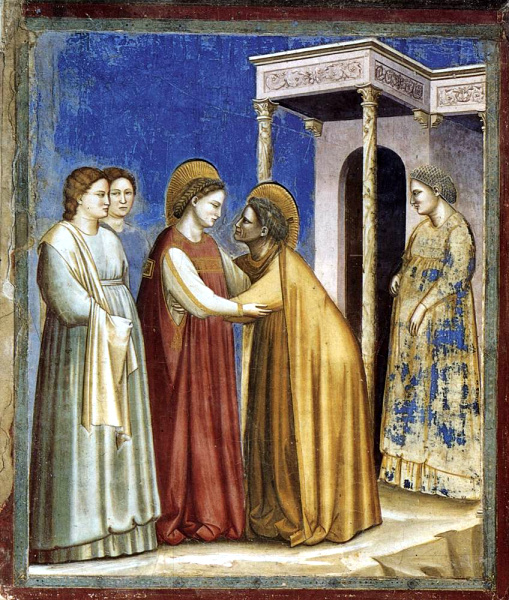
Yesterday, November 5 was the feast day of St. Elizabeth and Zachery, the parents of St. John the Baptist. Yesterday, the focus of our blog was on Zechariah, (today we will concentrate on Elizabeth). The account of Mary’s Visitation to Elizabeth (and her unborn baby John) and Zechariah, is found in Luke 1:38-57.
- Humble Elizabeth has an important role in this encounter; Fulton Sheen spoke of it in this way: “One of the most beautiful moments in history was that when pregnancy met pregnancy ‑ when child bearers became the first heralds of the King of Kings.” (The Worlds First Love)
- Elizabeth seems to have been awestruck by the immediate revelation she received at this moment. Some people would be similarly overwhelmed should a famous celebrity or world leader walk in their front door, but for Elizabeth there could have been nothing more momentous than the pregnant mother of the Messiah – carrying Him within her – entering her home. The Holy Spirit imparts to Elizabeth the gifts of knowledge and understanding, and she, who is full of good will and faith, is enlightened as to the meaning of what is occurring (Lk 1:42).
- Archbishop Goodier notes that “… throughout His life the one desire of Jesus was that He should be discovered; that He should be discovered, and recognized, owned. For every step made in that discovery He was grateful; no man made it but met with reward overflowing. The one thread of interest running through the whole drama of His life is the growth of this discovery.”( The Public Life of Our Lord Jesus Christ, Vol. One) Unborn John and his mother Elizabeth share in this first discovery together, as if to remind us all that the first place Jesus should be discovered is in the family.
- Consider the astounding words of Elizabeth which introduce, for the first time, two titles: the title “Lord” to describe unborn baby Jesus, and the title “Mother of (the) Lord” to describe Mary.
- For Elizabeth this was a bittersweet time. Her husband was still distressed at having doubted Gabriel: as his wife, she was yoked to his troubled thoughts and sad countenance. With whom could she share her joy? To whom could she vent her anxieties about her son’s childhood, and from whom could she receive encouraging words in return? Who could understand her situation and nurture hope in her new mother’s heart? And who could lift the spirits of her husband? Enter Mary: her young faithful heart near exploding with the Holy Spirit and the exuberant joy of miraculous motherhood and intimate knowledge of the Messianic mission. Mary’s companionship and support were a great blessing for Elizabeth.
- But more important than Mary, the unborn Lord arrives with His divine companionship. Now Elizabeth could pour out her heart…..and then listen with a renewed heart as the Word spoke to her. Conversations had been banished from her house and silence had been a constant companion, but now the very Word of God Himself came in through the front door and dwelt in the center of her home. Condensed from Unborn Jesus Our Hope.
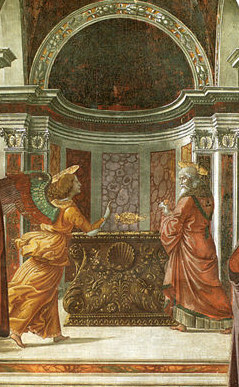
Today, November 5 is the feast day of Saints Zachary and Elizabeth, the parents of St. John the Baptist. Today the focus will be on Zechariah, (tomorrow we will concentrate on Elizabeth). The account of the Archangel Gabriel appearing to Zechariah is found in Luke 1:5-25.
- The priest Zechariah had been the first person told of the Messiah’s impending mission to the House of Israel. That God willed this is understandable as he was a faithful and holy priest. Zechariah represents the remnant of faithful souls within Israel awaiting the Messiah.
- Gabriel’s initial greeting to Zechariah had been full of tenderness as he recounted God’s attentiveness to the prayers of both Zechariah and Elizabeth. He then proclaimed the conception and future mission of Zechariah’s son John.
- But Zechariah confronts the Archangel with a doubting question: “How shall I know this? For I am an old man, and my wife is advanced in years.” Suddenly, this joyous breathtaking event sours.
- Zechariah of Ain‑Karim, would have had a keen interest in the prophecies and teaching concerning the long awaited Messiah, but now by his own doubt and lack of faith he had rebuffed the exalted Archangel Gabriel, the same angel who had appeared to the great prophet Daniel.
- The Archangel has no choice but to put aside the rest of the message as it was intended to be delivered. He delivers instead a brief angelic rebuke: “I am Gabriel, who stand in the presence of God and I was sent to speak to you, and to bring you this good news.”
- The divine message has, in effect, been cut short and there is nothing left to say. Indeed, the Angel will see to it that Zechariah has nothing else to say for a very long time: “…..you will be silent and unable to speak until the day that these things come to pass….” And when would “these things come to pass”?
- And so for the next six months, prior to the arrival of Mary (and unborn Jesus), Zechariah was a man ashamed, begging God to forgive him for his stubborn and hardened heart. He was acutely aware of his sinfulness and weakness and would have prayed often, readily identifying with many of the Psalms. “O Lord, rebuke me not in thy anger, nor chasten me in thy wrath…! I am utterly bowed down and prostrate; all the day I go about mourning” (Ps 38:1,6).
- Finally, with Mary and unborn Jesus came hope. Literally, physically, supernaturally, prophetically. A great ray of light broke through the clouds of Zechariah’s thoughts and musings. As he could witness God fulfilling His promises to Israel ‑ in spite of his own obstinacy ‑ hope began to grow in him and even the courage to believe more fiercely that yes, God could forgive him, God would forgive him and even rely on him again. For Zechariah this visit was a wonderful gift from God, an indescribable consolation. And in three short months his lips would again sing aloud the praises of God his Savior. (Luke1:67-79) Condensed from Unborn Jesus Our Hope.
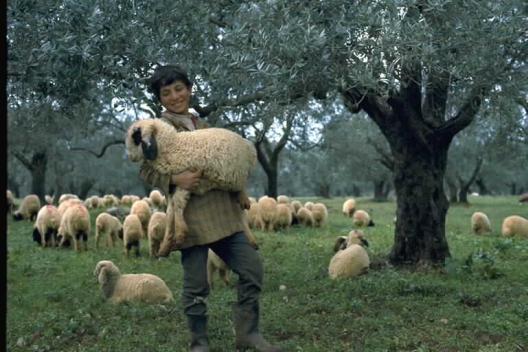
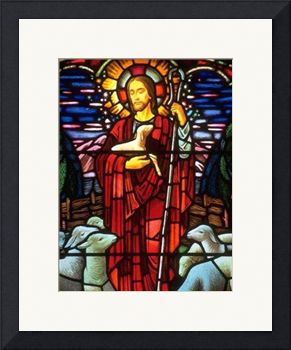
Today, Friday, November 2nd is All Souls Day, and the Psalm for today’s Mass is the one and only Psalm 23. My childhood was not very religious, but my grade two class did memorize Psalm 23 (King James Version, KJV). It left a formative and lasting impression upon my little eight year old mind. I would suggest to parents and teachers alike that this is one of the best religious passages for a child to memorize.
While only six verses in length, it is chock full of positive and healthy images for the childlike. Let’s look at a few (KJV) verses:
“The Lord is my shepherd” – this suggests a one-on-one relationship of simple dependency. But the shepherd is the one who CARES ‘for’ the sheep and ‘about’ the sheep.
He leads me “beside the still waters” and “makes me to lie down in green pastures”. For the childlike mind these are calm and peaceful images of a little innocent sheep being cared for.
“He restoreth my soul” – now we drift into the spiritual ever so gently. The child might wonder what is “my soul” and he is left with a beautiful image to guide his questioning.
“He leadeth me in the paths of righteousness for His name’s sake”. Perhaps this is now stretching the child’s moral framework, but that is a good thing. God, my shepherd is leading me somewhere “for His name’s sake”. There is a purpose behind His leading, it is not aimless, it is for my good (whatever that might be).
Even in a dark valley (“the valley of the shadow of death”) He is with me so I need not be afraid. He even comforts me.
He prepares a meal for me and pours mysterious oil upon my head. These are profound images that the child can ponder without fully understanding them. That is a good thing. The child doesn’t need to understand all of this like some dumbed-down cartoon. The child can be left wondering about such mysterious images.
“Goodness and mercy shall follow me” all through my life “and I will dwell in the house of the Lord forever” – that is, His door is open and He invites me into His house. The Shepherd’s house is a place of safety, refuge and hope for me.
We do not think about God in simple childlike ways often enough. There are passages and stories in the Bible that are especially poignant for children (and the childlike). Let’s cherish them and pass them on.
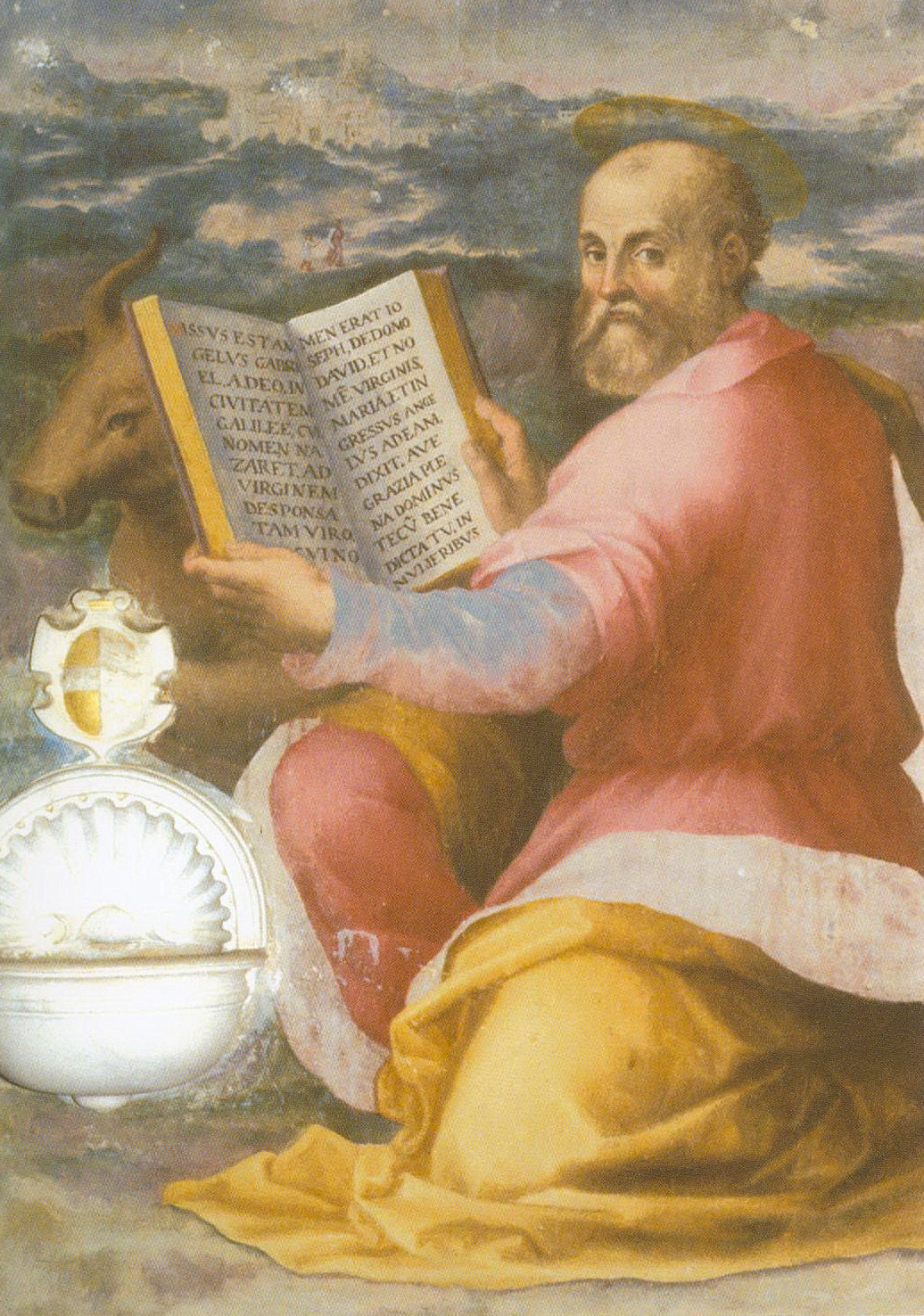
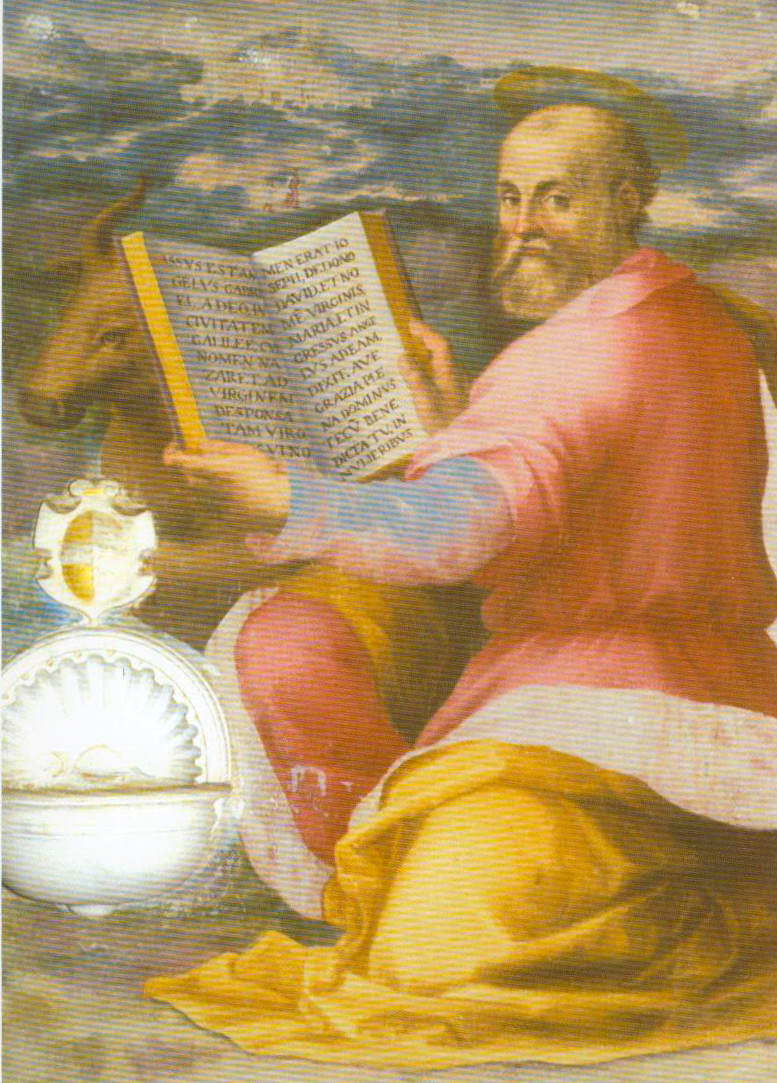
Michele Tosini (1503-77) St. Luke
October 18 is the feast day of St. Luke.
In chapters One and Two of the Gospel of St. Luke we have 127 verses of narrative concerning the infancy and childhood of Jesus Christ and mysteries surrounding His infancy (Lk 1:5 – 2:52). These verses are unique to Luke and outline the earliest vignettes known about the childhood of Jesus Christ. The verses restricted to the infancy period are slightly less: 114 verses (Lk 1:5 – Lk 2:39).
The extraordinary account of the Annunciation to Mary by the Archangel Gabriel, for example, is presented only in Luke and no where else. Likewise, the remarkable Visitation event (and Magnificat “song”) and Bethlehem birth saga are Lukan treasures only. Which might lead us to wonder how would Christianity be different if there was no Luke? Would we celebrate Christmas? (Matthew also provides 47 verses of invaluable introductory information as well concerning Mary, Joseph and Jesus, before and after the birth. Mt 1:18 – 2:23)
We are indebted to Luke in a thousand ways, but especially for the first two chapters of his Gospel which are in a way a “prologue”, comparable to the famous “Prologue” to the Gospel of John (Jn 1:1-18): “In the beginning was the Word, and the Word was with God…” But while the Prologue of John is about Mysteries and realities concerning the Word Incarnate, this “prologue” of Luke’s is focused on biological and historical events which reveal the Child Incarnate. While John is mystical, Luke is highly personal yet supernatural. All of this is to say that, the Incarnation Mystery of faith is so wondrous, that we need both Luke and John to unfold for us its beauty and reality. We can listen to John’s Prologue and see it with the eyes of the heart, but Luke’s we visualize all in fabulous images.
But it is only Luke who reveals to us the babyhood of Jesus and the attendant mysteries thereto. Luke is one of the Church’s great “Pro – Life” saints! There is no way around it. He alone tells of the conception of Jesus Christ, paints for us the tender mother who opens up her heart and soul to God’s plan and Spirit, then recounts the mysterious encounter between pregnant mothers and unborn children and finally recounts in all its poverty and glory the birth of humankind’s Savior in a manger.
St. Luke we thank you for the little details you carefully recorded about our Savior’s first nine months in the womb and then in the manger. You, St. Luke, have brought more tears of joy to human eyes than any other author in human history. You have revealed to us the mother of the baby Jesus and have transported us in our thoughts to kneel beside the beasts and shepherds, beneath the angels’ meditative gaze. It was first your descriptive words which gave rise to those Christmas hymns we sing now that cause our hearts to bow down in adoration again.
St. Luke, when we see you in heaven, we will get in that very long reception line of pro-life Christians who want to shake your hand, the hand which wrote down the sacred events of our Savior’s babyhood, events which gave us hope for all our earthly days.
George A. Peate, Unborn Word Alliance
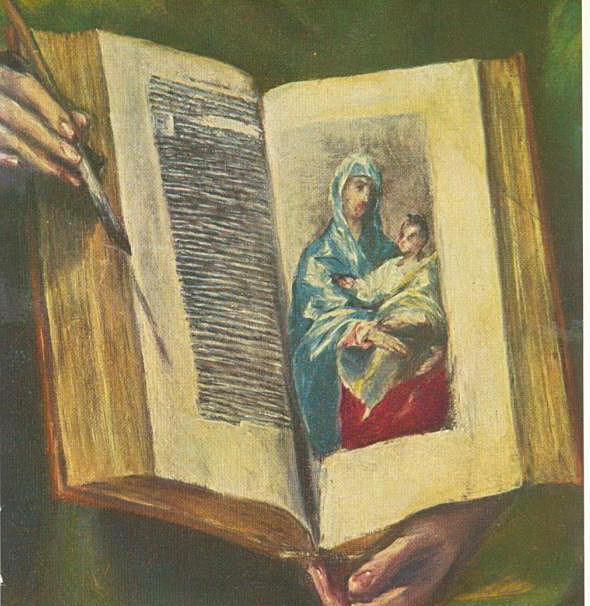
El Greco (1541-1614) St. Luke (detail)
Filed under: Biblical Reflections, Quotes from Great Christians, Religion
Today September 17 is the feastday of St. Robert Bellarmine (1542-1621). He was a Jesuit and a Doctor of the Church. Here is a beautiful quote from him about the obedience of the infant Christ.
“In the first place, the obedience of Christ to His Father began with His Conception and continued uninterruptedly to His Death. The life of our Lord Jesus Christ was one perpetual act of obedience. The Soul of Christ from the moment of its creation enjoyed the exercise of its free will, was full of grace and wisdom, and consequently, even when enclosed in His Mother’s womb, was capable of practicing the virtue of obedience.
The Psalmist speaking in the Person of Christ says: “In the head of the book it is written of Me that I should do Thy will. O My God, I have desired it, and Thy law in the midst of My Heart.” (Psalm 40: 8, 9). These words may be thus simplified: ” In the head of the book”–that is from the beginning to the end of the inspired writings of Scripture–it is shown that I was chosen and sent into the world “to do Thy will. O My God, I have desired it,” and freely accepted it. I have placed “Thy law,” Thy commandment, Thy desire, “in the midst of My Heart,” to ponder upon it constantly, to obey it accurately and promptly.
The very words of Christ Himself mean the same. “My meat is to do the will of Him that sent Me, that I may perfect His work.” (John 4:34). For as a man does not take food now and again and at distant intervals during life, but daily eats and takes a pleasure in it, so Christ our Lord was intent upon being obedient to His Father every day of His life. It was His joy and His pleasure.
“I came down from Heaven not to do My own will, but the will of Him that sent Me.” (John 6:38).
And again. “He that sent Me is with Me, and He hath not left Me alone; for I do always the things that please Him.”( John 8:29)
And since obedience is the most excellent of all sacrifices, as Samuel told Saul, (1 Kings 15:22) so every action which Christ performed during His life was a sacrifice most pleasing to the Divine Majesty.
The first prerogative then of our Lord’s obedience is that it lasted from the moment of His Conception to His Death upon the Cross.”
From The Seven Words on the Cross by St. Robert Bellermine
 UNBORN WORD of the day