


Matthew, Mark, Luke and John agree. When the Son of God came into the world He was not warmly received.
There was a saying in Israel: “Can anything good come out of Nazareth?” (Jn 1:46) Yet it was precisely there – to Nazareth – that God sent His holy messenger “the angel Gabriel” to address the woman chosen to be the Mother of Jesus – and Mary conceived of the Holy Spirit there in Nazareth. Yes, the salvation of humanity comes out of Nazareth!
Years later Jesus would explain that “Foxes have holes, and birds of the air have nests; but the Son of man has nowhere to lay his head.” (Mt 8:20, also Lk 9:57) Yet it is true, that the Unborn Son of man laid His head to rest within the womb of His mother for nine sacred months! Her womb, like her heart was full of the love of God!
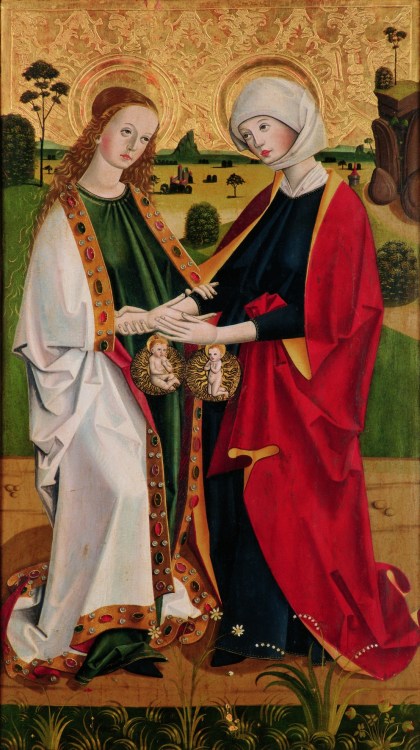
The Lord told us also: “A prophet is not without honor, except in his own country, and among his own kin, and in his own house.” (Mk 6:4, also Lk 4:24). And yet when Mary (and her unborn Child) arrived at the home of her cousin Elizabeth (who was six months pregnant with John the Baptist), Unborn Jesus was warmly received by Elizabeth and her unborn son John who leaped in the womb for joy!
After spending three months with Elizabeth (and John…unborn, then finally born), Mary returned to Nazareth. “He came to his own home, and his own people received him not” (Jn 1:11).
So, we see that in the initial months of the Incarnation, the Son of God was lovingly welcomed and received by two women and an unborn baby: Mary, Elizabeth and unborn John the Baptist. The prophets had spoken of “a remnant” of faithful Israelites – here were three faithful ones, waiting for the prayers of their ancestors to be answered.
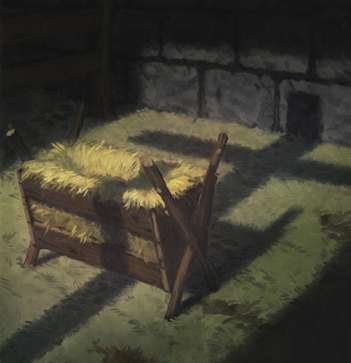
Today, during the Stations of the Cross , Pope Benedict prayed this prayer at the Seventh Station.
“We have faith, Lord, but not enough. Help us to have more. May we never question or mock serious things in life like a cynic. Allow us not to drift into the desert of godlessness. Enable us to perceive you in the gentle breeze, see you in street corners, love you in the unborn child.
God, enable us to understand that on Tabor or Calvary, your Son is the Lord. Robed or stripped of his garments, he is the Saviour of the world. Make us attentive to his quiet presences: in his “word”, in tabernacles, shrines, humble places, simple persons, the life of the poor, laughter of children, whispering pines, rolling hills, the tiniest living cell, the smallest atom, and the distant galaxies.
May we watch with wonder as he walks on the waters of the Rhine and the Nile and the Tanganyika.”
Filed under: Biblical Reflections
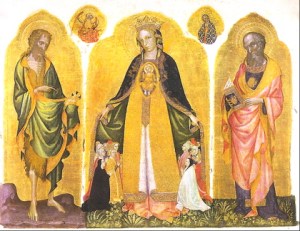
Accademia, by Jacobello del Fiore
The Lord is with thee. These words were often said of or to those to whom God was about to entrust some special work.
God told Abraham that he would be with him when made his covenant with him “Abram tell flat on his face. And God said to him: “Behold, my covenant is with you, and you shall be the father of a multitude of nations. No longer shall your name be Abram, but your name shall be Abraham; for I have made you the father of a multitude of nations. Genesis 17:2-4
He was “with Joseph ” while he was in Putiphar’s prison, preparing him for the great work of serving the nation during the famine. “But the LORD was with Joseph and extended kindness to him, and gave him favor in the sight of the chief jailer.” (Gen. 39. 21.)
“I will be with thee,” God said to Moses at the burning bush, when He told him that it was he who was to bring the children of Israel out of Egypt. “I will be with you; and this shall be your proof that it is I who have sent you: when you bring my people out of Egypt, you will worship God on this very mountain.” (Ex. 3 12.)
And to Joshua, who had to bring the chosen people into the promised land, He said : “As I have been with Moses, so I will be with thee… Fear not, and be not dismayed: because the Lord thy God is with thee in all things whatsoever thou shalt go to.” (Jos. 1. 5,9.)
“The Lord is with thee, O most valiant of men.” This was the message the angel brought to Gideon at the threshing floor, for he was to leave his wheat and go to deliver God’s people from idolatry and from their enemies. (Jud. 6. 12.)
In the New Testament there are two instances where these special words are spoken. They are the last words Jesus said to the Apostles before he ascended into Heaven. These are the words that accompanied His commission to send them out to bring the Good News to the world. “And behold, I am with you always, until the end of the age.” (Matthew 28:20)
And they are among the first words spoken to Mary:
“And now when Mary is being singled out for the greatest work that was ever entrusted to any child of Adam that of being the Mother of Him Who was to save not one nation only, but the whole world, God sends an Archangel and bids him say to her : ‘The Lord is with thee.’ (Lk. 1:28 ) God was with Mary always; but now all three Persons of the Blessed Trinity are to be with her in a very special way, to enable her to co-operate with God’s designs for her.” From Mater Christi by Mother St. Paul, 1920.
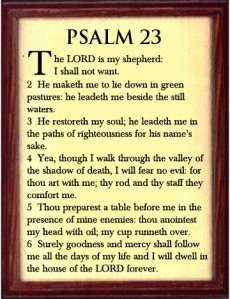
We consider now the last two verses of this beautiful Psalm, verses 5-6.
In the early Church, Psalm 23 was associated with the three sacraments of initiation: Baptism – verse 2 “beside the still waters”, Confirmation – verse 5 “thou anointest my head with oil”, Eucharist – verse 5 “Thou preparest a table before me”. Further, it even seemed to comment on one’s new life in the Church and one’s promised life hereafter: “I will dwell in the house of the Lord forever” (verse 6). It seems like a prophetic Ecclesiastical Psalm.
But let’s step back and look at two other simple themes running through this Psalm: the Path of Righteousness and the Will of God.
THE PATH OF RIGHTEOUSNESS: “he leadeth me” (v.2), “he leadeth me” (v.3), “in the paths of righteousness” (v.3), “I walk…thou art with me” (v.4), “shall follow me” (v.6). Psalm 23 describes a journey of faith, a journey along a path which leads us to a place; the Church. Nature reveals God’s creative hand to us (v.2), but proceeding we experience the tender hand of God as “He restoreth my soul” (v.3) and then comforts me (v.4). By the time we arrive at His Eucharistic liturgy, “He preparest a table before me” (v.5), almost like a servant – reminding us of Jesus washing the feet of His apostles at the Last Supper. And Jesus did prepare the table for them at that last supper as He changed the bread into His Body and the wine into His Blood – this was thoughtful loving preparation. So the “waters” of verse 2 have now been changed into wine “my cup runneth over”, and within the Church, into His blood. “He prepares the mystical table” as the early Church Father, St. Gregory of Nyssa, commented concerning verse 5.
THE WILL OF GOD: “The Lord is my shepherd” tells us right away that we are sheep who must follow the Shepherd’s “will”. It is His tender-hearted will that we rest and eat in “green pastures” and rest and drink “the still waters” (v.2) because He intends to “restoreth” our souls. He wills that we represent Him even within the “valley of the shadow of death” (v.4) – today read “valley of the culture of death”. He protects us by being with us; “for thou art with me” (v.4). He is strong and mighty, inspiring His flock to witness to the truth of His Culture of Life “for his name’s sake” (v.3). Verses 5-6 speak of the abundant blessings which the Lord intends for us; sacramentally, mystically, eternally, first in this world, then in the next. “Mercy and goodness shall follow me” within the Mystical Body of Christ, as God wills.
The Good Shepherd also entrusted Peter with this shepherding tradition and mandate: “Feed my lambs”, “Tend my sheep”, “Feed my sheep” (Jn 21:15,16,17).

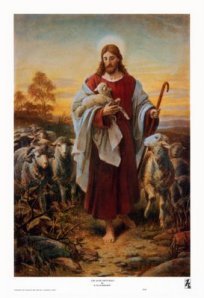
The second of three reflections on Psalm 23, considers verse 4.
The last line of verse 3 – “he leadeth me in the paths of righteousness for his name sake” – brings us to “walking the walk” in verse 4:
“Yea, though I walk through the valley of the shadow of death, I will fear no evil: for thou art with me; thy rod and thy staff they comfort me.”
Are we surprised that righteousness has led us into a certain element of risk and danger? Confronting evil in the world has become difficult. 21st century consequences – that is, problematic and unexpected ones – are now multiplying. What seemed simple has become much more complicated, partly due to the sins and weaknesses of the Good Shepherd’s followers, and partly due to the moral shambles of modern civilization.
We are walking through the sinister valley of the “culture of death”! But God is with us – that changes everything! “Where sin increased, grace abounded all the more” (Rom 5:20). So the Christian, that is, the follower of the Good Shepherd, should not be afraid. Just stay close to Him, don’t wander off…
King David, the author of this Psalm, was a shepherd and later a king. Christ the Lord is also both Shepherd and King. But when Christ was coming into the world it was an awesome fearsome thing. First, the Archangel Gabriel appeared to the priest Zechariah. His first words were: “Do not be afraid, Zechariah…(Lk 1:13). Then Gabriel appeared to Mary: “Hail, full of grace, the Lord is with you!…Do not be afraid, Mary…(Lk 1:28,30). Later, an angel of the Lord appeared to Joseph in a dream: “Joseph, son of David, do not fear to take Mary your wife…(Mt 1:20). And finally in the hills of Bethlehem an angel of the Lord came to the shepherds watching their flocks: “Be not afraid; for behold, I bring you good news of a great joy…(Lk 2:10).
He is Emmanuel, which means “God is with us” (Isa 7:14). So, as verse 4 tells us: “I will fear no evil: for (God) art with me”…God is with us.
“Thy rod and thy staff they comfort me”. The shepherd’s rod and staff remind us of the prophecy that the Messiah would come from the tribe of Judah: “The scepter shall not depart from Judah, nor the ruler’s staff from between his feet, until he comes to whom it belongs” (Gen 49:10). The rod (scepter-like) is for exercising power by striking an enemy, defending against evil. The staff is for steadying one on his journey, leaning upon it for comforting rest.
So the Messiah would be Emmanuel, “God with us”, a Shepherd King guiding and protecting us. His sign is a cross of two beams, much like a rod and staff intersecting and fastened together.With the cross He has already defeated death and evil. From our 21st century vantage point we look out to Nazareth and Bethlehem and we see Him coming: The Shepherd King of the Culture of Life.
See also: Another reflection on Psalm 23.
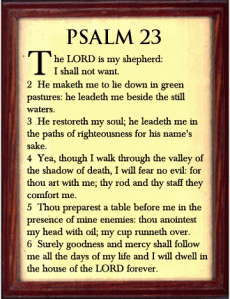
The first of three reflections on Psalm 23, considers verses 1-3.
In one of his great Messianic outpourings, Isaiah told us that the Messiah would be “like a shepherd”: feeding his flock, gently leading them, gathering them in his arms and holding them “in his bosom” (Isa 40:11). So when we read “The Lord is my shepherd” we are to picture the tenderhearted Christ who once told His followers “I am the good shepherd” (Jn 10:11). In verse 3 of the Psalm we read that the shepherd “leadeth me in the paths of righteousness”. Jesus alluded to this when He described the good shepherd: “…the sheep hear his voice, and he calls his own sheep by name and leads them out…he goes before them, and the sheep follow him, for they know his voice” (Jn 10:2-4). So Jesus the good shepherd leads us in the paths of righteousness, into all good.
When we read about the green pastures, first we should appreciate the fact that these are “His pastures”, but for our benefit. St. Cyril of Alexandria, an early Church Father, says the pastures are “the ever-fresh words of Holy Scripture, which nourishes the hearts of believers and gives them spiritual strength”.
But to my mind, perhaps the key to this entire Psalm is found in the following words: “He leadeth me beside the still waters. He restoreth my soul” (Ps 23:2-3). Many early Church Fathers took this reference to “waters” as a reference to baptism. So, just as Jesus Himself was baptized, so He leads us along this righteous path to also be baptized “in the name of the Father and of the Son and of the Holy Spirit” (Mt 28:18-20).
This baptism “restoreth my soul” in the proper and holy relationship it is meant to have with the Holy Trinity. These still waters, beside which we rest, are also very deep waters. That is, they are deep mystically speaking, like the waters of the Jordan River within which Jesus was baptized. When Jesus emerged from the water witnesses beheld a Trinitarian Theophany: a Dove (the Holy Spirit) came down upon Him and a Voice (the Father’s) resounded around Him: “This is my beloved Son, with whom I am well pleased” (Mt 3:13-17). We can quietly meditate beside these still waters, beside this pool of Revelation, discovering here the deep mysteries of the Holy Trinity.
Gaze again upon these still mystical waters into the mystery of the Incarnation. See how the Incarnate Unborn Jesus first meets John the Baptist when both dwelled within the deep amniotic waters of their mothers’ wombs. In this first meeting, Christ anointed the unborn baby John with His Spirit and John leaped for joy (Lk 1:39-44).
The Good Shepherd leads us “beside still waters”, where we rejoice as we contemplate the deep teaching of the Holy Trinity and the Incarnation. As baptized Christians we rest here, content. Another early Church Father, St. Gregory of Nyssa, reflecting on verses 2-3 of this Psalm refers to “the pastures and fountains of doctrine”. In due course, we hear again the voice of the Good Shepherd: “…whoever drinks of the water that I shall give him will never thirst; the water that I shall give him will become in him a spring of water welling up to eternal life” (Jn 4:14).
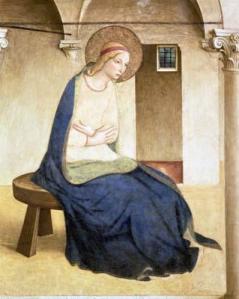
Fra Angelico – The Annunciation, detail of the Virgin
Saturday, Jan. 3, 2009 is the Feast day of The Most Holy Name of Jesus. The Archangel Gabriel was sent on a mission to deliver a message to the Virgin Mary who lived in Nazareth (Lk 1:26-38). A key component of that message was the Name of the Messiah, a further installment in the prophetic revelations through the millennia concerning the identity of the Messiah. Previously, the revelations and prophecies had been getting more and more specific as the year of his advent approached.
God the Father spoke to Adam and Eve about the Messiah (Gen 3:15). As centuries unfolded, so too the mystery of the Messiah unfolded. It was revealed – He would be from the tribe of Judah. It was revealed – He would be born in Bethlehem. It was revealed – He would be a descendant of King David.
But now, in these last days – actually moments before the Incarnation of the Son of God – His Holy Name was revealed – to one trusted custodian: “you shall call his name Jesus”. Here we must pause and reflect on Mary’s state of soul. The Angel departs, the Holy Spirit comes upon her, the power of the Most High overshadows her, and after all is said and done, she is left alone (almost), to marvel, with a handful of words in her heart which break open the sacred mystery of the Messiah:
“Do not be afraid”
“Son of the Most High”
“His kingdom”
“holy, the Son of God”
“Jesus”
Of these five “words”, the first and the last are the most “personal” with respect to Mary’s human heart: “Do not be afraid, Mary…” and “JESUS”, her baby’s name.
“Jesus” was a special name; the fruit of God’s Heart. A name with a message, it means “Yahweh is salvation”. But uppermost in Mary’s mind was that this was her child’s name. She would have repeated it, interiorly, with great frequency…out of love, out of reverence and awe, in thanksgiving and with expectation.
After the Holy Spirit revealed the “Divine” pregnancy of Mary to Elizabeth, it was now Mary’s privilege to announce to Elizabeth and her husband Zechariah the name of the Messiah; “Jesus”(Lk 1:39-56). This holy couple represented the “remnant” of Israel who faithfully awaited the fulfillment of God’s promises through the coming of the Messiah. So to them Mary revealed the Most Holy Name of Jesus. Later, the name was also revealed to Joseph.
For nine sacred months this name was pondered within this Mother’s Heart. She held the Divine Person in her womb and His Holy Name in her heart. Both hidden from the world until the proper time. Decades later, St. Paul would say of this “name”, that it was “the name which is above every name” (Phil 2:9). But for Mary, it was simply the most beautiful name she had ever heard or spoken.

Adoration of the Magi by Fra Angelico and Fra Filippo Lippi
The second reading at Mass this Sunday, September 28, 2008, is the oft’ quoted passage from Paul’s Letter to the Philippians: 2:5-11. Not only oft’ quoted, but frequently relied upon by theologians and other Christian scholars because of its richly compact theological truths.
First it tells us, beautifully, about the attitude or mindset which Christ had when He came into the world, His incarnational virtues of humility and obedience; “obedient to the point of death, even death on a cross”.
Then Paul transitions to the Father’s wonderful exaltation of His only-begotten Son, “that at the name of Jesus every knee should bend, of those in heaven and on earth and under the earth, and every tongue confess that Jesus Christ is Lord, to the glory of God the Father”.
Let’s go back in time, ‘salvation history time’, to the first time when this literally happened. It was nighttime in the hill country outside Bethlehem, two thousand years ago (Lk 2:8-20). The angel of the Lord appeared to shepherds watching their sheep: The angel “confessed with his tongue” the Lordship of Jesus Christ: “…for to you is born this day in the city of David a Savior, who is Christ the Lord”. Suddenly “a multitude of the heavenly host” joined this angel praising God. They were all confessing with their tongues, the Lordship of Jesus Christ. Some paintings of this scene even suggest that these angels in the sky are in a kneeling position.
Next, we see the shepherds kneeling around the babe wrapped in swaddling cloths lying in the manger. And they “made known the saying which had been told them concerning this child”. They too were “confessing” the Lordship of Jesus Christ, while kneeling.
We can be certain that Mary and Joseph, at least for part of that evening, were also kneeling and confessing the Lordship of Jesus Christ. Later, we hear of the wise men from the East. When “they saw the child with Mary his mother…they fell down and worshipped him” (Mt 2:11).
We can join with these Holy Ones of old, God’s angels, Mary and Joseph, the shepherds and wise men, and yes, with St. Paul, bending our knee to the Name of Jesus, and confessing with our tongue His glorious Lordship! But we can do more yet. Every physical action while acknowledging the Lordship of Christ, is likewise, an act of praise, honor or worship. With our eyes we can honor Him! With our hands – even if quietly folded in simple prayer – we can honor Him! With our head – whether bowed low or lifted high – we can honor Him! With our intellect! With our will! With our memory! With our imagination! With our time! Have I forgotten something?
Our lives are replete with opportunities to praise, honor and worship Jesus Christ our Lord. On the stairs, in the elevator, on the landing, in the hallway, on the bus, in the parking lot. We can sanctify the world, acknowledging His Lordship!
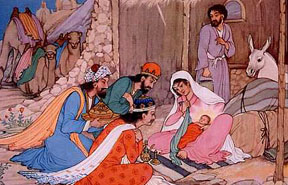
The Gospel of Matthew tells us about the “wise men from the East”. They really had only one objective for their long journey. If their journey could be compared to a race, then Bethlehem was the finish line, but what was the prize? In fact, when they set out they didn’t know where the finish line was either. Wise men on a Mission!
So when they arrived in Jerusalem, they were saying to various people: “Where is he who has been born king of the Jews? For we have seen his star in the East, and have come to worship him” (Mt 2:1-12).
The Infant King of the Jews was the prize they sought. To see Him and worship Him! These wise men were prepared for the realization of their objective. So when they finally found “the child with Mary his mother”, what did they do? “They fell down and worshipped him“. If this had been a test of some kind – they passed with flying colors!
It is interesting that they fell down – physically, probably kneeling in holy reverence – and that the infant was “with Mary his mother”. So is it possible that someone looking from a distance might wonder whether they were worshipping the infant or the mother or both? This is the criticism sometimes leveled at Catholics. Do they worship Mary the mother of Jesus? Of course not! By virtue of her Divinely determined maternal role, Mary is always close to Jesus Christ her Son. But she is always distinct from Him. He is God, she is human. But Matthew presents the Infant King of the Jews “with Mary his mother” because the Infant King needed His mother – He would have been lost without her! On earth, when He was a small child, she was His heaven. This shows us how much the Father trusted Mary to be the best of mothers to the Father’s only begotten Son.)
Of course, these wise men are remembered primarily for what they did next: “Then, opening their treasures, they offered him gifts, gold and frankincense and myrrh.” But this lavish gift-giving was part of their worship! We mustn’t separate their worship from their gift-giving. First came the worship, then the gift-giving. The worship established the context, the gift-giving was an extension of the worship, part of the worship. Worship of God is the heartbeat of the Church, and refreshment to the spiritual life.

In yesterday’s Sunday Mass, all three readings lent themselves to pro-life reflections. This is not to suggest how fanatical this writer is, but rather how truly universal the “Gospel of Life” message is. Let’s look at one reading:
“For as the rain and the snow come down from heaven,
and return not thither but water the earth,
making it bring forth and sprout,
giving seed to the sower and bread to the eater,
so shall my word be that goes forth from my mouth;
it shall not return to me empty,
but it shall accomplish that which I purpose,
and prosper in the thing for which I sent it.” Isaiah 55:10-11
These two beautiful verses from the prophet Isaiah put all of God’s creation in proper perspective. They describe the creative work of God and the purpose of things. But more, they provide an archetype – no, not the rain and the snow – the archetype is God’s word.
Just as God’s word goes forth to fulfill its purpose, and does not return to God “empty”, so all created things have their purpose and are sent forth accordingly.
God’s word represents God’s Will, God’s Plan, God’s commands, God’s teaching. But then came the Incarnation. God’s Word is wonderfully described in John’s prologue: Jn 1:1-18. The Word did not return to the Father “empty”. And the Word also did “accomplish that which I purpose”.
“And from his fullness have we all received, grace upon grace” (Jn 1:16).
So, the word was an archetype, but through the Word all things were made, and that brings us to humans – specifically to unborn ones! The unborn baby is created in the image and likeness of God (Gen 1:26). We must ask ourselves, whether each unborn baby has a purpose to fulfill? THE ANSWER MUST BE “YES“!
No human being has the authority or the right to kill an unborn baby who has been sent forth by God – in the image and likeness of God – to accomplish the Divine Will…
HOLY INFORMATION…TO INFORM THE CONSCIENCE…AND FORM THE HEART…
Just as feeding one’s body should not be an altogether haphazard exercise but needs to be self-regulated for one’s own good health and well being, so too one needs to look to nourishing sources for information. Not all information is equal – some is garbage-like and some is holy!
St Paul told the Ephesians: “…walk as children of light (for the fruit of light is found in all that is good and right and true), and try to learn what is pleasing to the Lord.” Eph 5:8-10
And he told the Phillipians also: “…whatever is true, whatever is honorable, whatever is just, whatever is pure, whatever is lovely, whatever is gracious, if there is any excellence, if there is anything worthy of praise, think about these things.” Phil 4:8
Our nation needs an informed electorate! But not informed with trivia, distorted half-truths, smooth-as-silk lies, compromised data, tainted journalism and all the other attempts to manipulate voters. The foregoing produces unformed/deformed consciences.
The voter with an unformed conscience considers unborn children as unimportant.
Seek that information that truly enlightens the intellect, enkindles the conscience and ignites the heart…
As one of the greatest men of the twentieth century said: “Our intelligence is not just an abstract machine; it is also incarnate and the heart is as important as the faculty of reason, or precisely reason is nothing without the heart”. Dr. Jerome Lejeune
The truth sets the heart free. A properly informed conscience will love the unborn child!
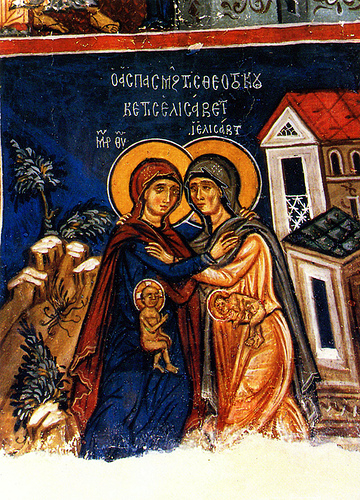
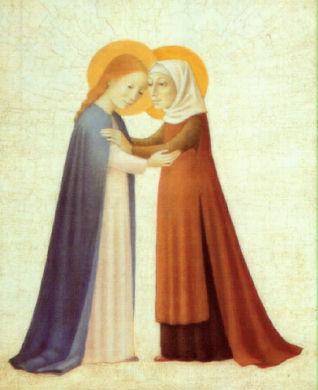
14th Century Wall Visitation
Today, Saturday March 31, 2008 is the Feast Day of the Visitation of the Blessed Virgin Mary. This Feast Day celebrates a great mystery of the Christian faith, one discussed by Blessed Teresa of Calcutta when she accepted her Nobel Peace Prize in 1979 and also by John Paul II in his great encyclical letter the Gospel of Life. Yet perhaps many Christians have not fully grasped the beautiful message we discover over and over again in this wonderful event related by St Luke, the Evangelist of the Child Jesus (see Luke 1:39-56).
For past posts, more theologically oriented than today’s see:
The Visitation – God visits His People
The Visitation – The unborn Christ begins his saving mission
What did Fulton Sheen think was One of the most beautiful moments in history?
Newly conceived Jesus acknowledged by John the Baptist
Now Mary’s cousin Elizabeth was not only older than her but also surpassed her (according to the world’s standards) in the dignity of her position as the wife of a priest (Zechariah) who served at the Jerusalem Temple. Yet in the mystery of the Visitation, Elizabeth bows to Mary (and her unborn child Jesus): “…and Elizabeth was filled with the Holy Spirit and she exclaimed with a loud cry, ‘Blesssed are you among women, and blessed is the fruit of your womb!” Elizabeth continues to bless Mary as “the mother of my Lord” and especially for her faith!
But we have another “match up” here. The older unborn baby – John – defers to or acknowledges, so to speak, the younger but greater unborn baby, Jesus. John leaps for joy at the approach of the Unborn Savior, but in a spiritual sense he kneels and worships the Unborn Christ Child. Three months later, just after John’s birth, the priest Zechariah (husband to Elizabeth and father to John) will sum things up quite simply: “Blessed be the Lord God of Israel, for he has visited and redeemed his people…” (Lk 1:68). Yes, Unborn Jesus, who is the Lord (according to Elizabeth and the Holy Spirit), has been visiting the home of Zechariah for three joyful months.
We too, like Unborn John, Elizabeth and Zechariah should worship Unborn Jesus and honor His mother Mary. We should also – along with all society and the medical and social service professions – show deference to all innocent unborn children, and their mothers, acknowledging the awesome dignity and reality of the hidden mystery of life, growing and maturing towards birth’s revelation.
Archbishop Fulton Sheen, was born on May 08, 1895. Here is what he wrote about the Visitaion:
“One of the most beautiful moments in history was that when pregnancy met pregnancy ‑ when child bearers became the first heralds of the King of Kings. All pagan religions begin with the teachings of adults, but Christianity begins with the birth of a Child. From that day to this, Christians have ever been the defenders of the family and the love of generation.”
“If we ever sat down to write out what we would expect the Infinite God to do, certainly the last thing we would expect would be to see him imprisoned in a carnal ciborium for nine months; and the next to last thing we would expect is that the ‘greatest man ever born of a woman’ while yet in his mother’s womb, would salute the yet imprisoned God-man. But this is precisely what took place in the Visitation.”
Archbishop Fulton Sheen, Ph.D., D.D., The World’s First Love (Garden City, NY: Doubleday & Company, Inc., 1956), 31.
Filed under: Biblical Reflections, Fathers of the Church, Pope Benedict XVI
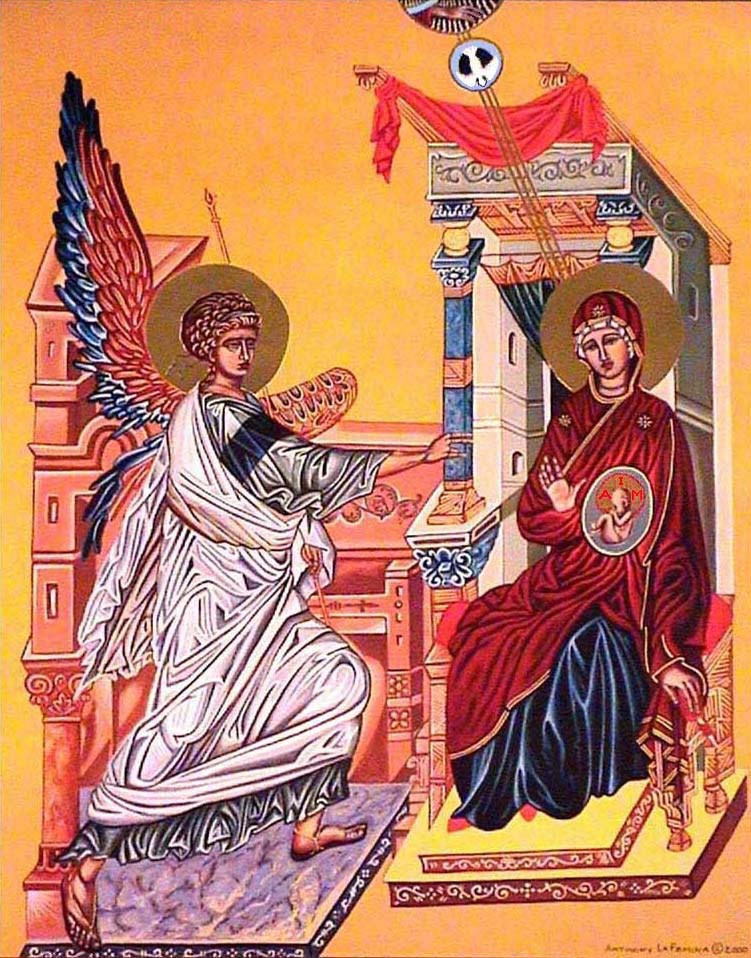
“The Lord has sworn in truth to David…’I will set upon your throne the fruit of your body'” Psalm 132:11
In the following passage Pope Benedict XVI comments on Psalm 132:11 by using a lengthy quote from St. Irenaeus:
“Let us end by remembering that the beginning of this second part of Psalm 132 was commonly used by the Fathers of the Church to describe the Incarnation of the Word in the Virgin Mary’s womb. St Irenaeus, referring to the prophecy of Isaiah about the Virgin in labour, had already explained:”
“The words: ‘Listen, then, O house of David!’ (Is 7: 13), indicate that the eternal King, whom God had promised David would be ‘the fruit of [his] body’ (Ps 132:11), was the same One, born of the Virgin and descended from David.Thus, God promised him that a king would be born who was ‘the fruit of [his] body’, a description that indicates a pregnant virgin. Scripture, therefore…sets down and affirms the fruit of the womb to proclaim that the One to come would be begotten of the Virgin. Likewise, Elizabeth herself, filled with the Holy Spirit, testified, saying to Mary: ‘Blessed are you among women and blessed is the fruit of your womb’ (Lk 1:42). In this way the Holy Spirit points out to those who want to hear him that in the Virgin’s, that is, Mary’s, giving birth is fulfilled God’s promise to David that he would raise up a king born of his body” (Contro le Eresie, 3, 21, 5: “Già e Non Ancora”, CCCXX, Milan, 1997, p. 285).
BENEDICT XVI
GENERAL AUDIENCE
Wednesday, 21 September 2005
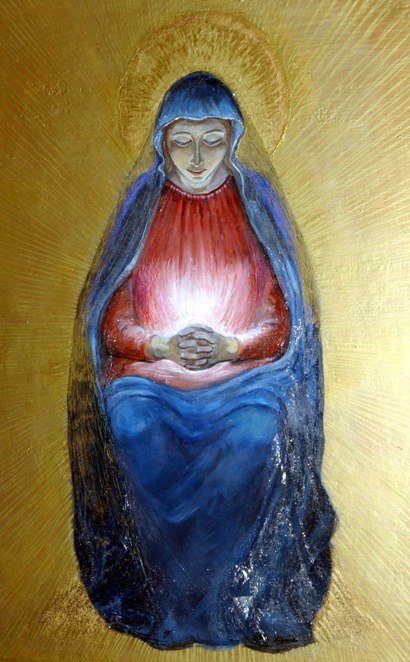
WITHOUT THE LORD’S DAY, SUNDAY, LIFE DOES NOT FLOURISH
At the conclusion of Mass, Pope Benedict went out into the adjoining square where he climbed a podium to pray the Angelus. Before the Marian prayer he said:
“Just as Mary bore Him in her womb – a defenseless little Child, totally dependent on the love of His Mother – so Jesus Christ, under the species of bread, has entrusted Himself to you, dear brothers and sisters.
Love Him as Mary loved Him! Bring Him to others, just as Mary brought Him to Elizabeth as the source of joyful exultation! The Virgin gave the Word of God a human body, and thus enabled Him to come into the world as a man.
Give your own bodies to the Lord, and let them become ever more fully instruments of God’s love, temples of the Holy Spirit! Bring Sunday, and its immense gift, into the world!”
Stephansplatz, Vienna
Sunday, 9 September 2007
The Holy Father needs our prayers as he brings the message of Christ to the United States this week.
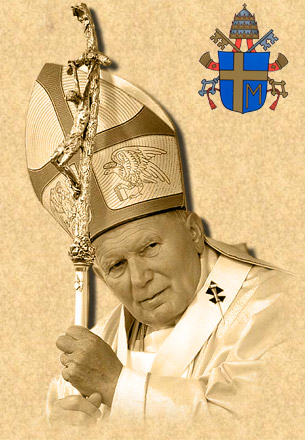
In 1999, at the age of 78, John Paul II wrote a fascinating letter. Fascinating, because as a senior citizen he wrote a Letter to the Elderly.
John Paul reminds us that: “In the past, great respect was shown to the elderly.” But today “among some peoples old age is esteemed and valued, while among others this is much less the case….”
He goes on to point out: “It has come to the point where euthanasia is increasingly put forward as a solution for difficult situations”.
There are many inspiring words of wisdom and counsel in this letter to the elderly but what I found interesting is that he points out the many prominent Biblical figures who in the later years of their lives did great things for God.
He gives 10 examples:
1. “Abraham, in whom the privilege of old age is stressed, this favour takes the form of a promise: ‘I will make of you a great nation, and I will bless you and make your name great. I will bless those who bless you and him who curses you I will curse; in you all the families of the earth will be blessed’ (Gen 12:2-3)”
2. “Sarah, a woman who sees her body growing old, yet experiences within the limitations of her aging flesh the power of God who makes good every human shortcoming.”
3. “Moses too was an old man when God entrusted him with the mission of leading the Chosen People out of Egypt. It was not in his youth but in his old age that, at the Lord’s command, he did mighty deeds on behalf of Israel.”
4. “Tobit, who humbly and courageously resolved to keep God’s Law, to help the needy and to endure blindness patiently, until the angel of God intervened to set his situation aright (cf. Tob 3:16-17).”
5. “Eleazar, whose martyrdom bore witness to an exceptional generosity and strength (cf. 2 Macc 6:18-31).”
6. “The Gospel of Luke begins by introducing a married couple ‘advanced in years’ (1:7): Elizabeth and Zechariah, the parents of John the Baptist. The Lord’s mercy reaches out to them (cf. Lk 1:5-25, 39-79)”
7. “…the aged Simeon, who had long awaited the Messiah. Taking the child in his arms, Simeon blesses God and proclaims the Nunc Dimittis: ‘Lord, now let your servant depart in peace’ (Lk 2:29).”
8. “Anna, a widow of eighty-four, a frequent visitor to the Temple, who now has the joy of seeing Jesus. The Evangelist tells us that ‘she began to praise God and spoke of the child to all who were looking for the redemption of Jerusalem’ (Lk 2:38).”
9. “Nicodemus too, a highly-regarded member of the Sanhedrin, was an elderly man. He visited Jesus by night in order not to be seen. To him the Divine Teacher reveals that he is the Son of God who has come to save the world (cf. Jn 3:1-21). Nicodemus appears again at the burial of Jesus, when, bringing a mixture of myrrh and aloes, he overcomes his fear and shows himself a disciple of the Crucified Lord (cf. Jn 19:38-40).”
10. “And what shall we say of Peter in his old age, called to bear witness to his faith by martyrdom? Jesus had once said to him: ‘When you were young you girded yourself and walked where you would; but when you are old, you will stretch out your hands, and another will gird you and carry you where you do not wish to go’ (Jn 21:18).”
He ends this list with a quote from the Psalms:
“The just will flourish like the palm-tree, and grow like a Lebanon cedar…, still bearing fruit when they are old, still full of sap, still green, to proclaim that the Lord is just” Psalm 92 (vv. 13, 15-16).
John Paul lived this fruitfulness in his own life – for after this letter – even in his old age he continued strong writing one more Encyclical letter Ecclesia de Eucharistia (17 April 2003) and 12 Apostolic letters. He also proclaimed a Jubilee year (2000) and met with the Youth in Canada in 2002. He wrote numerous letters and preached the Angelus message regularly till March 20, 2005 just a couple of weeks before his death.
Especially impressive were the 18 Pilgrimages (to 24 countries) that he made after 1999, which are listed here:
In 2000 (Fatima, Jubilee Pilgrimage to the Holy Land, and the Jubilee Pilgrimage to Mount Sinai) – in 2001 Kazakhstan, Armenia, Ukraine, and the Jubilee Pilgrimage “in the footsteps of Saint Paul the Apostle”: Greece, Syria, Malta) – in 2002 (Poland, Toronto, Ciudad de Guatemala and Ciudad de México, Azerbaijan, Bulgaria and Ischia) -in 2003 (Pompei (Italy), Slovakia, Bosnia and Herzegovina, Croatia and Spain) – in 2004 (Loreto (Italy), Lourdes (France) and Bern (Switzerland) ).
John Paul II certainly lived what he preached in this letter!
A great man whom I once met – Eddie Doherty – had been a writer when he was younger and received a special dispensation to become a priest at the age of 78. When I met Father Eddie he was even older – I will always remember a wonderful thing he said to me one day:
“I’m going to get older and older and then I am going to die and get younger and younger…”
Filed under: Biblical Reflections
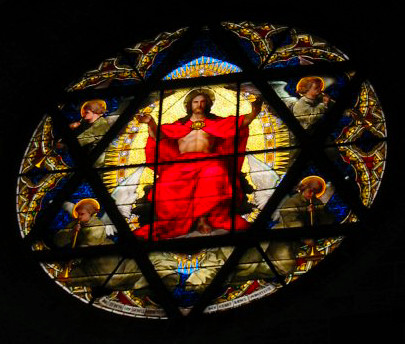
You read about it on the first page of your New Testament: “We have seen his star in the east” (Mt 2:2).
You read about it on the last page of your New Testament: “I am…the bright morning star” (Rev 22:16).
You read about it in the first Pope’s letter in the New Testament: “…until the day dawns and the morning star rises in your hearts” (II Peter 1:19).
Christ’s entry into the world was made known by a star. It was shining in His Father’s heaven while He was growing in His mother’s womb. It was a star of prophecy and Good News, it’s brilliance rivaled only by “the glory of the Lord” which shone around the Angel of the Lord with that “multitude of the heavenly host” announcing the birth of God’s only begotten Son (Lk 2:9-14).
In the last chapter of the last book of the Bible Jesus calls Himself “the bright morning star”. The morning star represents Christ in His glory, but also the Life of Christ – as did the Bethlehem star. The Christian tries to follow the morning star too, as did the three wise men. The Christian Pilgrim follows the star of Christ from Nazareth (where He was conceived), to Bethlehem (where He was born), through all of the events of His life, and especially to that Eastern morn!
There is a daily challenge to the Christian life, but every once in awhile, when we glimpse the loving Heart of Christ (Mt 11:29), or feel His love being poured into our hearts by His Holy Spirit (Rom 5:5), or witness His loving presence reflected in another (Jn 13:34), or are struck by the brilliant light of His truth (Jn 8:12, 12:46) we experience His morning star rising in our hearts – and we recall the power of the Risen Lord – and a call to follow wherever this bright Morning Star might lead us…
You read about it in the last (current) Pope’s last Encyclical letter On Hope: “…what can I do in order that others may be saved and that for them too the star of hope may rise?” (#48)
 UNBORN WORD of the day