


Tis the Season of ‘The Gospel of Life’
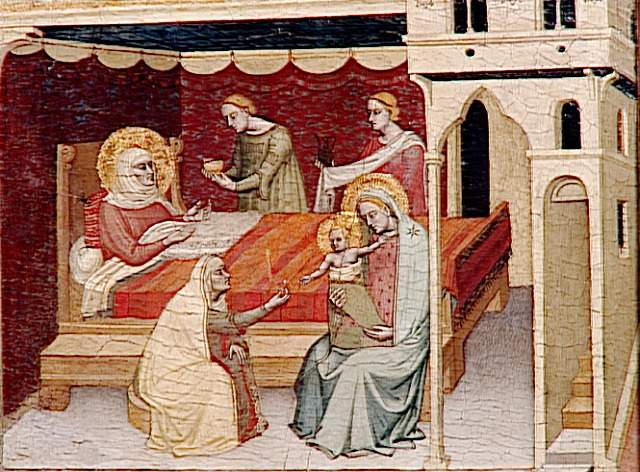
Finally, Elizabeth gave birth to John the Baptist. Here is a picture of Elizabeth after giving birth. My mother is seated in the foreground holding newborn John. (You can’t see me.) Lk 1:57
Meditation
The first three months of Jesus’ life were spent with unborn John. He stayed till John was born.
What does that say to our world?
Could it be that Unborn Jesus was sanctifying the unborn state and hallowing the journey that all unborn infants take from conception to birth? For three months all appears ordinary even though the presence of Christ Unborn is extraordinary. It is precisely the ordinariness of their lives now and the nearness of the two unborn infants to each other that underscores the solidarity that exists between Unborn Jesus and all unborn infants. He is, in an incomprehensible way, a steadfast companion to this little one growing towards birth.
Finally, John is born. The end of his gestation brings celebration. The birth of a child is one of the most profound experiences a woman and a couple can undergo. Unborn Jesus waited for unborn John’s journey to end and this new beginning.
And the Incarnate Word “saw that it was good”, the two hundred and eightieth day.
Tis the Season of ‘The Gospel of Life’
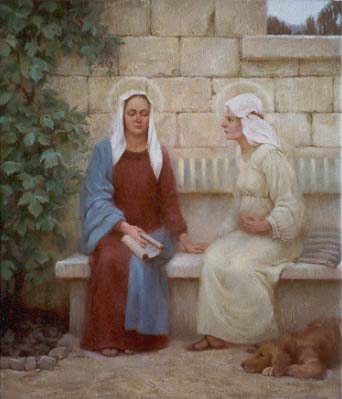
Mary Visits Elizabeth, Andrei Severetnikov
My mother and I stayed with cousin Elizabeth, Zechariah and unborn John for three months. Our parents spent this time in fellowship, prayer and reflection.
Meditation
The tone established for this ninety‑day visit might simply be stated as joy. Joy in the fulfillment of God’s promises! Messianic Joy!
The focus of the ninety‑day visit was preparation. God had called all of these individuals to serve Him in a most extraordinary manner, and before proceeding further God prepared them for the months and years ahead. Elizabeth and Zechariah were well disposed, after six quiet months spent in large measure listening, praying and reflecting. Mary was young and eager to continue as the Lord willed. But all three needed this special time with the Word Incarnate. And paradoxically, unborn John would now be prepared by the unborn Lord to years later return the favor and “prepare the way of the Lord” (Is 40:3).
We can not say definitively what Unborn Jesus did while still in the womb of His mother. But we can ponder these events with faith and love. What was this Divine Presence like within Mary’s womb, nestled under the beacon of her heart? “The flame of fire in the burning bush was a figure of Jesus in Mary’s sacred womb…. So He still speaks as if concealed in Mary’s womb…”*
… Perhaps another analogy might help us to further appreciate the power of this Unborn presence. Consider how the fire in a fireplace within a small cabin draws all who enter towards its glowing warmth. In a similar spiritual sense, the Unborn Son of God would have attracted His hosts ‑ Elizabeth and Zechariah ‑ to Himself. For their part, remaining humble and receptive, they would sense the tranquility of His Being and their open hearts would be enflamed by His nearness. Similarly, recall how the woman who touched the hem of His garment, while a crowd bustled about Him, was instantly healed by the Power in Him. Crowds were attracted to Him. For those of good will, His presence was attractiveness itself, and no doubt His physical presence would have become the new focal point of this small home. Excerpt from Unborn Jesus Our Hope, George Peate.
*This quote taken from Richard F. Clarke, S.J., “The Coming Of Christ”, pamphlet D446 (London: Catholic Truth Society, 1964), 38
Tis the Season of ‘The Gospel of Life’
 Mary in the House of Elizabeth by Robert Anning Bell (1863-1933)
My mother and I visited with cousins Elizabeth (unborn John) and Zechariah for three months (Luke 1:56). Here are my mother and Elizabeth sewing baby clothes.
Meditation
“We live in an age of impatience, an age which in everything, from learning the ABC to industry, tries to cut out and do away with the natural season of growth. That is why so much in our life is abortive. We ought to let everything grow in us, as Christ grew in Mary….. No man should ever make anything except in the spirit in which a woman bears a child, in the spirit in which Christ was formed in Mary’s womb, in the love with which God created the world.”
“In this contemplation there is great virtue in practicing patience in small things until the habit of Advent returns to us.”
Caryll Houselander (1901 – 1954)
The Reed Of God
Tis the Season of ‘The Gospel of Life’
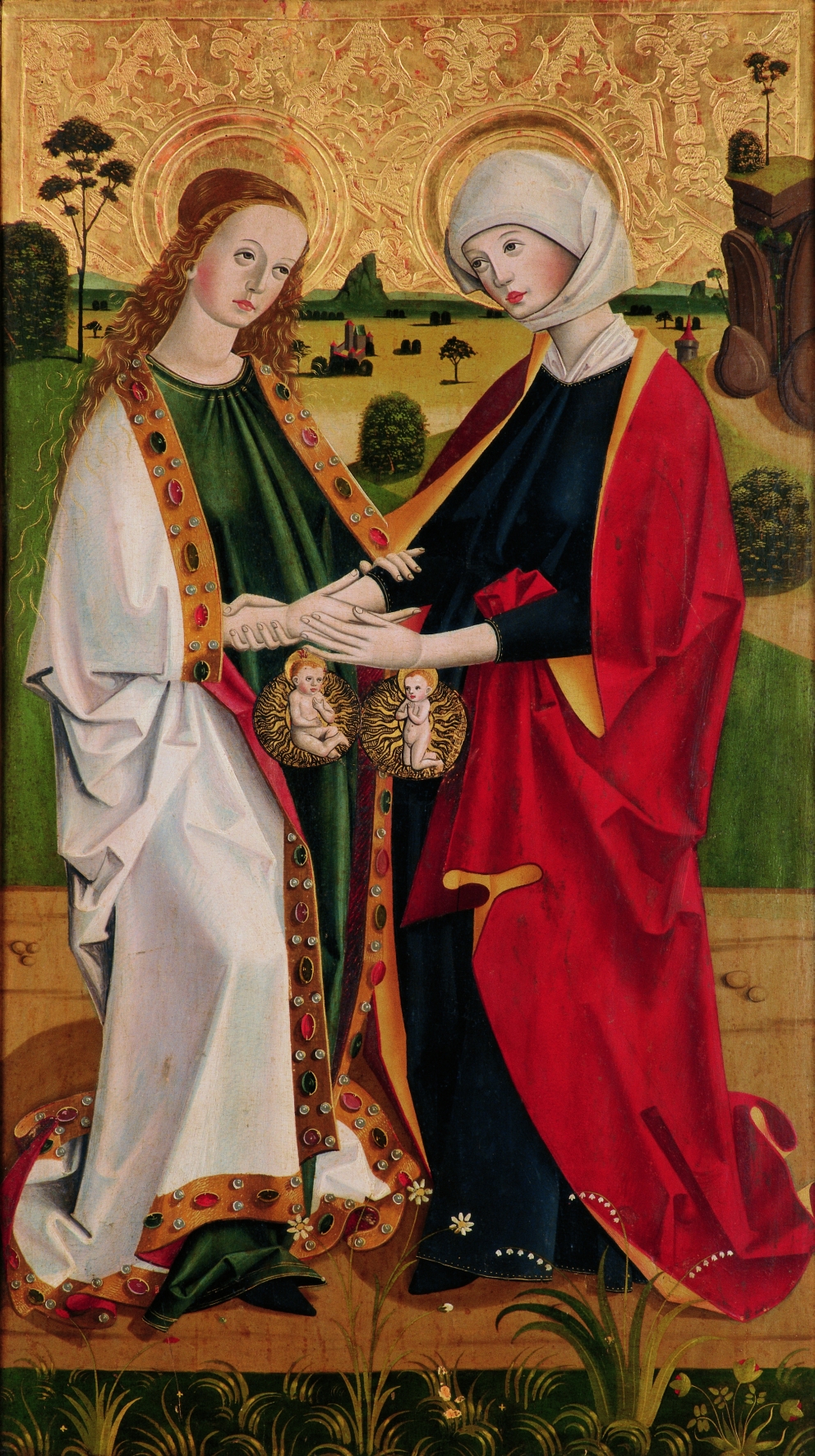
From Salzburg Cathedral exhibit Mary Expectant with Child November 25, 2006 – January 7, 2007
My mother’s joy and happiness could not be contained. She was filled with wonder and began to rejoice in God’s magnificent plan of Salvation. Listen to her beautiful prayer the Magnificat.
Meditation
“Mary also anticipated, in the mystery of the incarnation, the Church’s Eucharistic faith. When, at the Visitation, she bore in her womb the Word made flesh, she became in some way a “tabernacle” – the first “tabernacle” in history – in which the Son of God, still invisible to our human gaze, allowed himself to be adored by Elizabeth, radiating his light as it were through the eyes and the voice of Mary….”
“In the Eucharist the Church is completely united to Christ and his sacrifice, and makes her own the spirit of Mary. This truth can be understood more deeply by re-reading the Magnificat in a Eucharistic key. The Eucharist, like the Canticle of Mary, is first and foremost praise and thanksgiving.
When Mary exclaims: ‘My soul magnifies the Lord and my spirit rejoices in God my Saviour’, she already bears Jesus in her womb. She praises God ‘through’ Jesus, but she also praises him ‘in’ Jesus and ‘with’ Jesus. This is itself the true ‘Eucharistic attitude’. At the same time Mary recalls the wonders worked by God in salvation history in fulfillment of the promise once made to the fathers (cf. Lk 1:55), and proclaims the wonder that surpasses them all, the redemptive incarnation.
Lastly, the Magnificat reflects the eschatological tension of the Eucharist. Every time the Son of God comes again to us in the “poverty” of the sacramental signs of bread and wine, the seeds of that new history wherein the mighty are ‘put down from their thrones’ and ‘those of low degree are exalted’ (cf. Lk 1:52), take root in the world.
… The Magnificat expresses Mary’s spirituality, and there is nothing greater than this spirituality for helping us to experience the mystery of the Eucharist. The Eucharist has been given to us so that our life, like that of Mary, may become completely a Magnificat!”
John Paul II, Encyclical Letter Ecclesia de Eucharistia, sectionz 55, 58
Tis the Season of ‘The Gospel of Life’
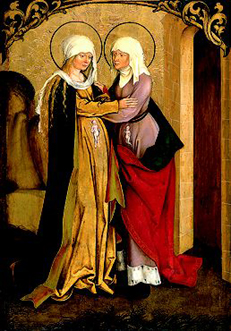
STRUEB, Hans and/or Jakob
The Visitation
c. 1505
Cousin Elizabeth was in the sixth month of her pregnancy with John the Baptist. Here is my mother greeting Elizabeth. I blessed unborn John and he leaped for joy. (Luke 1:39-55)
Meditation
“Humble Elizabeth has an important role in this encounter; Fulton Sheen spoke of it in this way: “One of the most beautiful moments in history was that when pregnancy met pregnancy ‑ when child bearers became the first heralds of the King of Kings.” God moves in mysterious ways. Fittingly, the elder of the two women present takes the lead in describing the great work God was doing in their midst. Most spiritual writers have held that Mary understood that it was not her mystery to reveal, but one God would make known. Thus the need for discretion made it unfitting for Mary to proclaim her secret to Elizabeth. However, Mother Angelica notes that “Like all fathers, God could not keep the wonderful secret too long. He had to tell someone, and that someone was Elizabeth….”
Elizabeth seems to have been awestruck by the immediate revelation she received at this moment. Some people would be similarly overwhelmed should a famous celebrity or world leader walk in their front door, but for Elizabeth there could have been nothing more momentous than the pregnant mother of the Messiah – carrying Him within her – entering her home. The Holy Spirit imparts to Elizabeth the gifts of knowledge and understanding, and she, who is full of good will and faith, is enlightened as to the meaning of what is occurring (Lk 1:42).
Archbishop Goodier notes that “… throughout His life the one desire of Jesus was that He should be discovered; that He should be discovered, and recognized, owned. For every step made in that discovery He was grateful; no man made it but met with reward overflowing. The one thread of interest running through the whole drama of His life is the growth of this discovery.” Unborn John and his mother Elizabeth share in this first discovery together, as if to remind us all that the first place Jesus should be discovered is in the family.”
George Peate, Unborn Jesus Our Hope
Tis the Season of ‘The Gospel of Life’
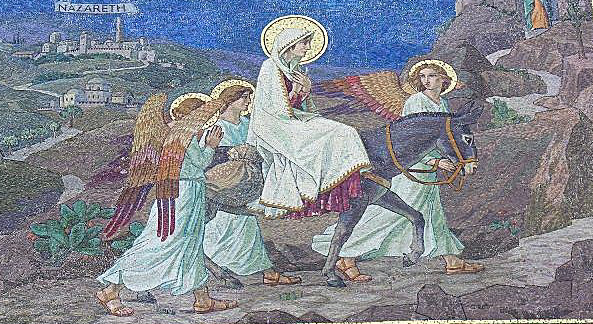
After I was miraculously conceived in my mother’s womb, she went with haste into the hill country of Judah to visit her cousin Elizabeth (Lk 1:39). Here is a picture of us traveling by donkey and accompanied by angels.
Meditation
A Prayer by Caryll Houselander
Breath of Heaven,
carry us on the impulse
of Christ’s love,
as easily as thistledown
is carried on the wind;
that in the Advent season of our souls,
while He is formed in us,
in secret and in silence-
the Creator
in the hands of his creatures,
as the Host
in the hands of the priest-
we may carry Him forth
to wherever He wishes to be,
as Mary carried Him over the hills
on an errand of love,
to the house of Elizabeth.
From the Splendor of the Rosary by Maisie Ward
with prayers by
Caryll Houselander

Tis the Season of ‘The Gospel of Life’
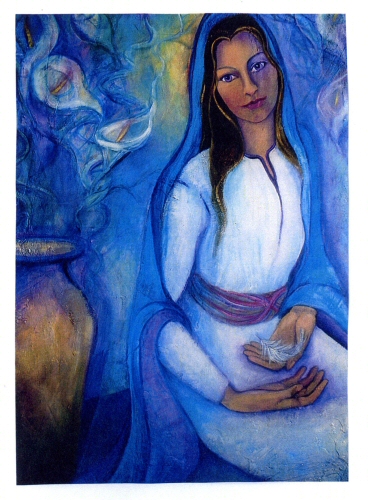
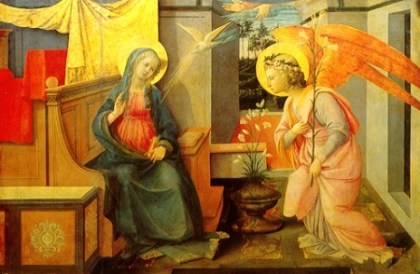
The Annunciation… and then the angel left her
by Geraldine Farrell
My mother said ‘yes’ and the Holy Spirit overshadowed her – although I was miraculously conceived, I began life as one cell just like any other unborn baby. And then the angel Gabriel left her… she had become my mother.
Meditation
The following reflections are from Cardinal Bérulle 1575-1629 (founder of the French School of Theology). Some of the most notable followers of the French School were St. Louis de Montfort, St. John Eudes, and Father Jean-Jacques Olier.
“Stuttering rather than speaking, this is what we can say about things that so greatly surpass the human mind and even the angelic mind. These are the first thoughts of the incarnate Word. This is the first conversation of Jesus in the Virgin. This is the Virgin’s first contemplation, or better yet, this is the Virgin’s first ecstasy before the Son of God made Son of Man in her.” p. 166
“The Virgin is involved with Jesus and she is the only one in the whole world involved with Jesus. Thus she is the only one in the whole world adoring the mystery of the Incarnation, which was brought about on earth for the earth but unknown to the earth. She is the only one adoring Jesus. The more that she is the only one captivated by such a great subject, the greater is her involvement. She is devoted to it with all her faculties. All her senses are brought to bear on it, for it is a tangible mystery and tangible within her. All her senses should pay homage to her God made tangible for human nature. Her whole mind is concentrated on it. And the Spirit of Jesus, which enlivens this little divinized body, enlivens the spirit and body of the Virgin as well, through grace, love and a holy, gentle influence.” p. 164
Bérulle and the French School: selected writings By Pierre de Bérulle, edited by William M. Thompson
The following is a footnote by William M. Thompson
“The authors of the French School were so struck by the humiliation and sublime grandeur of Jesus living in Mary’s womb that they counted his time on earth from the moment of conception…Bérulle implies that Nazareth and not Bethlehem is where the “first birth” of Jesus occurs. It is fascinating to note that, although he intended to write about all of Jesus’ thirty-four years on earth, Bérulle’s Life of Jesus, through its thirty chapters, never moves beyond the nine months of gestation.” p. 187
Bérulle and the French School: selected writings By Pierre de Bérulle, edited by William M. Thompson
Tis the Season of ‘The Gospel of Life’
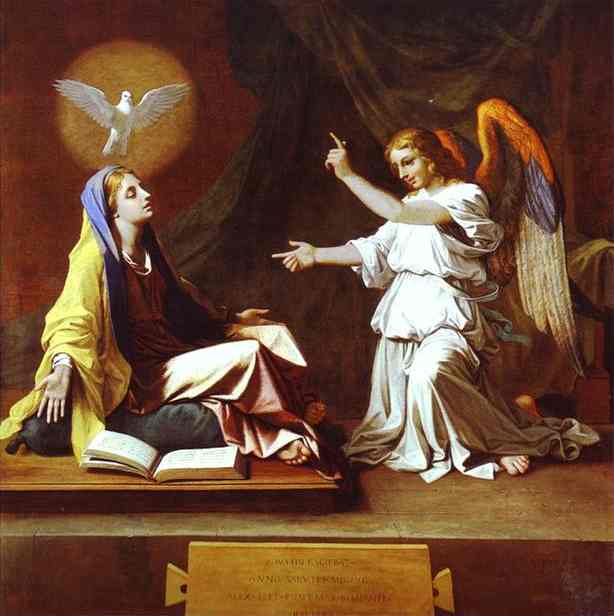
The Annunciation. c.1655 by Nicolas Poussin
I was conceived in Nazareth. The Angel Gabriel appeared to my mother, the Holy Spirit came upon her and the Power of the Most High overshadowed her. (Luke 1:26-38)
Meditation
“The Incarnation is as much the world in which we live as the globe on which we tread, with its earth, air, fire and water, its sun, moon and stars, its animal, vegetable and mineral kingdoms. If we look at our souls, their present wants and eternal expectations, their life, strength, health and maladies, the Incarnation is as indispensable to them, and as indispensable every hour of the day, as the heat and cold, the air and light, are to our natural subsistence..” We live and move in the Incarnation. We are what we are, through it. It covers us, underlies us, and is all around us. It is incessantly affecting us in almost numberless ways, both within and without. We cannot get beyond the reach of its blessed influence, even by disbelieving it or dishonoring it.” Father Faber (The Blessed Sacrament)
“When we cast the mysteries of His Life into great groups and masses, we make His Life threefold, Joyful, Suffering and Glorious. The most complete form is that which distinguishes eight lives in Him, His Unborn Life, Infant Life, Hidden Life, Public Life, Suffering Life, Risen Life, Ascended Life, and Sacramental Life. Into these moulds the Incarnation pours itself, and comes out in forms and shapes of the most surpassing beauty.” Father Faber (Bethlehem, p.242)
Conception by Gabori Sandor
When Christ came into the world He was an unborn baby. If we could have seen Him in the womb, we would have seen Him in His littleness and vulnerability. Initially, He barely looked human. Around 18 days after His conception, His rudimentary heart began to physically pulsate with blood – this would be the currency He would use to purchase the salvation of humankind! Like a mint manufacturing the currency of a commonwealth, here we would see the production of a body and It’s blood for a future day in the Kingdom of God, a day when a supreme price would be paid (I Cor 7:23).
Pope Pius XII reminds us that the mystery of Christ’s love is deeper than the physical body we might have observed, explaining that from the first moment of His conception: “Immediately the Heart of Jesus, ever to be adored, has begun to pulsate with love, divine and human” (Haurietis Aquas). So His Love precedes His blood. The river that is God’s Love becomes the stream of blood coursing through this unborn baby’s primitive heart; and it beats a psalmody of salvific love for us. But no one hears it yet…or rather, only His mother hears it, feels it, indeed she surrounds it as a chamber holding a melody.
About thirty-three years later, as His final Passover drew near, Jesus sat in the temple one day – where the blood of lambs, goats and bulls had been offered for centuries – across from the treasury, and He watched as people placed money donations into it. Suddenly, He saw that poor widow who put in her two meager “copper coins” (Mk 12:41-44). His heart went out to her….”he called his disciples to him”… and His words went out to His disciples.
Finally Gethsemane. Now His blood begins to trickle down – He begins the messy business of paying for our salvation…paying for Mercy, paying for forgiveness, paying for our stubbornness, selfishness and stupidity, paying for the love we throw back in God’s face. From Gethsemane and all through that night and the following day His blood slowly trickles down…now from thorns, now from scourging, now from the abrasive cross laid upon Him. This is the currency of our salvation! Now on the cross. Suddenly we see it – His Sacred Body is the Treasury, the Mint which has been long producing the Mystical Currency of God’s Love for us. See in the open palm of each hand a crimson coin. Two coins. He has taken them out of the Treasury of His broken Body and holds them out for us; two small reddened coins. Worthless to the world, priceless to the soul.
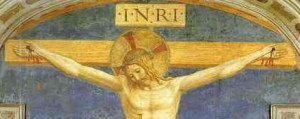
Fra Angelico. Christ on the Cross Adored by St. Dominic.detail c.1442
Filed under: Biblical Reflections, Incarnation, Mother of the Lord, Unborn Jesus
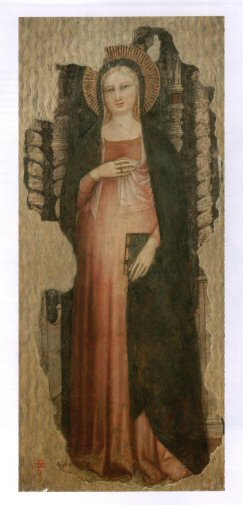
Nardo di Cione, 1346-m. 1365, Madonna del parto , Firenze, San Lorenzo: 1365
Our prior six posts* have considered the mystery of Mary’s contemplation and remembrance of all the significant events, revelations and Divine inspirations that occurred in her life, and in the lives of others nearby, during the course of her nine month pregnancy. With Christ alive just inches beneath her listening heart, she was the living echo of God’s abundant grace during those initial months of the Incarnation.
It fell upon her, that is, it was an integral part of her office as Mother to the Incarnate Word, to be exquisitely attentive to every event, revelation and inspiration concerning her Son during His entire life, but especially during the sacred months of her pregnancy while she was the only one in direct communion with Him.
Before the apostles had ever been chosen or an Apostles Creed had been formulated, she was the contemplative memory of the Church (as John Paul II would say). Before the great St. Paul was converted, Mary was pondering in her heart the deepest mysteries of Christ, and marveling at the Plan of Salvation as it was unfolding – first, within her body, as a softly lit light, and later as a glowing beacon for all of Israel to behold. She carried the church’s forming Creed in her heart while carrying humanity’s developing Unborn Redeemer within her womb.
With the birth of Christ came yet another cloudburst of inspired witnesses: the angels spoke to the shepherds and the shepherds came to worship and told Mary and Joseph what they had been told. Next, the three wise men from the East came and also shared their wisdom. At the Temple, holy Simeon and the prophetess Anna were inspired to speak of the Christ child. An angel appeared to Joseph to instruct him. As Mary and Joseph fled with their newborn Son, Christ now became a political problem and death for young children was the King’s answer to the problem of Christ.
We do not have time here to sift through all of these wondrous happenings in this “fourth trimester” – the months immediately following the Nativity – but the Holy Spirit was extremely active and gracious during this hallowed time as well.
*This 7th post concludes this series.
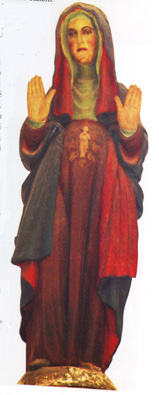
Statue de la Vierge enceinte, seul reste de cette L’abbaye des Allois (moniales bénédictines
This is our sixth post in a series exploring the Creed of Christian faith being revealed to Mary during her pregnancy, trimester by trimester, event by event. We now come to the third trimester. Lk 2:1-7 explains that Caesar has inadvertently determined the place for the Christ Child to be born. According to the census (enrollment) ordered by Caesar, Joseph would have to travel to Bethlehem to fulfill his obligation. Mary (and Unborn Jesus) would accompany him.
Micah the prophet had prophesied this eventuality (see Micah 5:2, Mt 2:4-6):
“And you, O Bethlehem, in the land of Judah,
are by no means least among the rulers of Judah;
for from you shall come a ruler
who will govern my people Israel.” Mt 2:6
Before hearing of the enrollment, Mary probably did not know for certain where her Son would be born. This news from Rome was like a piece of a puzzle, which enabled Mary to connect the dots and it is very possible she related the above text from Micah to her specific travel itinerary, and praised God. The verse not only identifies the place of the birth, but states that her Son will be “a ruler who will govern my people Israel”. Mary can now add this information to all of the prior information she had been receiving from angels (Gabriel and the angel of the Lord), remnant Saints (Elizabeth, Zechariah, Joseph) and the Holy Spirit. Now politicians and prophets are enlightening her concerning the Will of God and the mystery of the Incarnation.
It is worth noting also that during these nine months Mary clearly would have ascribed other Old Testament prophecies to her Son (and herself) and would have been thereby further enlightened. One example should suffice: “Behold, a virgin shall conceive, and bear a son, and shall call his name Immanuel” (Isa 7:14). If nothing else, she could derive from this verse the fact that she as virgin Mother held a Messianic office and the prophets through the centuries were preparing the people for this great dawning of the Messianic Age.
The third trimester ends when the child leaves the womb and is born. So we still have another third trimester event to consider. Mary and Unborn Jesus, along with Joseph, were turned away at the Inn “because there was no place for them”. Here is a profound message for Mary about the difficulty and rejection in store for her Son. Like many of the prophets before Him, her son would no doubt meet with some rejection. (Mary may have even gone so far as to possibly relate the Messianic Psalm 22 to her Son even now, before He had even been born: “My God, my God, why hast thou forsaken me?”; verse 1).
So they end up in a manger, in humility, and she senses the meekness of God’s Plan for her Son, even now before He is born. She intuitively senses here in this manger, the order of Creation, and perceives that her Son has come indeed to restore a proper order to all things; from the animal kingdom to the angelic realms. She will no longer be heavy with child, but her heart will remain full of Incarnation truths and mysteries, both lived and believed.
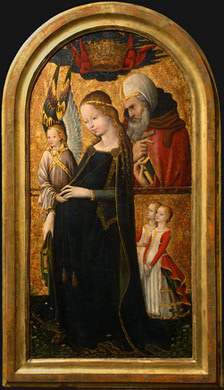
The Expectant Madonna with Saint Joseph, 15th century French, National Gallery of Art, Samuel H. Kress Collection
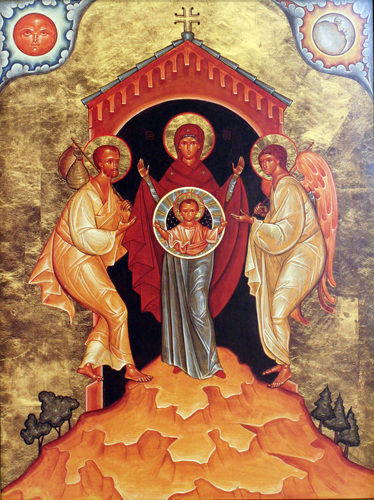
Artist . Brother Claude Lane, O.S.B Title The Dream of Joseph Location Mt. Angel Abbey, Oregon On one side Joseph is pictured as a traveler, his feet still in movement, and carrying a knapsack. The Angel is pictured on the other side.
We all know of Joseph’s dilemma. But when did this occur? Mary (and Unborn Jesus) probably returned to Nazareth after visiting Elizabeth (unborn/newborn John) and Zechariah, just as the second trimester of Mary’s pregnancy was getting underway. The first page of the New Testament presents this huge problem and holy solution: somehow Mary “was found to be with child” (Mt 1:19). An angel of the Lord appears to Joseph in a dream:
“Joseph, son of David, do not fear to take Mary your wife, for that which is conceived in her is of the Holy Spirit; she will bear a son, and you shall call his name Jesus, for he will save his people from their sins”.
Joseph does as the angel instructs him. And he tells Mary what he was told by God’s messenger. This is the pattern, each person drawn into the Messianic Mission shares his or her inspiration or spiritual experience with Mary (or she in fact witnesses it) and as John Paul II says “Mary is the contemplative “memory” of the Church…” Message for 77th World Mission Day #3. She cherishes the revealed information within her heart and memory. Let’s consider four points from the angel’s instruction.
“Son of David” – this is how the angel addresses Joseph. It is as if Joseph is given a “Messianic office” while he will faithfully do the will of God, parenting the true Son of God. Mary can see in this the supernatural dignity of Joseph’s role as adoptive father of her son. Her relationship with Joseph is solidified and they will act as a team, in harmony with God who is closely watching over their lives. Thirty years hence, Joseph’s son will be called by the same title on many occasions (Mt 9:27, 12:23, 21:9, Mk 10:48). This title then is shared between father and son; perhaps Mary sensed that this would be one of her son’s titles.
“Holy Spirit” – this reference to God is a New Testament term, and here it is on the very first page of the New Testament, revealed for the world to hear, by the angel of the Lord to Joseph. But the same term, “Holy Spirit”, had already been spoken to Mary in the same context, by Gabriel. For Mary this is not a coincidence, not even a mere confirmation, it is a holy revelation of the first order – it was fitting that it was revealed to Joseph not by human lips, but by the breath of an angel, commissioned to deliver the message for the glory of God and for the particular good of Mary and her Unborn Son. The angel’s words to Joseph were a sign for him, a sign for Mary and a timeless sign for the universal Church.
“Jesus” – we spoke earlier about this name. Mary sees here the intimate detail revealed to her alone thus far, now being shared by God with one other special person. The family of three is now complete, built up around this Name, this Person; “Jesus”.
“He will save his people from their sins” – finally, here is the reason for the Incarnation, the reason for this Messianic Mission! This is a supernatural remedy for the fallen condition of humanity. Adam and Eve’s misdeeds will be undone by this Savior. Mary is given a ringing proclamation to ponder, a motto for her life which will always give perspective to every event, every question, every hope. Mary can read between the lines here and see one word loud and clear: MERCY. Her Son, as Savior, will embody God’s Mercy.
The early Creed of Christianity, in its embryonic statement is taking shape within the heart of Mary, encounter by encounter, methodically, trimester by trimester. But one other sign came to Mary during this second trimester, not mentioned in the bible, but mentioned by every woman who has ever carried an unborn baby to term; the Unborn Son of God poked her, pushed at her, prodded her – with His hands, His feet, even His elbows – what did she think of that?
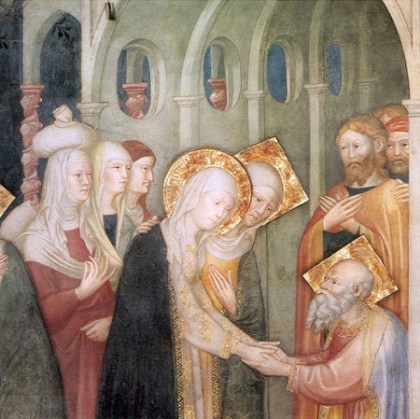
Mary and Elisabeth Meet Zachariah Lorenzo Salimbeni
Luke 1:56 tells us that Mary (and Unborn Jesus) stayed with Elizabeth (and unborn John) and Elizabeth’s husband Zechariah for three months. Most spiritual writers through the centuries have understood this to mean that Mary was present for John’s birth (and for the circumcision and naming of John eight days later). In fact, many believe that it was Mary who told Luke the details of these various events – or if not Mary directly, that Luke learned of them through a Marian tradition.
The priest Zechariah was the first representative of Israel to be informed of the immediate coming of the Messiah. See Lk 1:5-25. When Gabriel appeared to Zechariah he received but a lukewarm reception. Gabriel was not impressed and struck Zechariah silent, unable to speak. Nonetheless, Zechariah would have relayed the words and events in a written form to his wife Elizabeth and also to his guest and relative Mary (especially since Mary was the mother of the Messiah).
Mary would have been immensely interested in every word that Gabriel spoke. While most of the angelic message was actually about the son Elizabeth would bear, there were multiple references to the Lord (v. 15, 16, 17). Curiously, and in light of Gabriel’s next visit to a representative of Israel – that is, Mary in Nazareth – each of these references to “the Lord” could be understood also as references to Jesus. (Recall Elizabeth’s later comment when Mary arrived: “And why is this granted me that the mother of my Lord should come to me?” v.43)
All of these references to “the Lord” revealed that there would be a period of preparation during which John would have a tremendous ministry to the people of Israel. One reason this is significant is because it indirectly predicts the early success of “Christianity” within Israel (for example on Pentecost and following). At any rate, this was an optimistic message from the angel about what was to come, albeit, within an indefinite time frame.
Not only was Gabriel’s message to Zechariah very optimistic, but Gabriel even described it in a telling phrase: “I was sent…to bring you this good news” (v. 19). This characterization by God’s messenger of what is coming, confirms in Mary’s mind that God’s Mercy is at work and is a wondrous force for good and blessing. But perhaps the most extraordinary aspect of Gabriel’s message was when he said of Elizabeth’s son: “he will be filled with the Holy Spirit, even from his mother’s womb” (v. 15). This explains the mystery of John leaping for joy when the Unborn Christ approaches him and Mary greets Elizabeth. Would Mary remember that spectacular event more than thirty years later when she was in the Upper Room with the early Church on Pentecost Day when the Holy Spirit would fill each member of the Church? (see Acts 1:13-14, 2:1-4).
Finally after the baby’s birth, when Zechariah obediently names his son John – according to Gabriel’s instructions – Zechariah is now filled with the Holy Spirit and speaks! He proclaims what we now call the Benedictus (Lk 1:67-79). Zechariah points to the mystery of Salvation that is dawning upon Israel. He speaks of Christ as “a horn of salvation” raised up by God Most High. Mary is nearby with this “horn of salvation”, the Christ, growing within her womb (unbeknownst to the neighbors gathered around for the blessed ceremonies). Zechariah confirms that all of this is “as he spoke by the mouth of his holy prophets from of old” – a phrase reminiscent of the Nicene Creed reference: “We believe in the Holy Spirit…He has spoken through the prophets”.
So once again, Mary is the recipient of all of this Divinely inspired information about the Messiah, His mission, the meaning of it, the supporting characters involved and so on. Mary’s heart is like a holy depository of sacred Messianic information. Mary – because God has called her to this function, as part of her “office” as the mother of “the Son of God” – is now the filter, the arbiter of the message of salvation, carrying it within her heart, to deliver at the appropriate time (while she carries the Christ within her, to be delivered after nine months).
This post is the 3rd in our series on the Creed developing within Mary’s Intellect and Heart as the Christ Child develops within her womb. We turn now to the Visitation: Lk 1:39-55.
The Holy Spirit is extremely active during the various exchanges and actions when Mary (and Unborn Jesus) arrive at the home of Zechariah and Elizabeth and specifically when Mary greets Elizabeth (and Unborn John) and when Elizabeth responds. Luke tells us that “Elizabeth was filled with the Holy Spirit and she exclaimed with a loud cry, ‘Blessed are you among women, and blessed is the fruit of your womb! And why is this granted me, that the mother of my Lord should come to me? For behold, when the voice of your greeting came to my ears, the babe in my womb leaped for joy. And blessed is she who believed that there would be a fulfilment of what was spoken to her from the Lord.’” So, Elizabeth refers to Mary’s unborn child (about one week after conception) as “my Lord”. This is revelatory! Elizabeth has identified Unborn Jesus as Messiah and Lord, and Mary as the Messiah’s mother. Elizabeth states that it is a privilege to have the mother of the Messiah and Lord visit her.
What does Mary learn from Elizabeth’s inspired words? First, let it be said that everything about God is extremely personal. God is NOT distant, obtuse, detached from His Creation and creatures! He has become Incarnate. He has fulfilled what He promised. A week ago Gabriel said that Mary had “found favor with God” (Lk 1:30). Now Elizabeth is acknowledging that Mary has a special relationship with God and is blessed for believing “that there would be a fulfillment of what was spoken to her”. This highlights Mary’s personal relationship with God. It is a beautiful relationship; alive in trust, bursting with expectation! Mary is being rewarded for obeying God and believing in the words spoken to her. This is God’s way of thanking Mary for accepting this motherhood of a Divine Person; the Son of God. So Mary sees and tastes the Goodness of God in the words of Elizabeth. This is living the Creed. The Creed in Mary’s heart says that “God is All Good, God is Most Faithful”. This belief drove her onward to Bethlehem, to Egypt, to Cana, to the foot of the cross, to the Upper Room and to Heaven.
But most of all, Mary hears her unborn child called “Lord”! She hears herself called “mother of (the) Lord”. These are titles, and offices. Elizabeth is testifying – albeit, indirectly – that Mary has been given a singular office by Almighty God; ‘mother of the Lord’. This is a sacred duty and obligation in service to the Mission of her Son (see prior post for Gabriel’s description of her Son). With the leaping of unborn John in his mother’s womb (caused by Unborn Jesus) and Elizabeth’s comments, Mary has now seen that her Son’s mission has already begun. She knows from firsthand experience that God is acting here and now, and that the Son of the Most High is the focal point of everything – she is her Son’s handmaiden.
The next 10 verses are Mary’s famous inspired response and are called the Magnificat for the opening line: “My soul magnifies the Lord, and my spirit rejoices in God my Savior…” Note the two words “Lord” and “Savior”. Incredibly, Mary is perceiving that these two titles, which she would have used in the past to describe the God of Abraham, Isaac and Jacob, can now also be used to describe her (unborn) Son. This is a fundamental unfolding Revelation of the first order. Elizabeth used the word “Lord” and Mary responds using the same term. But she says “my soul magnifies the Lord” because He is within her, and she is reflective of His Presence as Elizabeth stated. Mary is inspired to use the term ‘Savior’ also. Mary is in a unique position, for when she speaks of God, she is speaking not only of her Creator Yahweh, but also of that Son growing within her. She is associating her Son with the term ‘Savior’, now pointing to the redemptive reality that is dawning upon Israel, twice referencing God’s mercy.
Mary’s Magnificat is centered upon the reality of God; referring at least 18 times to God (he, his, him, and so on). The last verse of the Magnificat recalls God’s relationship with Abraham. Mary is showing the continuity of God’s personal redemptive relationship with the people of Israel, and her Magnificat seems to recapitulate that historical relationship. Abraham was the Father of their faith – now Mary is the Mother of their Savior. She is discovering these truths of the Incarnation as she is living them (and she was inspired by the Holy Spirit as she gave voice to these truths). Her Magnificat offers a holy glimpse into the Creed that is taking hold of her heart, a unique Creed, a mixture of faith, hope, love and maternity – a tender personal Creed especially due to this fourth mentioned element; maternity. Every Christian can learn of this palpable Creed by sharing in Mary’s intimate perspective on her unborn Savior Son!
Our next post will consider the three months Mary (and Unborn Jesus) spent with Zechariah, Elizabeth (and unborn, then newborn John).
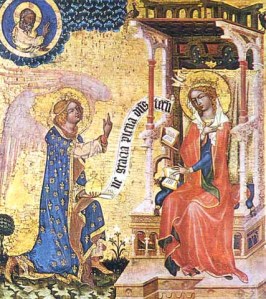
In our last post we listed the extraordinary events and Revelations which unfolded in the life of Mary (and Unborn Jesus) during the nine months of her pregnancy. Our list was presented trimester-by-trimester and relied upon the Gospels of Luke and Matthew for scriptural facts. Today’s post is part of a series of upcoming posts reflecting upon the content of the Revelations given to Mary, trimester-by-trimester; the meaning and significance of these Revelations will be discussed.
FIRST TRIMESTER:
Luke 1:28, 30: The initial mystery of her favored relationship to God is revealed to Mary by Gabriel.
Lk 1:31-33 The miraculous nature of her impending pregnancy is revealed to Mary. That her child will be a male, and will be “called the Son of the Most High”, that He will be given the throne of David, will reign forever and there will be no end to His kingdom. This means that her Son will be a King, not just an earthly King by an eternal King, with subjects. Many Christians think of Christ’s kingship as symbolic, but it is not merely symbolic – it is a real and true kingship, in fact Christ is the true measure of all Kings (and Queens) throughout history. There is an incredibly personal and poignant word given to Mary also about this pregnancy, this Son: “you shall call his name Jesus”. Here begins the magnificent Christian devotion to the Holy Name of Jesus. It was a name she would embrace in prayer, a name to whisper, a name to marvel at, a name like no other name – a name she discovered by the hour, a name sent down from Heaven upon the head of her baby.
Lk 1:35 This has to be the most fantastic truth ever revealed to a human being!!! The Archangel Gabriel explains how the Incarnation will take place. The child “will be called holy, the Son of God” because the child will be conceived, as the Nicene Creed says, “by the power of the Holy Spirit” and as Gabriel says “ The Holy Spirit will come upon you, and the power of the Most High will overshadow you…” Virtually the entire first half of the Nicene Creed is embedded here in the cumulative words of Gabriel to Mary! Mary represents the Church and Gabriel is the messenger of God “Most High”. He is revealing the first mystical kernel of the Christian Creed to Mary and she will embrace it body and soul – she will live the Creed. The Church’s belief in the Incarnation will be rooted in this evangelical exchange. Mary will tell the Church what she was told and the Church will cling to this holy revelation, her martyrs will cling to it with their dying breaths!
Lk 1:36-37 Gabriel tells Mary about the pregnancy of Elizabeth, putting everything into perspective: “For with God nothing will be impossible”. (Approximately a week later, when Mary sees with her own eyes that Elizabeth is, in fact, six months pregnant, she will understand all the more emphatically, the power in the words revealed to her.)
Lk 1:38 Mary’s response to this litany of heavenly revelations has calmed Christians for two thousand years: “Behold, I am the handmaid of the Lord; let it be to me according to your word.” In her heart she now has the key to human history, the hope of humanity, the revelation of all God’s promises in one Word. As the Fathers of the Church would say, she conceives in her heart before conceiving in her womb.
She immediately conceives in her womb – now Christ is physically growing within her womb and the Christian Creed is mystically growing within her intellect and heart. The Creed – in embryonic state – is taking root in a human heart.
Our next post will consider the Visitation (Lk 1:39-45, 46-55).
Mary’s pregnancy was unique for dozens of reasons. One aspect of her pregnancy that has been neglected is the corresponding Revelations she received regularly throughout the pregnancy which are explicitly referenced in the Gospels but almost universally overlooked. God wanted her to be illuminated in her intellect and heart while she was nurturing within her womb the growing mystery of salvation; the Incarnate Son of God.
Let’s do a quick review of these Revelations by trimester (approximated). Note that each Revelation is either directly given to her by an angel of God or by the Holy Spirit or by persons who were directly instructed by angels or inspired by the Holy Spirit. (And all of these direct Revelations presuppose a profound and holy grasp of her foundational Israelite faith, including a superior knowledge of Hebrew scripture).
FIRST TRIMESTER: Luke 1:26-38 (this Revelation was given in conjunction with the conception of Christ), Lk 1:39-45, Lk 1:46-55 (these two occurred about one week later). Mary stayed with Elizabeth and Zechariah for three months and the following Revelations were given her: Lk 1:5-25, Lk 1:57-79. (We are assuming that Mary who experienced these events or had them relayed to her firsthand, passed them on to Luke.)
SECOND TRIMESTER: Matthew 1:20-24 (cross reference Isaiah 7:14). Joseph is instructed by an angel and no doubt revealed to Mary exactly what he had been told.
THIRD TRIMESTER: Luke 2:1-7 (cross reference Micah 5:2).
FOURTH TRIMESTER ? – REVELATIONS IMMEDIATELY FOLLOWING
THE NATIVITY: Luke 2:8-20, Lk 2:21, Lk 2:22-38, Matthew 2:1-11, Mt 2:12-18.
Mary is tutored by God throughout her pregnancy and immediately following the birth of Jesus. As she was living God’s Plan of Salvation, minute-by-minute, experiencing these grace-charged events, she was also being given Revealed teachings from God (directly and indirectly). We have listed a sequence of both events and Revelations above. In our next post, we will reflect upon the “Revealed teachings” given to Mary during these months, in part to prepare and strengthen her as she embraced her role as an intimate supporting collaborator in the Incarnation Mission of Jesus Christ.
As Mary flees for Egypt, her womb is now empty, but her intellect is full, her heart even fuller…with love for the child in her arms.
El Greco (1541-1614) St. Luke (detail)

The first reading in Sunday’s Catholic Mass (7-12-09) was from the 7th chapter of Amos. It recounts a well known confrontation between Amos and the established priesthood in 8th century Israel. Amos is the outsider who God sends to the powerful to shake them up and set them straight, but the powerful elite reject humble Amos, and rejecting him, they consequently are rejecting God also.
The priest of Bethel, Amaziah, who is close to King Jeroboam, tells Amos that he is not welcome. Amos responds by emphatically stressing the point that he is no “professional” prophet, not a member of some elite class of religious functionaries, rather he was recruited for this job by God Himself: “I am no prophet, nor a prophet’s son; but I am a herdsman, and a dresser of sycamore trees, and the Lord took me from following the flock, and the Lord said to me, ‘Go, prophesy to my people Israel…”
Today, around the world there are hundreds of thousands of Pro Life prophets who God has inspired to help pregnant women, help the unborn in various ways, to speak out for a Culture of Life. These men and women can say to the “Elite” politicians, journalists, doctors, judges, lawyers, professors, social engineers and social workers, as Amos did; “I am no professional pundit… I am no establishment-paid prophet, I am a housewife, a repairman, a salesman, a clerk, and the Lord took me and said to me ‘Go, bear witness to the Gospel of Life which I have given to the people as a gift to guide them in their lives and in their families.’”
The prophetic office is associated with witnessing to the truth revealed by God to His Church, but also to witnessing to the truth about human life. The Pro Life movement worldwide is thus a prophetic movement inspired by God. While we do not find our bearings through polls, yet Pro Life prophets can find some small consolation in the fact that the majority of Americans in a Gallup Poll (51%) “now call themselves pro-life rather than pro-choice on the issue of abortion”. Gallup has asked this question annually for the past 15 years and this is the first year a majority have answered this way – up from 44% last year! (Associated Press, 5/16/09)
PRO LIFE PROPHETS KEEP UP THE GOOD WORK!!!
 UNBORN WORD of the day