Our Lord’s first words ‑ uttered from the womb ‑ are not recorded in any of the Gospels, but in the book of Hebrews. The first act of Jesus Christ after His Incarnation is a prayer offering Himself and His human body to the Father:
Consequently, when Christ came into the world, he said,
“Sacrifices and offerings thou hast not desired,
but a body hast thou prepared for me;
in burnt offerings and sin offerings
thou hast taken no pleasure.
Then I said, “Lo, I have come to do Thy will, O God,’
as it is written of me in the roll of the book.” (Heb 10:5‑7) (see link on sidebar for further explanation)
These words (foretold in Psalm 40) ‑ are the only words known to be spoken by Unborn Jesus (or by any unborn child for that matter). Pope Paul VI referred to this prayer as “the fundamental offering that the Incarnate Word made to the Father when He entered the world”. The point here is that this prayer was not offered prior to the Incarnation but rather after it had occurred.
In her book Ortus Christi, Mother St. Paul links this fundamental offering of Christ to our prayer.
“What was the essence of His prayer (during those nine months)? What was it which lay behind all? It was the intention. And what was that? We have meditated on it many times: “Behold I come to do Thy Will O my God.”
Naturally there are many different ways of doing that Will, and many different degrees in the perfection with which it is done; and that is why we are quite safe in picturing to ourselves Jesus in the womb of His mother forgetting no single detail; or perhaps a truer picture would be a union with His Father so perfect that there was no need to talk about what was so evident.
Now let us apply this to myself and I will find that instead of being discouraging , it is most encouraging, instead of making my prayers harder it will make them far easier.
What is the intention in my prayers? Is it not to please God and to do His Will? …Now let me see how this works out in practice. I pay a visit to our Lord, perhaps I am too tired to think about Him, I may even sleep in His Presence; perhaps I am so busy that I find it impossible to keep away distracting thoughts…the time is up and I go, thinking, perhaps, what is the good of paying Him a visit like that?
There is great good even in that visit which all the same might have been so much more perfect. What was my intention in paying it? Certainly to please Him. Then I have pleased Him. It was a pleasure to Him to see me come in and sit with Him, even though I was occupied with my own concerns most of the time. We are too much taken up with asking how we say our prayers, but the important question is why do we say them.
To go and sit in His presence because He is lonely or because I am tired and I would rather sit with Him than anyone else is prayer even if I say nothing. What God is doing for me is of far more importance to my soul than what I am doing for God; and all the time that I am there, whether I am thinking of Him or not, He is impressing His image on my soul…”
JUST 14 MORE PRAYING DAYS ‘TIL CHRIST’S BIRTH!
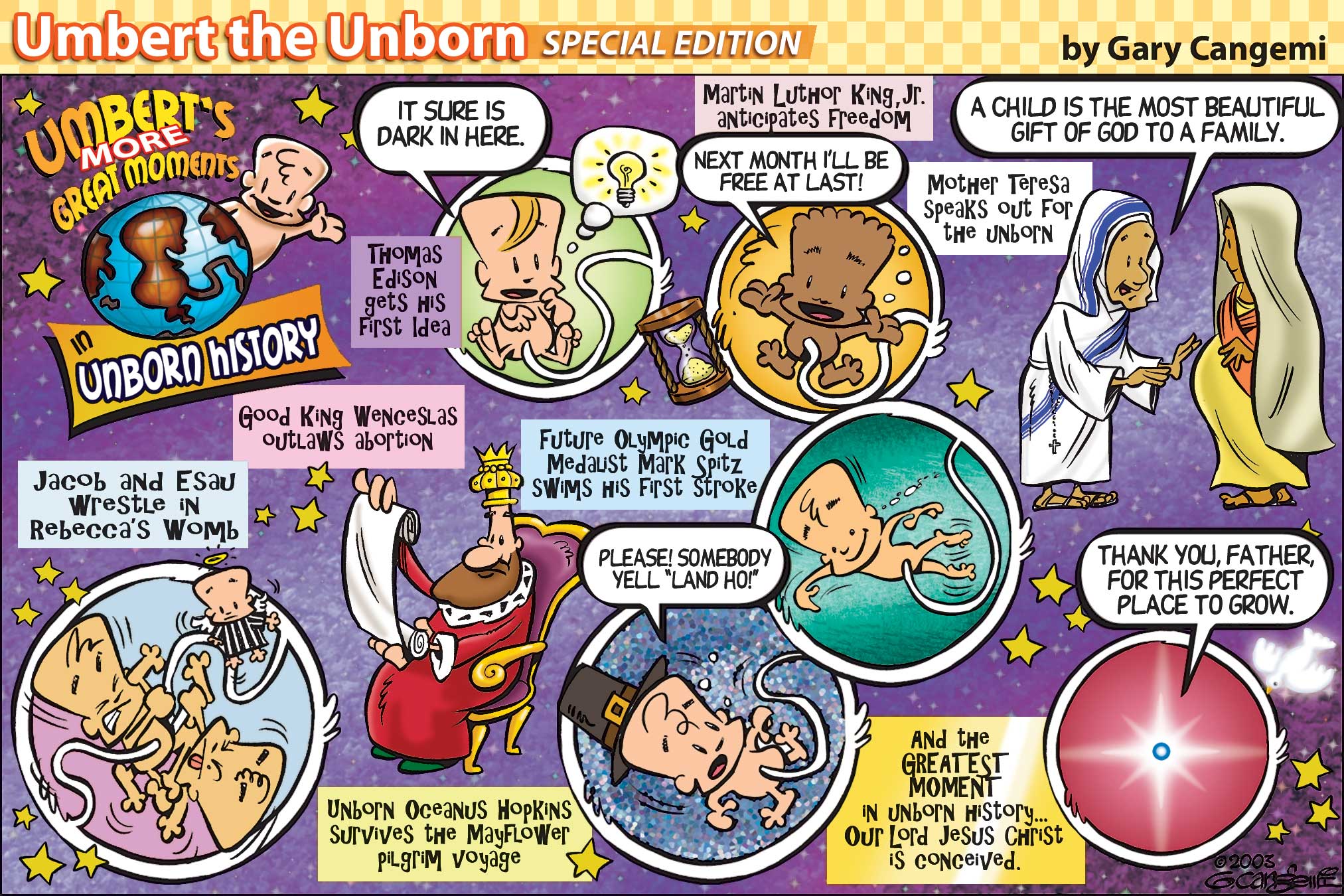
(POSTED WITH PERMISSION FROM THE ARTIST*)
Throughout human history there has only been one redemptive pregnancy. Eve’s first pregnancy, with Cain, was a prototypical pregnancy, but was not a redemptive pregnancy. When Abraham’s wife Sarah was pregnant with Isaac it was a pregnancy of promise and destiny, but not redemptive. When famous mothers or mothers of famous children were pregnant their pregnancies were perhaps remarkable or noteworthy, but not redemptive. And when your mother was pregnant with you, it was a very special pregnancy, but not redemptive. Only the pregnancy of Mary of Nazareth was, in every sense of the word, Redemptive: a pregnancy which Christians can discover by faith, and in our present age must discover.
Right from the start, and providentially so, the Incarnation and the redemptive pregnancy of Mary the mother of Unborn Jesus are filled with hope from on high. A hushed whisper of hope for undeserving humanity. Hope for every family. Hope for every mother. Hope for every unborn child.
Many unborn children today have few friends. Enter Unborn
Jesus, the best friend of each unborn child. Now that the unborn are fiercely persecuted and disdained, the first unborn child comes to be identified with them completely, in every possible way. And He calls out to the Church to be discovered, understood and loved. Does God love unborn children? Unborn Jesus answered that question for nine months and forever.
JUST 15 MORE PRAYING DAYS ‘TIL CHRIST’S BIRTH!
*We would like to thank Gary Cangemi for permitting us to use his wonderful cartoon.
Filed under: Advent
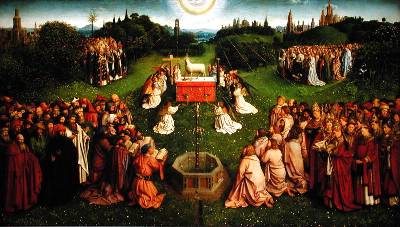
Adoration of the Mystic Lamb by Jan van Eyck*
Mother St. Paul gives a wonderful summation of how God prepared His people and our world to receive the Messiah. She ends the reflection with a beautiful prayer.
“The desired of all the nations shall come” Haggai 2:7 (Douay-Rheims)
“Ever since God at the time of man’s fall had made His great promise concerning the Woman and her Seed, He that was to come had been to the nations “their desired One,” That promise had been carefully cherished, handed on from father to son till Moses came and recorded it in the book of Genesis ; and though of necessity one nation had to be selected to which the Woman and her Seed were to belong, yet the promise was given to all nations and all claimed their share in it.
The chosen nation through whom all the others were to be blessed was Abraham’s. Through him and his seed the great promise was to be fulfilled (Gen. 12:3) The time was hinted at in the patriarch Jacob’s blessing to Judah : “The sceptre shall not be taken away from Judah, nor a ruler from his thigh, till He come that is to be sent and He shall be the expectation of nations” (Gen.49:10).
The house or family which was to have the joy of realizing the promise was David’s; the place where the Woman was to bring forth her Seed was Bethlehem. Here “she that travaileth shall bring forth” and here”shall He come. . that is to be the Ruler in Israel” (Mich. 2.3). Each subsequent prophecy or promise developed and enlarged the original one given in Eden…
O King of nations, as I look back through the ages
and see the Child and His Mother so clearly set forth in promise and prophecy, in type and example, when I think of Your plans for the redemption of the world, made from all eternity and gradually unfolding as the fullness of time approached, when I think of the nations all desiring Your coming, when I think of the intense desire of Your loving Heart, there is one thing that seems to jar and to be out of harmony with the rest, and that is the lamentable want of desire in my own heart ! The time is very short now, the Child with His Mother are already on the way to Bethlehem. Oh ! Let me multiply my Acts of Desire that my little King when He comes may be indeed my “desired One” too.”
Mother St. Paul, Ortus Christi
*In this beautiful painting are Jewish prophets and pagan writers all who waited for the Messiah. We also see women and men who were martyred for the faith, the Twelve Apostles as well as Popes, and Bishops and Priests – all surrounding the desire of their hearts – the Mystic Lamb, Jesus.
JUST 18 MORE PRAYING DAYS ‘TIL CHRIST’S BIRTH!
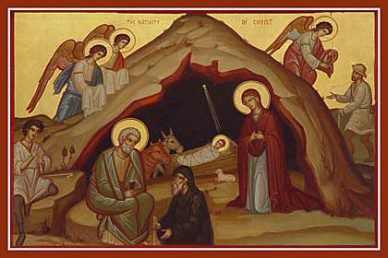
“God does not come in the thunder, but in the April breeze. Because he does not shout but only whispers, the soul must be careful not to neglect the visitation.” Archbishop Fulton Sheen, Lift Up Your Hearts.
When God first came to us it was in the most hidden, silent and ordinary way; first in his mother’s womb and then, as a baby in a manger. In the Old Testament God prepared His people for this hidden way.
“There shall come forth a shoot from the stump of Jesse, and a branch shall grow out of his roots.” Isaiah: 11: 1
“Therefore the Lord himself will give you this sign: the virgin shall be with child, and bear a son, and shall name him Immanuel.” Isaiah 7 13-14
“The LORD has created a new thing upon the earth: the woman must encompass the man with devotion.” Jeremiah 31:22
“But you, O Bethlehem Ephrathah, who are little to be among the clans of Judah, from you shall come forth for me one who is to be ruler in Israel, whose origin is from old, from ancient days…” Micah 5: 2
Recall also how the prophet Elijah sought God in a cave on Mount Horeb (I Kings 19:9‑13). God made Himself known to Elijah not in power and might, but rather in “a still small voice” which Elijah heard from within the cave. So, too, here in this Bethlehem cave, amidst the hushed prayers and whisperings of humans and angels alike, soon would come a little cry of newborn Divinity, muffled so as not to frighten any away – “a still small voice”.
Let us listen to the ‘whisper’ of Christ in the womb. Let us quiet ourselves so we can hear the still, small voice in the manger. It is in such quiet events that God normally speaks to us.
JUST 19 MORE PRAYING DAYS ‘TIL CHRIST’S BIRTH!
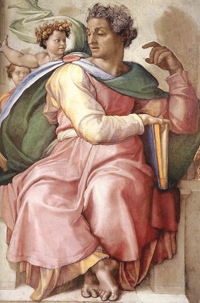
Sistine Chapel Ceiling: The Prophet Isaiah
Michelangelo Buonarroti
Many Bible scholars explain that chapters 7‑12 of Isaiah form a distinct section ‑ the Book of Immanuel ‑ in which we find repeated references to the Messiah. But within this “Book of Immanuel”, there are a number of references to the Messiah as a baby and small child. This unique prophetic perspective on the Child Messiah is fascinating, and should be of great interest to our modern world. Let’s consider some of these verses:
“Therefore the Lord himself will give you this sign: the virgin shall be with child, and bear a son, and shall name him Immanuel.” Isaiah 7:14
“For to us a child is born, to us a son is given; and the government will be upon his shoulder, and his name will be called ‘Wonderful Counselor, Mighty God, Everlasting Father, Prince of Peace’…. “Isaiah 9:6
“The wolf shall dwell with the lamb, and the leopard shall lie down with the kid, and the calf and the lion and the fatling together, and a little child shall lead them.” Isaiah 11:6
Isaiah, under the influence of the Spirit of God, focuses on a ‘child’ (a son) who is the Messiah and more, he is Immanuel (God with us), Mighty God and Prince of Peace. And in some real way, this ‘little child shall lead’ us. Not by mere coincidence has the Church come to love these prophetic passages with a tender passion. The Church sees the incarnational mystery revealed here in beauty, hope and peace.
Now if Isaiah was attracted by this ‘child’, can you imagine how Mary (after she had conceived the Son of God) felt as she recalled the words: “…the virgin shall be with child, and bear a son, and name him Immanuel”. For Mary was the virgin chosen by God to fulfill this prophecy and her unborn baby was the promised One. But all Christians should share in that same prophetic joy and anticipation at hearing “to us a child is born” and “to us a son is given”. To us Unborn Jesus was sent as a sign of hope ‑ and for every vulnerable unborn child: He is their only Hope.
JUST 20 MORE PRAYING DAYS ‘TIL CHRIST’S BIRTH!
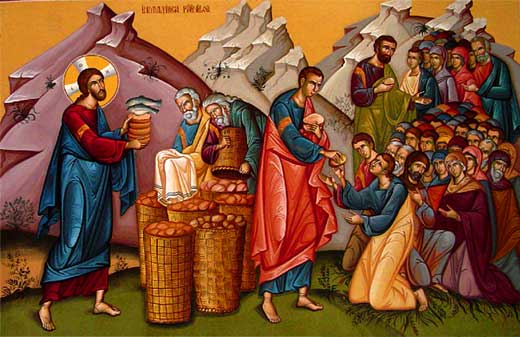
It was one of the lesser known prophets that actually named names in his prophecy:
“But you, O Bethlehem Ephrathah,
who are little to be among the clans of Judah,
from you shall come forth for me
one who is to be ruler in Israel,
whose origin is from of old,
from ancient days.” Micah 5:2
Bethlehem! The name means “house of bread”. God pulled out all the stops when He inspired this prophecy. There is a long prophetic line – a “bread line” – straight through the history of the Jewish people which culminates in the birth of Jesus “the Bread of Life”, in Bethlehem “the house of Bread”. Let’s take a look.
First there was Melchizedek, the priest king of Salem, way back in the time of Abraham (Gen 14:13-24). He brought out bread and wine as an offering, and in the name of “God Most High, maker of heaven and earth” blessed Abraham.
Then there was the unleavened bread of the Passover (Exodus 12) which the people were instructed to prepare and eat (with the lamb). And this has been celebrated every year, just as Jesus celebrated it with His apostles on the night before He died.
Remember the Manna! The people asked, “What is it?” Moses answered: “It is the bread which the Lord has given you to eat” (Ex 16:11-16). (The Lord told Moses he would “rain bread from heaven” for the people to collect daily.) A portion of this wafer-like bread was apparently to be kept in the ark of the covenant (Ex 16:31-34). In subsequent centuries during Temple worship flour offerings were routinely made in the form of unleavened cake/bread kneaded with oil.
When Micah made his prophecy about Bethlehem, no one could have imagined how its fulfillment would also embody the fullness of Israelite worship and sacrifice. The fulfillment came with the birth of the baby Jesus in Bethlehem. But Christ continued its fulfillment in various ways throughout His life: the multiplication of the loaves and fishes, the teaching of the Lord’s Prayer (“give us this day our daily bread”), His sermon in John 6 (note His sermon rejected in Jn 6:66), the Last Supper, and after His resurrection in Emmaus when He revealed Himself through the blessing of the bread and again when He prepares a meal on the beach for His apostles of cooked fish and bread (Jn 21:9-14) and was revealed to them through this.
So Micah’s prophecy is truly Eucharistic. The Church continues in its worship today the fulfillment of the Bethlehem miracle (and keeps a portion of the wafer-like Eucharist in the tabernacle). Join this “bread line” and participate in the daily fulfillment of prophecy.
JUST 21 MORE PRAYING DAYS ‘TIL CHRIST’S BIRTH!
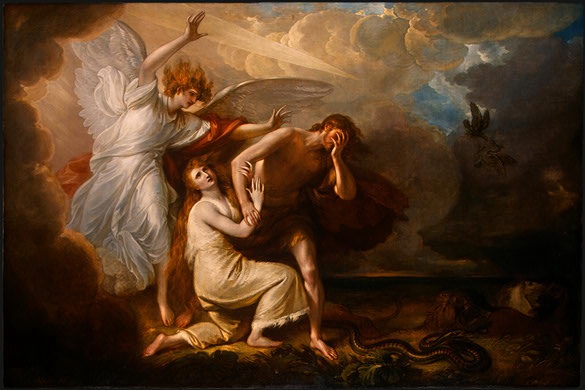
How appropriate that the first prophecy about the Messiah was spoken by God Himself while Adam and Eve stood dumbfounded in the Garden of Eden. But was it a spiritual slight to humanity that it wasn’t spoken to humans but rather to the serpent?
“I will put enmity between you and the woman,
and between your seed and her seed;
he shall bruise your head,
and you shall bruise his heel.” Gen 3:15
Four lines and four participants: “I” of course is God, “you” is the serpent (see Gen 3:14),”he” (also “his” and “her seed”) is the Messiah and “the woman” is the mother of the Messiah.
The point is that here we have God, right in the Garden of Eden, making a specific, definitive and hopeful promise to all of humanity using biological language “her seed”. Shall we understand this term as her ovum fertilized or as her male child delivered? Either way, it is a powerful promise. Notice that it is “her seed” and not “his seed”.
Yet throughout the Bible we read about male descendants, as in Matthew’s genealogy of Jesus. Remember the King James Version? “Abraham begat Isaac; and Isaac begat Jacob” and on and on. But here God directs us to the woman’s descendant. This is a tender prophecy spoken at a sad time when God has just discovered the rebellion of the first two parents. Already He knows it is Mary who will be the faithful and loving mother to His only begotten Son and His reference to “her seed” is pointed. In fact, He will preserve her specially for this unique office as ‘Mother of (the) Lord’ (see Lk 1:43).
We learn here of God’s merciful ‘impatience’. As soon as our first parents rebel against His Beautiful and Holy Will, God immediately reveals this wonderful plan for humanity centered around one Person, a Savior, Who will be born of that special woman deep in human history, beneath the Christmas star, with witnesses ‘round about: beasts and peasants, angels and kings.
And the ‘sign’, as the angels put it (Lk 2:12): it’s how His mother wraps Him up in swaddling cloths to keep Him warm after nursing Him and then lays her baby down in a manger to sleep.
JUST 22 MORE PRAYING DAYS ‘TIL CHRIST’S BIRTH!

Disclaimer: While Xtreme prayer is very beneficial, participating in Xtreme Sports can be hazardous to your health.
JUST 23 MORE PRAYING DAYS ‘TIL CHRIST’S BIRTH!
Next time your kid starts ooohhing and aaahhing about the guy leaping off a bridge with a parachute or jumping over ten sixteen wheelers on a dirt bike, you can chime in with your own examples of Xtreme Prayer!!! Read on.
Back in the day – the Gospel day – Jesus gave us some examples of Xtreme Prayer:
Remember the parable of the widow and the unrighteous judge? The widow bothered the judge constantly seeking justice and finally he found in her favor just to get rid of her (LK 18:1-8). Remember the father who brought his son to the apostles to have an unclean spirit cast out, but they were unable to do so? Jesus explained: “This kind cannot be driven out by anything but prayer and fasting” (Mk 9:16-29). We are also told that Jesus often spent “all night” praying (for example Lk 6:12). That was Xtreme Prayer then.
Here are some examples of Xtreme Prayer now:
Maintain your daily prayer regime during the most distracted season of them all!!!
Praying at the Mall – no seriously, PRAYING AT THE MALL!!!!!!!
Sit alone in a room and sincerely sing five or more (religious) Christmas carols.
Spend MORE than one hour in prayer.
Go to Church twice on the same day!!
Pray two or more Novenas at the same time.
Pray two or more litanies on the same day.
Pray MORE than five decades of the rosary on the same day.
You get the idea. You don’t need an expensive helmet for any of these (except maybe the Mall suggestion). Isn’t it amazing how free and accessible God is, anytime, anywhere, you choose the words…
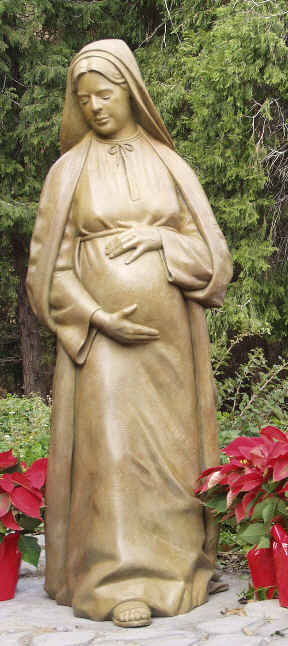
“Redeemer in the Womb”
St. Francis Xavier Cabrini church in Crestline*
Yesterday, we had a post – The End of Advent. We are trying to encourage others as well as ourselves – not to let the superficial ‘Christmas gobble up Advent’ this year. We also are offering free pro-life prayer cards. As these cards have an Advent theme they are a way to connect this Advent with prayer for the Unborn. Just click the icon below to request a free set of these cards (in English or Spanish).

*MARY WALKS IN CRESTLINE. This statue (above)of the Virgin Mary was dedicated on Gaudete Sunday, December 15, 2003 at St. Francis Xavier Cabrini church in Crestline. The statue, called “Redeemer in the Womb,” was commissioned by the parish’s pastor, the Rev. Amaro Saumell; it portrays Mary, at full term of pregnancy, as if she were walking through the church garden. The statue was meant to convey a pro-life message. “The Redeemer in the Womb,” Father Saumell told the December 19-25 Alpenhorn News, “is a statement of pro-life, the value of life in all of life’s stages, even in the womb.”

Our Lady of the New Advent
by Fr. William McNichols
On December 2, the season of Advent begins. I think as Christians we have to begin to think of a way to circumvent the madness of the ‘Christmas season’ and return to the quiet, prayerful and waiting season of Advent.
In the recent issue of First Things Magazine, Joseph Bottoms has an article entitled The End of Advent. It begins:
“Christmas had devoured Advent, gobbled it up with the turkey giblets and the goblets of the season. Every secularized holiday tends to loose the context it had in the liturgical year…Easter has hopped across Lent, Halloween has frightened away All Saints, and New Years has drunk up Epiphany. Still the disappearance of Advent seems seems especially disturbing…”
I think if we are to live Advent well, it requires careful planning. To have a strategy – even now it’s not too late to try and get some of the busy work of Christmas out of the way before Advent begins. As we do this, we can thoughtfully plan to live a prayerful Advent season so that Christmas will be a reliving of the joyful birth of our Savior.
In his blog, Abbey-Roads2, Terry Nelson offers a great suggestion – a novena to the Infant Jesus that he prays each month starting on the 17 and ending on the 25th. He prepares for Christmas all year. WOW!
At ‘UNBORN WORD of the day’, we will be offering prayerful short Advent meditations starting on December 2 till Christmas. Beginning with the waiting of the chosen people for the Messiah, we will then follow the Unborn Christ Child’s time of waiting from conception to birth. This will be our small contribution to help put Advent back in Christmas.
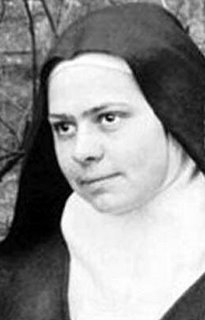
Today, November 8 is the feast day of Blessed Elizabeth of the Trinity (1880-1906). She has been called the Saint of the Divine Indwelling. In 1901 she entered the Carmelite order, receiving the name “Sister Elizabeth of the Trinity.” In his book Redeemer in the Womb, John Saward, points to her as one of three woman in the 20th century who emphasize the importance of Jesus’ life in the womb. (The other two are Caryll Houselander and Adrienne von Speyr.) Another lesser known woman who wrote extensively on this topic was Mother St. Paul.
Here is a quote from Blessed Elizabeth:
“It seems to me that the attitude of the Virgin during the months between the Annunciation and the Nativity is the model for interior souls, for those whom God has chosen to live inwardly, in the depths of the unfathomable abyss.” From Le Ciel dans la foi.
She elaborates in a letter to her sister, Guite (Oeuvres completes):
“Think what must have been going on in the Virgin’s soul after the Incarnation, when she possessed within her the Word incarnate, the Gift of God…In what silence, what recollection, what adoration she must have buried herself in the depths of her soul to embrace this God whose Mother she was. My little Guite, he is in us. O let us stay close to him in this silence, with this love, of the Virgin. This is the way to spend Advent, isn’t it?”
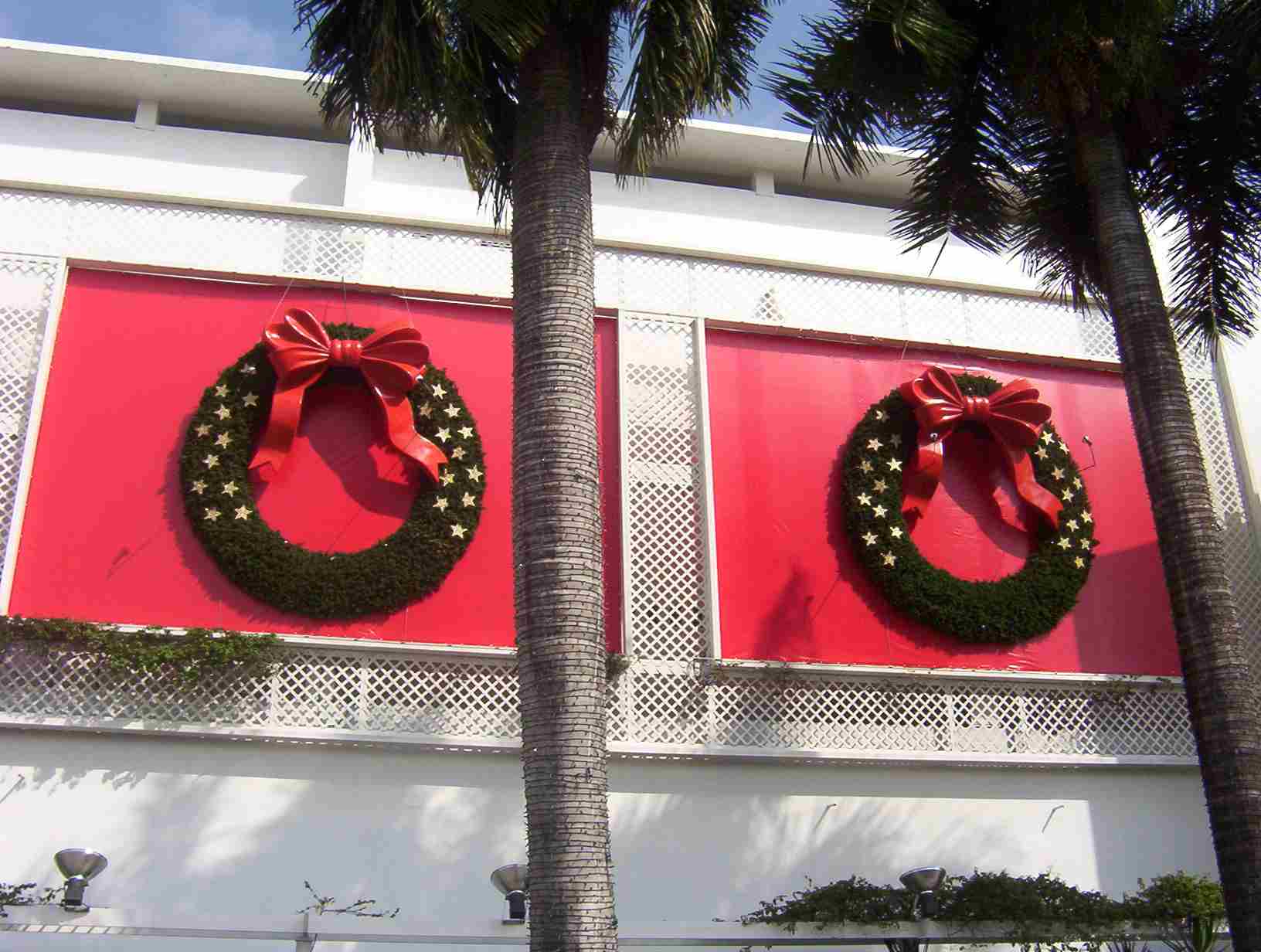
When most people start taking down their Halloween decorations, stores around Los Angeles put up garland and wreaths.
One of my pet peeves is the fact that commercially the Christmas season now starts right after Halloween. When I was young businesses did not promote Christmas until after Thanksgiving. But we are living more and more in a consumer society – you guessed it Christmas = money.
Why don’t we try to beat them at their own game? Let’s make this a real Christmas season and start preparing spiritually now. Today Dan and Mike Engler sent us a link to a really great video on You-tube. It combines Christmas with the pro-life message. Click here:
O Holy Night-A Pro-life Christmas

 UNBORN WORD of the day