


Filed under: Evangelium Vitae
AROUND THE WORLD AND THROUGH THE CENTURIES WITH THE UNBORN CHRIST CHILD
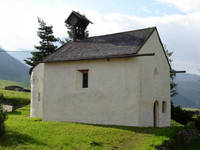
Chapel of St. Leonard Nauders Austria
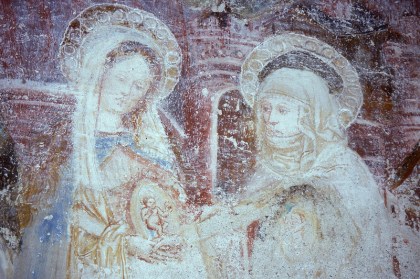
Maria Heimsuchung – One of Three Frescoes found in the Chapel of St. Leonard
The wall paintings in the Chapel of St. Leonard are among the most important Romanesque frescoes discoveries that have been made in North Tyrol ever. Their rediscovery goes back to 1914. Although the paintings are not completely preserved, they are among the earliest frescoes of North Tyrol and thus are important in Austria’s art history. The latest research link these frescos to benchmark examples in South Tyrol and Graubünden and assume that the frescoes were created by 1210.
“Truly He is in haste to be about His Father’s business. Truly He is an impatient conqueror, to be thus early beginning His conquests, and laying the foundations of His world wide empire. He can not bear to be in the world for even so short a while, but sin shall feel the weight of His unborn arm…..His first mission and ministry was in the womb, and the babe unborn the first conquest of His divine apostolate…..and the Unborn Child destroys the sin and abolishes the curse of the unborn child.” Frederick W. Faber, D.D., The Blessed Sacrament (Baltimore, MD: John Murphy Company, circa 1855), 162 163.
ANNUNCIATION OF USTYUG 1119-1130, THE TRETYAKOV GALLERY MOSCOW, RUSSIA
December 3, 2012, 10:35 pm | Edit this
Filed under: Advent, Incarnation, Mother of the Lord, The Incarnation, Unborn Jesus
AROUND THE WORLD AND THROUGH THE CENTURIES WITH THE UNBORN CHRIST CHILD
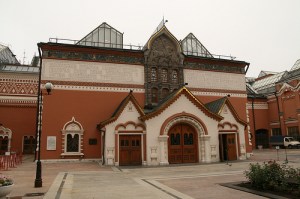
The Tretyakov Gallery
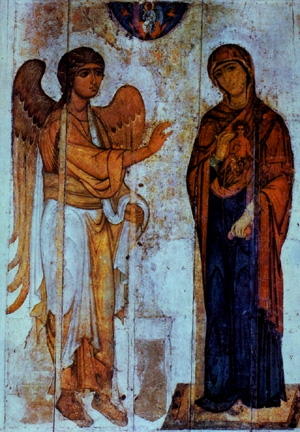
One of the earliest images of Christ in the womb is the Annunciation of Ustyug
The Annunciation of Ustyug gained its name due to the legend that Saint Procopius of Ustyug predicted the fall of a meteorite and other calamities near the town of Veliky Ustyug. He tried to convince the citizens to confess their sins and pray for the city to be saved. They did not believe him and only at the last minute, when the storm had already started, escaped to the church and started to pray before the icon and were saved.
The icon depicts Christ Emmanuel standing In the womb of the Virgin, giving a blessing with his right hand. On the left – the archangel Gabriel, greets the Virgin Mary and is blessing her. At the top of the center, in a blue semi-circle of the sky with gold stars the Father is portrayed with a blue halo of glory. He sits on a red throne, at the foot of which are red cherubim, and above on the sides – red and gold Seraphim. The Father holds a scroll in his left hand, and His right hand blesses Mary.
The Ustyug Annunciation in its iconography has its roots in Eastern Christian art. The point of this type of art is to explain the supernatural Conception – Incarnation of the deity. Therefore, in Russia, the Virgin with the Christ child depicted near her heart is sometimes called Our Lady of the Incarnation.
“For you must know that the sublime work of the Incarnation was the work of the whole Trinity, although it was only the Person of the Son of God who became incarnate. It was as if one who put on a tunic were helped by two standing on either side of him who held the tunic in their hands….For although the Holy Trinity is every where, nevertheless you must think of It in your meditation as being here in a very special manner, by reason of the great and unique work which is being done.” St. Bonaventure, Meditations On The Life Of Christ, trans. Sister M. Emmanuel, O.S.B. (St. Louis, MO: B. Herder Book Co., 1934), 16.
Leave a Comment so far
Leave a comment
 UNBORN WORD of the day