


Filed under: Advent, Incarnation, Mother of the Lord, Unborn Jesus | Tags: byzantine painting, religion, wall paintings
AROUND THE WORLD AND THROUGH THE CENTURIES WITH THE UNBORN CHRIST CHILD
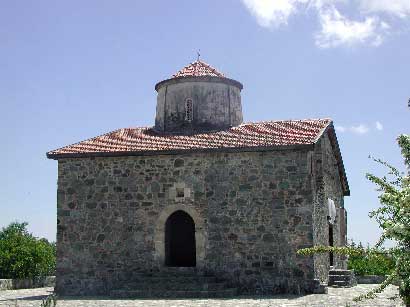
Timios Stavros Church
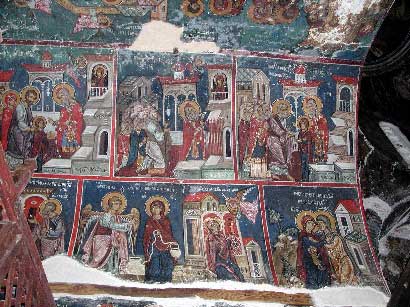
Timios Stavros Church Wall Painting (Full)
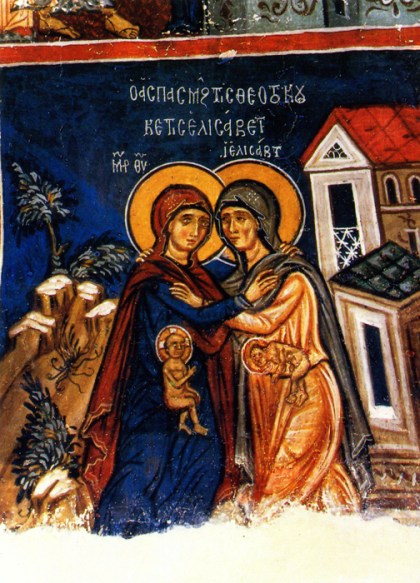
Unborn John the Baptist Bows Before Unborn Jesus Church Wall Painting (detail)
In the central part of Cyprus, in the mountains of the Troodos range, some of the most important monuments of the history of Byzantine painting have survived. These are painted churches which have preserved to this day brilliant examples of various trends of Byzantine and post-Byzantine monumental art, from the 11th to the 19th century. The church of Timios Stavros is situated in a central area of the Troodos mountain range, at the south end of the village of Pelendri.
The original church was destroyed under unknown circumstances. Only the apse survived, which was incorporated in a new church of the same type, built at the end of the 13th or the beginning of the 14th century. The main part of the church of Timios Stavros was decorated during the second half of the 14th century. At least two artists belonging to the same workshop were involved, together with their students. Many donors contributed towards this decoration complex. From these wall-paintings we can distinguish a group which follows the Palaiologan style developed in Constantinople during the 14th century.
“God has become a child, and so he wants first to be known and adored by a child…Thus the Infant-God is recognized and manifested, not by and angel, but by a child. So his first prophet is a child, just as shortly his first martyrs will be children.” Cardinal Bérulle (1575 -1629)
“I thank thee, Father, Lord of heaven and earth, that thou hast hidden these things from the wise and understanding and revealed them to babes; yea, Father, for such was thy gracious will.” Lk.10.21
AROUND THE WORLD AND THROUGH THE CENTURIES WITH THE UNBORN CHRIST CHILD
Metropolitan Museum of Art, New York City
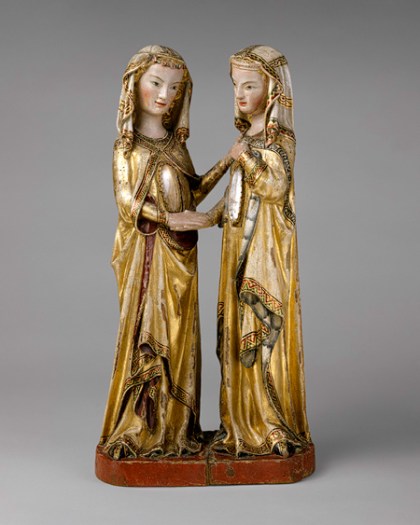
The Visitation This artwork is currently on display in Gallery 304
Soon after the Virgin Mary learned of her miraculous conception of Jesus, she visited her kinswoman Elizabeth, who was also expecting a child, John the Baptist. This representation of their joyous meeting comes from the Dominican convent of Katharinenthal, in the Lake Constance region of present-day Switzerland.
Carved of walnut, with the original paint and gilding almost completely preserved, the figures of Mary and Elizabeth are each inset with crystal-covered cavities through which images of their infants may originally have been seen. The representation of the Visitation incorporating images of the unborn Christ and John the Baptist, found with some frequency in contemporary works from German-speaking lands, emphasizes the moment when, according to “The Golden Legend,” Saint John, being unable “to manifest his joy with his tongue,” leapt “with joy in his mother’s womb.” The Virgin tenderly places her hand on Elizabeth’s shoulder, while her cousin raises her arm to her breast in reference to her declaration, “Who am I, that the mother of the Lord should visit me?” (Luke 1:43).
Bishop Austin Vaughn (1927-2000), formerly Auxiliary Bishop of New York, who himself was arrested a number of times for prayerfully protesting in front of abortion facilities once wrote in an article entitled The Catholic Duty to Be Pro – Life: “It is not an accident, I think, that in the scriptures the first person, after Mary, who adored Jesus when He came into the world was St. John the Baptist….The second person who ever worshipped Jesus, after Mary, was an unborn baby, and I think God made it that way to tell us in our day and age the worth and importance of every individual right from the very beginning of life”.
AROUND THE WORLD AND THROUGH THE CENTURIES WITH THE UNBORN CHRIST CHILD
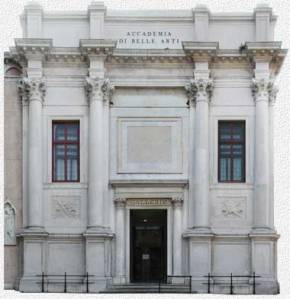
Gallerie dell’Accademia, Venice, Italy
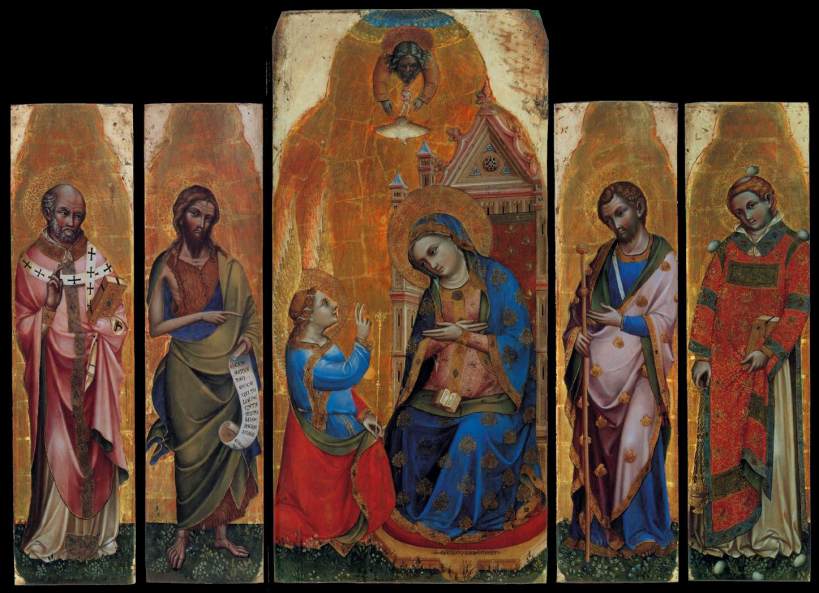
Annunciation with Saints by Lorezo Venzian
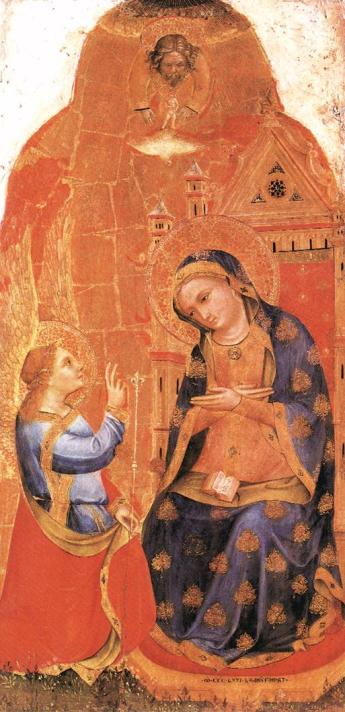
Annunciation by Lorezo Venzian (detail)
The Accademia fine Art Gallery of Venice, is one of the most important Italian museums. This painting, signed and dated in 1371, is the central panel of a polyptych. Here we can see clearly how Lorenzo Veneziano, in his mature work moved increasingly towards the musical expressiveness of colour shot through with Gothic accents.
The figure of the Virgin is sitting with her hands crossed prayerfully listening to the message of the angel. The angel is kneeling before her, his right hand raised and his wings pointing toward the sky where the Eternal Father appears, as a crowning figure releasing the dove with the unborn Christ Child.
But the knowledge and love of our Divine Redeemer, of which we were the object from the first moment of His Incarnation, exceed all that the human intellect can hope to grasp. For hardly was He conceived in the womb of the Mother of God, when He began to enjoy the Beatific Vision, and in that vision all the members of His Mystical Body were continually and unceasingly present to Him, and He embraced them with His redeeming love. Pope Pius XII, Mystici Corporis (On the Mystical Body of Christ) #75.
Filed under: Advent, Mother of the Lord, Quotes from Great Christians, The Incarnation, Unborn Jesus
AROUND THE WORLD AND THROUGH THE CENTURIES WITH THE UNBORN CHRIST CHILD
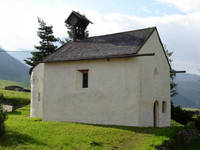
Chapel of St. Leonard Nauders Austria
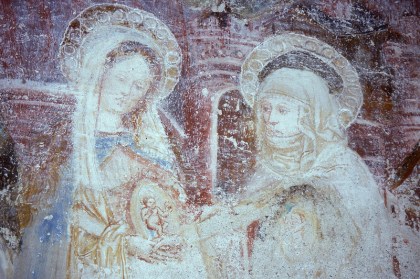
Maria Heimsuchung – One of Three Frescoes found in the Chapel of St. Leonard
The wall paintings in the Chapel of St. Leonard are among the most important Romanesque frescoes discoveries that have been made in North Tyrol ever. Their rediscovery goes back to 1914. Although the paintings are not completely preserved, they are among the earliest frescoes of North Tyrol and thus are important in Austria’s art history. The latest research link these frescos to benchmark examples in South Tyrol and Graubünden and assume that the frescoes were created by 1210.
“Truly He is in haste to be about His Father’s business. Truly He is an impatient conqueror, to be thus early beginning His conquests, and laying the foundations of His world wide empire. He can not bear to be in the world for even so short a while, but sin shall feel the weight of His unborn arm…..His first mission and ministry was in the womb, and the babe unborn the first conquest of His divine apostolate…..and the Unborn Child destroys the sin and abolishes the curse of the unborn child.” Frederick W. Faber, D.D., The Blessed Sacrament (Baltimore, MD: John Murphy Company, circa 1855), 162 163.
Filed under: Advent, Christmas, How are we to honor Unborn Jesus, Incarnation, Pro-life

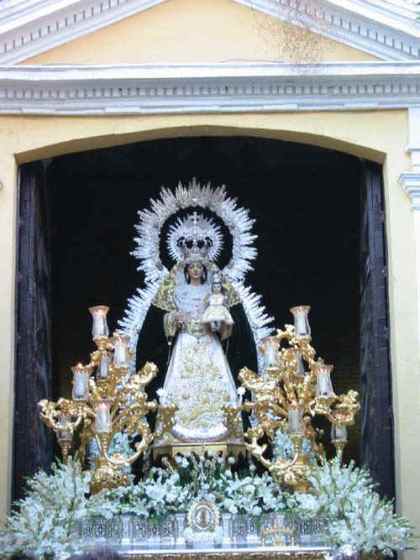
Our Lady of Hope, is renowned for her beauty. The image is from the second half of the 16th century but later restorations (one by Castillo Lastrucci), added to it‘s beauty and unmistakable Sevillian style. The Virgin wears a green coat with sterling silver lining, highlighting her magnificent crown. All year – except Advent – Mary holds the infant Jesus with her left hand and arm.
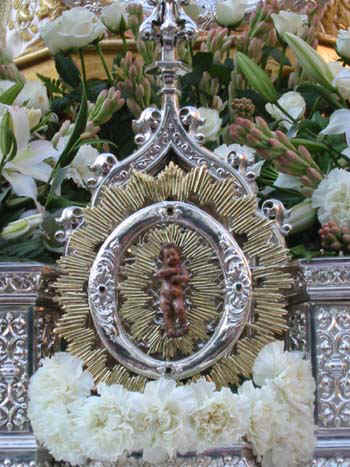
Below the statue (see above photos), in front of the basket appears an oval “O” iconographic detail of the Unborn Christ Child (reminiscent of the Advent “O” antiphons).
During Advent, the oval with the Unborn Christ is placed upon the Virgin, in front of her womb. (The infant Jesus is taken down from Mary’s left hand during Advent and placed in an ornate casing.) See photos below.
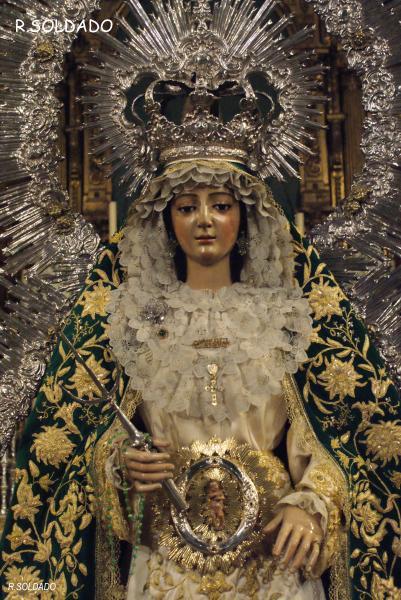
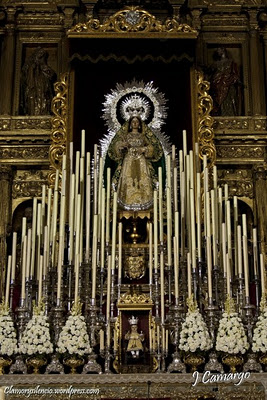
Then, on Christmas day the unborn Christ oval is returned to its place below the statue and the infant Jesus returned to Mary’s hand. These rituals give a unique charm to this statue and the Incarnation event.
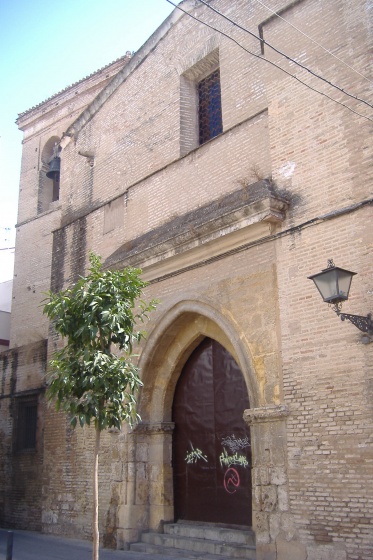
Iglesia de San Martín de Tours de Sevilla
 UNBORN WORD of the day