


Filed under: Unborn Jesus

Yesterday we talked about the Church’s longstanding devotion to the Christ Child. A natural extension of that devotion is devotion to the Unborn Christ Child.
We can demonstrate that Unborn Jesus, during His nine months in the womb, identified with unborn children in many ways. (See our post on the Visitation for part of this demonstration). Once we make this simple but profound connection between Unborn Jesus and all unborn children today –especially those at risk – the devotion takes shape quite logically.
It is, like most devotions, a devotion of discovery. That is, we discover Christ in a new and powerful way. And in discovering Unborn Jesus we re-discover the beauty and meaning of each unborn child. He is like a prism through which we see the human integrity and beauty of all unborn children, no matter their age, size, color, shape or other characteristics.
This discovery of the Unborn God leads our thoughts to a unifying principle of supernatural awareness, such that the Christian devotional heart harmonizes with the Christian social conscience! A powerful unity of purpose which brings together Christian spirituality on the one hand with this basic human rights issue – the right to life of unborn children – on the other hand. Both hands in prayer.
We are presented with an altogether unique devotional opportunity. The devotional heart and the social conscience each inform and heighten the awareness of the other. The right to life of unborn children is linked to the life of the Unborn Savior. Devotion leads to action. (And for a different side of the coin, see our post on The Sacred Heart.)
Filed under: Unborn Jesus
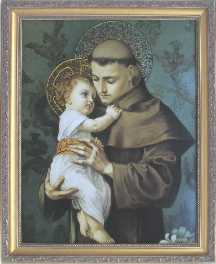
The life of Jesus Christ has enamored Christians from the earliest days. While we don’t know a lot about His hidden years growing up in Nazareth, and then working as a carpenter, yet every aspect of His life and all the events of His life fascinate us and draw us deeper into the mystery of His Person and mission.
No doubt it was such a loving fascination with Christ that caused
St Francis of Assisi (1182 -1226) one Christmas to construct a manger and re-enact the Christmas story. The focal point of his devotional creation was the little newborn baby Jesus – an act of tender devotion by a loving disciple.
A contemporary of Francis’ – and another Franciscan – St. Anthony of Padua (1195-1231), whose feast day is today, is almost always portrayed in paintings and sculptures holding the small Christ Child and looking intently at His face. This portrayal is based on an actual event that was witnessed by a friend of Anthony’s one evening.
What drew the mystic Francis (who had received the stigmata) and this Doctor of the Church, Anthony, to the baby Jesus?
The great St. Teresa of Avila (another reformer of the Church, like Francis) had a devotion to the Christ Child also and in each of the many convents which she founded she placed a statue of the Christ Child. What drew this sixteenth century saint to this young Child?
Do we not find Christ in His utter simplicity and lowliness when we see Him as a Child? But also, He is God approachable – as in the crib – who can fear God as newborn baby? Who would not be able to draw near to God in His “helplessness”, His weakness, His poverty, His innocent childlike revelation of Himself?
Jesus as a baby and infant calls the world to Himself – we can whisper something to Him and even be playful with Him. Certainly, this is part of the message of St. Therese of Lisieux (1873-1897) also known as Theresa of the Child Jesus. From her own childhood she was attracted to the Child Jesus. She wrote to Him, drew pictures for Him and learned spiritual lessons from Him. Even in her early adult years (she died at the age of 24) she often thought of Christ (and her own life) in the simplest childlike terms. She called her path to God and Heaven “her little way”. And in the last century the Church weighed in on this “little way” – naming her Doctor of the Church (like her namesake Teresa of Avila).
As you can see the Church has had a rich tradition through the centuries of devotion to the Christ Child. Devotion to the Unborn Christ Child is simply an extension of devotion to the (born) Christ Child. Given the reality of abortion-on-demand, we think it is important for the Church to discover the solidarity established between Unborn Jesus and every unborn child, especially those unborn infants at risk.
Filed under: John Paul II
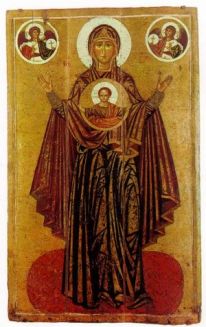
This Saturday June 16 is the Feast of the Immaculate Heart of Mary – in preparation for this great feast day I thought it would be nice to quote John Paul the Great.
“Not only is the dignity of this Motherhood unique and unrepeatable in the history of the human race, but Mary’s participation, due to this Maternity, in God’s plan for man’s salvation through the mystery of the Redemption is also unique in profundity and range of action.
We can say that the mystery of the Redemption took shape beneath the heart of the Virgin of Nazareth when she pronounced her ‘fiat’. From then on, under the special influence of the Holy Spirit, this heart, the heart of both a virgin and a mother, has always followed the work of her Son and has gone out to all those whom Christ has embraced and continues to embrace with inexhaustible love.”
Filed under: The Incarnation
The first reading in yesterday’s Sunday Mass for the Solemnity of Corpus Christi, spoke about the ancient priest Melchizedek making a sacrifice of bread and wine (Gen 14:18-20). This sacrifice prefigured the offering of Jesus during the Last Supper. In this short reading of three verses, a term appears three times which is a very instructive term: “God Most High”. But Melchizedek’s sacrifice, while prophetic, was incomplete and awaited the Body of God’s Son.
Now fast forward to the Annunciation/Incarnation. Gabriel explains to Mary that her son “will be called the Son of the Most High” (Lk 1:32) and that “The Holy Spirit will come upon you, and the power of the Most High will overshadow you (Lk 1:35). In a way, the credibility and authenticity of the message delivered to Mary is intensified by this majestic reference to God as “the Most High”. And the hint of “priesthood”, in the line of Melchizedek, has now been established. She then conceives miraculously the “Son of the Most High”.
A short time afterwards –maybe a week or so later – when she enters Elizabeth’s home and greets her, she utters her famous Magnificat (Lk 1:46-55). Twice during this prayer song she speaks of her lowliness and the lowliness of those who find favor with God: “…for He has regarded the low estate of his handmaiden” and “exalted those of low degree…”
So here we have it then, the matter-of-fact contrast, in terms of spiritual stature (‘height’ or ‘distance’): God Most High and Mary of low estate. Yet it is this humility in Mary which God “regards” with favor (Lk 1:30) and He exalts her above others and instructs us to exalt her as well: “For behold, henceforth all generations will call me blessed…” But why do we call her blessed? “…for he who is mighty has done great things for me, and holy is his name.”
The “great things” God had done for Mary at that point in her life, were primarily the same “great things” which He had also done for us, that is, the Incarnation – Christ Unborn within her, within His mother. These were incomparable things, things which cause awe and wonder in the Christian heart. And by virtue of these “great things”, we too have a share in Mary’s blessedness.
Filed under: The Eucharist
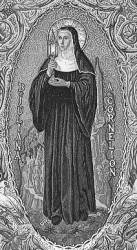
You may have never heard of Blessed Juliana of Cornillon (Juliana of Liege), 1192 -1258. She was an Augustinian nun who was the first promoter of a feast day in honor of the Blessed Sacrament. She has been recognized as the person primarily responsible for the introduction of the Corpus Christi feast day during the middle ages. According to Acta Sanctorum, she had a unique and extraordinary devotion. She said the Magnificat (Lk 1:46-55) nine times a day; once for each month that Our Lord spent in the womb of His mother. (The Magnificat was proclaimed by Mary while she was pregnant.) One can not help but see the beautiful connection here in Juliana’s spiritual life between her devotion to the Body of Christ in the womb and the Body of Christ upon the altar.
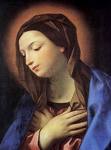
Which leads us to the second woman: Mary the Mother of Jesus. In his encyclical letter ECCLESIA DE EUCHARISTIA, On the Eucharist in Its Relationship to the Church, John Paul II discusses Mary and the Eucharist:
“In a certain sense Mary lived her Eucharistic faith even before the institution of the Eucharist, by the very fact that she offered her virginal womb for the Incarnation of God’s Word. The Eucharist, while commemorating the passion and resurrection, is also in continuity with the incarnation. At the Annunciation Mary conceived the Son of God in the physical reality of his body and blood, thus anticipating within herself what to some degree happens sacramentally in every believer who receives, under the signs of bread and wine, the Lord’s body and blood.”
“As a result, there is a profound analogy between the Fiat which Mary said in reply to the angel, and the Amen which every believer says when receiving the body of the Lord. Mary was asked to believe that the One whom she conceived “through the Holy Spirit” was “the Son of God” (Lk 1:30-35). In continuity with the Virgin’s faith, in the Eucharistic mystery we are asked to believe that the same Jesus Christ, Son of God and Son of Mary, becomes present in his full humanity and divinity under the signs of bread and wine.”
“Blessed is she who believed” (Lk 1:45). Mary also anticipated, in the mystery of the incarnation, the Church’s Eucharistic faith. When, at the Visitation, she bore in her womb the Word made flesh, she became in some way a “tabernacle” – the first “tabernacle” in history – in which the Son of God, still invisible to our human gaze, allowed himself to be adored by Elizabeth, radiating his light as it were through the eyes and the voice of Mary. And is not the enraptured gaze of Mary as she contemplated the face of the newborn Christ and cradled him in her arms that unparalleled model of love which should inspire us every time we receive Eucharistic communion?”(#55)
“The Eucharist has been given to us so that our life, like that of Mary, may become completely a Magnificat!” (#58)
Filed under: Unborn Jesus
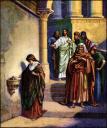
The Gospel reading at Mass today recounts the scene when Jesus sat down across from the Temple Treasury and watched the people putting money into it. He spied a poor widow who “put in two small coins worth a few cents” – the famous “widow’s mite”. Jesus explained that she “put in more than all the other contributors”. This wonderful hopeful story touches on a theme that recurs in various ways in the New Testament. Remember when Jesus spoke about having faith “the size of a mustard seed”?
Here are some other examples:
“God chose what is weak in the world to shame the strong” I Cor 1:27
“…for when I am weak, then I am strong.” II Cor 12:10
St. Paul says that God spoke these words to him:
“My grace is sufficient for you, for my power is made perfect in weakness.” II Cor 12:9
Christ too came in “weakness”, first as a tiny unborn baby, then an infant, toddler and so on. He took on our weaknesses as part of His Incarnation. He even singled out the “least” to identify with them in a most special manner: “Truly, I say to you, as you did it to one of the least of these my brethren, you did it to me.” (Mt 25:40) And we know that the unborn are among the “least of the least”. Where Christ is, there is hope…
Now this relates to the world’s current struggle between the Culture of Life and the Culture of Death. And it is again the amazing St. Paul who reveals this mystery of Providence to us: “…where sin increased, grace abounded all the more…” (Rom 5:20) St. Paul is pointing not to a half empty glass of sin but to a glass already half full of Grace and rising, continuing to fill even more. We live in a culture that is rampant with sins, and among these abortion is near the top of the list – quite possibly at the top – yet God is pouring out His Grace on our world to bring about a pro – life surge of awareness and awakening! Rejoice!
Filed under: Unborn Jesus
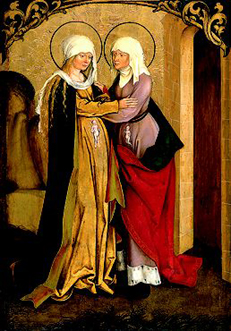
STRUEB, Hans and/or Jakob
The Visitation
c. 1505
The Visitation
by
Joyce Kilmer
(For Louise Imogen Guiney)
There is a wall of flesh before the eyes
Of John, who yet perceives and hails his King.
It is Our Lady’s painful bliss to bring
Before mankind the Glory of the skies.
Her cousin feels her womb’s sweet burden rise
And leap with joy, and she comes forth to sing,
With trembling mouth, her words of welcoming.
She knows her hidden God, and prophesies.
Saint John, pray for us, weary souls that tarry
Where life is withered by sin’s deadly breath.
Pray for us, whom the dogs of Satan harry,
Saint John, Saint Anne, and Saint Elizabeth.
And, Mother Mary, give us Christ to carry
Within our hearts, that we may conquer death.
Filed under: Evangelium Vitae
John Paul II Says in the encyclical Evangelium Vitae:
“The Gospel of life is something concrete and personal, for it consists in the proclamation of the very person of Jesus…Through the words, the actions and the very person of Jesus man is given the possibility of ‘knowing’ the complete truth concerning the value of human life…In Christ, the Gospel of life is definitively proclaimed and fully given” (#29).
In addition to the numerous marvels in the adult life of Jesus – the profundity of teaching, the healing touches, supernatural acts completing and anointing natural ones, His Passion journey through sorrowing redeeming death unto Resurrection – we must add those actions (yes, and even words – see Heb 10:5-7) of the Unborn Christ Child, through which we are “given the possibility of ‘knowing’ the complete truth concerning the value of human life”. Even the Unborn months of Christ’s life are a revelation to all Christians.
Specifically, we “discover” Christ in His unborn state and through these discoveries we learn about the spiritual personhood of all unborn babies. For He was like all unborn babies in countless respects. Perhaps the most profound lessons are discovered in the solidarity which the Unborn Christ has with all unborn children. Not a “natural” solidarity only, not a solidarity that is merely “symbolic”, but a supernatural solidarity. For Christianity is not a man-made religion. Christianity goes through the symbol to the mystical. The symbol is static, the mystical is living and active like the Word of God.
There are a number of key events in the life of the unborn Christ Child where we witness His solidarity with the unborn. One example was posted on this site on May 31st, the Feast of the Visitation. In the future we will be devoting lots of attention to these events.
GAP
Filed under: Quotes from Great Christians
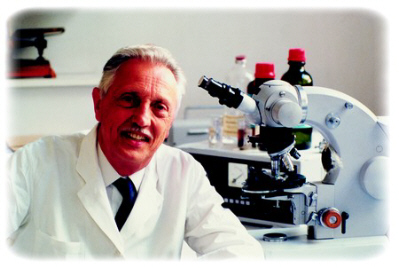
“At the true age of one month, a human being is four and a half millimeters long. Its tiny heart has already been beating for a week, its arms, legs, head, brain are already recognizable. At two months old, from head to the tip of its bottom, the human embryo is about three centimeters long. It could fit curled up inside a walnut shell. Inside a clenched fist, it would be invisible, and the clenched fist would crush it accidentally without even noticing. But open your hand, the embryo is almost complete, hands, feet, head, organs, brain, everything is in its place and from now on will merely grow. Look more closely , you can already read the life lines in its palms and predict its good fortunes. Look closer still, with an ordinary microscope, and you can see its fingerprints. Everything is already there and it would be possible to issue its identity card.”
“The incredible Tom Thumb, the man no bigger than my thumb, actually exists ; not the one in the fairy tale, but the one which every one of us once was.” Dr. Jerome LeJeune (the great pro-life scientist who discovered the cause of Downs Syndrome)
Filed under: Evangelium Vitae
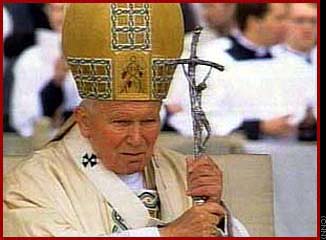
In the Gospel of Life, John Paul II presents a powerful and prophetic teaching in defense of human life. Nowhere is this more evident than in Section 57 of the encyclical. Could the following be anything but an infallible and definitive teaching?
“Therefore, by the authority which Christ conferred upon Peter and his Successors, and in communion with the Bishops of the Catholic Church, I confirm that the direct and voluntary killing of an innocent human being is always gravely immoral. This doctrine, based upon that unwritten law which man, in the light of reason, finds in his own heart (cf. Rom 2:14-15), is reaffirmed by Sacred Scripture, transmitted by the Tradition of the Church and taught by the ordinary and universal Magisterium. ” (Footnote 51: LG 25) Evangelium Vitae, 57
The footnote references the Vatican II document, Lumen Gentium, point 25. Point 25 talks about Papal Infallibility.
See also Section 58 of The Gospel of Life below which elaborates on this strong teaching in Section 57.
“The deliberate decision to deprive an innocent human being of his life is always morally evil and can never be licit either as an end in itself or as a means to a good end. It is in fact a grave act of disobedience to the moral law, and indeed to God himself, the author and guarantor of that law; it contradicts the fundamental virtues of justice and charity. “Nothing and no one can in any way permit the killing of an innocent human being, whether a fetus or an embryo, an infant or an adult, an old person, or one suffering from an incurable disease, or a person who is dying. Furthermore, no one is permitted to ask for this act of killing, either for himself or herself or for another person entrusted to his or her care, nor can he or she consent to it, either explicitly or implicitly. Nor can any authority legitimately recommend or permit such an action“. Evangelium Vitae, 58
Filed under: The Incarnation
The Gospel reading at Mass today, Monday, 6-4-07, is: Mark 12:1-12. In this reading Jesus is speaking to the chief priests, scribes and elders. Things got a little heated, when Jesus finally said to them,
“Have you not read this scripture passage: ‘The stone that the builders rejected has become the cornerstone; by the Lord has this been done, and it is wonderful in our eyes’?”
As we know, Jesus is the wonderful “cornerstone” of a New Covenant and a New Creation, and He was pointing to this mystery and showing its fulfillment in Himself.
But Jesus also spoke of His Body as a temple (Jn 2:19-21). And St. Paul spoke of our bodies as temples (I Cor 3:16-17, II Cor 6:16-18). So let us go back now to the moment of the Incarnation, that one-cell stage of His life. At conception, that one cell was the “cornerstone” of His Body, just as the one cell stage of human development is the “cornerstone” of every human life. Not only is this “cornerstone cell” special, but it is engraved we might say by “the creative action of God”.
As Pope John XXIII said in his encyclical Mater et Magistra:
“Human life is sacred. From its very beginnings it calls for the creative action of God. By the violation of His laws, the Divine Majesty is offended…(#194).”
Those “builders of society” today, who reject new human lives in their earliest beginnings, that is, at the zygote or embryonic stage of life, who would experiment upon them and dispose of them as some waste product, are gravely offending God. They reject that very special “cornerstone cell” of a new person’s life, and then they destroy it. But this is an area where they lack expertise and jurisdiction. Only God has this sacred expertise and ultimate jurisdiction! The first living cell, the “cornerstone cell” of every person’s body and life must be respected not rejected!
Filed under: The Incarnation
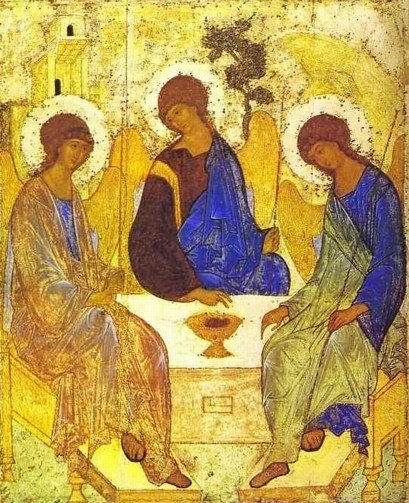
June 3rd, Solemnity of the Most Holy Trinity
St. Bonaventure (1221-1274) says of the Incarnation:
“For you must know that the sublime work of the Incarnation was the work of the whole Trinity, although it was only the Person of the Son of God who became incarnate. It was as if one who put on a tunic were helped by two standing on either side of him who held the tunic in their hands…For although the Holy Trinity is everywhere, nevertheless you must think of It in your meditation as being here in a very special manner, by reason of the great and unique work which is being done.” Meditations On The Life Of Christ
And St. Bernard in a prayer to Mary about the Incarnation says:
“Nor is God the Son alone with you, whom you clothe with your flesh; but also God the Holy Spirit, of whom you conceive; and God the Father, who has begotten that which you conceive.”
John Paul II says:
“In the salvific design of the Most Holy Trinity, the mystery of the Incarnation constitutes the superabundant fulfilment of the promise made by God to man after original sin…” Mother of the Redeemer, 11
Filed under: Sacred Heart
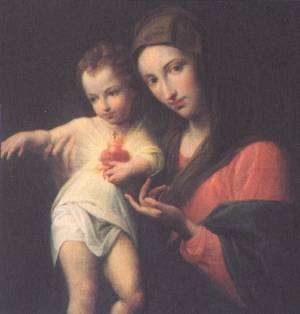
June is the month of the Sacred Heart of Jesus. Much can be said about His heart and His love for innocent babies and children. But there is also another perspective too and that is how much He cares for people who are pro – life and trying to build up a Culture of Life and protect the unborn. In other words, God reaches out to you this month in a special way, to encourage you in your pro-life work!
“Come to me, all (you who are pro-life) who labor and are heavy laden, and I will give you rest. Take my yoke upon you, and learn from me; for I am gentle and lowly in heart, and you will find rest for your souls. For my yoke is easy, and my burden is light.” Mt 11:28-30
If you are sometimes discouraged in your pro-life work there is a place you can always go for courage and encouragement – to the Heart of Jesus Christ!
 UNBORN WORD of the day